What Is Similarity of Quadrilaterals? Definition, Properties, Criteria, Examples and Notes
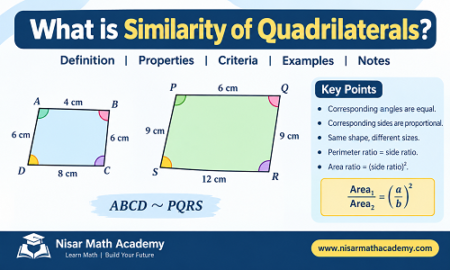
What Is Similarity of Quadrilaterals?
Similarity of quadrilaterals is an important concept in geometry. It helps us compare two quadrilaterals that have the same shape but may have different sizes.
In this article, we will learn the definition of similar quadrilaterals, corresponding angles and sides, conditions for similarity, scale factor, examples, and the relationship between the area of quadrilateral figures.
These notes are prepared in a simple student-notes style for students who want to understand the topic clearly and revise it quickly.
Definition of Similar Quadrilaterals
Two quadrilaterals are said to be similar if their corresponding angles are equal and their corresponding sides are proportional.
In simple words, similar quadrilaterals have the same shape but not necessarily the same size.
For example, if quadrilateral ABCD is similar to quadrilateral PQRS, we can write:
ABCD ∼ PQRS
The symbol ∼ means “is similar to.”
When two quadrilaterals are similar:
- Their corresponding angles are equal.
- Their corresponding sides are proportional.
- Their shapes are the same.
- Their sizes may be different.
- One quadrilateral can be considered an enlargement or reduction of the other.
Corresponding Parts of Similar Quadrilaterals
Suppose:
ABCD ∼ PQRS
Then the corresponding vertices are:
A ↔ P
B ↔ Q
C ↔ R
D ↔ S
Therefore, the corresponding sides are:
AB ↔ PQ
BC ↔ QR
CD ↔ RS
DA ↔ SP
And the corresponding angles are:
∠A ↔ ∠P
∠B ↔ ∠Q
∠C ↔ ∠R
∠D ↔ ∠S
Thus:
∠A = ∠P
∠B = ∠Q
∠C = ∠R
∠D = ∠S
The corresponding sides satisfy:
AB/PQ = BC/QR = CD/RS = DA/SP
This common ratio is called the scale factor between the two similar quadrilaterals.
Conditions for Similarity of Quadrilaterals
Two quadrilaterals are similar when their corresponding angles are equal and their corresponding sides are proportional.
Therefore, if:
∠A = ∠P
∠B = ∠Q
∠C = ∠R
∠D = ∠S
and
AB/PQ = BC/QR = CD/RS = DA/SP
then:
ABCD ∼ PQRS
It is important to remember that equality of angles alone is not sufficient to establish the similarity of arbitrary quadrilaterals. The corresponding side lengths must also have the required proportional relationship.
Similarity Ratio
The ratio between corresponding sides of two similar quadrilaterals is called the similarity ratio or scale factor.
For example, suppose two similar quadrilaterals have corresponding sides:
AB = 6 cm
PQ = 9 cm
Then:
AB/PQ = 6/9 = 2/3
So the similarity ratio from ABCD to PQRS is:
2 : 3
If we go from the smaller quadrilateral to the larger one, the scale factor is:
3/2
Example of Similar Quadrilaterals
Suppose quadrilateral ABCD is similar to quadrilateral PQRS.
The sides of ABCD are:
AB = 4 cm
BC = 6 cm
CD = 8 cm
DA = 10 cm
The corresponding side PQ of the second quadrilateral is 6 cm.
Since:
AB/PQ = 4/6 = 2/3
the scale factor from ABCD to PQRS is:
3/2
Therefore:
QR = 6 × 3/2 = 9 cm
Similarly:
RS = 8 × 3/2 = 12 cm
SP = 10 × 3/2 = 15 cm
So the sides of PQRS are:
6 cm, 9 cm, 12 cm and 15 cm
The two quadrilaterals have the same shape but different sizes.
Similarity of Rectangles
Rectangles provide a useful example of similar quadrilaterals.
All rectangles have four right angles, but not all rectangles are similar.
For two rectangles to be similar, their corresponding side lengths must be proportional.
For example:
Rectangle 1: 4 cm × 6 cm
Rectangle 2: 6 cm × 9 cm
Their corresponding side ratios are:
4/6 = 6/9 = 2/3
Therefore, these rectangles are similar.
However, a 4 cm × 6 cm rectangle and a 5 cm × 6 cm rectangle are not similar because their corresponding sides are not proportional.
Similarity of Squares
All squares are similar to one another.
Every square has:
- Four equal sides
- Four equal angles
- Each angle equal to 90°
A square with side 4 cm and a square with side 8 cm have different sizes but exactly the same shape.
Therefore, they are similar.
Similarity of Parallelograms
Two parallelograms can be similar if their corresponding angles are equal and their corresponding sides are proportional.
Simply having opposite sides equal is not enough to prove that two parallelograms are similar.
Both the angle relationships and side proportions must satisfy the conditions for similarity.
Similarity of Trapeziums
Two trapeziums may also be similar.
For two trapeziums to be similar, their corresponding angles must be equal and their corresponding sides must be proportional.
The order in which the vertices are matched is important because corresponding sides and angles depend on the correspondence.
Perimeter of Similar Quadrilaterals
The perimeters of similar quadrilaterals are in the same ratio as their corresponding sides.
Suppose the scale factor between two similar quadrilaterals is:
2 : 3
Then their perimeters are also in the ratio:
2 : 3
For example, if the perimeter of the smaller quadrilateral is 20 cm and the scale factor from smaller to larger is 3/2, then:
Perimeter of larger quadrilateral
= 20 × 3/2
= 30 cm
Area of Similar Quadrilaterals
The area of quadrilateral figures that are similar changes according to the square of the scale factor.
If the corresponding sides of two similar quadrilaterals are in the ratio:
a : b
then their areas are in the ratio:
a² : b²
For example, if the corresponding sides are in the ratio:
2 : 3
then the areas are in the ratio:
2² : 3²
= 4 : 9
Therefore, if the area of the smaller quadrilateral is 40 cm², the area of the larger quadrilateral is:
40 × 9/4
= 90 cm²
This is an important result for solving problems involving the area of similar quadrilaterals.
Difference Between Congruent and Similar Quadrilaterals
Similar and congruent figures are related concepts, but they are not the same.
Similar quadrilaterals:
- Have the same shape.
- Corresponding angles are equal.
- Corresponding sides are proportional.
- Their sizes may be different.
Congruent quadrilaterals:
- Have exactly the same shape.
- Have exactly the same size.
- Corresponding angles are equal.
- Corresponding sides are equal.
Therefore, every pair of congruent quadrilaterals has the same shape and size, whereas similar quadrilaterals can have different sizes.
Real-Life Applications of Similar Quadrilaterals
Similarity is used in many practical situations.
Some examples include:
- Maps and floor plans
- Architectural drawings
- Scale models
- Computer graphics
- Engineering designs
- Photography and image resizing
- Construction plans
- Enlargement and reduction of diagrams
For example, an architect may create a small-scale rectangular plan of a building. The plan and the actual building can have the same shape while their dimensions are different.
How to Solve Problems on Similar Quadrilaterals
Follow these steps:
Step 1: Identify the corresponding vertices.
Step 2: Match the corresponding sides and angles.
Step 3: Write the proportion between corresponding sides.
Step 4: Substitute the known values.
Step 5: Solve the proportion.
Step 6: If an area is required, remember that the area ratio is the square of the side ratio.
Important Formulas
For similar quadrilaterals:
Corresponding angles are equal
∠A = ∠P
Corresponding sides are proportional
AB/PQ = BC/QR = CD/RS = DA/SP
Perimeter ratio = corresponding side ratio
P₁/P₂ = k
Area ratio = square of corresponding side ratio
A₁/A₂ = k²
where k is the ratio of corresponding sides.
Common Mistakes to Avoid
Students often make the following mistakes:
- Assuming that all quadrilaterals with four sides are similar.
- Comparing non-corresponding sides.
- Forgetting to match the vertices in the correct order.
- Assuming that equal angles alone prove similarity.
- Using the side ratio instead of its square when calculating the area ratio.
- Confusing similarity with congruence.
Key Points to Remember
- Similar quadrilaterals have the same shape but may have different sizes.
- Corresponding angles of similar quadrilaterals are equal.
- Corresponding sides are proportional.
- The symbol ∼ represents similarity.
- Perimeters of similar figures are in the ratio of corresponding sides.
- Areas of similar figures are in the square of the ratio of corresponding sides.
- All squares are similar to one another.
- Not all rectangles are necessarily similar.
- Similarity is widely used in scale drawings, maps, models, and construction.
Short Notes on Similarity of Quadrilaterals
Similarity of quadrilaterals means that two quadrilaterals have the same shape, although their sizes may be different.
If:
ABCD ∼ PQRS
then:
∠A = ∠P
∠B = ∠Q
∠C = ∠R
∠D = ∠S
and:
AB/PQ = BC/QR = CD/RS = DA/SP
The ratio of corresponding sides is called the scale factor.
If the side ratio is a : b, then:
Perimeter ratio = a : b
and:
Area ratio = a² : b²
All squares are similar, but rectangles are similar only when their corresponding sides are proportional.
MCQs on Similarity of Quadrilaterals
1. What does the symbol ∼ represent?
A. Equal to
B. Similar to
C. Greater than
D. Parallel to
Answer: B. Similar to
2. Similar quadrilaterals have:
A. The same size only
B. The same shape only
C. The same shape and necessarily the same size
D. Different shapes
Answer: B. The same shape only
3. In similar quadrilaterals, corresponding angles are:
A. Unequal
B. Supplementary
C. Equal
D. Always acute
Answer: C. Equal
4. In similar quadrilaterals, corresponding sides are:
A. Equal only
B. Proportional
C. Perpendicular
D. Parallel
Answer: B. Proportional
5. If corresponding sides of two similar quadrilaterals are in the ratio 2 : 3, their areas are in the ratio:
A. 2 : 3
B. 3 : 2
C. 4 : 9
D. 8 : 27
Answer: C. 4 : 9
6. The perimeters of similar quadrilaterals are in the ratio of their:
A. Areas
B. Corresponding sides
C. Angles
D. Diagonals only
Answer: B. Corresponding sides
7. Which figures are always similar?
A. Rectangles
B. Parallelograms
C. Squares
D. Trapeziums
Answer: C. Squares
8. Two rectangles are similar when their corresponding sides are:
A. Equal in every case
B. Proportional
C. Perpendicular
D. Unrelated
Answer: B. Proportional
9. If the side scale factor is 3, the area scale factor is:
A. 3
B. 6
C. 9
D. 12
Answer: C. 9
10. Similarity is especially useful in:
A. Scale drawings
B. Random measurements
C. Counting numbers
D. Addition only
Answer: A. Scale drawings
Worksheet / Assignment
Part A: Short Questions
- Define similar quadrilaterals.
- What is meant by corresponding sides?
- What is meant by corresponding angles?
- Write the conditions for two quadrilaterals to be similar.
- What is the difference between similar and congruent quadrilaterals?
- Are all squares similar? Give a reason.
- Are all rectangles similar? Explain.
- What is a scale factor?
Part B: Solve the Following
Question 1:
Two similar quadrilaterals have corresponding sides in the ratio 2 : 5. Find their perimeter ratio.
Question 2:
Two similar quadrilaterals have corresponding sides in the ratio 3 : 4. Find the ratio of their areas.
Question 3:
Two similar quadrilaterals have corresponding sides 6 cm and 9 cm. Find the scale factor from the smaller quadrilateral to the larger quadrilateral.
Question 4:
The sides of one quadrilateral are 4 cm, 6 cm, 8 cm and 10 cm. A similar quadrilateral has its corresponding first side equal to 6 cm. Find its other three sides.
Question 5:
The area of a smaller similar quadrilateral is 24 cm². If the corresponding sides of the smaller and larger quadrilaterals are in the ratio 2 : 3, find the area of the larger quadrilateral.
Part C: Conceptual Questions
- Explain why two rectangles with dimensions 4 cm × 6 cm and 6 cm × 9 cm are similar.
- Explain why two rectangles with dimensions 4 cm × 6 cm and 5 cm × 6 cm are not similar.
- A student says, “Two quadrilaterals are similar if all their corresponding angles are equal.” Is this statement sufficient for arbitrary quadrilaterals? Explain.
- Explain the relationship between the side ratio and area ratio of similar quadrilaterals.
Conclusion
The similarity of quadrilaterals is an important concept for understanding relationships between geometric figures. Two quadrilaterals are similar when their corresponding angles are equal and their corresponding sides are proportional. Similarity allows us to calculate unknown lengths, perimeters, and areas using a scale factor.
Students can use these notes for revision, homework, and preparation for mathematics assessments. For additional online math academy notes, recorded lectures, assessments, lesson plans, and other learning resources, students can explore Nisar Math Academy and learn with Sir Nisar.
You May be Interested In:
What Are Similar Triangles? Definition, Properties, Formulas, Examples and Notes
Similarity of Polygons in Mathematics: Definition, Rules, Examples and Formulas
Logic and Its Application in Mathematics: Statements, Operators, Proofs and Examples

Leave a Reply