Geometrical Properties of Parallelograms: Definition, Properties, Formulas and Examples
Introduction
A parallelogram is an important type of quadrilateral studied in geometry. Understanding its properties helps students solve questions involving sides, angles, diagonals, and parallel lines.
The geometrical properties of parallelograms are based mainly on the relationship between their opposite sides, opposite angles, adjacent angles, and diagonals.
In this article, we will learn the definition of a parallelogram, its important geometrical properties, formulas, diagram-based explanations, solved examples, common mistakes, and practice questions. These concepts are particularly useful for Class 9 Maths students preparing their notes and examinations.
What Is a Parallelogram?
Parallelogram Definition
A parallelogram is a quadrilateral in which both pairs of opposite sides are parallel.
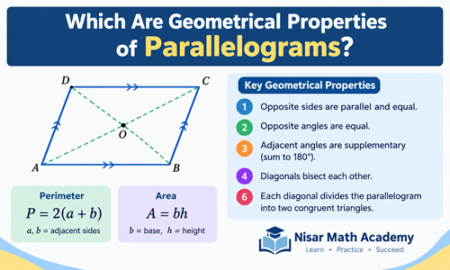
Consider parallelogram ABCD:
- AB ∥ CD
- AD ∥ BC
Here, AB and CD are one pair of opposite parallel sides, while AD and BC are the other pair.
Diagram-Based Explanation
Imagine a four-sided figure named ABCD. Draw AB as the lower side and CD as the upper side. Make AB and CD parallel. Then draw AD and BC so that they are also parallel to each other.
The resulting quadrilateral ABCD is a parallelogram.
A simple representation is:
        D────────C
       /        /
      /        /
     A────────B
In this figure:
- AB ∥ CD
- AD ∥ BC
- ∠A and ∠C are opposite angles.
- ∠B and ∠D are opposite angles.
- AC and BD are the diagonals.
Geometrical Properties of Parallelograms
A parallelogram has several important geometrical properties. These properties are frequently used in Class 9 geometry problems.
Property 1: Opposite Sides Are Parallel
In a parallelogram, both pairs of opposite sides are parallel.
For parallelogram ABCD:
and
This property is actually part of the definition of a parallelogram.
Property 2: Opposite Sides Are Equal
The opposite sides of a parallelogram are equal in length.
Therefore:
and
For example, if:
then:
Similarly, if:
then:
Property 3: Opposite Angles Are Equal
The opposite angles of a parallelogram are equal.
Therefore:
and
This property is very useful when one angle is given and another angle needs to be calculated.
Property 4: Adjacent Angles Are Supplementary
Two angles next to each other in a parallelogram are supplementary.
The sum of supplementary angles is:
Therefore:
Similarly:
and
Property 5: Diagonals Bisect Each Other
The diagonals of a parallelogram bisect each other.
If diagonals AC and BD intersect at point O, then:
and
This means that the point where the diagonals intersect divides each diagonal into two equal parts.
Property 6: Each Diagonal Divides the Parallelogram into Two Congruent Triangles
A diagonal of a parallelogram divides it into two congruent triangles.
For example, diagonal AC divides parallelogram ABCD into:
and
These two triangles are congruent.
Similarly, diagonal BD divides the parallelogram into two congruent triangles.
Important Properties at a Glance
| Property | Result |
|---|---|
| Opposite sides | Parallel |
| Opposite sides | Equal |
| Opposite angles | Equal |
| Adjacent angles | Supplementary |
| Diagonals | Bisect each other |
| Each diagonal | Forms two congruent triangles |
Formulas Related to a Parallelogram
Perimeter of a Parallelogram
If the adjacent sides are and , then:
where represents the perimeter.
Area of a Parallelogram
The area is:
where:
- = base
- = perpendicular height
Therefore:
It is important to remember that the height is the perpendicular distance between the parallel sides. It is not necessarily the slanting side.
Solved Examples
Example 1: Finding an Opposite Side
In parallelogram ABCD:
Find .
Solution
Opposite sides of a parallelogram are equal.
Therefore:
So:
Answer:
Example 2: Finding an Opposite Angle
Suppose:
Find .
Solution
Opposite angles of a parallelogram are equal.
Therefore:
Hence:
Answer:
Example 3: Finding an Adjacent Angle
Suppose:
Find .
Solution
Adjacent angles of a parallelogram are supplementary.
Therefore:
Substitute:
Thus:
Answer:
Example 4: Finding the Other Angles
If one angle of a parallelogram is , find all four angles.
Solution
Let:
The opposite angle is equal:
Adjacent angles are supplementary:
The opposite angle is equal:
Therefore, the four angles are:
Example 5: Finding a Missing Part of a Diagonal
The diagonals of parallelogram ABCD intersect at O. If:
find .
Solution
The diagonals of a parallelogram bisect each other.
Therefore:
Hence:
Answer:
Example 6: Finding the Perimeter
The adjacent sides of a parallelogram are 9 cm and 6 cm. Find its perimeter.
Solution
Use:
Substitute:
Answer:
Example 7: Finding the Area
A parallelogram has a base of 12 cm and a perpendicular height of 5 cm. Find its area.
Solution
Use:
Substitute:
Answer:
Why Are the Geometrical Properties of Parallelograms Important?
These properties allow students to find unknown sides, angles, and diagonal segments without measuring them directly.
For example:
- If one side is known, its opposite side can be found.
- If one angle is known, its opposite angle can be found.
- If one angle is known, an adjacent angle can be calculated using .
- If one half of a diagonal is known, the other half can be found.
- Perimeter and area can be calculated using standard formulas.
These ideas also form a foundation for studying other quadrilaterals such as rectangles, rhombuses, and squares.
Real-Life Applications of Parallelograms
Parallelogram shapes and their properties can be seen in many areas of mathematics, design, construction, and engineering.
Examples include:
- Architectural designs
- Floor and wall patterns
- Structural designs
- Graphic designs
- Geometric patterns
- Engineering diagrams
- Tile and paving patterns
The mathematical properties help designers and engineers understand relationships between lengths, angles, and parallel lines.
Common Mistakes Students Make
1. Confusing Opposite and Adjacent Angles
Opposite angles are equal, while adjacent angles add up to .
2. Assuming All Four Sides Are Equal
A general parallelogram does not necessarily have four equal sides.
Only opposite sides are guaranteed to be equal.
3. Assuming All Four Angles Are Equal
A general parallelogram does not necessarily have four right angles.
Only opposite angles are equal.
4. Using the Slanting Side as Height
For area calculations, the height must be the perpendicular distance between the parallel sides.
5. Forgetting the Diagonal Property
The diagonals of a general parallelogram bisect each other, but they are not necessarily equal.
Frequently Asked Questions
What is a parallelogram?
A parallelogram is a quadrilateral in which both pairs of opposite sides are parallel.
What are the main geometrical properties of parallelograms?
The main properties are that opposite sides are parallel and equal, opposite angles are equal, adjacent angles are supplementary, and diagonals bisect each other.
Are opposite sides of a parallelogram equal?
Yes. Both pairs of opposite sides are equal.
Are opposite angles of a parallelogram equal?
Yes. Opposite angles are equal.
Do the diagonals of a parallelogram bisect each other?
Yes. Each diagonal is divided into two equal parts at their point of intersection.
Are the diagonals of a parallelogram equal?
Not necessarily. Equal diagonals are a special property of rectangles and squares, but not of every parallelogram.
What is the formula for the area of a parallelogram?
where is the base and is the perpendicular height.
What is the formula for the perimeter of a parallelogram?
where and are the lengths of two adjacent sides.
Short Conclusion
A parallelogram is a quadrilateral with two pairs of parallel opposite sides. Its most important geometrical properties are that opposite sides are equal, opposite angles are equal, adjacent angles are supplementary, and the diagonals bisect each other.
Remembering these properties makes many Class 9 geometry questions much easier. Students should practise both conceptual and numerical questions to become confident with parallelograms.
Students looking for Class 9 Maths notes, recorded video lectures, assessments, worksheets, and other mathematics learning resources can also explore the resources available at Nisar Math Academy.
Related Questions for Students
- What is the definition of a parallelogram?
- Why are opposite sides of a parallelogram equal?
- Are opposite angles of a parallelogram equal?
- What is the relationship between adjacent angles?
- How do the diagonals of a parallelogram behave?
- How is the area of a parallelogram calculated?
- How is the perimeter of a parallelogram calculated?
- What is the difference between a parallelogram and a rectangle?
- What is the difference between a parallelogram and a rhombus?
- How can unknown angles be calculated using parallelogram properties?
- How can an unknown diagonal segment be found?
- Why is perpendicular height used in the area formula?
Short Notes: Geometrical Properties of Parallelograms
Definition
A parallelogram is a quadrilateral whose both pairs of opposite sides are parallel.
Main Properties
- Opposite sides are parallel.
- Opposite sides are equal.
- Opposite angles are equal.
- Adjacent angles are supplementary.
- Diagonals bisect each other.
- Each diagonal divides the parallelogram into two congruent triangles.
Important Relations
If diagonals intersect at :
Important Formulas
Perimeter:
Area:
MCQs
1. What is a parallelogram?
A. A quadrilateral with no parallel sides
B. A quadrilateral with one pair of equal sides only
C. A quadrilateral with both pairs of opposite sides parallel
D. A triangle with parallel sides
Correct Answer: C
2. In a parallelogram, opposite sides are:
A. Unequal
B. Equal
C. Perpendicular
D. Always of different lengths
Correct Answer: B
3. Opposite angles of a parallelogram are:
A. Equal
B. Supplementary
C. Always
D. Unequal
Correct Answer: A
4. The sum of two adjacent angles of a parallelogram is:
A.
B.
C.
D.
Correct Answer: C
5. If one angle of a parallelogram is , its opposite angle is:
A.
B.
C.
D.
Correct Answer: B
6. If one angle of a parallelogram is , an adjacent angle is:
A.
B.
C.
D.
Correct Answer: C
7. The diagonals of a parallelogram:
A. Always have equal lengths
B. Bisect each other
C. Are always perpendicular
D. Never intersect
Correct Answer: B
8. If cm in a parallelogram whose diagonals intersect at O, then is:
A. 4 cm
B. 8 cm
C. 16 cm
D. 24 cm
Correct Answer: B
9. The perimeter of a parallelogram with adjacent sides 7 cm and 5 cm is:
A. 12 cm
B. 17 cm
C. 24 cm
D. 35 cm
Correct Answer: C
10. The area of a parallelogram with base 10 cm and perpendicular height 6 cm is:
A.
B.
C.
D.
Correct Answer: C
11. If cm in parallelogram ABCD, then CD is:
A. 4.5 cm
B. 9 cm
C. 18 cm
D. Cannot be determined
Correct Answer: B
12. Which formula gives the area of a parallelogram?
A.
B.
C.
D.
Correct Answer: C
Worksheet / Assignment
Part A: Definitions and Concepts
- Define a parallelogram.
- State two properties of the opposite sides of a parallelogram.
- What is the relationship between opposite angles of a parallelogram?
- What is the relationship between adjacent angles of a parallelogram?
- State the property of the diagonals of a parallelogram.
Part B: Numerical Questions
- One angle of a parallelogram is . Find its opposite angle.
- One angle of a parallelogram is . Find an adjacent angle.
- Two adjacent sides of a parallelogram are 8 cm and 11 cm. Find its perimeter.
- A parallelogram has a base of 14 cm and a perpendicular height of 6 cm. Find its area.
- The diagonals of a parallelogram intersect at O. If cm, find .
- If cm, find .
- In parallelogram ABCD, cm. Find .
- In parallelogram ABCD, cm. Find .
- One angle of a parallelogram is . Find all four angles.
- A parallelogram has a base of 18 cm and area . Find its perpendicular height.
Answer Key
- A quadrilateral with both pairs of opposite sides parallel.
- Opposite sides are parallel and equal.
- Opposite angles are equal.
- Adjacent angles add up to .
- The diagonals bisect each other.
- cm
- cm
- cm
- cm
- cm
- cm
Final Revision Point
For examinations, remember these four key facts first:
These four properties form the foundation for solving many questions involving parallelograms in Class 9 Mathematics.
You May be Interested In:
Geometrical Properties of Triangles: Definitions, Formulas & Examples
Properties of Polygon: Definitions, Angle Properties, Formulas and Examples
How to Find Area of Similar Figures: Formula, Examples, Notes & Worksheet

Leave a Reply