What Are Similar Triangles? Definition, Properties, Formulas, Examples and Notes
Introduction
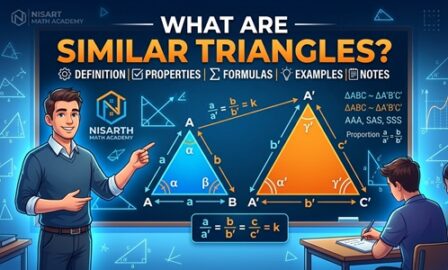
Similar triangles are triangles that have the same shape but do not necessarily have the same size. In similar triangles, the corresponding angles are equal and the corresponding sides are proportional.
Similarity is an important concept in geometry because it allows us to find unknown lengths and angles without measuring them directly.
For example, if two triangular shapes have corresponding angles equal and their corresponding sides are in the same ratio, the triangles are similar.
In this article, you will learn:
- The definition of similar triangles
- The difference between similar and congruent triangles
- Properties of similar triangles
- Conditions or criteria for proving triangles similar
- How to identify corresponding sides and angles
- The scale factor of similar triangles
- Step-by-step solved examples
- Applications of similar triangles in real life
- Common mistakes students should avoid
- Revision notes, MCQs, and a worksheet
What Are Similar Triangles?
Two triangles are called similar triangles if:
- Their corresponding angles are equal.
- Their corresponding sides are proportional.
The symbol for similarity is:
For example, if triangle is similar to triangle , we write:
The order of the letters is important. It tells us which vertices correspond to each other:
Therefore:
and
Similar Triangles Definition
A simple similar triangles definition is:
Two triangles are similar if their corresponding angles are equal and their corresponding sides are proportional.
Similar triangles have the same shape, although their sizes may be different.
Example
Suppose one triangle has sides:
and another triangle has sides:
Check the ratios:
Since all corresponding sides have the same ratio, the triangles are similar.
The second triangle is an enlargement of the first triangle by a scale factor of .
How to Understand Similar Triangles
Imagine two triangular road signs. One is small and another is twice as large, but both have exactly the same shape.
If every side of the larger triangle is twice the corresponding side of the smaller triangle, while the corresponding angles remain equal, the two triangles are similar.
Diagram Description
Imagine two triangles placed side by side:
- Triangle is the smaller triangle.
- Triangle is the larger triangle.
- corresponds to .
- corresponds to .
- corresponds to .
- Each angle in the first triangle is equal to its corresponding angle in the second triangle.
- Every side of the second triangle is a fixed multiple of its corresponding side in the first triangle.
This represents:
Properties of Similar Triangles
Similar triangles have several important properties.
1. Corresponding Angles Are Equal
If:
then:
2. Corresponding Sides Are Proportional
The corresponding sides have the same ratio:
This common ratio is related to the scale factor.
3. Similar Triangles Have the Same Shape
Their sizes may be different, but their shapes are the same.
One triangle may be an enlargement or reduction of the other.
4. Their Perimeters Are in the Same Ratio as Corresponding Sides
If the scale factor is , then:
5. Their Areas Are Related to the Square of the Scale Factor
If two similar triangles have a scale factor , then:
For example, if the side lengths are in the ratio , their areas are in the ratio:
Corresponding Sides and Angles
Identifying corresponding parts is one of the most important steps when working with similar triangles.
Suppose:
Then:
Therefore, the corresponding sides are:
| Triangle | Triangle |
|---|---|
Thus:
Always match the sides according to their corresponding angles.
Criteria for Similar Triangles
There are three commonly used criteria for proving that two triangles are similar.
1. AA Similarity Criterion
AA means Angle-Angle.
If two corresponding angles of one triangle are equal to two corresponding angles of another triangle, the triangles are similar.
For example:
and
then:
The third pair of angles will also be equal because the sum of the angles of a triangle is .
2. SSS Similarity Criterion
SSS means Side-Side-Side.
If the three corresponding sides of two triangles are proportional, the triangles are similar.
For example:
Therefore:
3. SAS Similarity Criterion
SAS means Side-Angle-Side.
If two corresponding sides are proportional and the included angle between them is equal, the triangles are similar.
For example:
and
Therefore:
Similar Triangles vs Congruent Triangles
Students often confuse similar triangles with congruent triangles.
| Similar Triangles | Congruent Triangles |
|---|---|
| Same shape | Same shape |
| Size may be different | Same size |
| Corresponding sides are proportional | Corresponding sides are equal |
| Corresponding angles are equal | Corresponding angles are equal |
| One can be an enlargement or reduction of the other | One can be superimposed exactly on the other |
| Symbol: | Symbol: |
Important Point
Every pair of congruent triangles is also similar, because their corresponding sides are proportional with ratio .
However, similar triangles do not have to be congruent.
For example, triangles with sides and are similar but not congruent.
Are Concurrent Triangles Similar?
The phrase “concurrent triangles” is not normally used as a criterion for triangle similarity.
The word concurrent generally describes lines, rays, or segments that meet at a common point. For example, three medians of a triangle are concurrent because they meet at the centroid.
Therefore, being concurrent does not by itself prove that two triangles are similar.
Students may sometimes confuse concurrent with congruent.
- Similar: same shape, corresponding sides proportional.
- Congruent: same shape and same size.
- Concurrent: lines or other geometric objects meet at one common point.
Similarity must be established using appropriate conditions such as AA, SSS, or SAS.
Scale Factor in Similar Triangles
The scale factor tells us how much larger or smaller one similar triangle is compared with another.
Suppose:
and:
Then the scale factor from to is:
Therefore, every corresponding side of triangle is twice the corresponding side of triangle .
Formula for Finding an Unknown Side
For similar triangles:
This proportion can be used to find an unknown length.
Worked Example 1: Finding an Unknown Side
Two similar triangles have corresponding sides of cm and cm. Another pair of corresponding sides is cm and cm. Find .
Solution
Because the triangles are similar:
Cross multiply:
Therefore:
Answer
Worked Example 2: Checking Whether Triangles Are Similar
Triangle has sides:
Triangle has corresponding sides:
Determine whether the triangles are similar.
Solution
Compare the corresponding sides:
All three ratios are equal.
Therefore, the corresponding sides are proportional.
Answer
The triangles are similar by the SSS similarity criterion.
Worked Example 3: Using Equal Angles
Suppose:
in triangle , and:
in triangle .
Determine whether the triangles are similar.
Solution
We have:
and:
Therefore, two corresponding angles are equal.
By the AA similarity criterion:
The third angles are also equal:
Answer
The triangles are similar by AA similarity.
Worked Example 4: Finding a Side Using Proportionality
Suppose:
with:
and:
Find .
Solution
Since the triangles are similar:
Substitute the values:
Simplify:
Cross multiply:
Therefore:
Answer
Worked Example 5: Similar Triangles and Area
Two similar triangles have corresponding sides in the ratio:
Find the ratio of their areas.
Solution
For similar triangles, the ratio of areas is the square of the ratio of corresponding sides.
Therefore:
Answer
Worked Example 6: Real-Life Height Measurement
A student wants to estimate the height of a tree. At the same time, a -metre vertical pole casts a -metre shadow. The tree casts a -metre shadow.
Assuming the sun’s rays create similar triangles, find the height of the tree.
Solution
The triangles formed by the pole and tree are similar.
Let the height of the tree be .
Set up the proportion:
Cross multiply:
Therefore:
Answer
The height of the tree is:
Practical Applications of Similar Triangles
Similar triangles are useful in many real-life situations.
1. Measuring the Height of Tall Objects
The height of a tree, building, tower, or pole can sometimes be calculated by comparing its shadow with the shadow of an object of known height.
2. Surveying
Surveyors use geometric relationships, including triangle similarity, to determine distances and heights that may be difficult to measure directly.
3. Maps and Scale Drawings
Maps and diagrams often represent real objects at a smaller scale. The same proportional relationships are used when converting between drawing measurements and actual measurements.
4. Photography and Image Enlargement
When an image is enlarged without changing its shape, corresponding dimensions maintain a constant scale factor.
5. Engineering and Construction
Scaled drawings and models can use proportional relationships to represent larger structures accurately.
How to Solve Similar Triangle Problems
Follow these steps:
Step 1: Identify the Two Triangles
Determine which two triangles are being compared.
Step 2: Match Corresponding Angles
Use equal angles or markings in the diagram to identify corresponding vertices.
Step 3: Match Corresponding Sides
Once corresponding vertices are known, identify the corresponding sides.
Step 4: Select the Correct Similarity Criterion
Use:
- AA
- SSS
- SAS
when appropriate.
Step 5: Write a Proportion
For corresponding sides, write:
Step 6: Solve for the Unknown
Use cross multiplication or another appropriate algebraic method.
Step 7: Check Your Answer
Make sure the answer follows the same scale relationship as the other corresponding sides.
Common Mistakes Students Make
Mistake 1: Matching the Wrong Sides
Students sometimes compare sides that are not corresponding.
Solution: Identify corresponding angles first, then match their opposite sides or connecting sides.
Mistake 2: Confusing Similar and Congruent
Similar triangles can have different sizes.
Congruent triangles must have the same size and shape.
Mistake 3: Reversing the Proportion
If:
is used on one side of a proportion, the other pair should use the same order.
Correct:
Do not mix:
unless the proportion is deliberately rearranged correctly.
Mistake 4: Assuming Two Triangles Are Similar Because They Look Similar
A diagram is not always drawn to scale.
Similarity should be established mathematically using appropriate information.
Mistake 5: Confusing Concurrent With Congruent
Concurrent describes lines or other geometric objects meeting at one point. It does not mean that triangles have the same shape or size.
Frequently Searched Questions About Similar Triangles
What is the definition of similar triangles?
Similar triangles are triangles having equal corresponding angles and proportional corresponding sides.
What is the symbol for similar triangles?
The symbol for similarity is:
For example:
How do you know if two triangles are similar?
Two triangles can be shown to be similar using criteria such as AA, SSS, or SAS.
Are all congruent triangles similar?
Yes. Congruent triangles have equal corresponding sides, so their side ratio is , making them similar as well.
Can similar triangles have different sizes?
Yes. Similar triangles have the same shape but can have different sizes.
What is the difference between similar and congruent triangles?
Similar triangles have proportional corresponding sides, whereas congruent triangles have equal corresponding sides as well as equal corresponding angles.
Are concurrent triangles always similar?
No. “Concurrent” is not a standard similarity criterion for triangles. Concurrency usually refers to lines or segments meeting at a common point.
Related Questions for Practice
Students studying this topic should also practise questions such as:
- Find the missing side in two similar triangles.
- Determine whether two triangles are similar using AA.
- Determine whether two triangles are similar using SSS.
- Determine whether two triangles are similar using SAS.
- Find the scale factor between two similar triangles.
- Find the perimeter of a similar triangle.
- Find the area ratio of two similar triangles.
- Use similar triangles to calculate the height of a tree.
- Identify corresponding angles and sides.
- Distinguish between similar and congruent triangles.
Short Conclusion
Similar triangles have the same shape, equal corresponding angles, and proportional corresponding sides. They can have different sizes because one triangle may be an enlargement or reduction of the other.
The three important similarity criteria are AA, SSS, and SAS. Once corresponding parts are identified correctly, proportions can be used to find unknown lengths, scale factors, and other quantities.
For students who want additional mathematics learning material, Nisar Math Academy provides mathematics notes, recorded video lectures, assessments, lesson plans, worksheets, solved questions, and other educational resources. Some learning resources are available free of charge, while full courses and additional resources are available through website membership.
Short Notes: Similar Triangles
Definition
Two triangles are similar if their corresponding angles are equal and their corresponding sides are proportional.
Main Properties
- Same shape
- Corresponding angles are equal
- Corresponding sides are proportional
- Sizes may be different
- Perimeters have the same ratio as corresponding sides
- Areas have the square of the side ratio
Similarity Criteria
AA
Two corresponding angles are equal.
SSS
All three corresponding sides are proportional.
SAS
Two corresponding sides are proportional and the included angle is equal.
Important Formula
For similar triangles:
Scale Factor
Area Ratio
If corresponding sides are in the ratio , then:
Similar vs Congruent
Similar: Same shape, possibly different size.
Congruent: Same shape and same size.
Concurrent: Lines or segments meeting at a common point; not a similarity criterion.
MCQs: Similar Triangles
1. What are similar triangles?
A. Triangles with only equal sides
B. Triangles with equal corresponding angles and proportional corresponding sides
C. Triangles with different shapes
D. Triangles with no equal angles
Correct Answer: B
2. What is the symbol for similarity?
A.
B.
C.
D.
Correct Answer: C
3. Which criterion uses two corresponding angles?
A. SSS
B. SAS
C. AA
D. RHS
Correct Answer: C
4. If two similar triangles have corresponding sides in the ratio , their area ratio is:
A.
B.
C.
D.
Correct Answer: B
5. Triangle has sides . A similar triangle has corresponding sides . What is the scale factor from the first triangle to the second?
A.
B.
C.
D.
Correct Answer: B
6. If , which side corresponds to ?
A.
B.
C.
D. and
Correct Answer: C
7. If corresponding sides of two triangles are cm and cm, the scale factor is:
A.
B.
C.
D.
Correct Answer: B
8. Which of the following is NOT a standard triangle similarity criterion?
A. AA
B. SSS
C. SAS
D. AAA as a separately named criterion
Correct Answer: D
9. If two triangles have the same shape but different sizes, they may be:
A. Similar
B. Concurrent
C. Perpendicular
D. Parallel
Correct Answer: A
10. Two similar triangles have side ratio . Their area ratio is:
A.
B.
C.
D.
Correct Answer: C
11. If two triangles have all three corresponding sides proportional, which criterion proves similarity?
A. AA
B. SSS
C. SAS
D. RHS
Correct Answer: B
12. If:
then is:
A.
B.
C.
D.
Correct Answer: B
13. Congruent triangles are:
A. Never similar
B. Always similar
C. Always different in shape
D. Similar only when their areas differ
Correct Answer: B
14. If the scale factor between two similar triangles is , the ratio of their areas is:
A.
B.
C.
D.
Correct Answer: C
15. The term “concurrent” generally describes:
A. Equal triangles
B. Proportional sides
C. Lines or segments meeting at one point
D. Equal angles
Correct Answer: C
Worksheet / Assignment: Similar Triangles
Part A: Definitions and Concepts
- Define similar triangles.
- Write the symbol used to represent similarity between two triangles.
- State any two properties of similar triangles.
- Name the three commonly used criteria for proving triangles similar.
- Explain the difference between similar and congruent triangles.
Part B: Identify Corresponding Parts
- If:
write the corresponding vertices and corresponding sides.
- If:
write the proportion involving all three pairs of corresponding sides.
Part C: Numerical Problems
- Two similar triangles have corresponding sides cm and cm. If another side of the smaller triangle is cm, find the corresponding side of the larger triangle.
- Two similar triangles have corresponding sides in the ratio . If a side of the smaller triangle is cm, find the corresponding side of the larger triangle.
- Triangle has sides , , and cm. Another triangle has corresponding sides , , and cm. Determine whether the triangles are similar.
- Two similar triangles have corresponding sides in the ratio . Find their area ratio.
- In two similar triangles:
Find .
- Two similar triangles have perimeters cm and cm. What is the ratio of their corresponding sides?
Part D: Word Problems
- A -metre pole casts a -metre shadow. At the same time, a building casts a -metre shadow. Assuming the triangles formed are similar, find the height of the building.
- A small triangular model has a side of cm. Its corresponding side on a similar larger model is cm. If another side of the small model is cm, find the corresponding side of the larger model.
Answer Key
- Two triangles are similar if their corresponding angles are equal and their corresponding sides are proportional.
- Any two: corresponding angles are equal; corresponding sides are proportional; same shape; perimeter ratio equals side ratio.
- AA, SSS, SAS.
- Similar triangles have the same shape but may have different sizes; congruent triangles have the same shape and size.
- .
.
- Yes. Each corresponding side of the second triangle is twice the corresponding side of the first.
Therefore, the corresponding side ratio is:
FAQs About Similar Triangles
1. What are similar triangles?
Similar triangles have equal corresponding angles and proportional corresponding sides.
2. What is the definition of similar triangles in simple words?
They are triangles that have the same shape but may have different sizes.
3. What are the criteria for similar triangles?
The commonly used criteria are AA, SSS, and SAS.
4. Can two triangles be similar but not congruent?
Yes. For example, triangles with side lengths and are similar but not congruent.
5. How are corresponding sides identified?
First identify corresponding vertices using equal angles or diagram markings. The sides connecting corresponding vertices are corresponding sides.
6. What happens to the area when a similar triangle is enlarged?
If the side scale factor is , the area scale factor is .
7. Are concurrent triangles always similar?
No. Concurrency does not establish triangle similarity. Similarity requires conditions such as AA, SSS, or SAS.
8. Where are similar triangles used in real life?
They can be used for indirect measurements, surveying, scale drawings, construction, maps, and other applications involving proportional dimensions.
Final Revision Checklist
Before solving a problem involving similar triangles, remember:
- Identify the two triangles.
- Match corresponding vertices.
- Match corresponding sides.
- Check whether AA, SSS, or SAS applies.
- Write the proportion carefully.
- Keep corresponding quantities in the same order.
- Solve for the unknown.
- Check whether the answer follows the correct scale factor.
- Remember that similar triangles can have different sizes.
- Do not confuse similar, congruent, and concurrent.
Nisar Math Academy provides additional mathematics notes, recorded lectures, assessments, worksheets, lesson plans, and solved questions to support students in their mathematics learning.
You May be Interested In:
Similarity of Polygons in Mathematics: Definition, Rules, Examples and Formulas
Logic and Its Application in Mathematics: Statements, Operators, Proofs and Examples
Application of Coordinate Geometry in Real Life Situations: Examples and Uses
Leave a Reply