Logic and Its Application in Mathematics: Statements, Operators, Proofs and Examples
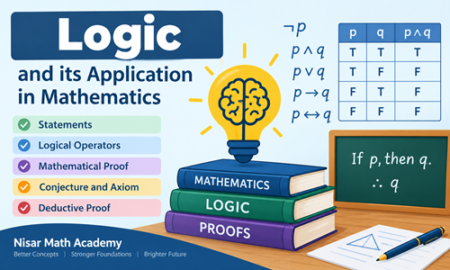
Introduction
Logic is an important part of mathematics because it helps us think clearly, make valid conclusions, and determine whether a mathematical argument is correct. Mathematics is not only about calculations; it also involves reasoning and proving that statements are true.
For example, if we know that:
- All squares have four sides.
- ABCD is a square.
Then we can logically conclude that ABCD has four sides.
Mathematical logic provides rules that help us connect statements and reach reliable conclusions. It is used in mathematical proofs, algebra, geometry, number theory, computer science, and many other areas.
In this article, we will learn:
- What logic means in mathematics
- What a mathematical statement is
- Logical operators and their symbols
- Truth values and truth tables
- Conjectures and axioms
- Mathematical proof
- Deductive proof
- Common types of reasoning
- Worked examples
- Applications of logic in mathematics and daily life
- Common mistakes students should avoid
What Is Logic in Mathematics?
Logic is the systematic study of reasoning and the rules used to determine whether a conclusion follows correctly from given information.
In mathematics, logic helps us decide whether an argument is valid.
For example:
If a number is divisible by 2, then it is even.
The number 18 is divisible by 2.
Therefore:
18 is even.
This conclusion follows logically from the given information.
Mathematical logic is therefore closely connected with statements, reasoning, proof, and conclusions.
What Is a Mathematical Statement?
A statement is a sentence that is either definitely true or false, but not both at the same time.
Examples of statements
- 5 + 3 = 8
This is true. - 10 is an odd number.
This is false. - A triangle has three sides.
This is true.
Each of these sentences has a definite truth value.
Examples that are not statements
Consider:
What is your name?
This is a question, so it is not a mathematical statement.
Similarly:
Close the door.
This is a command, not a statement.
Therefore, a statement must have a definite truth value.
Truth Value of a Statement
The truth value of a statement tells us whether the statement is True (T) or False (F).
For example:
| Statement | Truth Value |
|---|---|
| 2 + 3 = 5 | True |
| 7 < 4 | False |
| 12 is divisible by 3 | True |
| 9 is an even number | False |
We commonly use T for true and F for false.
Simple and Compound Statements
Statements can be classified into simple and compound statements.
Simple Statement
A simple statement contains one basic idea and cannot be divided into smaller statements using logical operators.
Example:
7 is a prime number.
Let this statement be represented by p.
Compound Statement
A compound statement is formed by combining two or more statements using logical operators.
For example:
7 is a prime number and 8 is an even number.
Let:
- p = 7 is a prime number.
- q = 8 is an even number.
Then the compound statement can be written as:
p ∧ q
Logical Operators
Logical operators are symbols or words used to combine or modify statements.
The most common logical operators are:
- NOT
- AND
- OR
- IF…THEN
- IF AND ONLY IF
1. NOT Operator
The NOT operator reverses the truth value of a statement.
It is represented by:
¬p
If:
p: 5 is greater than 2.
Then p is true.
Therefore:
¬p: 5 is not greater than 2.
is false.
The truth table is:
| p | ¬p |
|---|---|
| T | F |
| F | T |
2. AND Operator
The AND operator is represented by:
∧
The statement p ∧ q is true only when both p and q are true.
Example:
4 is an even number AND 9 is an odd number.
Both statements are true, so the compound statement is true.
Truth table for AND
| p | q | p ∧ q |
|---|---|---|
| T | T | T |
| T | F | F |
| F | T | F |
| F | F | F |
Therefore, AND requires both statements to be true.
3. OR Operator
The OR operator is represented by:
∨
The statement p ∨ q is true when at least one of p or q is true.
Truth table for OR
| p | q | p ∨ q |
|---|---|---|
| T | T | T |
| T | F | T |
| F | T | T |
| F | F | F |
For example:
5 is even OR 7 is odd.
The first statement is false, but the second is true. Therefore, the compound statement is true.
4. Conditional Statement
A conditional statement has the form:
If p, then q.
It is represented by:
p → q
Here:
- p is called the hypothesis or antecedent.
- q is called the conclusion or consequent.
Example:
If a number is divisible by 4, then it is even.
Here:
- p = The number is divisible by 4.
- q = The number is even.
The logical form is:
p → q
Truth table for implication
| p | q | p → q |
|---|---|---|
| T | T | T |
| T | F | F |
| F | T | T |
| F | F | T |
The conditional statement is false only when p is true and q is false.
5. Biconditional Statement
A biconditional statement has the form:
p if and only if q
It is represented by:
p ↔ q
It is true when p and q have the same truth value.
Truth table
| p | q | p ↔ q |
|---|---|---|
| T | T | T |
| T | F | F |
| F | T | F |
| F | F | T |
For example:
A number is even if and only if it is divisible by 2.
For integers, these two conditions are equivalent.
What Is a Mathematical Proof?
A mathematical proof is a logical argument that demonstrates that a mathematical statement is true.
A proof begins with known facts, definitions, axioms, or previously established results and uses logical reasoning to reach a conclusion.
For example, consider:
The sum of two even integers is even.
Let the two even integers be:
2m and 2n
where m and n are integers.
Their sum is:
2m + 2n = 2(m + n)
Since m + n is an integer, the result is divisible by 2.
Therefore:
The sum of two even integers is even.
This is a mathematical proof.
What Is an Axiom?
An axiom is a statement accepted as true without requiring proof within a particular mathematical system.
Axioms provide a foundation for mathematical reasoning.
For example, in Euclidean geometry, one of the familiar ideas is that:
Through two distinct points, exactly one straight line can be drawn.
Such foundational assumptions allow mathematicians to develop further results.
What Is a Conjecture?
A conjecture is a mathematical statement that is believed to be true but has not yet been proved.
A conjecture may be supported by examples, patterns, or calculations, but examples alone do not establish a universal mathematical proof.
For example, suppose a student observes:
- 1 + 3 = 4
- 3 + 5 = 8
- 5 + 7 = 12
- 7 + 9 = 16
The student might notice that the sum of two odd numbers appears to be even.
This observation can lead to a conjecture:
The sum of any two odd integers is even.
The conjecture can then be proved mathematically.
Conjecture vs Axiom
| Conjecture | Axiom |
|---|---|
| A statement believed to be true but requiring proof | A statement accepted as true within a mathematical system |
| May be supported by observations or patterns | Used as a foundation for further reasoning |
| Can later be proved or disproved | Normally not proved within that system |
| Examples and evidence may motivate it | Provides starting assumptions |
Deductive Proof
A deductive proof uses general principles, definitions, axioms, and previously established results to reach a specific conclusion.
The reasoning generally follows this pattern:
Known facts → Logical reasoning → Conclusion
Example
Suppose:
- All multiples of 5 end in 0 or 5.
- 35 is a multiple of 5.
Therefore:
- 35 ends in 0 or 5.
Since 35 ends in 5, the conclusion is correct.
Inductive Reasoning and Deductive Reasoning
These two forms of reasoning are important in mathematics.
Inductive Reasoning
Inductive reasoning starts with particular observations and moves toward a general conclusion.
Example:
- 2² = 4
- 3² = 9
- 4² = 16
- 5² = 25
A student may observe that the square of an integer is positive.
Such observations can suggest a general rule, but the observation itself may not constitute a proof.
Deductive Reasoning
Deductive reasoning starts with accepted general facts and applies them to reach a specific conclusion.
Example:
- Every square has four equal sides.
- ABCD is a square.
- Therefore, ABCD has four equal sides.
Difference
| Inductive Reasoning | Deductive Reasoning |
|---|---|
| Moves from specific observations to a general idea | Moves from general facts to a specific conclusion |
| Often helps form conjectures | Commonly used in mathematical proofs |
| Based on patterns and observations | Based on logical rules and established facts |
Worked Example 1: Identifying a Statement
Question
Determine whether the following are statements:
- 12 is an even number.
- What is 5 + 6?
- x + 3 = 7.
- 9 < 4.
Solution
1. 12 is an even number.
It is either true or false. Therefore, it is a statement.
2. What is 5 + 6?
This is a question. Therefore, it is not a statement.
3. x + 3 = 7
Its truth depends on the value of x. Without specifying x, it is an open sentence rather than a statement.
4. 9 < 4
It is false, but it has a definite truth value. Therefore, it is a statement.
Worked Example 2: Using the AND Operator
Let:
p = 6 is an even number.
q = 9 is an odd number.
Determine the truth value of:
p ∧ q
Solution
p is true.
q is true.
For AND, both statements must be true.
Therefore:
p ∧ q = T
Worked Example 3: Using the OR Operator
Let:
p = 10 is an odd number.
q = 15 is divisible by 3.
Determine:
p ∨ q
Solution
p is false.
q is true.
For OR, at least one statement must be true.
Therefore:
p ∨ q = T
Worked Example 4: Negation
Let:
p = 8 is an odd number.
Determine ¬p.
Solution
The statement p is false because 8 is even.
Therefore, its negation is true:
¬p = 8 is not an odd number.
Hence:
¬p = T
Worked Example 5: A Simple Deductive Proof
Question
Prove that the sum of two odd integers is even.
Solution
Let the two odd integers be:
2m + 1 and 2n + 1
where m and n are integers.
Their sum is:
(2m + 1) + (2n + 1)
= 2m + 2n + 2
= 2(m + n + 1)
Since m + n + 1 is an integer, the result is divisible by 2.
Therefore:
The sum of two odd integers is even.
Worked Example 6: Proving a Number Is Divisible by 3
Question
Prove that the sum of three consecutive integers is divisible by 3.
Solution
Let the three consecutive integers be:
n, n + 1, n + 2
Their sum is:
n + (n + 1) + (n + 2)
= 3n + 3
= 3(n + 1)
Therefore, the sum is divisible by 3.
Hence proved.
Worked Example 7: Checking a Conditional Statement
Consider:
If a number is divisible by 4, then it is even.
Take the number 12.
Solution
12 is divisible by 4 because:
12 ÷ 4 = 3
Also:
12 ÷ 2 = 6
Therefore, 12 is even.
The example supports the conditional statement.
However, remember that checking a few examples is not by itself a proof of a universal mathematical statement. A proof requires general reasoning.
Converse of a Conditional Statement
If we have:
If p, then q
the converse is:
If q, then p
For example:
Original statement:
If a number is divisible by 4, then it is even.
Converse:
If a number is even, then it is divisible by 4.
The converse is false.
For example, 6 is even, but 6 is not divisible by 4.
Therefore, a statement and its converse do not necessarily have the same truth value.
Contrapositive
For the conditional statement:
p → q
the contrapositive is:
¬q → ¬p
Example:
Original:
If a number is divisible by 4, then it is even.
Contrapositive:
If a number is not even, then it is not divisible by 4.
The original statement and its contrapositive are logically equivalent.
Applications of Logic in Mathematics
Logic has many applications in mathematics.
1. Mathematical Proofs
Logic provides the foundation for proving mathematical theorems and results.
2. Geometry
Geometric theorems require logical reasoning based on definitions, axioms, postulates, and previously proved results.
3. Algebra
Logic helps us justify algebraic transformations and conclusions.
4. Number Theory
Statements about prime numbers, divisibility, factors, and integers are frequently established using logical arguments.
5. Computer Science
Computers use logical operations such as AND, OR, and NOT in programming and digital circuits.
6. Problem Solving
When solving a mathematical problem, logic helps us identify relevant information, choose appropriate methods, and check whether the conclusion follows from the given conditions.
Logic in Real-Life Situations
Logic is not limited to mathematics.
For example:
If it is raining, I will carry an umbrella.
If it is raining, the condition suggests carrying an umbrella.
Similarly, decision-making often involves conditions:
- If the answer satisfies the equation, accept it.
- If a number is divisible by 2, it is even.
- If two angles are complementary, their sum is 90°.
These examples demonstrate how conditional reasoning can be used in everyday situations.
Diagram-Based Explanation of Logic
A useful diagram for understanding mathematical reasoning can be described as follows:
Given Information → Logical Rules → Reasoning → Conclusion
For example:
Given:
n is divisible by 2.
↓
Rule:
Every integer divisible by 2 is even.
↓
Conclusion:
n is even.
When preparing a visual diagram for students, the four stages can be placed inside four connected boxes with arrows pointing from the given information toward the final conclusion.
Common Mistakes Students Make
1. Thinking Every Sentence Is a Statement
Questions and commands are not mathematical statements because they do not have a definite truth value.
2. Confusing AND with OR
For AND, both statements must be true.
For OR, at least one statement must be true.
3. Assuming Examples Are Proof
Testing several numbers can help identify a pattern, but examples alone do not prove a statement for all numbers.
4. Confusing a Statement With Its Converse
From:
If p, then q
we cannot automatically conclude:
If q, then p.
The converse must be examined separately.
5. Ignoring Definitions
Many mathematical proofs depend on precise definitions. Students should understand the definitions before beginning a proof.
6. Making Unsupported Conclusions
A conclusion must follow logically from the information provided.
Why Is Logic Important in Mathematics?
Logic helps students:
- Think systematically
- Understand mathematical arguments
- Identify valid and invalid reasoning
- Construct mathematical proofs
- Solve problems step by step
- Understand relationships between mathematical statements
- Avoid incorrect conclusions
- Develop analytical thinking
A strong understanding of logic can therefore make many areas of mathematics easier to understand.
Short Conclusion
Logic is a fundamental part of mathematics. It provides rules for forming statements, combining ideas, evaluating truth values, and developing mathematical proofs.
Concepts such as statements, logical operators, axioms, conjectures, deductive reasoning, conditional statements, and proofs help students understand how mathematical conclusions are established.
Students studying mathematics should not focus only on memorizing formulas. They should also learn how to reason logically and explain why a mathematical result is true.
For students looking for mathematics notes, recorded lectures, assessments, worksheets, and solved questions, Nisar Math Academy provides a range of learning resources designed to support mathematics study.
Short Notes on Logic
Important Definitions
Logic: The systematic study of valid reasoning.
Statement: A sentence that is definitely true or false.
Truth Value: The value True (T) or False (F) assigned to a statement.
Simple Statement: A statement containing one basic proposition.
Compound Statement: A statement formed by combining two or more statements.
Axiom: A statement accepted as true within a mathematical system without proof.
Conjecture: A statement believed to be true but not yet proved.
Mathematical Proof: A logical argument used to establish the truth of a mathematical statement.
Deductive Proof: A proof that uses known facts, definitions, axioms, and established results to reach a logical conclusion.
Important Logical Symbols
| Operation | Symbol | Meaning |
|---|---|---|
| NOT | ¬p | Not p |
| AND | p ∧ q | p and q |
| OR | p ∨ q | p or q |
| Conditional | p → q | If p, then q |
| Biconditional | p ↔ q | p if and only if q |
Key Points to Remember
- A statement must have a definite truth value.
- AND is true only when both statements are true.
- OR is true when at least one statement is true.
- NOT reverses the truth value.
- A conditional statement has the form p → q.
- The converse of p → q is q → p.
- The contrapositive of p → q is ¬q → ¬p.
- A conjecture requires proof before it can be established as a theorem.
- Logic is essential for mathematical proof and reasoning.
MCQs on Logic
1. What is logic mainly concerned with?
A. Drawing graphs
B. Valid reasoning
C. Measuring angles
D. Finding areas
Correct Answer: B. Valid reasoning
2. Which of the following is a statement?
A. What is your age?
B. Close the book.
C. 7 + 5 = 12
D. Please solve this problem.
Correct Answer: C. 7 + 5 = 12
3. What is the truth value of the statement “9 is an even number”?
A. True
B. False
C. Both true and false
D. Cannot be determined
Correct Answer: B. False
4. Which symbol represents NOT?
A. ∧
B. ∨
C. ¬
D. →
Correct Answer: C. ¬
5. The statement p ∧ q is true when:
A. p is false only
B. q is false only
C. Both p and q are true
D. Both p and q are false
Correct Answer: C. Both p and q are true
6. The statement p ∨ q is false when:
A. p is true
B. q is true
C. Both are true
D. Both are false
Correct Answer: D. Both are false
7. Which symbol represents implication?
A. ∧
B. ∨
C. →
D. ↔
Correct Answer: C. →
8. Which of the following is a conjecture?
A. A statement accepted as an axiom
B. A statement believed to be true but not yet proved
C. A false statement
D. A question
Correct Answer: B. A statement believed to be true but not yet proved
9. Which type of reasoning is commonly used to establish mathematical results from known facts?
A. Deductive reasoning
B. Guessing
C. Estimation only
D. Observation only
Correct Answer: A. Deductive reasoning
10. What is the converse of “If p, then q”?
A. If not p, then not q
B. If q, then p
C. If not q, then not p
D. p and q
Correct Answer: B. If q, then p
11. What is the contrapositive of p → q?
A. q → p
B. ¬p → ¬q
C. ¬q → ¬p
D. p ↔ q
Correct Answer: C. ¬q → ¬p
12. Which statement is true?
A. The sum of two even integers is odd.
B. The sum of two odd integers is even.
C. Every odd integer is divisible by 2.
D. Every even integer is prime.
Correct Answer: B. The sum of two odd integers is even.
13. Which of the following is an axiom?
A. A statement accepted as a starting assumption
B. A statement that must always be false
C. A question
D. A numerical calculation
Correct Answer: A. A statement accepted as a starting assumption
14. What is the result of 2m + 2n?
A. 2(m + n)
B. 2(m − n)
C. m + n
D. mn
Correct Answer: A. 2(m + n)
15. Which area strongly depends on logical reasoning?
A. Mathematical proof
B. Random guessing
C. Memorizing numbers only
D. Copying calculations
Correct Answer: A. Mathematical proof
Worksheet / Assignment: Logic
Part A: Definitions
- Define logic in mathematics.
- What is a mathematical statement?
- Define an axiom.
- What is a conjecture?
- Define mathematical proof.
Part B: Conceptual Questions
- Determine whether each is a statement:
- (a) 15 is divisible by 3.
- (b) What is 4 + 5?
- (c) Please solve x + 2 = 7.
- (d) 11 is an even number.
- Explain the difference between a simple statement and a compound statement.
- Explain the difference between inductive and deductive reasoning.
- Write the converse of:“If a number is divisible by 6, then it is divisible by 3.”
- Write the contrapositive of:
“If a number is divisible by 5, then it ends in 0 or 5.”
Part C: Logical Operators
- Let:
p = 8 is even.
q = 11 is odd.
Find the truth values of:
- (a) p
- (b) q
- (c) ¬p
- (d) p ∧ q
- (e) p ∨ q
- Construct the truth table for p ∧ q.
Part D: Proof and Numerical Reasoning
- Prove that the sum of two even integers is even.
- Prove that the sum of two odd integers is even.
- Prove that the sum of three consecutive integers is divisible by 3.
Answer Key
- Logic is the systematic study of valid reasoning and conclusions.
- A statement is a sentence that is definitely true or false.
- An axiom is a statement accepted as true within a mathematical system without proof.
- A conjecture is a statement believed to be true but not yet proved.
- A mathematical proof is a logical argument establishing that a mathematical statement is true.
- (a) Statement — True
- (b) Not a statement — question
- (c) Not a statement as written — command/open sentence depending on interpretation
- (d) Statement — False
- A simple statement expresses one basic idea, while a compound statement combines statements using logical operators.
- Inductive reasoning moves from observations to a general idea; deductive reasoning uses established facts to reach a logical conclusion.
- Converse:If a number is divisible by 3, then it is divisible by 6.
- Contrapositive:
If a number does not end in 0 or 5, then it is not divisible by 5.
- (a) p = T
- (b) q = T
- (c) ¬p = F
- (d) p ∧ q = T
- (e) p ∨ q = T
| p | q | p ∧ q |
|---|---|---|
| T | T | T |
| T | F | F |
| F | T | F |
| F | F | F |
- Let the two even integers be 2m and 2n.
Their sum:
2m + 2n = 2(m + n)
Therefore, their sum is even.
- Let the two odd integers be 2m + 1 and 2n + 1.
Their sum:
(2m + 1) + (2n + 1)
= 2(m + n + 1)
Therefore, their sum is even.
- Let the three consecutive integers be n, n + 1, and n + 2.
Their sum:
n + (n + 1) + (n + 2)
= 3n + 3
= 3(n + 1)
Therefore, the sum is divisible by 3.
Frequently Asked Questions About Logic
1. What is logic in mathematics?
Logic is the systematic study of reasoning. In mathematics, it helps us determine whether conclusions follow correctly from given information.
2. What is a statement in mathematics?
A statement is a sentence that has a definite truth value: either true or false.
3. What are the main logical operators?
The commonly used logical operators are NOT (¬), AND (∧), OR (∨), conditional (→), and biconditional (↔).
4. What is a mathematical proof?
A mathematical proof is a logical sequence of statements that establishes the truth of a mathematical result.
5. What is the difference between a conjecture and an axiom?
A conjecture is a statement believed to be true but requiring proof, whereas an axiom is accepted as true as a foundation of a mathematical system.
6. What is deductive proof?
Deductive proof uses definitions, axioms, known facts, and previously established results to reach a logically necessary conclusion.
7. What is the converse of a statement?
For the conditional statement “If p, then q,” the converse is “If q, then p.”
8. Why is logic important in mathematics?
Logic helps students construct proofs, analyze statements, solve problems systematically, and determine whether mathematical conclusions are valid.
WordPress Tags
Application of Coordinate Geometry in Real Life Situations: Examples and Uses
What Is Equation of Straight Line? Definition, Forms, Formula and Examples
What is Distance Formula and How to Apply It in Mathematics?

Leave a Reply