Similarity of Polygons in Mathematics: Definition, Rules, Examples and Formulas
Introduction
The similarity of polygons is an important concept in geometry. It helps us determine whether two polygons have the same shape even when their sizes are different.
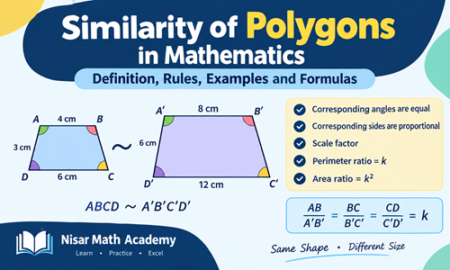
Two polygons are similar when their corresponding angles are equal and their corresponding sides are proportional. In other words, similar polygons have the same shape, but they do not necessarily have the same size.
For example, two squares of different sizes are always similar because all their corresponding angles are equal and their corresponding sides have the same ratio.
In this article, you will learn:
- What similarity of polygons means
- Conditions for two polygons to be similar
- How to identify corresponding sides and angles
- How to find the scale factor
- How to find missing sides of similar polygons
- Worked numerical examples
- Real-life applications of similar polygons
- Common mistakes students make
- Short revision notes
- MCQs and a practice worksheet
What Is Similarity of Polygons?
Two polygons are similar if:
- Their corresponding angles are equal.
- Their corresponding sides are proportional.
The symbol ∼ is used to represent similarity.
For example:
This means that triangle ABC is similar to triangle DEF.
The order of the letters is important. It tells us which vertices correspond:
Therefore:
and
The same idea applies to polygons with four, five, six, or more sides.
Conditions for Similar Polygons
For two polygons to be similar, the following conditions must be satisfied.
1. Corresponding Angles Must Be Equal
Every corresponding angle of one polygon must be equal to the corresponding angle of the other polygon.
For example, if:
then its corresponding angle in the second polygon must also be:
2. Corresponding Sides Must Be Proportional
Corresponding sides must have the same ratio.
Suppose one polygon has corresponding sides:
and another polygon has:
Then:
Therefore, the corresponding sides are proportional.
If their corresponding angles are also equal, the polygons are similar.
What Does the Order of Vertices Mean?
Consider:
The order tells us the correspondence:
| First Polygon | Second Polygon |
|---|---|
| A | W |
| B | X |
| C | Y |
| D | Z |
Therefore:
Writing the vertices in the correct order is important when solving similarity problems.
Scale Factor of Similar Polygons
The scale factor tells us how much one polygon has been enlarged or reduced compared with another.
The formula is:
For example, if a side of the original polygon is 5 cm and the corresponding side of the enlarged polygon is 10 cm:
So the new polygon is twice as large in terms of its corresponding lengths.
Important Point
If the scale factor is:
- Greater than 1 → the figure is enlarged.
- Between 0 and 1 → the figure is reduced.
- Equal to 1 → the two figures have the same size as well as the same shape.
How to Find Similarity of Polygons
To determine whether two polygons are similar, follow these steps.
Step 1: Identify Corresponding Vertices
Determine which vertices of the first polygon correspond to the vertices of the second polygon.
Step 2: Compare Corresponding Angles
Check whether corresponding angles are equal.
Step 3: Compare Corresponding Sides
Calculate the ratios of corresponding sides.
For example:
If all the ratios are equal and the corresponding angles are equal, the polygons are similar.
Step 4: Write the Similarity Statement
For example:
Diagram-Based Explanation
Imagine two rectangles.
The first rectangle has length 6 cm and width 4 cm.
The second rectangle has length 9 cm and width 6 cm.
The side ratios are:
The corresponding angles of both rectangles are right angles:
Therefore, the two rectangles have the same shape and are similar.
A diagram would show the two rectangles with their corresponding vertices labelled in the same order. Arrows or matching labels can be used to show which sides correspond.
Worked Example 1: Are Two Rectangles Similar?
A rectangle has dimensions 8 cm and 5 cm. Another rectangle has dimensions 16 cm and 10 cm. Determine whether the rectangles are similar.
Solution
For the corresponding lengths:
For the corresponding widths:
The ratios are equal.
Both rectangles also have four right angles.
Therefore, the rectangles are similar.
The scale factor is:
Worked Example 2: Finding a Missing Side
Two similar polygons have corresponding sides of 6 cm and 9 cm. Another side of the smaller polygon is 8 cm. Find the corresponding side of the larger polygon.
Solution
The scale factor is:
Let the missing side of the larger polygon be .
Therefore:
Cross-multiply:
Therefore:
Worked Example 3: Checking Whether Two Polygons Are Similar
The corresponding sides of two quadrilaterals are:
First quadrilateral:
Second quadrilateral:
Determine whether their corresponding sides are proportional.
Solution
Calculate the ratios:
All ratios are equal to 2.
Thus, the corresponding sides are proportional.
If the corresponding angles are also equal, the quadrilaterals are similar.
Therefore, based on the side information:
Worked Example 4: Similar Pentagons
Two similar pentagons have a scale factor of 3 from the smaller pentagon to the larger pentagon. One side of the smaller pentagon is 7 cm. Find the corresponding side of the larger pentagon.
Solution
Use:
Therefore:
Hence:
Worked Example 5: Finding a Scale Factor
A corresponding side of one polygon is 12 cm and the corresponding side of a similar polygon is 18 cm. Find the scale factor from the first polygon to the second.
Solution
Therefore:
Properties of Similar Polygons
Similar polygons have several important properties.
Property 1: Corresponding Angles Are Equal
If two polygons are similar:
for each pair of corresponding angles.
Property 2: Corresponding Sides Are Proportional
If two polygons are similar:
and so on for all corresponding sides.
Property 3: Perimeters Have the Same Ratio as Corresponding Sides
If the scale factor is , then:
where and are the perimeters of the similar polygons.
Property 4: Areas Have the Square of the Scale Factor
If two polygons are similar and their linear scale factor is , then:
For example, if the scale factor is 3:
So the larger polygon has 9 times the area.
Similarity and Congruence: What Is the Difference?
Similarity and congruence are related but different concepts.
| Similar Figures | Congruent Figures |
|---|---|
| Same shape | Same shape |
| Size may be different | Same size |
| Corresponding angles are equal | Corresponding angles are equal |
| Corresponding sides are proportional | Corresponding sides are equal |
| Scale factor may be different from 1 | Scale factor is 1 |
Every pair of congruent polygons is also similar, because their corresponding sides have a ratio of 1.
However, similar polygons do not have to be congruent.
Which Polygons Are Similar?
Two polygons can be similar when they have the same shape and satisfy the required angle and side conditions.
Examples include:
- Any two squares are similar.
- Any two equilateral triangles are similar.
- Rectangles with the same length-to-width ratio are similar.
- Regular polygons with the same number of sides are similar.
However, two polygons having the same number of sides does not automatically make them similar.
For example, two rectangles with dimensions 2 cm × 4 cm and 3 cm × 8 cm are not similar because:
but
Their side ratios do not match.
Real-Life Applications of Similar Polygons
Similarity is useful in many practical situations.
Maps and Scale Drawings
Maps use a scale to represent large areas on smaller pieces of paper or screens. The shapes remain proportional.
Architecture
Architects often use scale drawings and models. A model of a building can represent the same shape as the actual building at a smaller scale.
Engineering
Engineers use scaled diagrams and models to represent machines, structures, and components.
Photography and Image Resizing
When an image is resized without distortion, its length and width change proportionally. This is closely related to the idea of similarity.
Design and Manufacturing
Manufacturers use scaled drawings when designing products and components.
Common Mistakes Students Make
Mistake 1: Assuming Same Number of Sides Means Similarity
Two pentagons are not necessarily similar just because both have five sides.
Mistake 2: Matching the Wrong Sides
Always identify corresponding vertices before comparing sides.
Mistake 3: Reversing the Scale Factor
If the question asks for the scale factor from the smaller figure to the larger figure, divide the larger corresponding side by the smaller corresponding side.
Mistake 4: Ignoring Angles
Proportional sides are important, but the appropriate angle conditions must also be considered.
Mistake 5: Confusing Similarity with Congruence
Similar figures may have different sizes. Congruent figures must have the same size and shape.
Mistake 6: Forgetting to Square the Scale Factor for Area
If the linear scale factor is , the area ratio is:
not .
Common Questions Students Ask
How do I know if two polygons are similar?
Check whether their corresponding angles are equal and their corresponding sides are proportional.
Can two polygons be similar but different in size?
Yes. Similar polygons have the same shape but can have different sizes.
Can two rectangles always be similar?
No. Two rectangles are similar only when their corresponding side ratios are equal.
Are all squares similar?
Yes. Every square has four equal sides and four right angles, so any two squares are similar.
Are all triangles similar?
No. Triangles can have different shapes. They must satisfy the appropriate similarity conditions.
Why Learn Similarity of Polygons?
Understanding similarity helps students solve many geometry problems involving:
- Missing side lengths
- Scale factors
- Perimeters
- Areas
- Scale drawings
- Maps
- Models
- Geometric constructions
It also provides an important foundation for more advanced topics in geometry.
Students looking for additional mathematics notes, recorded lectures, assessments, worksheets, and solved questions can explore the learning resources available through Nisar Math Academy.
Conclusion
The similarity of polygons describes the relationship between polygons that have the same shape but may have different sizes. Their corresponding angles are equal, while their corresponding sides are proportional.
The most important relationship to remember is:
If the scale factor is , then:
and:
Learning how to identify corresponding parts and calculate scale factors makes polygon similarity problems much easier.
Short Notes: Similarity of Polygons
- Similar polygons: Polygons having the same shape but not necessarily the same size.
- Corresponding angles of similar polygons are equal.
- Corresponding sides are proportional.
- Similarity symbol:
- If:
then:
- Scale factor:
- Perimeter ratio:
- Area ratio:
- Similar figures can have different sizes.
- Congruent figures have the same size and shape.
- All squares are similar.
- Not all rectangles are similar.
- Having the same number of sides does not automatically mean that two polygons are similar.
MCQs: Similarity of Polygons
1. What does it mean when two polygons are similar?
A. They have the same area
B. They have the same shape but may have different sizes
C. They always have the same perimeter
D. They have different angles
Correct Answer: B
2. What must be true about corresponding angles of similar polygons?
A. They are supplementary
B. They are proportional
C. They are equal
D. They are always acute
Correct Answer: C
3. What must be true about corresponding sides of similar polygons?
A. They must be equal
B. They must be proportional
C. They must be perpendicular
D. They must be parallel
Correct Answer: B
4. What is the scale factor when a side changes from 5 cm to 15 cm?
A. 2
B. 3
C. 5
D. 10
Correct Answer: B
5. If the scale factor between two similar polygons is 4, what is the ratio of their areas?
A. 4
B. 8
C. 12
D. 16
Correct Answer: D
6. If two polygons are congruent, their scale factor is:
A. 0
B. 1
C. 2
D. 10
Correct Answer: B
7. Which statement is true?
A. All rectangles are similar
B. All squares are similar
C. All quadrilaterals are similar
D. All pentagons are similar
Correct Answer: B
8. A polygon has a side of 8 cm. Its corresponding side in a similar polygon is 12 cm. What is the scale factor?
A. 1.2
B. 1.5
C. 2
D. 4
Correct Answer: B
9. If the linear scale factor is 5, the area scale factor is:
A. 5
B. 10
C. 15
D. 25
Correct Answer: D
10. Two rectangles have dimensions 4 cm × 6 cm and 8 cm × 12 cm. Are they similar?
A. Yes
B. No
C. Only if their areas are equal
D. Cannot be determined
Correct Answer: A
11. Which symbol represents similarity?
A. =
B. ≅
C. ∼
D. <
Correct Answer: C
12. Two similar polygons have a scale factor of 2. If the smaller polygon has a perimeter of 18 cm, what is the perimeter of the larger polygon?
A. 9 cm
B. 20 cm
C. 36 cm
D. 40 cm
Correct Answer: C
Worksheet / Assignment: Similarity of Polygons
Part A: Definitions and Concepts
- Define similar polygons.
- State the two main conditions required for two polygons to be similar.
- What is meant by corresponding sides?
- What is a scale factor?
- Explain the difference between similar and congruent polygons.
Part B: Numerical Questions
- Two similar polygons have corresponding sides of 7 cm and 21 cm. Find the scale factor.
- A side of a smaller similar polygon is 9 cm. The corresponding side of the larger polygon is 15 cm. Find the scale factor.
- Two similar polygons have a scale factor of 4. If a side of the smaller polygon is 6 cm, find the corresponding side of the larger polygon.
- Two similar rectangles have dimensions 5 cm × 8 cm and 10 cm × 16 cm. Determine whether they are similar.
- Two similar polygons have a scale factor of 3. If the smaller polygon has a perimeter of 24 cm, find the perimeter of the larger polygon.
- Two similar polygons have a linear scale factor of 2. Find the ratio of their areas.
- A smaller polygon has an area of 30 cm². A similar larger polygon has a scale factor of 3. Find its area.
Part C: Word Problems
- A map is drawn using a scale such that every length in the actual area is represented by one-fifth of its actual length. If a road is 2 km long, what length would represent it on the map using this scale?
- A model building is similar to an actual building. The scale factor from the model to the actual building is 50. If the model is 12 cm tall, find the actual height.
- A designer enlarges a rectangular image so that every length becomes 1.5 times its original length. If the original image has an area of 40 cm², find the new area.
Answer Key
- Polygons having the same shape, with corresponding angles equal and corresponding sides proportional.
- Corresponding angles must be equal and corresponding sides must be proportional.
- Sides that occupy matching positions in two polygons.
- The ratio between corresponding lengths of two similar figures.
- Similar figures have the same shape but may have different sizes; congruent figures have the same shape and size.
Answer: 3
Answer: 5/35/3 or approximately 1.67
Answer: 24 cm
Answer: Yes, they are similar.
Answer: 72 cm
Answer: 4:1
Answer: 270 cm²
Answer: 0.4 km, or 400 m
Answer: 600 cm or 6 m
Answer: 90 cm²
FAQs About Similarity of Polygons
1. What is similarity of polygons?
Similarity of polygons means that two polygons have the same shape, while their sizes may be different. Their corresponding angles are equal and corresponding sides are proportional.
2. How do you find similarity of polygons?
Identify corresponding vertices, compare corresponding angles, and check whether the corresponding side lengths have the same ratio.
3. Which polygons are similar?
Polygons are similar when they have equal corresponding angles and proportional corresponding sides. For example, all squares are similar.
4. Are all rectangles similar?
No. Rectangles are similar only when their corresponding length-to-width ratios are equal.
5. Are similar polygons always the same size?
No. Similar polygons can have different sizes.
6. What happens to the area when a polygon is enlarged?
If the linear scale factor is , the area changes by a factor of:
7. What is the difference between similarity and congruence?
Similar polygons have the same shape but may have different sizes. Congruent polygons have both the same shape and the same size.
8. Why is similarity of polygons important?
Similarity is used to solve problems involving missing lengths, scale drawings, maps, models, areas, perimeters, architecture, engineering, and geometric design.
You May be Interested In:
Logic and Its Application in Mathematics: Statements, Operators, Proofs and Examples
Application of Coordinate Geometry in Real Life Situations: Examples and Uses
What Is Equation of Straight Line? Definition, Forms, Formula and Examples

Leave a Reply