Geometrical Properties of Triangles: Definitions, Formulas & Examples
Introduction
A triangle is one of the most important figures in geometry. It is a closed plane figure made up of three line segments, three vertices, and three angles. Understanding the geometrical properties of triangles is essential for solving many problems in Class 9 Maths and higher-level mathematics.
Triangles are classified according to their sides and angles. They also follow important rules such as the angle sum property, exterior angle property, and relationships between their sides and angles.
In this article, you will learn:
- What a triangle is
- The basic parts of a triangle
- Types of triangles
- Important geometrical properties of triangles
- The angle sum property
- The exterior angle property
- The relationship between sides and angles
- Important formulas
- Step-by-step solved examples
- Common mistakes
- Real-life applications
- Revision notes
- MCQs
- A practice worksheet with answers
These concepts are useful for students preparing Class 9 Maths and for anyone looking for clear online math academy notes.
What Is a Triangle?
A triangle is a closed geometrical figure formed by three line segments.
For example, consider triangle .
It has:
- Three sides: , , and
- Three vertices: , , and
- Three interior angles: , , and
The three angles of a triangle are usually represented as:
The sides opposite these angles are respectively:
- Side is opposite
- Side is opposite
- Side is opposite
Diagram-Based Explanation
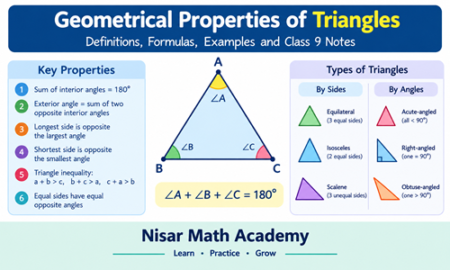
Imagine a triangle drawn with at the top and and at the bottom. The three line segments joining these points form the triangle.
If a diagram is inserted in your notes, label all three vertices and sides clearly. The angles should be marked inside the triangle.
Basic Geometrical Properties of Triangles
The most important geometrical properties of triangles include the following:
- A triangle has three sides.
- A triangle has three vertices.
- A triangle has three interior angles.
- The sum of the three interior angles is .
- The exterior angle of a triangle is equal to the sum of the two opposite interior angles.
- The longest side is opposite the largest angle.
- The shortest side is opposite the smallest angle.
- The sum of the lengths of any two sides is greater than the length of the third side.
- A triangle can be classified according to its sides or angles.
- In an equilateral triangle, all three sides and all three angles are equal.
- In an isosceles triangle, two sides and the angles opposite them are equal.
- A right-angled triangle contains one angle of .
Let us study these properties in detail.
Types of Triangles According to Their Sides
Triangles can be classified into three types according to the lengths of their sides.
1. Equilateral Triangle
An equilateral triangle has all three sides equal.
If:
then is an equilateral triangle.
Each angle of an equilateral triangle is:
Therefore:
Important Properties
- All three sides are equal.
- All three angles are equal.
- Each angle measures .
- It is also an example of an acute triangle.
2. Isosceles Triangle
An isosceles triangle has two equal sides.
For example:
Then triangle is isosceles.
The angles opposite the equal sides are also equal.
Therefore:
This is known as the isosceles triangle property.
3. Scalene Triangle
A scalene triangle has three unequal sides.
For example:
Its three angles are also generally unequal.
Types of Triangles According to Their Angles
Triangles can also be classified according to their angles.
1. Acute-Angled Triangle
A triangle is called an acute-angled triangle if all three angles are less than .
For example:
Since all three angles are less than , the triangle is acute-angled.
2. Right-Angled Triangle
A triangle having one angle equal to is called a right-angled triangle.
For example:
The side opposite the right angle is called the hypotenuse.
The hypotenuse is always the longest side of a right-angled triangle.
3. Obtuse-Angled Triangle
A triangle having one angle greater than is called an obtuse-angled triangle.
For example:
Since one angle is greater than , the triangle is obtuse-angled.
Angle Sum Property of a Triangle
One of the most important geometrical properties of triangles is the angle sum property.
Statement
The sum of the three interior angles of a triangle is .
For triangle :
This property is used frequently to find an unknown angle.
Worked Example 1: Finding an Unknown Angle
Two angles of a triangle are and . Find the third angle.
Solution
Let the third angle be .
Using the angle sum property:
Therefore:
So, the third angle is .
Exterior Angle Property of a Triangle
When one side of a triangle is extended, an exterior angle is formed.
The exterior angle of a triangle is equal to the sum of the two opposite interior angles.
For example, if side of triangle is extended to point , then is an exterior angle.
According to the exterior angle theorem:
Worked Example 2: Exterior Angle
The two opposite interior angles of a triangle are and . Find the exterior angle.
Solution
Using the exterior angle property:
Therefore:
Relationship Between Sides and Angles of a Triangle
There is an important relationship between the sides and angles of a triangle.
Larger Angle and Larger Opposite Side
The larger angle is opposite the longer side.
Similarly:
The smaller angle is opposite the shorter side.
For example, if:
then the side opposite is longer than the side opposite .
In triangle :
means:
Worked Example 3
In triangle :
Which side is the longest?
Solution
The largest angle is:
which is .
The side opposite is .
Therefore:
The smallest angle is , so the side , opposite , is the shortest side.
Equal Sides and Equal Angles
Another important property is:
Equal sides of a triangle have equal opposite angles.
Similarly:
Equal angles of a triangle have equal opposite sides.
For an isosceles triangle:
Therefore, the angles opposite these sides are equal:
This property is particularly useful when solving geometrical problems.
Triangle Inequality Property
The lengths of the sides of a triangle follow the triangle inequality property.
The sum of the lengths of any two sides of a triangle must be greater than the third side.
If the sides are , , and , then:
Worked Example 4: Can Three Lengths Form a Triangle?
Can cm, cm, and cm form a triangle?
Solution
Check all three conditions:
True.
Next:
True.
Finally:
True.
Therefore, these three lengths can form a triangle.
Example 5: Three Lengths That Cannot Form a Triangle
Can cm, cm, and cm form a triangle?
Check:
This is false.
Therefore, these lengths cannot form a triangle.
Properties of a Right-Angled Triangle
A right-angled triangle has one angle equal to .
The side opposite the right angle is called the hypotenuse.
For a right triangle with perpendicular sides and , and hypotenuse , the Pythagorean theorem states:
Worked Example 6: Finding the Hypotenuse
The perpendicular sides of a right-angled triangle are cm and cm. Find the hypotenuse.
Solution
Using Pythagorean theorem:
Taking the positive square root:
Therefore:
Important Properties of an Equilateral Triangle
For an equilateral triangle:
and:
If the side length is , then its perimeter is:
Its area is:
Worked Example 7
Find the perimeter of an equilateral triangle whose side is cm.
Solution
Important Properties of an Isosceles Triangle
An isosceles triangle has two equal sides.
If:
then:
The equal angles are called the base angles.
Worked Example 8
An isosceles triangle has two equal base angles. If one base angle is , find the third angle.
Solution
Since the base angles are equal:
Using the angle sum property:
Therefore:
Perimeter of a Triangle
The perimeter of a triangle is the sum of the lengths of its three sides.
If the sides are , , and :
Example
A triangle has sides cm, cm, and cm.
Area of a Triangle
The basic formula for the area of a triangle is:
where:
- = base
- = perpendicular height
Worked Example 9
Find the area of a triangle with base cm and perpendicular height cm.
Solution
Therefore:
Practical Applications of Triangle Properties
Triangles are not limited to textbook exercises. They are used in many real-life situations.
1. Construction
Triangles are used in roof structures, bridges, towers, and supporting frameworks because triangular arrangements can provide structural stability.
2. Architecture
Architects use triangle shapes and their geometrical relationships when designing buildings, roofs, trusses, and decorative structures.
3. Engineering
Engineers use triangle geometry when designing bridges, machines, frames, and other structures.
4. Land Measurement
Triangle properties are useful in surveying and determining distances and areas of land.
5. Navigation and Mapping
Geometrical relationships involving triangles can be used to calculate distances and positions.
6. Computer Graphics
Triangles are widely used to represent surfaces and shapes in computer graphics and 3D modelling.
Common Questions Students Search For
Which are the geometrical properties of triangles?
Important properties include the angle sum property, exterior angle property, relationships between equal sides and equal angles, relationships between larger sides and larger angles, and the triangle inequality property.
What is the angle sum property of a triangle?
The sum of the three interior angles of every triangle is:
What is the exterior angle property?
An exterior angle of a triangle is equal to the sum of its two opposite interior angles.
What are the three types of triangles according to sides?
They are:
- Equilateral triangle
- Isosceles triangle
- Scalene triangle
What are the three types of triangles according to angles?
They are:
- Acute-angled triangle
- Right-angled triangle
- Obtuse-angled triangle
Which side is opposite the largest angle?
The longest side is opposite the largest angle.
Which side is opposite the smallest angle?
The shortest side is opposite the smallest angle.
Common Mistakes Students Make
Mistake 1: Forgetting that angles add to
Students sometimes use for the angles of a triangle.
Remember:
Mistake 2: Matching a side with the wrong angle
A side is opposite the angle that does not touch that side.
For example, in triangle , side is opposite .
Mistake 3: Confusing equal sides and equal angles
In an isosceles triangle, equal sides have equal opposite angles.
Do not assume that any two angles are equal without a valid reason.
Mistake 4: Ignoring the triangle inequality
Three positive lengths do not necessarily form a triangle. Always check whether the sum of any two sides is greater than the third side.
Mistake 5: Forgetting units for area
Perimeter is measured in units such as cm, while area is measured in square units such as:
Mistake 6: Using the wrong side as the hypotenuse
In a right-angled triangle, the hypotenuse is always opposite the angle.
Quick Revision Table
| Property | Important Result |
|---|---|
| Number of sides | 3 |
| Number of vertices | 3 |
| Sum of interior angles | |
| Exterior angle | Sum of two opposite interior angles |
| Equilateral triangle | Three equal sides |
| Equilateral triangle angles | |
| Isosceles triangle | Two equal sides |
| Scalene triangle | Three unequal sides |
| Right triangle | One angle is |
| Obtuse triangle | One angle is greater than |
| Acute triangle | All angles are less than |
| Longest side | Opposite largest angle |
| Shortest side | Opposite smallest angle |
| Triangle inequality | Sum of any two sides third side |
| Area | |
| Perimeter | |
| Pythagorean theorem |
Short Conclusion
The geometrical properties of triangles form an important part of elementary and Class 9 geometry. The most useful properties to remember are the angle sum property, exterior angle property, relationships between sides and angles, triangle inequality, and the special properties of equilateral, isosceles, scalene, acute, right, and obtuse triangles.
A strong understanding of these properties makes it easier to solve geometry problems involving unknown angles, side lengths, area, perimeter, congruence, similarity, and other related concepts.
Students preparing Class 9 Maths can use these concepts as revision material alongside their textbook, solved questions, assessments, and other Class 9 Maths Notes available through educational resources such as Nisar Math Academy.
Short Notes: Geometrical Properties of Triangles
Definition
A triangle is a closed figure formed by three line segments.
Main Properties
- A triangle has 3 sides, 3 vertices, and 3 angles.
- The sum of its interior angles is .
- An exterior angle equals the sum of the two opposite interior angles.
- The longest side is opposite the largest angle.
- The shortest side is opposite the smallest angle.
- Equal sides have equal opposite angles.
- Equal angles have equal opposite sides.
- The sum of any two sides must be greater than the third side.
Types According to Sides
Equilateral: Three equal sides and three angles.
Isosceles: Two equal sides and two equal opposite angles.
Scalene: All three sides are unequal.
Types According to Angles
Acute: All angles are less than .
Right: One angle is .
Obtuse: One angle is greater than .
Important Formulas
For a right-angled triangle:
For an equilateral triangle:
MCQs: Geometrical Properties of Triangles
1. What is the sum of the three interior angles of a triangle?
A.
B.
C.
D.
Correct Answer: B. 180∘180^\circ
2. A triangle having three equal sides is called:
A. Scalene
B. Isosceles
C. Equilateral
D. Right-angled
Correct Answer: C. Equilateral
3. Each angle of an equilateral triangle is:
A.
B.
C.
D.
Correct Answer: C. 60∘60^\circ
4. A triangle with two equal sides is called:
A. Scalene
B. Isosceles
C. Equilateral
D. Obtuse
Correct Answer: B. Isosceles
5. A triangle with one angle equal to is:
A. Acute
B. Obtuse
C. Right-angled
D. Equilateral
Correct Answer: C. Right-angled
6. If two angles of a triangle are and , the third angle is:
A.
B.
C.
D.
Correct Answer: C. 70∘70^\circ
7. The side opposite the largest angle of a triangle is:
A. The shortest side
B. The longest side
C. Always equal to another side
D. The perpendicular side
Correct Answer: B. The longest side
8. The exterior angle of a triangle is equal to:
A. One interior angle
B. The difference of two interior angles
C. The sum of the two opposite interior angles
D.
Correct Answer: C. The sum of the two opposite interior angles
9. Which of the following can form a triangle?
A.
B.
C.
D.
Correct Answer: C. 4,5,64,5,6
10. The perimeter of a triangle with sides cm, cm, and cm is:
A. cm
B. cm
C. cm
D. cm
Correct Answer: C. 1818 cm
11. The area of a triangle with base cm and height cm is:
A.
B.
C.
D.
Correct Answer: B. 20 cm220\text{ cm}^2
12. If two sides of a triangle are equal, then the angles opposite them are:
A. Supplementary
B. Equal
C. Complementary
D. Unequal
Correct Answer: B. Equal
13. A triangle having all three unequal sides is called:
A. Equilateral
B. Isosceles
C. Scalene
D. Right-angled
Correct Answer: C. Scalene
14. If the angles of a triangle are and , the triangle is:
A. Right-angled
B. Obtuse-angled
C. Acute-angled
D. Equilateral
Correct Answer: C. Acute-angled
15. In a right-angled triangle, the side opposite the angle is called:
A. Base
B. Height
C. Hypotenuse
D. Median
Correct Answer: C. Hypotenuse
Worksheet / Assignment
Part A: Definitions and Concepts
- Define a triangle.
- State the angle sum property of a triangle.
- What is an equilateral triangle?
- What is an isosceles triangle?
- What is a scalene triangle?
- Define a right-angled triangle.
- State the exterior angle property of a triangle.
Part B: Numerical Questions
- Find the third angle of a triangle if two angles are and .
- Find the third angle of a triangle whose two angles are and .
- An isosceles triangle has equal base angles of . Find its third angle.
- Find the perimeter of a triangle whose sides are cm, cm, and cm.
- Find the area of a triangle with base cm and perpendicular height cm.
- The two perpendicular sides of a right-angled triangle are cm and cm. Find the hypotenuse.
Part C: Word and Application Problems
- A triangular garden has sides m, m, and m. Find its perimeter.
- A triangular sign has a base of m and a perpendicular height of m. Find its area.
Answer Key
- A closed figure formed by three line segments.
- The sum of the three interior angles of a triangle is .
- A triangle having three equal sides.
- A triangle having two equal sides.
- A triangle having three unequal sides.
- A triangle having one angle equal to .
- An exterior angle equals the sum of the two opposite interior angles.
- cm
- cm
- m
Frequently Asked Questions
1. What are the geometrical properties of triangles?
The main properties include the angle sum property, exterior angle property, triangle inequality, and relationships between the sides and angles of a triangle.
2. What is the most important property of a triangle?
One of the fundamental properties is that the sum of its three interior angles is always .
3. What are the six types of triangles?
According to sides, triangles are equilateral, isosceles, and scalene. According to angles, they are acute-angled, right-angled, and obtuse-angled.
4. What is the formula for the area of a triangle?
The basic formula is:
where is the base and is the perpendicular height.
5. What is the triangle inequality property?
The sum of the lengths of any two sides of a triangle must be greater than the length of the third side.
6. Which side of a triangle is the longest?
The side opposite the largest angle is the longest side.
7. Are the angles of an equilateral triangle equal?
Yes. Each angle of an equilateral triangle is .
8. What is the difference between an isosceles and an equilateral triangle?
An isosceles triangle has at least two equal sides, while an equilateral triangle has all three sides equal.
Final Revision
For Class 9 Maths, remember these key facts:
These basic geometric properties of triangles provide a strong foundation for further topics in geometry, including congruent triangles, similar triangles, trigonometry, and coordinate geometry.
You May be Interested In:
Properties of Polygon: Definitions, Angle Properties, Formulas and Examples
How to Find Area of Similar Figures: Formula, Examples, Notes & Worksheet
What Is Similarity of Quadrilaterals? Definition, Properties, Criteria, Examples and Notes
Leave a Reply