Properties of Polygon: Definitions, Angle Properties, Formulas and Examples
Introduction
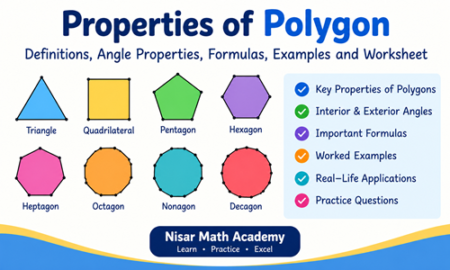
A polygon is a closed two-dimensional shape made up of three or more straight line segments. Triangles, quadrilaterals, pentagons, hexagons, and octagons are all examples of polygons.
Understanding the properties of polygon is important because polygon questions often involve the number of sides, interior angles, exterior angles, regular and irregular polygons, and the relationship between their sides and angles.
In this article, you will learn:
- What a polygon is
- The basic properties of polygons
- Types of polygons according to the number of sides
- Regular and irregular polygons
- Convex and concave polygons
- Interior and exterior angles
- Formulas for finding angle sums
- Step-by-step solved examples
- Properties of irregular polygons
- Common angle properties of polygons questions
- Real-life applications
- Common mistakes
- Revision notes
- MCQs and a practice worksheet
What Is a Polygon?
A polygon is a closed plane figure formed by three or more straight line segments.
The line segments are called sides, and the points where two sides meet are called vertices.
For example, a triangle has:
- 3 sides
- 3 vertices
- 3 interior angles
A quadrilateral has:
- 4 sides
- 4 vertices
- 4 interior angles
Important Properties of a Polygon
Every polygon has the following basic features:
- It is a closed figure.
- It has at least three sides.
- Its sides are straight line segments.
- Two sides meet at a vertex.
- The number of vertices is equal to the number of sides.
- It has interior angles.
- It may have exterior angles.
- It can be regular or irregular.
- It can be convex or concave.
Names of Polygons According to the Number of Sides
Polygons are commonly named according to their number of sides.
| Number of sides | Name |
|---|---|
| 3 | Triangle |
| 4 | Quadrilateral |
| 5 | Pentagon |
| 6 | Hexagon |
| 7 | Heptagon |
| 8 | Octagon |
| 9 | Nonagon |
| 10 | Decagon |
| 11 | Undecagon |
| 12 | Dodecagon |
For example, a polygon with 8 sides is called an octagon.
Regular and Irregular Polygons
Polygons can be classified according to whether their sides and angles are equal.
Regular Polygon
A regular polygon has:
- All sides equal
- All interior angles equal
- All exterior angles equal
Examples include a square and an equilateral triangle.
A regular pentagon is a five-sided polygon in which all five sides and all five interior angles are equal.
Irregular Polygon
An irregular polygon does not have all sides and angles equal.
For example, a quadrilateral with sides of different lengths is generally an irregular polygon.
The properties of irregular polygon still follow the general polygon angle formulas. However, individual interior angles do not have to be equal.
For an irregular polygon, the sum of the interior angles is still:
where is the number of sides.
Convex and Concave Polygons
Another way to classify polygons is according to their shape.
Convex Polygon
A polygon is convex if all of its interior angles are less than .
A line segment joining any two points inside a convex polygon remains inside the polygon.
Concave Polygon
A polygon is concave if at least one interior angle is greater than .
A concave polygon has an inward indentation.
Simple Comparison
| Feature | Convex Polygon | Concave Polygon |
|---|---|---|
| Interior angles | All less than | At least one greater than |
| Indentation | No | Yes |
| General shape | Bulges outward | Has an inward part |
Interior Angles of a Polygon
An interior angle is an angle formed inside a polygon by two adjacent sides.
The sum of the interior angles of a polygon depends on its number of sides.
Formula for the Sum of Interior Angles
For a polygon with sides:
This is one of the most important formulas in polygon questions.
Why Does the Formula Work?
A polygon can be divided into triangles by drawing diagonals from one vertex.
A polygon with sides can be divided into:
triangles.
Since each triangle has an angle sum of :
Interior Angle of a Regular Polygon
For a regular polygon, all interior angles are equal.
Therefore:
where is the number of sides.
Example: Interior Angle of a Regular Pentagon
A pentagon has:
Therefore:
So each interior angle of a regular pentagon is:
Exterior Angles of a Polygon
An exterior angle is formed when one side of a polygon is extended.
For a convex polygon, an interior angle and its corresponding exterior angle form a straight line.
Therefore:
So:
Sum of Exterior Angles
The sum of one exterior angle at each vertex of any convex polygon is:
This is an important property of polygons.
Exterior Angle of a Regular Polygon
Since all exterior angles of a regular polygon are equal:
where is the number of sides.
Example: Exterior Angle of a Regular Hexagon
A hexagon has:
Therefore:
So each exterior angle is:
The corresponding interior angle is:
Therefore:
Relationship Between Interior and Exterior Angles
For a regular polygon:
For example, if an exterior angle is :
Worked Examples
Example 1: Find the Sum of Interior Angles of a Hexagon
A hexagon has 6 sides.
Use:
Substitute :
Answer:
Example 2: Find the Sum of Interior Angles of a Decagon
A decagon has 10 sides.
Answer:
Example 3: Find Each Interior Angle of a Regular Octagon
An octagon has 8 sides.
First find the sum:
Since the octagon is regular, divide by 8:
Answer:
Example 4: Find Each Exterior Angle of a Regular Decagon
A decagon has 10 sides.
Use:
Therefore:
Answer:
Example 5: Find the Number of Sides When Each Exterior Angle Is
For a regular polygon:
Given:
Multiply both sides by :
Therefore:
Answer: The polygon has:
It is a regular dodecagon.
Example 6: Find an Unknown Interior Angle
The interior angles of a pentagon are:
Find .
The sum of the interior angles of a pentagon is:
Therefore:
Add the known angles:
Thus:
Answer:
Angle Properties of Polygons Questions
Students are often asked questions such as:
- Find the sum of the interior angles of a polygon.
- Find an unknown interior angle.
- Find each interior angle of a regular polygon.
- Find each exterior angle of a regular polygon.
- Find the number of sides when an exterior angle is given.
- Find the number of sides when an interior angle is given.
- Determine whether a polygon is regular or irregular.
- Find missing angles using the angle sum of a polygon.
Example: Finding the Number of Sides from an Interior Angle
Suppose each interior angle of a regular polygon is .
The exterior angle is:
Now:
Therefore, the polygon has:
Diagonals of a Polygon
A diagonal is a line segment joining two non-adjacent vertices of a polygon.
The number of diagonals in an -sided polygon is:
Example: Number of Diagonals in a Hexagon
For a hexagon:
Therefore:
So a hexagon has:
Important Polygon Formulas
| Quantity | Formula |
|---|---|
| Sum of interior angles | |
| Each interior angle of a regular polygon | |
| Sum of exterior angles | |
| Each exterior angle of a regular polygon | |
| Interior + exterior angle | |
| Number of diagonals |
Here represents the number of sides.
Properties of Common Polygons
Triangle
A triangle has:
- 3 sides
- 3 vertices
- Interior angle sum
Quadrilateral
A quadrilateral has:
- 4 sides
- 4 vertices
- Interior angle sum
Pentagon
A pentagon has:
- 5 sides
- 5 vertices
- Interior angle sum
Hexagon
A hexagon has:
- 6 sides
- 6 vertices
- Interior angle sum
Octagon
An octagon has:
- 8 sides
- 8 vertices
- Interior angle sum
Practical Applications of Polygons
Polygons are found in many real-life objects and designs.
Examples include:
- Floor tiles
- Road signs
- Building designs
- Window frames
- Architectural structures
- Computer graphics
- Engineering drawings
- Maps
- Decorative patterns
For example, a STOP road sign is commonly designed as an octagon. Floor tiles may be square, rectangular, hexagonal, or other polygonal shapes.
Understanding polygon properties helps students analyze these shapes mathematically.
Common Mistakes Students Make
1. Using the wrong formula
Students sometimes use:
when they actually need each angle of a regular polygon.
Remember:
2. Forgetting that regular polygons have equal angles
The formula for each interior angle applies directly when the polygon is regular.
An irregular polygon can have different interior angles.
3. Confusing interior and exterior angles
For a convex polygon:
4. Forgetting that exterior angles add to
For one exterior angle at each vertex:
5. Confusing the number of sides with the number of angles
A polygon with sides also has vertices and interior angles.
Quick Revision Table
| Polygon | Sides | Interior Angle Sum |
|---|---|---|
| Triangle | 3 | |
| Quadrilateral | 4 | |
| Pentagon | 5 | |
| Hexagon | 6 | |
| Heptagon | 7 | |
| Octagon | 8 | |
| Nonagon | 9 | |
| Decagon | 10 |
How to Solve Polygon Angle Problems
Use the following method:
Step 1: Identify the number of sides.
Step 2: Decide whether the polygon is regular or irregular.
Step 3: Choose the appropriate formula.
For the interior angle sum:
For each interior angle of a regular polygon:
For each exterior angle of a regular polygon:
Step 4: Substitute the values.
Step 5: Simplify the calculation.
Step 6: Check whether the answer is reasonable.
Students looking for additional mathematics notes, recorded lectures, assessments, lesson plans, and worksheets can also explore the learning resources available at Nisar Math Academy.
Conclusion
The properties of polygons provide the foundation for solving many geometry problems. The most important ideas are the number of sides, vertices, interior angles, exterior angles, regular and irregular polygons, and the formulas connecting these quantities.
Remember these key formulas:
With these formulas and a clear understanding of regular and irregular polygons, students can solve most basic polygon angle problems systematically.
Short Notes: Properties of Polygons
- A polygon is a closed plane figure made from straight line segments.
- A polygon has at least 3 sides.
- The number of sides = number of vertices = number of interior angles.
- A regular polygon has all sides and all interior angles equal.
- An irregular polygon does not have all sides and angles equal.
- A convex polygon has all interior angles less than .
- A concave polygon has at least one interior angle greater than .
Important Formulas
Interior angle sum:
Each interior angle of a regular polygon:
Sum of exterior angles:
Each exterior angle of a regular polygon:
Interior + exterior angle:
Number of diagonals:
MCQs: Properties of Polygon
1. What is a polygon?
A. A closed figure made only of curved lines
B. A closed figure made of straight line segments
C. An open curved figure
D. A three-dimensional solid
Correct Answer: B
2. What is the sum of the interior angles of a pentagon?
A.
B.
C.
D.
Correct Answer: C
3. How many sides does a hexagon have?
A. 5
B. 6
C. 7
D. 8
Correct Answer: B
4. What is the sum of the exterior angles of a convex polygon?
A.
B.
C.
D.
Correct Answer: C
5. What is each interior angle of a regular hexagon?
A.
B.
C.
D.
Correct Answer: C
6. What is each exterior angle of a regular octagon?
A.
B.
C.
D.
Correct Answer: B
7. Which polygon has 10 sides?
A. Nonagon
B. Octagon
C. Decagon
D. Dodecagon
Correct Answer: C
8. What is the formula for the sum of the interior angles of an -sided polygon?
A.
B.
C.
D.
Correct Answer: B
9. If each exterior angle of a regular polygon is , how many sides does it have?
A. 8
B. 9
C. 10
D. 12
Correct Answer: C
10. What is each interior angle of a regular pentagon?
A.
B.
C.
D.
Correct Answer: B
11. Which of the following is a regular polygon?
A. A square
B. An arbitrary rectangle
C. An irregular quadrilateral
D. A general trapezium
Correct Answer: A
12. What is the sum of the interior angles of an octagon?
A.
B.
C.
D.
Correct Answer: C
13. A polygon with one interior angle greater than is called:
A. Regular
B. Convex
C. Concave
D. Equilateral
Correct Answer: C
14. How many diagonals does a hexagon have?
A. 6
B. 8
C. 9
D. 12
Correct Answer: C
15. If an interior angle of a convex polygon is , what is the corresponding exterior angle?
A.
B.
C.
D.
Correct Answer: B
Worksheet / Assignment: Properties of Polygons
Part A: Definitions and Concepts
- Define a polygon.
- What is meant by a regular polygon?
- What is an irregular polygon?
- What is the difference between a convex polygon and a concave polygon?
- How many sides and vertices does a nonagon have?
Part B: Formula-Based Questions
- Find the sum of the interior angles of a heptagon.
- Find the sum of the interior angles of a decagon.
- Find each interior angle of a regular octagon.
- Find each exterior angle of a regular pentagon.
- A regular polygon has each exterior angle equal to . Find the number of sides.
Part C: Numerical and Word Problems
- The interior angles of a quadrilateral are , , , and . Find .
- Each interior angle of a regular polygon is . Find the number of sides.
- A regular polygon has 15 sides. Find each exterior angle.
- Find the number of diagonals in an octagon.
- The interior angles of a pentagon are , , , , and . Find .
Frequently Asked Questions
1. What are the properties of a polygon?
A polygon is a closed figure made from straight line segments. It has at least three sides, and its number of sides equals its number of vertices and interior angles.
2. What is the formula for the interior angles of a polygon?
The sum of the interior angles of an -sided polygon is:
3. What is the angle sum of a polygon?
For an -sided polygon, the interior angle sum is:
4. What is the sum of exterior angles of a polygon?
The sum of one exterior angle at each vertex of a convex polygon is:
5. How do you find each interior angle of a regular polygon?
Use:
where is the number of sides.
6. What is the difference between a regular and irregular polygon?
A regular polygon has equal sides and equal interior angles. An irregular polygon does not have all sides and angles equal.
7. How do you find the number of sides from an exterior angle?
For a regular polygon:
8. How many diagonals does an -sided polygon have?
The number of diagonals is:
You May be Interested In:
How to Find Area of Similar Figures: Formula, Examples, Notes & Worksheet
What Is Similarity of Quadrilaterals? Definition, Properties, Criteria, Examples and Notes
What Are Similar Triangles? Definition, Properties, Formulas, Examples and Notes

Leave a Reply