What Is Equation of Straight Line? Definition, Forms, Formula and Examples
Introduction
The equation of straight line is an important topic in coordinate geometry. A straight line can be represented on the Cartesian plane by using an algebraic equation. This equation gives us a mathematical relationship between the coordinates of every point lying on the line.
In simple words, the equation of a straight line is a mathematical statement that represents all the points through which a particular straight line passes.
The concept of straight lines is useful in mathematics, physics, engineering, economics, and many other fields.
What Is a Straight Line?
A straight line is a set of points extending indefinitely in both directions. On a Cartesian plane, a straight line can be represented using the coordinates of its points.
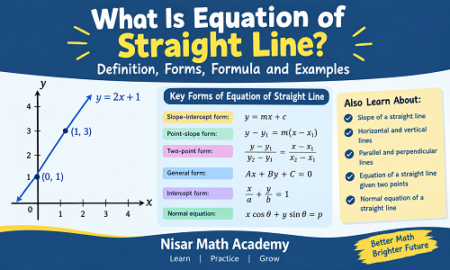
For example, the equation
y = 2x + 1
represents a straight line.
For different values of x, we can calculate the corresponding values of y. The resulting ordered pairs will lie on the same straight line.
For example:
If x = 0,
y = 2(0) + 1 = 1
So, one point is (0, 1).
If x = 1,
y = 2(1) + 1 = 3
So, another point is (1, 3).
These points lie on the straight line represented by y = 2x + 1.
What Is the Equation of Straight Line?
The equation of straight line is an algebraic equation that represents a straight line on the coordinate plane.
One of the most commonly used forms is:
y = mx + c
where:
- m = slope or gradient of the line
- c = y-intercept
- x = x-coordinate
- y = y-coordinate
The slope tells us how steeply the line rises or falls, while the y-intercept tells us the point where the line crosses the y-axis.
Slope of a Straight Line
The slope of a straight line is the ratio of the change in y-coordinate to the change in x-coordinate.
If two points on a line are:
(x₁, y₁) and (x₂, y₂)
then the slope is:
m = (y₂ − y₁) / (x₂ − x₁)
A positive slope means that the line generally rises from left to right.
A negative slope means that the line generally falls from left to right.
A horizontal line has slope zero.
A vertical line has an undefined slope.
Slope-Intercept Form of a Straight Line
The most familiar form of the equation of a straight line is:
y = mx + c
This is called the slope-intercept form.
Here:
m = slope
and
c = y-intercept
Example
Find the equation of a straight line with slope 3 and y-intercept 2.
Using:
y = mx + c
Put m = 3 and c = 2:
y = 3x + 2
Therefore, the required equation is:
y = 3x + 2
Point-Slope Form of Straight Line
If the slope of a line and one point on the line are known, we can use the point-slope form.
The formula is:
y − y₁ = m(x − x₁)
where:
- m is the slope
- (x₁, y₁) is a known point on the line
Example
Find the equation of a line passing through the point (2, 3) with slope 4.
Using:
y − y₁ = m(x − x₁)
Substitute:
m = 4
x₁ = 2
y₁ = 3
Therefore:
y − 3 = 4(x − 2)
Expanding:
y − 3 = 4x − 8
Therefore:
y = 4x − 5
Hence, the equation of the straight line is:
y = 4x − 5
Equation of Straight Line Given Two Points
Sometimes the slope is not directly given. Instead, two points on the line are given.
Suppose the two points are:
(x₁, y₁) and (x₂, y₂)
First, find the slope:
m = (y₂ − y₁) / (x₂ − x₁)
Then use the point-slope formula:
y − y₁ = m(x − x₁)
This gives the equation of the straight line given two points.
Example
Find the equation of a straight line passing through the points (1, 2) and (3, 6).
First find the slope:
m = (6 − 2) / (3 − 1)
m = 4 / 2
m = 2
Now use the point-slope form:
y − 2 = 2(x − 1)
Expand:
y − 2 = 2x − 2
Therefore:
y = 2x
Hence, the equation of the straight line is:
y = 2x
General Form of the Equation of a Straight Line
A straight line can also be written in general form as:
Ax + By + C = 0
where A, B and C are constants and A and B are not both zero.
For example:
2x + 3y − 6 = 0
is the general form of the equation of a straight line.
Converting to Slope-Intercept Form
Consider:
2x + 3y − 6 = 0
Move 2x and −6:
3y = −2x + 6
Divide by 3:
y = −(2/3)x + 2
Therefore:
m = −2/3
and
c = 2
Horizontal Straight Line
A horizontal straight line is parallel to the x-axis.
Its equation has the form:
y = k
where k is a constant.
For example:
y = 4
represents a horizontal line passing through y = 4.
Its slope is:
m = 0
Vertical Straight Line
A vertical straight line is parallel to the y-axis.
Its equation has the form:
x = k
where k is a constant.
For example:
x = 5
represents a vertical line passing through x = 5.
The slope of a vertical line is undefined because the change in x is zero.
Normal Equation of Straight Line
Another important form is the normal equation of straight line.
It is written as:
x cos θ + y sin θ = p
where:
- p is the perpendicular distance of the line from the origin.
- θ is the angle made by the perpendicular from the origin with the positive direction of the x-axis.
This form is particularly useful when the perpendicular distance from the origin and the direction of the normal are known.
Intercept Form of Straight Line
If a line cuts the x-axis at a point with x-coordinate a and the y-axis at a point with y-coordinate b, its intercept form is:
x/a + y/b = 1
where:
- a = x-intercept
- b = y-intercept
Example
Find the equation of a line whose x-intercept is 4 and y-intercept is 6.
Using:
x/a + y/b = 1
Put a = 4 and b = 6:
x/4 + y/6 = 1
This is the required equation.
Two-Point Form
The two-point form of the equation of a straight line is:
(y − y₁)/(y₂ − y₁) = (x − x₁)/(x₂ − x₁)
This form is used when two points through which the line passes are known.
For example, if a line passes through:
(x₁, y₁) and (x₂, y₂)
then the above formula can be used directly to obtain its equation.
How to Find the Equation of a Straight Line
The method depends on the information given.
Case 1: Slope and y-intercept are given
Use:
y = mx + c
Case 2: Slope and one point are given
Use:
y − y₁ = m(x − x₁)
Case 3: Two points are given
First calculate:
m = (y₂ − y₁)/(x₂ − x₁)
Then use:
y − y₁ = m(x − x₁)
Case 4: x-intercept and y-intercept are given
Use:
x/a + y/b = 1
Case 5: Perpendicular distance and angle are given
Use the normal equation:
x cos θ + y sin θ = p
Worked Example
Find the equation of the straight line passing through (2, 5) and (4, 9).
Step 1: Find the slope
m = (9 − 5)/(4 − 2)
m = 4/2
m = 2
Step 2: Use the point-slope form
Using the point (2, 5):
y − 5 = 2(x − 2)
Step 3: Simplify
y − 5 = 2x − 4
Therefore:
y = 2x + 1
Hence, the equation of the straight line is:
y = 2x + 1
Parallel Straight Lines
Two straight lines are parallel when they have the same slope but different intercepts.
For example:
y = 2x + 3
and
y = 2x − 5
both have slope 2. Therefore, they are parallel.
Perpendicular Straight Lines
Two non-vertical straight lines are perpendicular when the product of their slopes is −1.
If the slopes are m₁ and m₂, then:
m₁m₂ = −1
For example, if one line has slope 2, the slope of a perpendicular line is:
−1/2
because:
2 × (−1/2) = −1
Importance of the Equation of Straight Line
The equation of a straight line helps us:
- Represent straight lines algebraically.
- Find points lying on a line.
- Determine the slope of a line.
- Find x- and y-intercepts.
- Determine whether two lines are parallel.
- Determine whether two lines are perpendicular.
- Solve coordinate geometry problems.
- Represent relationships between two variables.
Common Mistakes Students Should Avoid
Students often make the following mistakes while solving problems involving straight lines:
- Using the wrong coordinates while calculating the slope.
- Interchanging x-coordinates and y-coordinates.
- Forgetting the negative sign in the slope formula.
- Using the slope-intercept formula when the required information is better suited to point-slope form.
- Making algebraic errors while simplifying the equation.
- Confusing a horizontal line with a vertical line.
- Forgetting that a vertical line has an undefined slope.
- Using the wrong intercept in the intercept form.
Quick Formula Table
Slope:
m = (y₂ − y₁)/(x₂ − x₁)
Slope-intercept form:
y = mx + c
Point-slope form:
y − y₁ = m(x − x₁)
Two-point form:
(y − y₁)/(y₂ − y₁) = (x − x₁)/(x₂ − x₁)
General form:
Ax + By + C = 0
Intercept form:
x/a + y/b = 1
Normal equation:
x cos θ + y sin θ = p
Horizontal line:
y = k
Vertical line:
x = k
Short Notes on Equation of Straight Line
The equation of straight line is an algebraic equation that represents a straight line on the Cartesian plane.
The most common form is:
y = mx + c
Here m represents the slope and c represents the y-intercept.
The slope of a line passing through two points (x₁, y₁) and (x₂, y₂) is:
m = (y₂ − y₁)/(x₂ − x₁)
If slope and one point are known, use:
y − y₁ = m(x − x₁)
If two points are given, first find the slope and then use the point-slope formula.
The general form is:
Ax + By + C = 0
The intercept form is:
x/a + y/b = 1
The normal equation is:
x cos θ + y sin θ = p
A horizontal line has the equation y = k, while a vertical line has the equation x = k.
Parallel lines have equal slopes, while perpendicular lines have slopes whose product is −1.
MCQs on Equation of Straight Line
MCQ 1
Which is the slope-intercept form of a straight line?
A. Ax + By + C = 0
B. y = mx + c
C. x = a
D. x/a + y/b = 0
Answer: B. y = mx + c
MCQ 2
In y = mx + c, what does m represent?
A. x-intercept
B. y-intercept
C. slope
D. constant only
Answer: C. slope
MCQ 3
What is the slope of a horizontal line?
A. 1
B. −1
C. 0
D. Undefined
Answer: C. 0
MCQ 4
What is the slope of a vertical line?
A. 0
B. 1
C. −1
D. Undefined
Answer: D. Undefined
MCQ 5
Which formula gives the slope through two points?
A. (x₂ − x₁)/(y₂ − y₁)
B. (y₂ − y₁)/(x₂ − x₁)
C. x + y
D. xy
Answer: B. (y₂ − y₁)/(x₂ − x₁)
MCQ 6
What is the equation of a horizontal line passing through y = 5?
A. x = 5
B. y = 5
C. y = x + 5
D. x + y = 5
Answer: B. y = 5
MCQ 7
What is the equation of a vertical line passing through x = 3?
A. y = 3
B. x = 3
C. y = 3x
D. x + y = 3
Answer: B. x = 3
MCQ 8
Which is the point-slope form?
A. y = mx + c
B. Ax + By + C = 0
C. y − y₁ = m(x − x₁)
D. x = k
Answer: C. y − y₁ = m(x − x₁)
MCQ 9
If two lines have equal slopes, they are generally:
A. Perpendicular
B. Parallel
C. Vertical
D. Horizontal only
Answer: B. Parallel
MCQ 10
The general form of a straight line is:
A. Ax + By + C = 0
B. y = x²
C. xy = c
D. x² + y² = r²
Answer: A. Ax + By + C = 0
Worksheet / Assignment
Part A: Basic Questions
- Define the equation of a straight line.
- Write the slope-intercept form of a straight line.
- What does m represent in y = mx + c?
- What does c represent in y = mx + c?
- Write the formula for finding the slope of a line through two points.
- Write the general form of the equation of a straight line.
- Write the equation of a horizontal line passing through y = 7.
- Write the equation of a vertical line passing through x = −4.
Part B: Find the Equation
- Find the equation of a line with slope 2 and y-intercept 3.
- Find the equation of a line with slope −3 and y-intercept 5.
- Find the equation of a line passing through (1, 2) with slope 4.
- Find the equation of a line passing through (2, 3) with slope −2.
- Find the equation of the line passing through (1, 2) and (3, 6).
- Find the equation of the line passing through (2, 5) and (4, 9).
- Find the equation of a line whose x-intercept is 4 and y-intercept is 6.
Part C: Conceptual Questions
- What is the difference between a horizontal and a vertical line?
- What is the slope of a horizontal line?
- Why is the slope of a vertical line undefined?
- When are two straight lines parallel?
- What is the condition for two non-vertical straight lines to be perpendicular?
Challenge Question
- A straight line passes through the points (−2, 3) and (4, −9). Find its slope and equation.
Answers to Selected Worksheet Questions
Q9: y = 2x + 3
Q10: y = −3x + 5
Q11: y = 4x − 2
Q12: y = −2x + 7
Q13: y = 2x
Q14: y = 2x + 1
Q15: x/4 + y/6 = 1
Q21: Slope = −2; equation: y = −2x − 1
Conclusion
The equation of straight line is one of the fundamental concepts of coordinate geometry. By understanding slope, intercepts, and different forms of a straight-line equation, students can solve a wide range of mathematical problems.
The most important forms to remember are the slope-intercept form, point-slope form, two-point form, general form, intercept form, and normal equation. Students should also understand the equations of horizontal and vertical lines and the conditions for parallel and perpendicular lines.
For more mathematics notes, recorded lectures, assessments, lesson plans, and educational resources, students can explore Nisar Math Academy. Free learning resources are also available for students, while complete courses and additional resources are available through website membership.
You May be Interested In:
What is Distance Formula and How to Apply It in Mathematics?
What Is Coordinate Plane? Definition, Axes, Quadrants, Examples & Notes
Angle of Elevation and Angle of Depression: Definition, Formulas, Examples and Questions

Leave a Reply