Angle of Elevation and Angle of Depression: Definition, Formulas, Examples and Questions
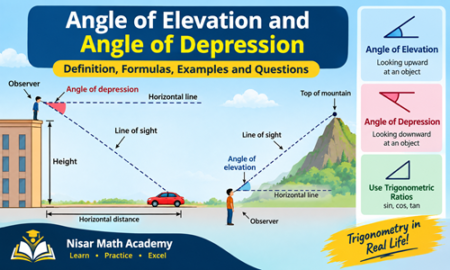
Understanding the angle of elevation and angle of depression is an important part of trigonometry. These angles are commonly used to solve problems involving the height and distance of objects such as buildings, towers, trees, mountains, and airplanes.
In this article, we will learn the angle of elevation and depression definition, their differences, formulas, examples, and how to solve angle of elevation and depression questions step by step.
What Is an Angle of Elevation?
The angle of elevation is the angle formed between the horizontal line through the observer’s eye and the line of sight when the observer looks upward at an object.
Definition of Angle of Elevation
If an object is above the horizontal level of an observer, the angle made by the line of sight with the horizontal line is called the angle of elevation.
In simple words:
When we look upward at an object, the angle between our horizontal line and our line of sight is called the angle of elevation.
For example, suppose a student is standing on the ground and looking at the top of a building. The angle between the horizontal line from the student’s eye and the line joining the student’s eye to the top of the building is the angle of elevation.
What Is an Angle of Depression?
The angle of depression is the angle formed between the horizontal line through the observer’s eye and the line of sight when the observer looks downward at an object.
Definition of Angle of Depression
If an object is below the horizontal level of an observer, the angle made by the line of sight with the horizontal line is called the angle of depression.
In simple words:
When we look downward at an object, the angle between our horizontal line and our line of sight is called the angle of depression.
For example, a person standing on the roof of a building and looking down at a car on the road observes the car at an angle of depression.
Angle of Elevation and Depression Definition
The main difference can be understood easily:
- Angle of elevation: We look upward at an object.
- Angle of depression: We look downward at an object.
Both angles are measured from a horizontal line.
Angle of Elevation vs Angle of Depression
| Angle of Elevation | Angle of Depression |
|---|---|
| The object is above the observer. | The object is below the observer. |
| The observer looks upward. | The observer looks downward. |
| The angle is measured upward from the horizontal. | The angle is measured downward from the horizontal. |
| It is commonly used to find the height of an object. | It is commonly used to find the distance or height of an object below the observer. |
Important Terms
To solve problems involving the angle of elevation and depression, we should understand the following terms.
Observer
The person or point from which an object is being viewed is called the observer.
Line of Sight
The straight line joining the observer’s eye to the object being observed is called the line of sight.
Horizontal Line
A line parallel to the ground passing through the observer’s eye is called the horizontal line.
Vertical Line
A line perpendicular to the horizontal line is called a vertical line.
Angle of Elevation
The angle between the horizontal line and the line of sight when the object is above the observer.
Angle of Depression
The angle between the horizontal line and the line of sight when the object is below the observer.
Why Are Angles of Elevation and Depression Important?
Angles of elevation and depression have many practical applications. They can be used to calculate:
- The height of a building
- The height of a tower
- The height of a tree
- The distance between two objects
- The height of a mountain
- The distance of an airplane from an observer
- The distance of a ship from a lighthouse
- The height or position of an object viewed from an elevated point
These problems are usually solved by forming a right-angled triangle and applying trigonometric ratios.
Angle of Elevation Formula
Most angle of elevation problems involve a right triangle. Depending on the information given, we can use sine, cosine, or tangent.
For example, if:
- Opposite side = height of object
- Adjacent side = horizontal distance
then tangent is usually the most convenient ratio.
tan θ = Opposite / Adjacent
Therefore:
Height = Distance × tan θ
and
Distance = Height / tan θ
Here, θ represents the angle of elevation.
Angle of Depression Formula
Angle of depression problems are also solved using trigonometric ratios.
If the vertical height and horizontal distance form the opposite and adjacent sides of a right triangle, respectively, then:
tan θ = Height / Horizontal Distance
Therefore:
Height = Horizontal Distance × tan θ
and
Horizontal Distance = Height / tan θ
The appropriate trigonometric ratio should always be selected according to the sides that are known and unknown.
Relation Between Angle of Elevation and Angle of Depression
A very important concept is that an angle of elevation and an angle of depression can be equal when they are formed by two parallel horizontal lines and the same line of sight.
For example, suppose an observer is standing on the top of a building and looking down at a person on the ground. The angle of depression at the observer and the corresponding angle of elevation at the person are equal because the horizontal lines are parallel.
Thus:
Angle of depression = Corresponding angle of elevation
This relationship is often used to solve trigonometric problems.
How to Solve Angle of Elevation and Depression Questions
Follow these steps:
Step 1: Draw a Diagram
Draw a simple diagram showing the observer, object, horizontal line, vertical height, and line of sight.
Step 2: Identify the Right Triangle
Most problems involving these angles can be represented by a right-angled triangle.
Step 3: Mark the Given Information
Write down the given height, distance, or angle.
Step 4: Identify the Unknown Quantity
Determine whether you need to find the height, horizontal distance, or angle.
Step 5: Select the Correct Trigonometric Ratio
Use:
sin θ = Opposite / Hypotenuse
cos θ = Adjacent / Hypotenuse
tan θ = Opposite / Adjacent
Step 6: Substitute the Values
Put the known values into the selected formula.
Step 7: Calculate the Answer
Solve the equation and write the answer with the correct unit.
Example 1: Finding the Height Using Angle of Elevation
A student stands 20 m away from a tower. The angle of elevation of the top of the tower is 30°. Find the height of the tower.
Solution
Given:
Horizontal distance = 20 m
Angle of elevation = 30°
Let the height of the tower be h.
Using tangent:
tan 30° = h / 20
Since:
tan 30° = 1/√3
Therefore:
1/√3 = h/20
So:
h = 20/√3
Rationalizing:
h = 20√3/3 m
Therefore, the height of the tower is approximately:
11.55 m
Example 2: Finding the Distance
A tower is 15 m high. The angle of elevation of its top from a point on the ground is 45°. Find the distance of the point from the foot of the tower.
Solution
Given:
Height = 15 m
Angle of elevation = 45°
Let the horizontal distance be d.
Using tangent:
tan 45° = 15/d
Since:
tan 45° = 1
Therefore:
1 = 15/d
So:
d = 15 m
Therefore, the required distance is 15 m.
Example 3: Angle of Depression
A person standing on the top of a 20 m high building observes a car on the road. The angle of depression is 45°. Find the horizontal distance of the car from the building.
Solution
Given:
Height = 20 m
Angle of depression = 45°
The corresponding angle of elevation from the car is also 45°.
Let the horizontal distance be d.
Using tangent:
tan 45° = 20/d
Since:
tan 45° = 1
Therefore:
1 = 20/d
So:
d = 20 m
Therefore, the car is 20 m from the foot of the building.
Important Points to Remember
- The angle of elevation is formed when we look upward.
- The angle of depression is formed when we look downward.
- Both angles are measured from a horizontal line.
- The line joining the observer to the object is called the line of sight.
- A right-angled triangle is commonly formed in these problems.
- Tangent is frequently used when height and horizontal distance are involved.
- Corresponding angles of elevation and depression are equal when the horizontal lines are parallel.
- Always draw a diagram before solving a word problem.
- Keep the units consistent.
- Use a calculator carefully when the angle does not have a simple trigonometric value.
Short Notes on Angle of Elevation and Depression
Angle of Elevation
The angle between the horizontal line and the line of sight when the observer looks upward at an object is called the angle of elevation.
Angle of Depression
The angle between the horizontal line and the line of sight when the observer looks downward at an object is called the angle of depression.
Line of Sight
The straight line joining the observer’s eye and the object is called the line of sight.
Main Formula
For a right triangle:
tan θ = Opposite / Adjacent
Therefore:
Height = Distance × tan θ
Key Difference
Elevation → Looking upward
Depression → Looking downward
Important Relationship
When the horizontal lines are parallel:
Angle of elevation = Corresponding angle of depression
MCQs on Angle of Elevation and Depression
MCQ 1
The angle formed between the horizontal line and the line of sight when an observer looks upward is called:
A. Angle of depression
B. Angle of elevation
C. Right angle
D. Reflex angle
Answer: B. Angle of elevation
MCQ 2
When an observer looks downward at an object, the angle formed is called:
A. Angle of elevation
B. Angle of depression
C. Acute angle only
D. Straight angle
Answer: B. Angle of depression
MCQ 3
The straight line joining the observer’s eye to the object is called:
A. Horizontal line
B. Vertical line
C. Line of sight
D. Base line
Answer: C. Line of sight
MCQ 4
Which trigonometric ratio is commonly used when the opposite and adjacent sides are known?
A. Sine
B. Cosine
C. Tangent
D. Secant
Answer: C. Tangent
MCQ 5
The angle of elevation is measured from the:
A. Vertical line
B. Horizontal line
C. Base only
D. Hypotenuse
Answer: B. Horizontal line
MCQ 6
If the angle of elevation of the top of a tower is 45° and the horizontal distance is 10 m, the height of the tower is:
A. 5 m
B. 10 m
C. 20 m
D. 45 m
Answer: B. 10 m
MCQ 7
If the angle of depression is 30°, the corresponding angle of elevation is:
A. 15°
B. 30°
C. 60°
D. 90°
Answer: B. 30°
MCQ 8
An observer looking at an airplane above him is observing it at an:
A. Angle of depression
B. Angle of elevation
C. Obtuse angle
D. Straight angle
Answer: B. Angle of elevation
MCQ 9
An observer standing on a building looks at a car on the road below. The angle observed is:
A. Angle of elevation
B. Angle of depression
C. Right angle
D. Reflex angle
Answer: B. Angle of depression
MCQ 10
In a right triangle:
A. tan θ = Adjacent/Opposite
B. tan θ = Hypotenuse/Opposite
C. tan θ = Opposite/Adjacent
D. tan θ = Opposite/Hypotenuse
Answer: C. tan θ = Opposite/Adjacent
Worksheet / Assignment
Part A: Fill in the Blanks
- The angle formed when an observer looks upward at an object is called the __________.
- The angle formed when an observer looks downward at an object is called the __________.
- The straight line joining the observer and the object is called the __________.
- The angle of elevation is measured from the __________ line.
- The trigonometric ratio tan θ is equal to __________ divided by __________.
- A triangle used in most angle of elevation problems is a __________ triangle.
- When horizontal lines are parallel, the corresponding angle of elevation and angle of depression are __________.
Part B: True or False
- The angle of elevation is formed when an observer looks upward.
- The angle of depression is formed when an observer looks upward.
- The line of sight joins the observer to the object.
- Tangent can be used when the opposite and adjacent sides are known.
- The angle of elevation is measured from the vertical line.
- Angle of elevation and the corresponding angle of depression can be equal.
Part C: Short Questions
- Define the angle of elevation.
- Define the angle of depression.
- What is meant by the line of sight?
- Write the formula for tan θ.
- State one difference between angle of elevation and angle of depression.
- Why are right-angled triangles used in angle of elevation and depression problems?
- What is the relationship between corresponding angles of elevation and depression?
Part D: Numerical Questions
- A student stands 25 m from a tower. The angle of elevation of the top of the tower is 45°. Find the height of the tower.
- A tree is 12 m high. The angle of elevation of its top from a point on the ground is 30°. Find the horizontal distance from the point to the tree.
- A person standing on a 30 m high building observes an object on the ground at an angle of depression of 45°. Find the horizontal distance of the object from the building.
- A tower is 20 m high and an observer stands 20 m away from its foot. Find the angle of elevation of the top of the tower.
- A person observes the top of a building at an angle of elevation of 60°. If the person is 10 m from the building, find the height of the building.
Part E: Challenge Questions
- A person standing some distance from a tower observes its top at an angle of elevation of 30°. If the tower is 40 m high, calculate the distance of the person from the tower.
- From the top of a 50 m high building, the angle of depression of a car is 30°. Find the horizontal distance of the car from the building.
- A student observes the top of a pole at an angle of elevation of 45°. If the student is 8 m from the pole, find the height of the pole.
Answers to Numerical Questions
- 25 m
- Approximately 20.78 m
- 30 m
- 45°
- Approximately 17.32 m
Conclusion
The angle of elevation and depression are important applications of trigonometry. The angle of elevation is used when an observer looks upward, while the angle of depression is used when an observer looks downward.
By drawing a suitable right-angled triangle and applying trigonometric ratios such as sine, cosine, and tangent, we can solve many real-life problems involving heights and distances.
Students should practise different angle of elevation and depression questions because these concepts are frequently used in trigonometry and mathematical problem-solving.
For more mathematics notes, recorded lectures, assessments, lesson plans, and other educational resources, visit Nisar Math Academy. Students can access selected free Class 9 Maths resources, while full-course content is available through website membership.
You May be Interested In:
What Are Trigonometric Ratios of Special Angles?
Applications of Trigonometric Ratios: How to Apply Trigonometric Ratios with Examples

Leave a Reply