What Is Coordinate Plane? Definition, Axes, Quadrants, Examples & Notes
What Is Coordinate Plane?
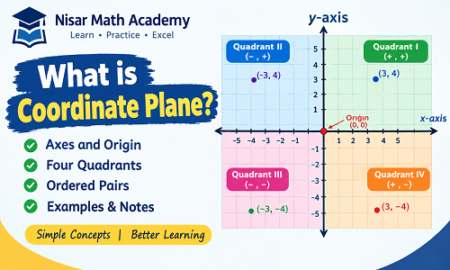
A coordinate plane is a two-dimensional plane used to locate and represent points by using two perpendicular number lines called the x-axis and y-axis.
The coordinate plane helps students describe the exact position of a point using an ordered pair such as (3, 2).
In simple words, the coordinate plane is a system in which we use two numbers to tell the position of a point.
For example, the point (4, 3) means:
- Move 4 units along the x-axis.
- Then move 3 units upward parallel to the y-axis.
This topic is an important part of coordinate geometry and is widely used in mathematics.
Define Coordinate Plane
Definition:
A coordinate plane is a two-dimensional plane formed by two perpendicular number lines, called the x-axis and y-axis, which are used to locate points using ordered pairs.
The x-axis is usually horizontal, while the y-axis is usually vertical.
Parts of a Coordinate Plane
A coordinate plane mainly consists of the following parts:
- x-axis
- y-axis
- Origin
- Four quadrants
- Ordered pairs or coordinates
1. x-axis
The x-axis is the horizontal number line in the coordinate plane.
Numbers to the right of the origin are positive, while numbers to the left are negative.
For example:
- +3 is three units to the right.
- −3 is three units to the left.
2. y-axis
The y-axis is the vertical number line in the coordinate plane.
Numbers above the origin are positive, while numbers below the origin are negative.
For example:
- +4 is four units upward.
- −4 is four units downward.
3. Origin
The point where the x-axis and y-axis intersect is called the origin.
The coordinates of the origin are:
(0, 0)
The origin is the reference point from which the position of other points is measured.
Four Quadrants of the Coordinate Plane
The x-axis and y-axis divide the coordinate plane into four regions, called quadrants.
They are numbered counterclockwise:
- First Quadrant (I)
- Second Quadrant (II)
- Third Quadrant (III)
- Fourth Quadrant (IV)
First Quadrant
In the first quadrant:
x > 0 and y > 0
Therefore, both coordinates are positive.
Example:
(3, 5)
Second Quadrant
In the second quadrant:
x < 0 and y > 0
Therefore, x is negative and y is positive.
Example:
(−3, 5)
Third Quadrant
In the third quadrant:
x < 0 and y < 0
Therefore, both coordinates are negative.
Example:
(−3, −5)
Fourth Quadrant
In the fourth quadrant:
x > 0 and y < 0
Therefore, x is positive and y is negative.
Example:
(3, −5)
Sign Rules of Four Quadrants
Students can remember the signs of coordinates as follows:
| Quadrant | x-coordinate | y-coordinate |
|---|---|---|
| I | Positive | Positive |
| II | Negative | Positive |
| III | Negative | Negative |
| IV | Positive | Negative |
A useful way to remember this is:
I: (+, +)
II: (−, +)
III: (−, −)
IV: (+, −)
What Is an Ordered Pair?
A point in a coordinate plane is represented by an ordered pair.
An ordered pair is written as:
(x, y)
The first number is called the x-coordinate, and the second number is called the y-coordinate.
For example:
(5, 2)
Here:
- x-coordinate = 5
- y-coordinate = 2
The order is important. (5, 2) and (2, 5) represent different points.
How to Plot a Point on a Coordinate Plane
To plot a point such as (4, 3):
Step 1: Start from the origin (0, 0).
Step 2: Move 4 units to the right because the x-coordinate is +4.
Step 3: Move 3 units upward because the y-coordinate is +3.
Step 4: Mark the point.
Therefore, the point is located at (4, 3).
Example of a Point in Each Quadrant
Consider the following points:
- A(3, 4) → First Quadrant
- B(−3, 4) → Second Quadrant
- C(−3, −4) → Third Quadrant
- D(3, −4) → Fourth Quadrant
The signs of the coordinates tell us the quadrant in which the point lies.
Points on the Axes
A point does not always lie in one of the four quadrants. It may lie directly on the x-axis or y-axis.
Point on the x-axis
For a point on the x-axis, the y-coordinate is always 0.
Examples:
(4, 0)
(−5, 0)
Point on the y-axis
For a point on the y-axis, the x-coordinate is always 0.
Examples:
(0, 3)
(0, −6)
Point at the Origin
The origin is:
(0, 0)
It lies on both the x-axis and y-axis.
Distance from the Axes
In a coordinate plane:
- The absolute value of the x-coordinate tells the horizontal distance of a point from the y-axis.
- The absolute value of the y-coordinate tells the vertical distance of a point from the x-axis.
For example, for point P(−6, 4):
- Its distance from the y-axis is 6 units.
- Its distance from the x-axis is 4 units.
Coordinate Plane Examples
Example 1
Determine the quadrant of P(5, 7).
Both coordinates are positive.
Therefore:
P(5, 7) lies in the First Quadrant.
Example 2
Determine the quadrant of Q(−4, 6).
The x-coordinate is negative and the y-coordinate is positive.
Therefore:
Q(−4, 6) lies in the Second Quadrant.
Example 3
Determine the quadrant of R(−2, −8).
Both coordinates are negative.
Therefore:
R(−2, −8) lies in the Third Quadrant.
Example 4
Determine the quadrant of S(6, −3).
The x-coordinate is positive and the y-coordinate is negative.
Therefore:
S(6, −3) lies in the Fourth Quadrant.
Why Is the Coordinate Plane Important?
The coordinate plane is important because it allows us to represent mathematical information visually.
It is used for:
- Plotting points
- Drawing graphs
- Studying linear equations
- Representing functions
- Finding distances between points
- Studying geometric shapes
- Understanding coordinate geometry
- Representing real-life data graphically
Students should understand the x-axis, y-axis, origin, quadrants, and ordered pairs before moving to more advanced topics in coordinate geometry.
Common Mistakes Students Should Avoid
Mistake 1: Reversing the Coordinates
Always remember:
(x, y)
The x-coordinate comes first and the y-coordinate comes second.
Mistake 2: Moving in the Wrong Direction
A positive x-coordinate means move right, while a negative x-coordinate means move left.
A positive y-coordinate means move up, while a negative y-coordinate means move down.
Mistake 3: Confusing the Axes
Remember:
- x-axis = horizontal
- y-axis = vertical
Mistake 4: Forgetting the Signs
The signs of x and y help identify the quadrant.
For example:
(−4, 5) is in Quadrant II, not Quadrant IV.
Short Notes on Coordinate Plane
Coordinate Plane: A two-dimensional plane used to locate points using ordered pairs.
x-axis: The horizontal number line.
y-axis: The vertical number line.
Origin: The point where the x-axis and y-axis intersect. Its coordinates are (0, 0).
Ordered Pair: A pair of numbers written as (x, y).
x-coordinate: The first number in an ordered pair.
y-coordinate: The second number in an ordered pair.
Quadrants: The four regions formed by the x-axis and y-axis.
Quadrant I: (+, +)
Quadrant II: (−, +)
Quadrant III: (−, −)
Quadrant IV: (+, −)
Coordinate Plane at a Glance
| Concept | Key Point |
|---|---|
| Coordinate plane | Used to locate points |
| x-axis | Horizontal |
| y-axis | Vertical |
| Origin | (0, 0) |
| Ordered pair | (x, y) |
| First coordinate | x-coordinate |
| Second coordinate | y-coordinate |
| Quadrant I | (+, +) |
| Quadrant II | (−, +) |
| Quadrant III | (−, −) |
| Quadrant IV | (+, −) |
MCQs on Coordinate Plane
1. What is a coordinate plane?
A) A one-dimensional line
B) A two-dimensional plane used to locate points
C) A circle
D) A triangle
Answer: B
2. What is the horizontal axis called?
A) y-axis
B) z-axis
C) x-axis
D) origin
Answer: C
3. What is the vertical axis called?
A) x-axis
B) y-axis
C) number axis
D) coordinate axis
Answer: B
4. What are the coordinates of the origin?
A) (1, 1)
B) (1, 0)
C) (0, 1)
D) (0, 0)
Answer: D
5. Which ordered pair lies in the First Quadrant?
A) (−2, 3)
B) (2, 3)
C) (−2, −3)
D) (2, −3)
Answer: B
6. Which ordered pair lies in the Second Quadrant?
A) (4, 5)
B) (−4, 5)
C) (−4, −5)
D) (4, −5)
Answer: B
7. Which ordered pair lies in the Third Quadrant?
A) (3, −4)
B) (−3, 4)
C) (−3, −4)
D) (3, 4)
Answer: C
8. Which ordered pair lies in the Fourth Quadrant?
A) (5, −2)
B) (−5, 2)
C) (−5, −2)
D) (5, 2)
Answer: A
9. In the ordered pair (7, 4), what is the x-coordinate?
A) 4
B) 7
C) 11
D) 3
Answer: B
10. In the ordered pair (7, 4), what is the y-coordinate?
A) 7
B) −7
C) 4
D) 11
Answer: C
11. If a point lies on the x-axis, its y-coordinate is:
A) 1
B) −1
C) 0
D) Any positive number
Answer: C
12. If a point lies on the y-axis, its x-coordinate is:
A) 0
B) 1
C) −1
D) Any positive number
Answer: A
Worksheet / Assignment on Coordinate Plane
Part A: Fill in the Blanks
- The horizontal axis is called the __________.
- The vertical axis is called the __________.
- The point where the two axes intersect is called the __________.
- The coordinates of the origin are __________.
- A point is represented by an __________ pair.
- The first number in an ordered pair is called the __________.
- The second number in an ordered pair is called the __________.
- The coordinate plane is divided into __________ quadrants.
Part B: Identify the Quadrant
Write the quadrant in which each point lies.
- A(4, 6)
- B(−4, 6)
- C(−4, −6)
- D(4, −6)
- E(8, 2)
- F(−7, 3)
- G(−5, −2)
- H(6, −4)
Part C: Short Questions
- Define coordinate plane.
- What is the origin?
- What is an ordered pair?
- What is the difference between the x-axis and y-axis?
- Write the signs of coordinates in all four quadrants.
- What are the coordinates of a point on the x-axis?
- What are the coordinates of a point on the y-axis?
- Explain how to plot the point (3, 5) on a coordinate plane.
Part D: Plotting Practice
Draw a coordinate plane and plot the following points:
A(2, 3), B(−3, 4), C(−4, −2), D(5, −3), E(0, 4), F(−5, 0)
Then identify whether each point lies in a quadrant or on an axis.
Conclusion
The coordinate plane is an important mathematical tool for locating and representing points. It consists of the horizontal x-axis and vertical y-axis, which intersect at the origin and divide the plane into four quadrants.
By understanding ordered pairs, axes, origin, quadrants, and positive and negative coordinates, students can easily learn the basic concepts of coordinate geometry.
For more student-friendly mathematics lessons, notes, assessments, and recorded lectures, students can explore Nisar Math Academy and its online math learning resources.
You May be Interested In:
Angle of Elevation and Angle of Depression: Definition, Formulas, Examples and Questions

Leave a Reply