What is Distance Formula and How to Apply It in Mathematics?
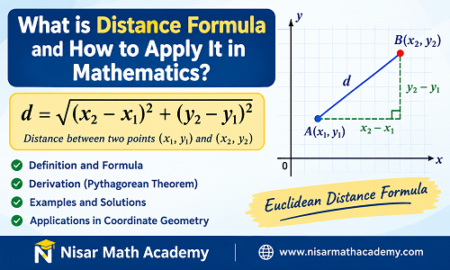
The distance formula is an important formula in coordinate geometry. It is used to find the distance between two points on the Cartesian coordinate plane.
When the coordinates of two points are known, we can use the distance formula to calculate the exact distance between them without measuring the distance manually.
In this article, we will learn what is distance formula, how to derive it, the distance between two points formula, and how to apply the distance formula in different mathematical problems.
What is Distance Formula?
The distance formula is a mathematical formula used to find the distance between two points in a coordinate plane.
Suppose we have two points:
A(x₁, y₁) and B(x₂, y₂)
The distance between these two points is given by:
d = √[(x₂ − x₁)² + (y₂ − y₁)²]
This is also known as the Euclidean distance formula in a two-dimensional coordinate plane.
genui{“learning_viz”:{“type_id”:”DISTANCE_FORMULA”,”content”:”d=\sqrt{(x_2-x_1)^2+(y_2-y_1)^2}”,”locale_override”:”en-US”}}
Distance Between Two Points Formula
The standard distance between two points formula is:
d = √[(x₂ − x₁)² + (y₂ − y₁)²]
Where:
- d = distance between the two points
- (x₁, y₁) = coordinates of the first point
- (x₂, y₂) = coordinates of the second point
- x₂ − x₁ = difference between the x-coordinates
- y₂ − y₁ = difference between the y-coordinates
The formula gives the shortest straight-line distance between the two points.
Why Do We Use the Distance Formula?
The distance formula is useful when we know the coordinates of two points but need to find the length of the line segment joining them.
For example, if the two points are:
A(2, 3) and B(6, 6)
we can find the distance between them using:
d = √[(6 − 2)² + (6 − 3)²]
d = √[4² + 3²]
d = √[16 + 9]
d = √25
d = 5
Therefore, the distance between A and B is 5 units.
Derivation of Distance Formula
The distance formula is based on the Pythagorean theorem.
Consider two points:
A(x₁, y₁) and B(x₂, y₂)
Draw a horizontal and a vertical line to form a right triangle.
The horizontal side of the triangle is:
x₂ − x₁
The vertical side is:
y₂ − y₁
According to the Pythagorean theorem:
Hypotenuse² = Base² + Perpendicular²
Therefore:
d² = (x₂ − x₁)² + (y₂ − y₁)²
Taking the square root on both sides:
d = √[(x₂ − x₁)² + (y₂ − y₁)²]
Thus, we obtain the distance formula.
How to Apply the Distance Formula
To use the distance formula correctly, follow these steps.
Step 1: Identify the Coordinates
Write the coordinates of the two points.
For example:
A(1, 2)
B(4, 6)
Therefore:
x₁ = 1, y₁ = 2
x₂ = 4, y₂ = 6
Step 2: Write the Formula
Write:
d = √[(x₂ − x₁)² + (y₂ − y₁)²]
Step 3: Substitute the Values
d = √[(4 − 1)² + (6 − 2)²]
Step 4: Simplify
d = √[3² + 4²]
d = √[9 + 16]
d = √25
Step 5: Find the Answer
d = 5
Therefore, the distance between the two points is 5 units.
Solved Example 1: Distance Between (2, 3) and (6, 6)
Find the distance between:
A(2, 3) and B(6, 6).
Using the distance formula:
d = √[(x₂ − x₁)² + (y₂ − y₁)²]
Substitute the coordinates:
d = √[(6 − 2)² + (6 − 3)²]
d = √[4² + 3²]
d = √[16 + 9]
d = √25
d = 5
Answer: 5 units
Solved Example 2: Distance Between (1, 2) and (4, 6)
Given:
A(1, 2)
B(4, 6)
Using the formula:
d = √[(4 − 1)² + (6 − 2)²]
d = √[3² + 4²]
d = √[9 + 16]
d = √25
d = 5
Therefore, the distance is 5 units.
Solved Example 3: Points With Negative Coordinates
Find the distance between:
A(-2, 3) and B(4, -5).
Using the formula:
d = √[(4 − (-2))² + (-5 − 3)²]
d = √[6² + (-8)²]
d = √[36 + 64]
d = √100
d = 10
Therefore, the distance between the two points is 10 units.
Distance Between Points on the Same Horizontal Line
If two points have the same y-coordinate, they lie on a horizontal line.
For example:
A(2, 5) and B(8, 5)
Using the distance formula:
d = √[(8 − 2)² + (5 − 5)²]
d = √[6² + 0²]
d = √36
d = 6
Therefore, the distance is 6 units.
In this case, we can also simply find the difference between the x-coordinates.
Distance Between Points on the Same Vertical Line
If two points have the same x-coordinate, they lie on a vertical line.
For example:
A(4, 2) and B(4, 9)
Using the formula:
d = √[(4 − 4)² + (9 − 2)²]
d = √[0² + 7²]
d = √49
d = 7
Therefore, the distance is 7 units.
Important Points to Remember
When applying the distance formula, remember the following points:
- Carefully identify the coordinates of both points.
- Use the same order of coordinates throughout the calculation.
- Remember to square both differences.
- Be careful when subtracting negative numbers.
- Take the square root after adding the squared values.
- Distance cannot be negative.
- Always write the appropriate unit with the answer when units are given.
Common Mistake With Negative Coordinates
Students often make mistakes when subtracting negative numbers.
For example:
4 − (-2) = 4 + 2 = 6
Similarly:
-5 − 3 = -8
After squaring:
(-8)² = 64
Remember that the square of a negative number is positive.
Distance Formula in Coordinate Geometry
The distance formula is one of the fundamental concepts of coordinate geometry. It allows us to determine the length of a line segment when the coordinates of its endpoints are known.
It can also be used in problems involving triangles, quadrilaterals, circles, and other geometric figures on the coordinate plane.
For example, if the coordinates of the vertices of a triangle are given, we can calculate the lengths of its three sides using the distance formula.
Applications of Distance Formula
The distance formula has many applications in mathematics.
1. Finding the Length of a Line Segment
It can be used to find the length between two points on a coordinate plane.
2. Finding the Sides of a Triangle
If the coordinates of the vertices of a triangle are given, the lengths of its sides can be calculated using the distance formula.
3. Studying Geometric Shapes
The formula can help determine whether points form particular geometric figures by comparing side lengths.
4. Coordinate Geometry Problems
Many coordinate geometry questions require finding distances between points.
5. Real-Life Mathematical Problems
The concept of distance between two points is also useful in maps, navigation, computer graphics, engineering, and other applications involving coordinates.
Distance Formula and Euclidean Distance
The distance formula used in a two-dimensional coordinate plane is commonly called the Euclidean distance formula.
For two points:
A(x₁, y₁) and B(x₂, y₂)
the Euclidean distance is:
d = √[(x₂ − x₁)² + (y₂ − y₁)²]
It represents the shortest straight-line distance between the two points.
Distance Formula in Three Dimensions
The same idea can be extended to three-dimensional coordinate geometry.
For points:
A(x₁, y₁, z₁)
and
B(x₂, y₂, z₂)
the distance formula becomes:
d = √[(x₂ − x₁)² + (y₂ − y₁)² + (z₂ − z₁)²]
However, for basic two-dimensional coordinate geometry, we normally use:
d = √[(x₂ − x₁)² + (y₂ − y₁)²]
Difference Between Distance Formula and Measuring Distance
Measuring distance directly is possible when a diagram is available and a scale is provided. However, when only the coordinates of two points are given, the distance formula provides a mathematical method for finding the exact distance.
For this reason, the distance formula is especially important in coordinate geometry.
Quick Revision
The most important formula to remember is:
Distance Formula
d = √[(x₂ − x₁)² + (y₂ − y₁)²]
For points A(x₁, y₁) and B(x₂, y₂):
Horizontal difference = x₂ − x₁
Vertical difference = y₂ − y₁
Then:
Distance = √[(Horizontal difference)² + (Vertical difference)²]
Short Notes on Distance Formula
- The distance formula finds the distance between two points.
- It is mainly used in coordinate geometry.
- For points A(x₁, y₁) and B(x₂, y₂), the formula is:d = √[(x₂ − x₁)² + (y₂ − y₁)²]
- The formula is based on the Pythagorean theorem.
- The distance is always non-negative.
- It is also called the two-dimensional Euclidean distance formula.
- If two points have the same x-coordinate, their distance is the difference between their y-coordinates.
- If two points have the same y-coordinate, their distance is the difference between their x-coordinates.
- The formula can be used to find the lengths of sides of geometric figures on a coordinate plane.
Frequently Asked Questions
What is distance formula?
The distance formula is a mathematical formula used to calculate the distance between two points in a coordinate plane.
What is the distance between two points formula?
For points (x₁, y₁) and (x₂, y₂), the distance between them is:
d = √[(x₂ − x₁)² + (y₂ − y₁)²]
Why is the distance formula based on the Pythagorean theorem?
The horizontal and vertical differences between two points form the two perpendicular sides of a right triangle. The distance between the points is the hypotenuse, so the Pythagorean theorem can be used.
Can distance be negative?
No. Distance is always zero or positive.
What is Euclidean distance formula?
The Euclidean distance formula gives the shortest straight-line distance between two points. In two dimensions, it is:
d = √[(x₂ − x₁)² + (y₂ − y₁)²]
What happens when both points are the same?
If the two points are identical, the distance between them is 0 units.
Conclusion
The distance formula is an important tool in coordinate geometry. It helps us calculate the distance between two points when their coordinates are known.
The formula is:
d = √[(x₂ − x₁)² + (y₂ − y₁)²]
The formula is derived from the Pythagorean theorem and can be applied to many problems involving points, line segments, triangles, and other geometric figures.
Students should practice substituting positive and negative coordinates carefully because correct handling of signs is essential when using the distance formula.
For more mathematics notes, recorded lectures, assessments, lesson plans, and other educational resources, visit Nisar Math Academy at www.nisarmathacademy.com.
MCQs on Distance Formula
1. What is the distance formula between two points (x₁, y₁) and (x₂, y₂)?
A. √[(x₂ − x₁)² + (y₂ − y₁)²]
B. (x₂ − x₁) + (y₂ − y₁)
C. √[(x₂ + x₁)² + (y₂ + y₁)²]
D. (x₂ − x₁)² − (y₂ − y₁)²
Answer: A
2. The distance formula is based on which theorem?
A. Binomial theorem
B. Pythagorean theorem
C. Remainder theorem
D. Factor theorem
Answer: B
3. What is the distance between (0, 0) and (3, 4)?
A. 3
B. 4
C. 5
D. 7
Answer: C
4. Which symbol is commonly used for distance?
A. d
B. x
C. y
D. m
Answer: A
5. What is the distance between (2, 5) and (8, 5)?
A. 5 units
B. 6 units
C. 7 units
D. 8 units
Answer: B
6. What is the distance between (4, 2) and (4, 9)?
A. 5 units
B. 6 units
C. 7 units
D. 8 units
Answer: C
7. The distance between two identical points is:
A. 1
B. -1
C. 0
D. Cannot be determined
Answer: C
8. The distance between two points can be:
A. Only negative
B. Only positive
C. Zero or positive
D. Always zero
Answer: C
9. In the distance formula, what is done to the coordinate differences?
A. They are added only
B. They are squared
C. They are divided
D. They are multiplied by 2
Answer: B
10. The two-dimensional distance formula is also commonly called:
A. Euclidean distance formula
B. Quadratic formula
C. Midpoint formula
D. Slope formula
Answer: A
Worksheet / Assignment
Topic: Distance Formula
Part A: Basic Questions
- Define the distance formula.
- Write the distance formula for two points (x₁, y₁) and (x₂, y₂).
- State the theorem on which the distance formula is based.
- What is the distance between two identical points?
- Can the distance between two points be negative? Explain briefly.
Part B: Find the Distance
Use the distance formula to find the distance between each pair of points.
- A(1, 2), B(4, 6)
- A(2, 3), B(6, 6)
- A(0, 0), B(5, 12)
- A(-2, 3), B(4, -5)
- A(3, 4), B(9, 12)
- A(-1, -2), B(2, 2)
- A(5, 7), B(5, 15)
- A(-4, 6), B(3, 6)
Part C: Conceptual Questions
- Why is the distance formula based on the Pythagorean theorem?
- What happens when two points have the same x-coordinate?
- What happens when two points have the same y-coordinate?
- Why must the coordinate differences be squared in the distance formula?
- Explain why distance cannot be negative.
Part D: Challenge Questions
- Find the length of each side of the triangle whose vertices are:
A(0, 0), B(3, 4), C(6, 0)
- Determine whether the points A(0, 0), B(3, 4), and C(6, 0) form an isosceles triangle.
- Find the distance between A(-3, -4) and B(3, 4).
- Find the value of x if the distance between A(x, 2) and B(5, 2) is 7 units.
- Find the distance between the points P(-2, -3) and Q(4, 5).
Assignment Instructions
- Write the formula before solving each question.
- Substitute the coordinates carefully.
- Show all calculation steps.
- Pay special attention to negative signs.
- Write the final answer with units where appropriate.
- Try to solve the questions without looking at the solved examples.
Nisar Math Academy — Online Math Notes, Recorded Lectures, Assessments and Lesson Plans
Suggested SEO title: Distance Formula: Definition, Formula, Examples & Applications
You May be Interested In:
What Is Coordinate Plane? Definition, Axes, Quadrants, Examples & Notes
Angle of Elevation and Angle of Depression: Definition, Formulas, Examples and Questions

Leave a Reply