How to Find Solution of a Triangle? Complete Guide with Formulas, Examples, Short Notes, MCQs and Worksheet
Introduction
In geometry and trigonometry, a triangle is a three-sided polygon having three angles. In many mathematical problems, some sides and angles of a triangle are known while one or more sides or angles are unknown. The process of finding all the unknown sides and angles is called the solution of a triangle.
Knowing how to find solution of a triangle is an important skill in trigonometry. Different methods are used depending on the information given in the question.
The most commonly used methods involve:
- Angle Sum Property
- Pythagorean Theorem
- Trigonometric Ratios
- Sine Rule
- Cosine Rule
In this article, we will learn finding solution of a triangle step by step with simple examples and student-friendly notes.
What Is the Solution of a Triangle?
The solution of a triangle means finding all the unknown sides and angles when sufficient information about the triangle is given.
For example, suppose a triangle has:
- Two known angles
- One known side
We can use the angle sum property and trigonometric relationships to determine the remaining angle and sides.
A complete solution normally gives the values of:
- All three angles
- All three sides
Remember that the three interior angles of every triangle have a sum of 180°.
Important Parts of a Triangle
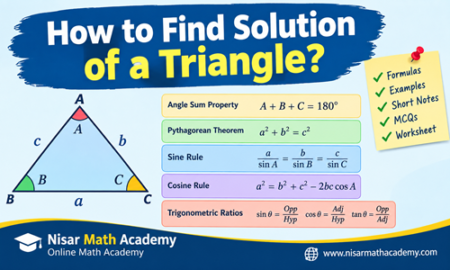
Consider a triangle ABC.
Its sides are:
- a = side opposite angle A
- b = side opposite angle B
- c = side opposite angle C
Its angles are:
- ∠A
- ∠B
- ∠C
The basic angle relationship is:
A + B + C = 180°
This relationship is useful for finding an unknown angle when the other two angles are known.
Conditions Required to Solve a Triangle
A triangle can be solved when enough information is given to determine its unknown parts.
Common cases include:
1. Three Sides Given — SSS
If all three sides are known, the triangle can be solved using the Cosine Rule to find the angles.
2. Two Sides and Included Angle — SAS
If two sides and the angle between them are known, the Cosine Rule can be used first to find the third side. The remaining angles can then be found using appropriate trigonometric relationships.
3. Two Angles and One Side — ASA or AAS
First find the third angle using:
A + B + C = 180°
Then the Sine Rule can be used to find the unknown sides.
4. Two Sides and an Opposite Angle — SSA
This case can sometimes have more than one possible triangle. Therefore, it is important to check the given information carefully before finding the solution.
5. Right-Angled Triangle
If one angle is 90°, trigonometric ratios and the Pythagorean Theorem can be used.
How to Find Solution of a Triangle
The general procedure for how to find solution of a triangle is:
Step 1: Draw and Label the Triangle
Draw the triangle and label the known sides and angles.
For example:
- Side a is opposite angle A.
- Side b is opposite angle B.
- Side c is opposite angle C.
Step 2: Identify the Given Information
Look carefully at the question and determine which sides and angles are known.
Ask yourself:
- Are three sides given?
- Are two sides and an angle given?
- Are two angles and one side given?
- Is the triangle right-angled?
Step 3: Find the Missing Angle
If two angles are known, use:
A + B + C = 180°
Therefore:
C = 180° − A − B
Step 4: Select the Appropriate Formula
Use the formula that matches the information given.
For right triangles, use trigonometric ratios or the Pythagorean Theorem.
For non-right triangles, the Sine Rule or Cosine Rule is often useful.
Step 5: Calculate the Unknown Parts
Substitute the known values into the appropriate formula and calculate the unknown side or angle.
Step 6: Check Your Answer
Finally, check that:
- All angles are positive.
- The three angles add up to 180°.
- The side lengths satisfy the triangle inequality.
- Your calculated values are reasonable.
Important Formulas for Finding Solution of a Triangle
1. Angle Sum Property
The sum of the three interior angles of a triangle is:
A + B + C = 180°
This is one of the most important formulas used in solving triangles.
2. Pythagorean Theorem
For a right-angled triangle:
a² + b² = c²
where c is the hypotenuse.
For example, if the two perpendicular sides are 3 cm and 4 cm:
c² = 3² + 4²
c² = 9 + 16
c² = 25
Therefore:
c = 5 cm
3. Trigonometric Ratios
For a right-angled triangle, the three basic trigonometric ratios are:
sin θ = Opposite / Hypotenuse
cos θ = Adjacent / Hypotenuse
tan θ = Opposite / Adjacent
These ratios are useful when a side and an angle are known.
4. Sine Rule
For a general triangle:
a / sin A = b / sin B = c / sin C
The Sine Rule is particularly useful when corresponding side-angle information is available.
It can be rearranged as:
a = b sin A / sin B
and similarly for other sides.
5. Cosine Rule
The Cosine Rule is:
a² = b² + c² − 2bc cos A
Similarly:
b² = a² + c² − 2ac cos B
c² = a² + b² − 2ab cos C
The Cosine Rule is especially useful when three sides are known or when two sides and the included angle are known.
Example 1: Finding an Unknown Angle
Suppose:
A = 60°
B = 70°
Find C.
Using:
A + B + C = 180°
60° + 70° + C = 180°
130° + C = 180°
Therefore:
C = 50°
So, the three angles are:
60°, 70°, 50°
Example 2: Solving a Right Triangle
Suppose a right-angled triangle has perpendicular sides of 6 cm and 8 cm. Find the hypotenuse.
Using the Pythagorean Theorem:
c² = a² + b²
c² = 6² + 8²
c² = 36 + 64
c² = 100
Therefore:
c = 10 cm
Example 3: Using the Sine Rule
Suppose:
A = 30°
B = 45°
a = 6 cm
Find b.
Using the Sine Rule:
a / sin A = b / sin B
Substitute the values:
6 / sin 30° = b / sin 45°
Since:
sin 30° = 0.5
sin 45° ≈ 0.7071
Therefore:
6 / 0.5 = b / 0.7071
12 = b / 0.7071
b ≈ 8.49 cm
Therefore:
b ≈ 8.49 cm
Example 4: Using the Cosine Rule
Suppose two sides of a triangle are:
b = 5 cm
c = 7 cm
and the included angle is:
A = 60°
Find side a.
Using the Cosine Rule:
a² = b² + c² − 2bc cos A
Substitute:
a² = 5² + 7² − 2(5)(7)cos 60°
a² = 25 + 49 − 70(0.5)
a² = 74 − 35
a² = 39
Therefore:
a = √39 ≈ 6.24 cm
Why Is Finding the Solution of a Triangle Important?
Finding solution of a triangle is useful in many areas of mathematics and practical applications.
It is used in:
- Trigonometry
- Geometry
- Surveying
- Construction
- Engineering
- Navigation
- Architecture
- Physics
Students should therefore understand not only the formulas but also when to use each formula.
Common Mistakes While Solving Triangles
Students often make the following mistakes:
Mistake 1: Forgetting the Angle Sum
The angles of a triangle must add up to 180°.
Mistake 2: Using the Wrong Side-Angle Pair
In the Sine Rule, each side must correspond to its opposite angle.
For example:
a ↔ A
b ↔ B
c ↔ C
Mistake 3: Confusing Hypotenuse and Other Sides
In a right-angled triangle, the hypotenuse is always opposite the 90° angle.
Mistake 4: Calculator in the Wrong Mode
When calculating trigonometric functions involving degrees, make sure the calculator is set to degree mode.
Mistake 5: Not Checking the Answer
Always check whether the calculated angles and sides make sense.
Short Notes: Solution of a Triangle
Definition
The process of finding all unknown sides and angles of a triangle from the given information is called the solution of a triangle.
Angle Sum
A + B + C = 180°
Pythagorean Theorem
For a right triangle:
a² + b² = c²
Trigonometric Ratios
sin θ = Opposite / Hypotenuse
cos θ = Adjacent / Hypotenuse
tan θ = Opposite / Adjacent
Sine Rule
a/sin A = b/sin B = c/sin C
Cosine Rule
a² = b² + c² − 2bc cos A
Common Cases
- SSS: Three sides known
- SAS: Two sides and included angle known
- ASA: Two angles and included side known
- AAS: Two angles and a non-included side known
- SSA: Two sides and an opposite angle known
Basic Steps
- Draw the triangle.
- Label the known values.
- Identify the type of problem.
- Select the appropriate formula.
- Calculate the unknown values.
- Check the answer.
MCQs on Solution of a Triangle
MCQ 1
The sum of the interior angles of a triangle is:
A) 90°
B) 180°
C) 270°
D) 360°
Answer: B) 180°
MCQ 2
Which theorem is used to solve for the hypotenuse of a right triangle when the other two sides are known?
A) Sine Rule
B) Cosine Rule
C) Pythagorean Theorem
D) Angle Sum Rule
Answer: C) Pythagorean Theorem
MCQ 3
The correct Sine Rule is:
A) a sin A = b sin B
B) a/sin A = b/sin B = c/sin C
C) a² = b² + c²
D) a + b + c = 180°
Answer: B
MCQ 4
The side opposite the 90° angle is called the:
A) Base
B) Adjacent side
C) Hypotenuse
D) Opposite side
Answer: C) Hypotenuse
MCQ 5
If two angles of a triangle are 50° and 60°, the third angle is:
A) 60°
B) 70°
C) 80°
D) 90°
Answer: B) 70°
MCQ 6
Which trigonometric ratio is equal to Opposite/Hypotenuse?
A) cos θ
B) tan θ
C) sin θ
D) sec θ
Answer: C) sin θ
MCQ 7
Which rule is particularly useful when three sides of a triangle are known?
A) Cosine Rule
B) Sine Rule
C) Tangent Rule
D) Angle Sum Rule only
Answer: A) Cosine Rule
MCQ 8
In the notation of a triangle, side a is opposite:
A) Angle B
B) Angle C
C) Angle A
D) 90°
Answer: C) Angle A
MCQ 9
If A = 90°, B = 40°, then C is:
A) 40°
B) 50°
C) 60°
D) 70°
Answer: B) 50°
MCQ 10
The Cosine Rule contains which trigonometric function?
A) sin
B) tan
C) cos
D) cot
Answer: C) cos
Worksheet / Assignment
Part A: Fill in the Blanks
- The sum of the angles of a triangle is ________.
- The side opposite the right angle is called the ________.
- The Pythagorean Theorem is ________.
- In a triangle, side a is opposite angle ________.
- The Sine Rule contains the ratios of sides to the ________ of their opposite angles.
Part B: Find the Missing Angle
- A = 40°, B = 70°. Find C.
- A = 65°, B = 55°. Find C.
- A = 90°, B = 35°. Find C.
- A = 75°, B = 45°. Find C.
- A = 52°, B = 68°. Find C.
Part C: Use the Pythagorean Theorem
- A right triangle has sides 3 cm and 4 cm. Find the hypotenuse.
- A right triangle has perpendicular sides 5 cm and 12 cm. Find the hypotenuse.
- The hypotenuse of a right triangle is 13 cm and one side is 5 cm. Find the other side.
Part D: Use Trigonometric Ratios
- Write the formula for sin θ.
- Write the formula for cos θ.
- Write the formula for tan θ.
- A right triangle has an angle of 30° and a hypotenuse of 10 cm. Find the side opposite the angle using the Sine Ratio.
- A right triangle has an angle of 60° and an adjacent side of 5 cm. Find the hypotenuse using the Cosine Ratio.
Part E: Sine Rule and Cosine Rule
- State the Sine Rule.
- State the Cosine Rule.
- Two sides of a triangle are 5 cm and 7 cm and the included angle is 60°. Find the third side.
- In a triangle, A = 30°, B = 45° and a = 6 cm. Find b using the Sine Rule.
- Explain when the Cosine Rule can be used to solve a triangle.
Part F: Challenge Questions
- Explain the difference between SSS, SAS, ASA and AAS.
- A triangle has angles 45° and 65°. Find the third angle and explain which property you used.
- Explain how you would decide whether to use the Sine Rule or Cosine Rule.
- Write the complete steps you would follow for finding solution of a triangle.
- Create your own triangle problem and solve it completely.
Answers to Worksheet
Part A
- 180°
- Hypotenuse
- a² + b² = c²
- A
- Sine
Part B
- 70°
- 60°
- 55°
- 60°
- 60°
Part C
- 5 cm
- 13 cm
- 12 cm
Part D
- sin θ = Opposite/Hypotenuse
- cos θ = Adjacent/Hypotenuse
- tan θ = Opposite/Adjacent
- 5 cm
- 10 cm
Part E
- a/sin A = b/sin B = c/sin C
- a² = b² + c² − 2bc cos A
- Approximately 6.24 cm
- Approximately 8.49 cm
- It is useful when three sides are known or when two sides and their included angle are known.
Final Summary
The solution of a triangle means finding its unknown sides and angles from the information provided. To solve a triangle correctly, first identify what is known and then select the appropriate mathematical relationship.
The most important tools are:
- Angle Sum Property: A + B + C = 180°
- Pythagorean Theorem: a² + b² = c²
- Trigonometric Ratios: sine, cosine and tangent
- Sine Rule: a/sin A = b/sin B = c/sin C
- Cosine Rule: a² = b² + c² − 2bc cos A
Students can use these methods to solve a wide range of triangle problems in geometry and trigonometry.
For more online math academy notes, recorded lectures, assessments, lesson plans and other mathematics learning material, visit Nisar Math Academy at nisarmathacademy.com. Free resources are also available for students, while full-course content is available through website membership.
You May be Interested In:
What Are Trigonometric Ratios of Special Angles?
Applications of Trigonometric Ratios: How to Apply Trigonometric Ratios with Examples
What Are Trigonometric Identities? Definition, Formulas, Examples, Short Notes, MCQs & Worksheet
Leave a Reply