Application of Coordinate Geometry in Real Life Situations: Examples and Uses
Introduction
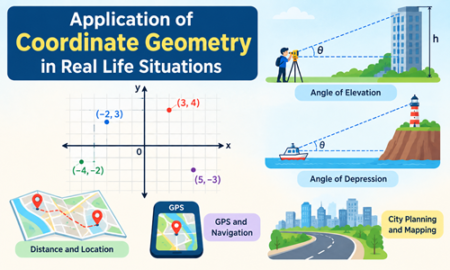
Coordinate geometry is an important branch of mathematics that connects algebra and geometry. It allows us to represent points, lines, distances, and shapes using numbers and equations on a coordinate plane.
The application of coordinate geometry in real life can be found in many areas, including maps, navigation, architecture, engineering, computer graphics, surveying, construction, robotics, astronomy, and location-based technologies.
For example, when we use a map to locate a particular place, we need a way to describe its position. Coordinate systems provide that mathematical framework. Similarly, engineers can use coordinates to describe the positions of different parts of a structure.
In this article, we will learn:
- What coordinate geometry is
- Important formulas used in coordinate geometry
- How coordinates describe positions
- Real-life applications of coordinate geometry
- Step-by-step numerical examples
- Applications in maps, construction, navigation, and computer graphics
- The relationship between complex numbers and coordinate geometry
- Common mistakes students should avoid
What Is Coordinate Geometry?
Coordinate geometry is the study of geometric figures using coordinates, algebraic equations, and formulas.
The most commonly used system is the Cartesian coordinate system, which consists of two perpendicular number lines:
- x-axis: horizontal axis
- y-axis: vertical axis
Their point of intersection is called the origin, represented by:
A point in the coordinate plane is normally written as:
Here:
- is the x-coordinate or abscissa.
- is the y-coordinate or ordinate.
Example
Consider the point:
This means that we move 4 units along the x-axis and then 3 units upward parallel to the y-axis.
Coordinate Plane and Its Quadrants
The x-axis and y-axis divide the coordinate plane into four regions called quadrants.
| Quadrant | Sign of x | Sign of y |
|---|---|---|
| First Quadrant | + | + |
| Second Quadrant | − | + |
| Third Quadrant | − | − |
| Fourth Quadrant | + | − |
For example:
- lies in the first quadrant.
- lies in the second quadrant.
- lies in the third quadrant.
- lies in the fourth quadrant.
Diagram Description
Imagine a horizontal x-axis crossing a vertical y-axis at the origin. The four regions around their intersection are numbered counterclockwise as Quadrants I, II, III, and IV.
This coordinate plane provides a mathematical method for describing locations.
Important Formulas in Coordinate Geometry
Several formulas make coordinate geometry useful for solving practical problems.
1. Distance Formula
For two points:
and
the distance between them is:
This formula is based on the Pythagorean theorem.
2. Midpoint Formula
The midpoint of the line segment joining:
and
is:
The midpoint formula is useful when finding the exact center of a line segment.
3. Section Formula
If a point divides the line segment joining and internally in the ratio , then:
This formula can be used to determine the position of a point between two known locations.
4. Slope Formula
The slope of a line passing through:
and
is:
The slope describes the direction and steepness of a line.
5. Equation of a Straight Line
One common form of the equation of a straight line is:
where:
- is the slope.
- is the y-intercept.
Coordinate geometry therefore allows real-world relationships to be represented mathematically.
Application of Coordinate Geometry in Real Life
Coordinate geometry has many practical applications. Some of the most important ones are discussed below.
1. Maps and Location Systems
One of the simplest applications of coordinate geometry is representing locations on maps.
A map can use coordinates to identify the position of:
- Cities
- Buildings
- Roads
- Bridges
- Schools
- Hospitals
- Railway stations
For example, suppose a simplified map represents a school by:
and a library by:
The distance between the two locations can be calculated using the distance formula.
Therefore, the two locations are 10 coordinate units apart.
In an actual map, the coordinate units can represent a particular physical distance according to the map’s scale.
2. Navigation
Coordinate systems are essential in navigation.
A navigation system needs mathematical ways to describe positions and calculate movement between locations.
For example, suppose a vehicle moves from:
to:
The straight-line distance is:
Thus, the direct distance between the two positions is 10 units.
Real navigation systems are much more sophisticated and can involve geographic coordinates, road networks, Earth’s curvature, and other mathematical models, but the basic idea of representing positions mathematically is closely related to coordinate geometry.
3. Land Surveying
Surveyors need to determine the locations and distances between points on land.
Suppose two surveyed points have simplified coordinates:
and
Their distance is:
Therefore, the distance between the points is approximately 72.11 coordinate units.
Surveying in the real world uses specialized equipment and coordinate systems, but coordinate mathematics is fundamental to representing and calculating positions.
4. Architecture and Construction
Architects and engineers use coordinates to specify the positions of different points in a design.
For example, a rectangular floor plan might have its corners represented by:
The coordinates immediately show that the rectangle has:
- Length = 12 units
- Width = 8 units
Its area is:
Therefore, the floor area is 96 square units.
Coordinate systems can also help describe the locations of doors, windows, columns, walls, and other structural elements in a design.
5. Computer Graphics
Coordinate geometry plays an important role in computer graphics.
A computer screen can be treated as a coordinate system. Points can be assigned coordinates, and these points can be joined to create:
- Lines
- Triangles
- Rectangles
- Circles
- Polygons
- 2D shapes
For example, a triangle may have vertices:
A graphics program can use these coordinates to determine where the triangle should appear on the screen.
Modern computer graphics also use more advanced coordinate systems and transformations such as translation, rotation, scaling, and reflection.
6. Game Development
Video games use coordinates to determine the position of objects.
For example, a character may have a position:
If the character moves 10 units to the right, the new position becomes:
If it then moves 20 units upward:
This simple example shows how coordinates can describe movement in a two-dimensional game environment.
Three-dimensional games use three coordinates:
where the third coordinate represents another spatial direction.
7. Robotics
Robots need to know where objects are located and where they should move.
Coordinate geometry can be used to describe positions and calculate movement.
Suppose a robot is at:
and needs to move to:
The straight-line distance is:
This type of calculation is part of the mathematical foundation used in positioning and movement systems.
Actual robots generally require more advanced mathematics involving vectors, matrices, angles, transformations, and three-dimensional coordinate systems.
8. Astronomy and Space Science
Coordinate systems are also used to describe the positions of objects in space.
Astronomers use different coordinate systems to specify the positions of:
- Stars
- Planets
- Galaxies
- Spacecraft
In elementary coordinate geometry, we work mainly with two-dimensional points such as:
In three-dimensional applications, a point can be represented by:
More advanced astronomical coordinate systems account for the three-dimensional nature of space and the observer’s position.
9. Urban Planning
Coordinate geometry can help represent roads, buildings, parks, and other features in an urban plan.
For example, planners can represent the corners of a rectangular park using coordinates:
The coordinate system makes it easier to describe the position and dimensions of the park.
Modern geographic information systems (GIS) extend these ideas to large-scale digital maps.
10. Determining the Center of a Line
The midpoint formula is useful when the center of a line segment needs to be found.
Suppose a road segment has endpoints:
and:
The midpoint is:
Thus, represents the exact midpoint of the segment in this coordinate model.
Worked Examples
Example 1: Finding the Distance Between Two Locations
Two points on a simplified map are:
and:
Find the distance between them.
Solution:
Using the distance formula:
Substitute the coordinates:
Therefore, the two locations are 10 coordinate units apart.
Example 2: Finding the Midpoint of Two Locations
Two points representing the ends of a road are:
and:
Find the midpoint.
Solution:
Using:
we get:
Therefore:
Example 3: Finding the Slope of a Road
A straight road passes through:
and:
Find its slope.
Solution:
The slope formula is:
Therefore:
The slope of the road in this coordinate model is 2.
Example 4: Finding an Unknown Coordinate
A point is 5 units away from:
Find possible values of .
Solution:
Using the distance formula:
Therefore:
So:
Hence:
or:
Therefore, the possible points are:
or
Example 5: Application to a Rectangular Plot
A rectangular plot has corners at:
Find its perimeter and area.
Solution:
Length:
Width:
Area:
Perimeter:
Therefore:
Application of Complex Numbers in Coordinate Geometry
Complex numbers can also be connected with coordinate geometry.
A complex number has the form:
where:
A complex number can be represented by a point:
on the Argand plane, also called the complex plane.
For example:
corresponds to the point:
The distance of this point from the origin is:
Thus, the modulus of the complex number is related to the distance from the origin in the coordinate plane.
This provides an important connection between complex numbers and coordinate geometry.
Coordinate Geometry and Vectors
Coordinate geometry is also closely related to vectors.
If a point changes from:
to:
the displacement can be represented by:
The vector therefore describes a movement of 5 units in the x-direction and 6 units in the y-direction.
Vectors and coordinates are widely used in physics, engineering, computer graphics, and mechanics.
Common Questions Students Search For
What are the applications of coordinate geometry?
Coordinate geometry is applied in maps, navigation, surveying, architecture, construction, computer graphics, robotics, game development, astronomy, and urban planning.
Why is coordinate geometry important in real life?
It provides a mathematical method for representing positions, distances, directions, shapes, and relationships.
Where is the distance formula used in real life?
The distance formula can be used in simplified mathematical models of maps, surveying, navigation, construction, and positioning problems.
What is the role of coordinates in maps?
Coordinates allow locations to be represented using numerical values so their positions can be identified and compared mathematically.
How are complex numbers related to coordinate geometry?
A complex number can be represented as the point on the complex plane.
Common Mistakes Students Make
1. Mixing Up x and y Coordinates
In:
the first value is always the x-coordinate and the second value is the y-coordinate.
2. Using the Wrong Signs
Students sometimes forget that points in different quadrants have different positive and negative signs.
3. Incorrectly Applying the Distance Formula
Remember:
Both coordinate differences must be squared.
4. Forgetting the Square Root
After calculating the sum of the squares, the square root must be taken to obtain the distance.
5. Confusing Slope With Distance
Slope describes the steepness or direction of a line, while distance measures how far apart two points are.
6. Ignoring Units
In real-life applications, students should identify the units being used, such as metres, kilometres, or square metres, when the scale is given.
How to Solve Real-Life Coordinate Geometry Problems
A useful procedure is:
- Identify the known points or coordinates.
- Write the appropriate formula.
- Substitute the coordinates carefully.
- Simplify the mathematical expression.
- Check signs and calculations.
- Include the appropriate units.
- Explain what the final answer means in the real-life situation.
Conclusion
The application of coordinate geometry in real life demonstrates how mathematics can be used to represent and solve practical problems. Coordinates provide a systematic way to describe positions, while formulas for distance, midpoint, slope, and equations of lines help us analyze relationships between those positions.
From maps and surveying to architecture, computer graphics, robotics, and space science, coordinate geometry provides an important mathematical foundation.
Students who understand the coordinate plane and its basic formulas can develop a stronger understanding of many advanced topics in mathematics and science.
For students looking for online math academy notes, recorded lectures, assessments, worksheets, solved questions, and other mathematics learning resources, Nisar Math Academy provides educational material designed to support mathematics learning.
Short Notes: Application of Coordinate Geometry
Coordinate Geometry
Coordinate geometry studies geometric objects using coordinates, equations, and algebraic methods.
Cartesian Plane
The Cartesian plane has:
- x-axis
- y-axis
- origin
- four quadrants
Coordinates
A point is written as:
The first value is x and the second value is y.
Distance Formula
Midpoint Formula
Slope Formula
Equation of a Straight Line
Real-Life Applications
Coordinate geometry is used in:
- Maps
- Navigation
- Land surveying
- Architecture
- Construction
- Computer graphics
- Video games
- Robotics
- Astronomy
- Urban planning
Complex Numbers
A complex number:
can be represented by the point:
on the complex plane.
MCQs
1. What is coordinate geometry?
A. Study of numbers only
B. Study of geometry using coordinates and algebra
C. Study of probability
D. Study of statistics
Correct Answer: B
2. What is the coordinate of the origin?
A.
B.
C.
D.
Correct Answer: D
3. Which formula finds the distance between two points?
A.
B.
C.
D.
Correct Answer: C
4. What is the midpoint of and ?
A.
B.
C.
D.
Correct Answer: A
5. Which formula gives the slope of a line?
A.
B.
C.
D.
Correct Answer: B
6. The point lies in which quadrant?
A. First
B. Second
C. Third
D. Fourth
Correct Answer: B
7. Which field commonly uses coordinates to represent locations?
A. Mapping
B. Poetry
C. Grammar
D. Literature
Correct Answer: A
8. What is the distance between and ?
A. 3 units
B. 4 units
C. 5 units
D. 7 units
Correct Answer: C
9. What is the midpoint of and ?
A.
B.
C.
D.
Correct Answer: B
10. A complex number can be represented on the complex plane by:
A. only
B.
C.
D.
Correct Answer: B
11. Which coordinate represents movement horizontally?
A. x-coordinate
B. y-coordinate
C. z-coordinate only
D. origin
Correct Answer: A
12. A slope of zero represents a:
A. Vertical line
B. Horizontal line
C. Curved line
D. Circular line
Correct Answer: B
13. Which area can use coordinate geometry to represent the position of objects on a screen?
A. Computer graphics
B. Grammar
C. History
D. Music theory
Correct Answer: A
Worksheet / Assignment
Questions
1. Definition
Define coordinate geometry in your own words.
2. Coordinate Plane
Name the two axes of the Cartesian coordinate plane.
3. Quadrants
State the signs of x and y coordinates in each of the four quadrants.
4. Distance
Find the distance between:
5. Midpoint
Find the midpoint of:
6. Slope
Find the slope of the line joining:
7. Location
A school is represented by and a hospital by . Find the straight-line distance between them.
8. Rectangle
The vertices of a rectangle are:
Find its area.
9. Midpoint Application
Two ends of a bridge are represented by:
and:
Find the midpoint of the bridge in this coordinate model.
10. Complex Numbers
Represent the complex number:
as a point on the complex plane.
11. Complex Number Distance
Find the modulus of:
12. Real-Life Application
A robot moves from:
to:
Find the straight-line distance between the two positions.
13. Conceptual Question
Explain two ways in which coordinate geometry can be used in construction or architecture.
14. Word Problem
A rectangular park is represented by the vertices:
Find:
a) its length
b) its width
c) its area
d) its perimeter
15. Application Question
Explain how coordinates can help represent the position of objects in a computer game.
Worksheet Answer Key
1.
Coordinate geometry is the study of geometric figures and relationships using coordinates, equations, and algebra.
2.
The two axes are:
- x-axis
- y-axis
3.
| Quadrant | x | y |
|---|---|---|
| I | + | + |
| II | − | + |
| III | − | − |
| IV | + | − |
4.
5.
6.
7.
8.
Length = 12 units
Width = 7 units
9.
10.
corresponds to:
11.
12.
13.
Coordinate geometry can be used to specify the locations of structural points and to calculate distances and dimensions in a mathematical model of a building or construction site.
14.
Length:
Width:
Area:
Perimeter:
15.
Coordinates can assign numerical positions to game objects. When an object moves, its coordinates are changed to represent its new position.
FAQs
1. What is the application of coordinate geometry?
Coordinate geometry is applied to practical problems involving positions, distances, slopes, shapes, and lines. Examples include mapping, surveying, architecture, navigation, robotics, and computer graphics.
2. What are the applications of coordinate geometry in real life?
Important applications include maps, navigation, land surveying, construction, architecture, computer graphics, gaming, robotics, astronomy, and urban planning.
3. Why is coordinate geometry important?
It provides a mathematical way to represent locations and geometric relationships using numbers and equations.
4. What is the distance formula?
For points and , the distance formula is:
5. What is the midpoint formula?
The midpoint of two points is:
6. How is coordinate geometry used in maps?
Coordinates can represent the positions of locations on a map and mathematical formulas can be used to calculate distances and relationships between those locations.
7. How are complex numbers related to coordinate geometry?
A complex number can be represented by the point on the complex plane.
8. Where can students learn more mathematics notes and solved examples?
Students can explore mathematics notes, recorded lectures, assessments, worksheets, and other learning resources at Nisar Math Academy.
You May be Interested In:
What Is Equation of Straight Line? Definition, Forms, Formula and Examples
What is Distance Formula and How to Apply It in Mathematics?
Leave a Reply