Real Life Application of Loci – Meaning, Examples and Uses in Daily Life
Introduction
Have you ever wondered how a mobile phone tower determines the possible locations of a mobile phone? Or how engineers decide where to build a road, railway track, or building while maintaining a fixed distance from another object?
Many such problems involve the mathematical concept of loci.
The real life application of loci is based on identifying all possible points that satisfy a particular geometrical condition. Loci help us understand positions, distances, directions, and boundaries in geometry.
In this article, we will explain the meaning and definition of loci, important formulas, practical applications, and step-by-step solved examples. These explanations are especially useful for Class 9 Maths students studying geometrical constructions.
1. What Is a Locus in Mathematics?
A locus is the path or set of all possible positions of a moving point that satisfies a given geometrical condition.
The plural of locus is loci.
For example, imagine a point moving around a fixed point while maintaining a constant distance of 5 cm. The path followed by the moving point forms a circle.
Therefore, a circle is the locus of all points that are at a fixed distance from a fixed point.
Important Examples of Loci
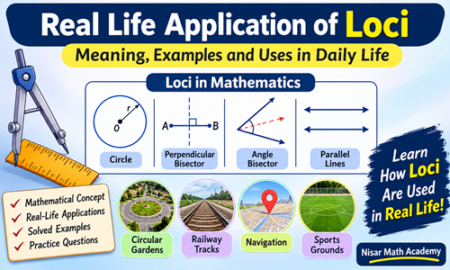
Some common geometrical loci are:
- A circle is the locus of points at a fixed distance from a fixed point.
- A perpendicular bisector is the locus of points equidistant from two fixed points.
- An angle bisector is the locus of points equidistant from the two arms of an angle.
- Two parallel lines are the loci of points at a fixed perpendicular distance from a given straight line, one on each side.
2. Why Are Loci Important in Mathematics?
Loci are important because they help us find all possible positions of a point under certain conditions.
They are used in:
- Geometrical constructions.
- Finding locations at a fixed distance.
- Designing roads and buildings.
- Navigation and positioning.
- Engineering and architecture.
- Computer graphics and mapping.
Understanding loci also makes it easier to solve geometrical construction problems in Class 9 Maths.
3. Important Rules and Formulas of Loci
Before discussing the real life application of loci, let us understand some important geometrical rules.
3.1 Locus of Points at a Fixed Distance from a Point
The locus of all points at a fixed distance from a fixed point is a circle.
If O is the fixed point and r is the constant distance, then:
OP = r
Here:
- O = Centre of the circle.
- P = Any point on the circle.
- r = Radius of the circle.
3.2 Locus of Points Equidistant from Two Fixed Points
The locus of all points equidistant from two fixed points A and B is the perpendicular bisector of line segment AB.
Mathematically:
PA = PB
Here, P represents any point on the perpendicular bisector.
3.3 Locus of Points Equidistant from Two Intersecting Lines
The locus of points equidistant from two intersecting straight lines consists of the two angle bisectors of the angles formed by those lines.
3.4 Locus of Points at a Fixed Distance from a Straight Line
The locus of points at a fixed perpendicular distance from a straight line consists of two lines parallel to the given line, one on each side.
3.5 Locus of Points Inside a Circle
The set of all points whose distance from a fixed centre is less than a given radius lies inside the circle.
If O is the centre and r is the radius:
OP < r
Similarly:
- OP = r represents points on the circumference.
- OP > r represents points outside the circle.
4. Real Life Application of Loci
Loci are not limited to classroom geometry. They have several practical applications in different fields.
Let us understand some important examples.
4.1 Finding Locations at a Fixed Distance
One of the simplest applications of loci is finding all possible locations at a fixed distance from a particular place.
Example:
Suppose a school is located at point O. A student wants to identify all locations that are exactly 2 kilometres away from the school.
The possible locations form a circular path around the school.
Here:
- The school represents the centre.
- The distance of 2 kilometres represents the radius.
- The circular boundary represents the required locus.
Mathematical concept: Circle.
Practical use: Finding locations within a specified distance of schools, hospitals, or other facilities.
4.2 Construction of Roads and Railway Tracks
Engineers sometimes need to maintain a fixed distance between a road or railway track and another straight boundary.
For example, if a railway track must remain 10 metres away from a straight boundary, the required path can be represented by a line parallel to that boundary.
The locus of points at a fixed perpendicular distance from a straight line consists of two parallel lines.
Mathematical concept: Parallel lines.
Practical use: Planning routes and maintaining required distances in construction projects.
4.3 Finding a Location Equidistant from Two Places
Suppose two villages, A and B, are located at different positions. A water supply facility needs to be placed at a location that is equally distant from both villages.
The required location must lie on the perpendicular bisector of the line segment joining A and B.
Mathematical concept: Perpendicular bisector.
Practical use: Planning the position of shared facilities between two locations.
4.4 Designing Buildings and Architecture
Architects use geometrical principles when designing buildings, gardens, parks, and other structures.
For example, suppose a circular garden is to be constructed around a fountain. Every point on its boundary must remain at the same distance from the fountain.
The boundary of the garden follows a circular locus.
Mathematical concept: Circle.
Practical use: Designing circular gardens, fountains, roundabouts, and other structures.
4.5 Navigation and Positioning
In navigation, distance measurements can help determine possible positions.
Suppose a ship is known to be 5 kilometres away from a fixed lighthouse. Its possible positions lie on a circle centred at the lighthouse, with a radius of 5 kilometres.
A second independent distance measurement can help narrow down the possible positions.
Mathematical concept: Intersection of loci.
Practical use: Understanding distance-based positioning and navigation systems.
4.6 Designing Sports Grounds
Loci are also useful in designing sports facilities.
For example, circular tracks, centre circles, and other marked areas in sports grounds involve geometrical shapes based on fixed distances.
A centre circle is formed by all points at the same distance from its centre.
Mathematical concept: Circular locus.
Practical use: Designing sports grounds and maintaining geometrical measurements.
4.7 Computer Graphics and Animation
Computer graphics use geometrical principles to create shapes, paths, and movements.
For example, when an object moves around a fixed point while maintaining a constant distance, its path is circular.
Similarly, software can use perpendicular bisectors and angle bisectors to calculate geometrical positions.
Mathematical concept: Geometrical loci.
Practical use: Designing computer-generated shapes, animations, and movement paths.
4.8 Planning the Location of Public Facilities
Suppose a new emergency facility must be located equally far from two important locations.
The perpendicular bisector of the line segment joining those locations provides the possible positions that satisfy the equal-distance condition.
Additional requirements, such as road access and land availability, can then help determine the final location.
Mathematical concept: Perpendicular bisector.
Practical use: Understanding geometrical conditions in public facility planning.
5. Diagram-Based Explanation of Loci
Diagrams make the concept of loci easier to understand.
Diagram 1: Circle as a Locus
Imagine a fixed point O in the centre of a circle.
Draw several points P, Q, and R on its circumference.
The distances are:
OP = OQ = OR = r
This shows that every point on the circumference is at the same distance from O.
Therefore, the circle is the locus of points at a fixed distance from a fixed point.
Diagram 2: Perpendicular Bisector
Draw a horizontal line segment AB.
Find its midpoint M and draw a perpendicular line through M.
Choose any point P on this perpendicular line.
The distances from P to A and B are equal:
PA = PB
This demonstrates that the perpendicular bisector is the locus of points equidistant from two fixed points.
Diagram 3: Angle Bisector
Draw an angle ABC.
Construct its angle bisector.
Choose any point P on the angle bisector.
Draw perpendicular lines from P to both arms of the angle.
If these perpendicular distances are PM and PN, then:
PM = PN
Thus, the angle bisector is the locus of points equidistant from the two arms of an angle.
6. Step-by-Step Solved Examples
Let us solve some problems to understand how loci are applied in mathematical situations.
Example 1: Finding the Radius of a Circular Locus
Question: A moving point remains at a constant distance of 7 cm from a fixed point O. What is its locus?
Solution:
Step 1: Identify the fixed point.
O is the fixed point.
Step 2: Identify the constant distance.
r = 7 cm
Step 3: Apply the rule of loci.
The locus of a point at a fixed distance from a fixed point is a circle.
Answer: The required locus is a circle with centre O and radius 7 cm.
Example 2: Finding an Equidistant Location
Question: Two points A and B are 12 cm apart. Find the geometrical locus of a point that is equally distant from A and B.
Solution:
Step 1: Given:
AB = 12 cm
Step 2: The required condition is:
PA = PB
Step 3: Construct the perpendicular bisector of AB.
Since every point on the perpendicular bisector is equally distant from A and B, it satisfies the given condition.
Answer: The required locus is the perpendicular bisector of AB.
Example 3: Finding the Perpendicular Distance from a Line
Question: A point moves so that it always remains 4 cm away from a straight line. Describe its locus.
Solution:
Step 1: Identify the given condition.
The perpendicular distance is constant and equal to 4 cm.
Step 2: Apply the locus rule.
Points at a fixed perpendicular distance from a straight line form two parallel lines.
Step 3: Draw two parallel lines.
Both lines must be 4 cm away from the given line, one on each side.
Answer: The locus consists of two parallel lines, each 4 cm away from the given line.
Example 4: Finding the Distance from a Fixed Point
Question: A circular park has a centre O. A point P lies on its boundary. If OP = 15 metres, find the diameter of the park.
Solution:
Given:
Radius = 15 m
Formula:
Diameter = 2 × Radius
Putting the value:
Diameter = 2 × 15
Diameter = 30 m
Answer: The diameter of the park is 30 metres.
Example 5: Finding a Point Equidistant from Two Locations
Question: Two buildings A and B are 20 metres apart. A security camera is to be installed at a point that is equally distant from both buildings. What geometrical construction can be used?
Solution:
Step 1: Draw the line segment AB.
AB = 20 m
Step 2: Find its midpoint M.
AM = MB = 10 m
Step 3: Draw a perpendicular line through M.
Step 4: Select a suitable point P on the perpendicular bisector.
Then:
PA = PB
Answer: The camera’s possible positions lie on the perpendicular bisector of AB. The exact installation point requires an additional condition.
Example 6: Applying the Intersection of Two Loci
Question: A point P must be 5 cm from point A and 4 cm from point B. If AB = 6 cm, describe how to locate P.
Solution:
Step 1: Draw AB = 6 cm.
Step 2: Draw a circle with centre A and radius 5 cm.
Step 3: Draw another circle with centre B and radius 4 cm.
Step 4: Identify the intersection points of the two circles.
At each intersection point:
PA = 5 cm
PB = 4 cm
Answer: The intersection points of the two circles represent the possible positions of P. There are two possible positions in this case.
7. How Are Loci Used in Geometrical Constructions?
In Class 9 Maths, loci are particularly important in geometrical constructions.
A geometrical construction often involves finding a point that satisfies two or more conditions.
For example:
- A point must be 5 cm from A.
- The same point must be equidistant from A and B.
We can construct the required point by drawing the appropriate loci and finding their intersection.
The intersection represents the position that satisfies both conditions.
This method is useful in solving construction problems accurately.
8. Common Mistakes Students Make
Students should avoid the following mistakes when solving questions about loci.
- Confusing locus and circle: A circle is only one type of locus. Not every locus is a circle.
- Ignoring perpendicular distance: The distance from a point to a straight line is measured along a perpendicular.
- Confusing midpoint and perpendicular bisector: A midpoint is a point, whereas a perpendicular bisector is a complete line.
- Forgetting the plural form: Locus is singular, while loci is plural.
- Ignoring both sides of a line: A fixed-distance locus from an unrestricted straight line generally consists of two parallel lines.
- Selecting the wrong intersection: When two loci intersect at multiple points, check which points satisfy all the given conditions.
9. Frequently Asked Questions About Real Life Application of Loci
Q1. What is the real life application of loci?
Loci are used in navigation, construction, architecture, road planning, computer graphics, and finding positions that satisfy specific distance conditions.
Q2. What is the simplest example of a locus?
A circle is the simplest example. It represents all points that are at a fixed distance from a fixed centre.
Q3. How are loci used in construction?
Loci help engineers and architects understand positions and boundaries that satisfy specific geometrical conditions.
Q4. What is the locus of points equidistant from two points?
It is the perpendicular bisector of the line segment joining the two fixed points.
Q5. What is the locus of points equidistant from two intersecting lines?
It consists of the two angle bisectors of the angles formed by the intersecting lines.
Q6. What is the difference between locus and loci?
Locus is the singular form, while loci is the plural form.
Q7. Why are loci important in Class 9 Maths?
Loci help students understand geometrical constructions, fixed distances, perpendicular bisectors, angle bisectors, and practical applications of geometry.
10. Learn More Class 9 Maths with Nisar Math Academy
Understanding geometrical concepts becomes easier when students combine mathematical notes with video explanations and regular practice.
Nisar Math Academy provides online mathematics learning resources, including:
- Class 9 Maths Notes.
- Recorded video lectures.
- Chapter-wise assessments.
- Solved mathematical questions.
- Worksheets and assignments.
- Mathematics lesson plans.
- Informational mathematics articles.
Students can access selected free resources, including notes for the first exercise of each chapter, selected assessments, lesson plans, and free lectures covering one question from each exercise.
Additional lectures and complete learning resources are available through website membership.
Visit https://nisarmathacademy.com/ to explore Class 9 Maths resources and improve your understanding of mathematics.
Conclusion
The real life application of loci demonstrates how geometrical concepts are useful beyond textbooks. Loci help us identify possible positions, maintain fixed distances, find equidistant locations, and understand geometrical paths.
From circular gardens and railway planning to navigation and computer graphics, the concept of loci has several practical uses.
For Class 9 Maths students, understanding the basic rules of loci and practising geometrical constructions provides a strong foundation for learning geometry.
3. Short Notes – Real Life Application of Loci
Short Notes: Loci
Definition
A locus is the path or set of all possible positions of a moving point that satisfies a given geometrical condition.
Plural of locus = Loci.
Important Rules of Loci
| Geometrical condition | Required locus |
|---|---|
| Fixed distance from a fixed point | Circle |
| Equidistant from two fixed points | Perpendicular bisector |
| Equidistant from two intersecting lines | Two angle bisectors |
| Fixed perpendicular distance from a straight line | Two parallel lines |
| Distance less than a fixed radius from a centre | Interior of a circle |
Important Formulas
- Circle circumference: (C = 2 * pi * r)
- Circle area: (A = pi * r * r)
- Diameter: (d = 2r)
- Radius: (r = d/2)
Real-Life Applications
- Finding places at a fixed distance from a school or hospital.
- Planning roads and railway tracks.
- Locating facilities equidistant from two places.
- Designing circular gardens and fountains.
- Understanding distance-based navigation.
- Designing sports grounds.
- Creating paths in computer graphics.
- Planning buildings and public facilities.
Important Geometrical Facts
- Every point on a circle is equally distant from its centre.
- Every point on a perpendicular bisector is equally distant from the endpoints of a line segment.
- Every point on an angle bisector is equally distant from the two arms of an angle.
- The shortest distance between a point and a straight line is the perpendicular distance.
Important Difference
- Locus: Singular form.
- Loci: Plural form.
Remember: The intersection of two loci gives the possible point or points that satisfy both geometrical conditions.
4. Multiple-Choice Questions (MCQs)
MCQs: Real Life Application of Loci
Q1. What is the plural of locus?
A. Locuses
B. Loci
C. Locum
D. Locis
Correct Answer: B. Loci
Q2. The locus of points at a fixed distance from a fixed point is a:
A. Straight line
B. Triangle
C. Circle
D. Rectangle
Correct Answer: C. Circle
Q3. The locus of points equidistant from two fixed points is called:
A. Angle bisector
B. Perpendicular bisector
C. Median
D. Altitude
Correct Answer: B. Perpendicular bisector
Q4. A point moves at a constant distance of 8 cm from a fixed point. What is its locus?
A. Circle of radius 8 cm
B. Circle of diameter 8 cm
C. Straight line of length 8 cm
D. Square of side 8 cm
Correct Answer: A. Circle of radius 8 cm
Q5. What is the locus of points equidistant from two intersecting lines?
A. Two parallel lines
B. Two angle bisectors
C. One circle
D. One perpendicular bisector
Correct Answer: B. Two angle bisectors
Q6. A point is 6 cm away from a fixed straight line. Its locus consists of:
A. Two circles
B. Two parallel lines
C. Two perpendicular lines
D. One triangle
Correct Answer: B. Two parallel lines
Q7. If the radius of a circular locus is 9 cm, its diameter is:
A. 9 cm
B. 18 cm
C. 27 cm
D. 36 cm
Correct Answer: B. 18 cm
Q8. Which geometrical concept is useful for locating a point equidistant from two villages?
A. Circle
B. Perpendicular bisector
C. Median
D. Altitude
Correct Answer: B. Perpendicular bisector
Q9. What does the intersection of two loci represent?
A. A point satisfying both conditions
B. The centre of every circle
C. The midpoint of every line
D. An unrelated point
Correct Answer: A. A point satisfying both conditions
Q10. A circle has a diameter of 24 cm. Its radius is:
A. 6 cm
B. 10 cm
C. 12 cm
D. 48 cm
Correct Answer: C. 12 cm
Q11. Which of the following is a practical application of circular loci?
A. Designing a circular garden
B. Measuring the weight of an object
C. Calculating temperature
D. Finding the mass of a substance
Correct Answer: A. Designing a circular garden
Q12. The shortest distance between a point and a straight line is measured along:
A. A parallel line
B. A perpendicular line
C. A curved line
D. Any slanting line
Correct Answer: B. A perpendicular line
Q13. If OP = 5 cm for every point P on a circular locus, then O is the:
A. Radius
B. Diameter
C. Centre
D. Circumference
Correct Answer: C. Centre
Q14. A circular park has a radius of 10 metres. Its diameter is:
A. 5 m
B. 10 m
C. 20 m
D. 40 m
Correct Answer: C. 20 m
Q15. Which of the following fields can use geometrical principles of loci?
A. Navigation
B. Architecture
C. Computer graphics
D. All of these
Correct Answer: D. All of these
5. Worksheet / Assignment
Worksheet: Real Life Application of Loci
Subject: Mathematics
Class: 9
Topic: Loci
Instructions: Attempt all questions. Show complete working for numerical problems.
Part A: Definitions and Basic Concepts
Q1. Define a locus in mathematics.
Q2. What is the plural of locus?
Q3. Define the locus of points equidistant from two fixed points.
Q4. What is the locus of points at a fixed perpendicular distance from a straight line?
Part B: Conceptual Questions
Q5. Explain why a circle is considered a locus.
Q6. Describe two real-life applications of loci.
Q7. Explain the difference between a locus and loci.
Q8. Which geometrical locus is useful for finding a location equidistant from two villages? Explain your answer.
Part C: Numerical Problems
Q9. A point moves at a constant distance of 6 cm from a fixed point O. Identify its locus and state its radius.
Q10. A circular garden has a diameter of 30 metres. Calculate its radius.
Q11. A circular park has a radius of 14 metres. Find its diameter.
Q12. Two fixed points A and B are 16 cm apart. Describe the construction required to find the locus of points equidistant from A and B.
Part D: Application-Based Questions
Q13. A hospital is located at point O. A residential area is to be developed at a distance of exactly 3 km from the hospital. Describe the geometrical locus of the possible locations.
Q14. Two schools are located at points A and B. A library is to be built at a location equally distant from both schools. Which geometrical construction will help identify the possible locations?
Q15. A point P must remain 5 cm from point A and 4 cm from point B. If AB = 6 cm, describe the construction used to locate P.
Answer Key
Q1. A locus is the path or set of all possible positions of a moving point satisfying a given geometrical condition.
Q2. Loci.
Q3. The perpendicular bisector of the line segment joining the two fixed points.
Q4. Two parallel straight lines, one on each side of the given line.
Q5. A circle consists of all points at an equal fixed distance from its centre.
Q6. Examples include designing circular gardens and locating places equidistant from two locations.
Q7. Locus is singular, whereas loci is plural.
Q8. Perpendicular bisector, because every point on it is equally distant from the two fixed points.
Q9. A circle with centre O and radius 6 cm.
Q10.
Given: Diameter = 30 m
Formula:
Radius = Diameter ÷ 2
= 30 ÷ 2
Answer: 15 m
Q11.
Given: Radius = 14 m
Formula:
Diameter = 2 × Radius
= 2 × 14
Answer: 28 m
Q12. Draw AB = 16 cm. Find its midpoint and construct a perpendicular line through the midpoint. This perpendicular bisector is the required locus.
Q13. A circle with the hospital as its centre and radius 3 km.
Q14. Construct the perpendicular bisector of AB.
Q15.
- Draw AB = 6 cm.
- Draw a circle with centre A and radius 5 cm.
- Draw another circle with centre B and radius 4 cm.
- The intersection points of the circles are the possible positions of P.
6. Frequently Asked Questions (FAQs)
These FAQs can also be used as a separate FAQ section or adapted for FAQ schema.
FAQs About Real Life Application of Loci
1. What is the real life application of loci?
Loci are used in navigation, construction, architecture, road planning, and finding positions at fixed distances from particular locations.
2. What is a locus in simple words?
A locus is the path or set of all points that satisfy a particular geometrical condition.
3. What are the four main types of loci studied in geometry?
Common examples include circles, perpendicular bisectors, angle bisectors, and parallel lines.
4. How are loci used in daily life?
They help in designing circular structures, planning routes, identifying equidistant locations, and understanding positioning.
5. What is the locus of a point equidistant from two fixed points?
It is the perpendicular bisector of the line segment joining those points.
6. What is the locus of points at a fixed distance from a straight line?
It consists of two parallel lines at the specified perpendicular distance from the given line.
7. Why should Class 9 students learn loci?
Loci develop geometrical understanding and help students solve construction problems involving fixed distances and equal distances.
8. Where can I find Class 9 Maths notes and lectures about loci?
Students can explore mathematics notes, recorded lectures, solved questions, and other learning resources at Nisar Math Academy: https://nisarmathacademy.com/.
You May be Interested In:
Loci and Construction: Definitions, Rules, Solved Examples, and Class 9 Maths Notes
Altitudes of Triangle: Definition, Properties, Formulas and Solved Examples
Angle Bisectors of a Triangle: Definition, Properties, Examples & MCQs
Leave a Reply