Altitudes of Triangle: Definition, Properties, Formulas and Solved Examples
Introduction
The altitudes of triangle are important concepts in geometry, especially in Class 9 Mathematics. An altitude helps us understand the height of a triangle, calculate its area, and identify a special point called the orthocentre.
In this article, you will learn the altitude of a triangle definition, how to draw an altitude of a triangle, the important properties of altitudes, and how to solve related mathematical problems step by step.
These notes are designed to help students understand the concept clearly and prepare for mathematics exercises, tests, and examinations.
What Is the Altitude of a Triangle?
Definition of Altitude of a Triangle
An altitude of a triangle is a perpendicular line segment drawn from a vertex of the triangle to the opposite side or to the line containing the opposite side.
The altitude makes an angle of 90° with the opposite side or its extended line.
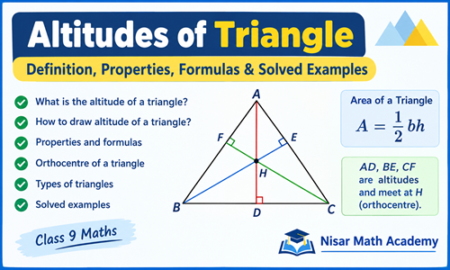
For example, consider triangle ABC. If a perpendicular line segment AD is drawn from vertex A to side BC, then AD is an altitude of triangle ABC.
Here:
- A is the vertex from which the altitude is drawn.
- BC is the opposite side, also called the base in this example.
- D is the foot of the altitude.
- AD is the altitude.
- AD ⟂ BC, which means AD is perpendicular to BC.
Diagram-Based Explanation
Imagine a triangle ABC with BC as its horizontal base and vertex A above it. Draw a straight line from A to BC so that it meets BC at point D and forms a right angle.
The resulting line segment AD represents the altitude.
The important point is that an altitude must be perpendicular to the opposite side or its extension. A line drawn from a vertex to the opposite side is not necessarily an altitude unless it forms a 90° angle.
How Many Altitudes Does a Triangle Have?
Every triangle has exactly three altitudes, one from each vertex.
For triangle ABC:
- AD is the altitude from vertex A to side BC.
- BE is the altitude from vertex B to side AC.
- CF is the altitude from vertex C to side AB.
These three altitudes are concurrent, which means that they meet at a common point called the orthocentre.
Important Properties of Altitudes of a Triangle
The following properties are useful for solving geometry problems.
1. Every Triangle Has Three Altitudes
A triangle has three vertices, and an altitude can be drawn from each vertex to the opposite side or its extension.
Therefore, every triangle has three altitudes.
2. An Altitude Is Perpendicular to the Opposite Side
If AD is an altitude of triangle ABC, then:
AD ⟂ BC
Therefore:
∠ADB = 90°
This perpendicular relationship is the defining property of an altitude.
3. Altitudes Are Concurrent
The altitudes of a triangle are concurrent. This means all three altitudes, or their supporting lines, meet at one point.
This common point is known as the orthocentre.
4. The Orthocentre Depends on the Type of Triangle
The position of the orthocentre varies according to the triangle’s angles.
- Acute-angled triangle: The orthocentre lies inside the triangle.
- Right-angled triangle: The orthocentre lies at the vertex containing the 90° angle.
- Obtuse-angled triangle: The orthocentre lies outside the triangle.
5. An Altitude May Lie Inside or Outside a Triangle
In an acute-angled triangle, each altitude lies inside the triangle.
In a right-angled triangle, two sides themselves act as altitudes.
In an obtuse-angled triangle, some altitudes meet the extensions of the opposite sides and therefore extend outside the triangle.
6. Altitude and Median Are Different
An altitude is perpendicular to the opposite side or its extension.
A median joins a vertex to the midpoint of the opposite side.
An altitude and a median may be the same line segment in special triangles, but they are not generally the same.
How to Draw an Altitude of a Triangle
Follow these steps to construct an altitude using a ruler and a set square.
- Draw triangle ABC.
- Select vertex A.
- Identify the opposite side BC.
- Place one edge of the set square along BC.
- Draw a perpendicular line from A to BC.
- Mark the intersection point as D.
- Write AD ⟂ BC and mark the right angle at D.
Thus, AD is the altitude from vertex A.
How to Draw an Altitude When the Opposite Side Must Be Extended
If triangle ABC is obtuse, the perpendicular from one vertex may meet the extension of the opposite side rather than the side itself.
In that case:
- Extend the required side using a ruler.
- Draw a perpendicular from the selected vertex to the extended line.
- Mark the foot of the perpendicular.
- Label the perpendicular segment as the altitude.
Remember that an altitude is defined using the opposite side’s line, so it does not always have to fall within the triangle.
Formulas Related to the Altitude of a Triangle
1. Area Formula Using Altitude
The area of a triangle is:
Area = ½ × base × height
If the base is b and the corresponding altitude is h, then:
A = ½bh
Here:
- A = area of the triangle
- b = length of the base
- h = perpendicular height or corresponding altitude
2. Finding the Altitude
Rearranging the area formula gives:
h = 2A ÷ b
This formula is useful when the area and base are known.
3. Finding the Base
If the area and altitude are known, the base can be calculated as:
b = 2A ÷ h
Always use the altitude corresponding to the chosen base.
Solved Examples
Example 1: Finding the Area Using an Altitude
Question: The base of a triangle is 12 cm and its corresponding altitude is 7 cm. Find its area.
Solution:
Step 1: Write the formula.
Area = ½ × base × altitude
Step 2: Substitute the values.
Area = ½ × 12 × 7
Step 3: Calculate.
Area = 6 × 7 = 42 cm²
Answer: 42 cm²
Example 2: Finding the Altitude from the Area
Question: The area of a triangle is 60 cm² and its base is 15 cm. Find the corresponding altitude.
Solution:
Step 1: Use the formula.
h = 2A ÷ b
Step 2: Substitute the values.
h = (2 × 60) ÷ 15
Step 3: Simplify.
h = 120 ÷ 15 = 8 cm
Answer: 8 cm
Example 3: Finding the Base of a Triangle
Question: A triangle has an area of 48 cm² and an altitude of 8 cm. Find its corresponding base.
Solution:
Step 1: Write the formula.
b = 2A ÷ h
Step 2: Substitute the values.
b = (2 × 48) ÷ 8
Step 3: Calculate.
b = 96 ÷ 8 = 12 cm
Answer: 12 cm
Example 4: Understanding the Altitude of a Right-Angled Triangle
Question: Triangle ABC is right-angled at B. Identify two altitudes of the triangle.
Solution:
Since ∠ABC = 90°, AB is perpendicular to BC.
Therefore, AB is an altitude from A to BC.
Similarly, BC is perpendicular to AB, so BC is an altitude from C to AB.
The third altitude is drawn from B perpendicular to the hypotenuse AC.
Answer: AB and BC are two altitudes. The third altitude is the perpendicular from B to AC.
Example 5: Finding an Altitude in an Isosceles Triangle
Question: An isosceles triangle has equal sides of 13 cm each and a base of 10 cm. Find the altitude drawn from the vertex between the equal sides.
Solution:
Step 1: In an isosceles triangle, the altitude from the vertex between the equal sides bisects the base.
Half of the base = 10 ÷ 2 = 5 cm.
Step 2: The altitude, half of the base, and one equal side form a right-angled triangle.
Let the altitude be h.
Using the Pythagorean theorem:
h² + 5² = 13²
h² + 25 = 169
h² = 144
h = 12 cm
Answer: 12 cm
Example 6: Finding the Area of a Triangle with a Different Shape
Question: A triangle has a base of 9 m and a perpendicular altitude of 4 m. Calculate its area.
Solution:
Area = ½ × base × altitude
Area = ½ × 9 × 4
Area = 18 m²
Answer: 18 m²
Altitudes in Different Types of Triangles
Altitudes of an Acute-Angled Triangle
An acute-angled triangle has all three angles less than 90°.
All three altitudes lie inside the triangle, and they meet at the orthocentre inside it.
Altitudes of a Right-Angled Triangle
A right-angled triangle has one angle equal to 90°.
Its two perpendicular sides are themselves altitudes. The third altitude is drawn from the right-angle vertex to the hypotenuse.
The orthocentre is located at the right-angle vertex.
Altitudes of an Obtuse-Angled Triangle
An obtuse-angled triangle has one angle greater than 90°.
Two altitudes meet the extensions of the opposite sides. The three altitudes meet at the orthocentre outside the triangle.
How Many Altitudes of an Isosceles Triangle Are Congruent?
An isosceles triangle has two equal sides and two equal base angles.
The two altitudes drawn from the base vertices to the opposite equal sides are congruent.
To understand this, consider an isosceles triangle ABC in which AB = AC.
Let BE be the altitude from B to AC, and let CD be the altitude from C to AB.
The area of triangle ABC can be written in two ways:
Area = ½ × AC × BE
Area = ½ × AB × CD
Since AB = AC, the two equations imply that BE = CD.
Therefore, these two altitudes are congruent.
The altitude drawn from the vertex between the equal sides to the base is not generally congruent to the other two altitudes.
In an equilateral triangle, all three altitudes are congruent because all three sides are equal.
What Is the Orthocentre of a Triangle?
The orthocentre is the point where the three altitudes of a triangle, or their supporting lines, meet.
It is an important point in triangle geometry.
For example, if AD, BE, and CF are the altitudes of triangle ABC, their common intersection point is H.
Thus, H is the orthocentre.
Remember:
- The orthocentre is inside an acute triangle.
- The orthocentre is at the right-angle vertex of a right triangle.
- The orthocentre is outside an obtuse triangle.
Real-Life Applications of Altitudes
Altitudes are useful in mathematics and practical measurements.
- Finding the area of land: If the base and perpendicular height of a triangular plot are known, its area can be calculated.
- Construction and engineering: Triangular designs often require perpendicular measurements for accurate calculations.
- Architecture: Altitudes help calculate the areas of triangular sections in roofs and structural designs.
- Surveying: Perpendicular distances can help determine the area of triangular regions.
- Geometry problems: Altitudes help solve problems involving right triangles, the Pythagorean theorem, and the orthocentre.
Common Mistakes Students Should Avoid
- Confusing an altitude with a median: A median joins a vertex to the midpoint of the opposite side; an altitude forms a right angle.
- Assuming every altitude lies inside the triangle: In an obtuse triangle, some altitudes meet extended sides.
- Forgetting the perpendicular condition: A line segment is an altitude only when it is perpendicular to the opposite side’s line.
- Using the wrong height in the area formula: The height must correspond to the selected base.
- Confusing area units with length units: An altitude is measured in cm or m, while area is measured in cm² or m².
- Assuming all three altitudes of an isosceles triangle are equal: Only the two altitudes from the base vertices are necessarily congruent; all three are congruent in an equilateral triangle.
Frequently Asked Questions
What is the altitude of a triangle?
The altitude is a perpendicular line segment drawn from a vertex to the opposite side or its extension.
How many altitudes does a triangle have?
Every triangle has three altitudes, one from each vertex.
Are the altitudes of a triangle concurrent?
Yes. The three altitudes, or their supporting lines, meet at a common point called the orthocentre.
Where is the orthocentre of a right-angled triangle?
It is located at the vertex containing the right angle.
Can an altitude lie outside a triangle?
Yes. In an obtuse-angled triangle, some altitudes meet the extensions of the opposite sides.
How is altitude used to calculate the area of a triangle?
Use the formula Area = ½ × base × altitude.
How many altitudes of an isosceles triangle are congruent?
The two altitudes from the base vertices to the opposite equal sides are congruent. In an equilateral triangle, all three altitudes are congruent.
Conclusion
The altitudes of triangle are perpendicular line segments drawn from the vertices to the opposite sides or their extensions. Every triangle has three altitudes, and they meet at the orthocentre.
Understanding the properties of altitudes makes it easier to calculate triangle areas, solve geometry problems, and identify the orthocentre in different types of triangles.
For additional learning, students can explore Class 9 Maths notes, recorded video lectures, solved questions, worksheets, and assessments at Nisar Math Academy. Some learning resources are available free of charge, while full courses and additional materials are available through website membership.
3. Short Notes: Altitudes of Triangle
Important Definitions
- Altitude: A perpendicular line segment drawn from a vertex to the opposite side or its extension.
- Foot of altitude: The point where the altitude meets the opposite side or its extended line.
- Orthocentre: The common point where the three altitudes of a triangle meet.
- Concurrent lines: Lines that pass through the same point.
Important Properties
- Every triangle has three altitudes.
- An altitude is perpendicular to the opposite side or its extension.
- The three altitudes are concurrent at the orthocentre.
- In an acute triangle, the orthocentre lies inside the triangle.
- In a right triangle, the orthocentre lies at the right-angle vertex.
- In an obtuse triangle, the orthocentre lies outside the triangle.
- In an isosceles triangle, the two altitudes drawn from the base vertices to the opposite equal sides are congruent.
- In an equilateral triangle, all three altitudes are congruent.
Important Formulas
Area of a triangle:
Area = ½ × base × altitude
Altitude:
Altitude = (2 × Area) ÷ base
Base:
Base = (2 × Area) ÷ altitude
Quick Revision Table
| Type of triangle | Position of orthocentre |
|---|---|
| Acute-angled triangle | Inside the triangle |
| Right-angled triangle | At the right-angle vertex |
| Obtuse-angled triangle | Outside the triangle |
Important Difference
| Altitude | Median |
|---|---|
| Perpendicular to the opposite side or its extension | Ends at the midpoint of the opposite side |
| Forms a 90° angle | Does not necessarily form a 90° angle |
| Used to determine the perpendicular height | Used to connect a vertex to the midpoint |
Remember: An altitude is always perpendicular, but it does not always bisect the opposite side.
4. Multiple-Choice Questions (MCQs)
Choose the correct option for each question. The answer key follows the questions.
1. What is an altitude of a triangle?
A. A line joining two vertices
B. A perpendicular segment from a vertex to the opposite side’s line
C. A segment joining two midpoints
D. A line parallel to the base
2. How many altitudes does every triangle have?
A. One
B. Two
C. Three
D. Four
3. What angle does an altitude make with the opposite side’s line?
A. 45°
B. 60°
C. 90°
D. 180°
4. What is the common point of the three altitudes called?
A. Centroid
B. Incentre
C. Circumcentre
D. Orthocentre
5. Where is the orthocentre of an acute-angled triangle?
A. Inside the triangle
B. Outside the triangle
C. At a vertex
D. On the longest side
6. Where is the orthocentre of a right-angled triangle?
A. At the midpoint of the hypotenuse
B. At the right-angle vertex
C. Outside the triangle
D. At the centroid
7. Where is the orthocentre of an obtuse-angled triangle?
A. Inside the triangle
B. At the midpoint of a side
C. Outside the triangle
D. Always on the base
8. What is the area of a triangle with base 10 cm and altitude 6 cm?
A. 60 cm²
B. 30 cm²
C. 16 cm²
D. 20 cm²
9. A triangle has area 36 cm² and base 9 cm. What is its altitude?
A. 4 cm
B. 6 cm
C. 8 cm
D. 9 cm
10. What is the altitude of a triangle with area 40 m² and base 10 m?
A. 2 m
B. 4 m
C. 8 m
D. 10 m
11. Which statement about the altitudes of a triangle is correct?
A. They are always equal
B. They are always parallel
C. They are concurrent
D. They always bisect the sides
12. In an isosceles triangle ABC, AB = AC. Which altitudes are congruent?
A. Only the altitude from A and the altitude from B
B. The altitudes from B and C to AC and AB, respectively
C. All three in every isosceles triangle
D. None of the altitudes
13. Which two sides of a right-angled triangle are also altitudes?
A. The two sides forming the right angle
B. The hypotenuse and one leg
C. Only the hypotenuse
D. No sides are altitudes
14. Which formula gives the altitude when area A and base b are known?
A. h = A ÷ 2b
B. h = 2A ÷ b
C. h = A × b
D. h = b ÷ 2A
15. A triangle has a base of 14 cm and an altitude of 5 cm. Find its area.
A. 70 cm²
B. 35 cm²
C. 19 cm²
D. 28 cm²
5. Worksheet / Assignment
Altitudes of Triangle — Class 9 Maths Worksheet
Subject: Mathematics
Topic: Altitudes of Triangle
Instructions: Attempt all questions. Show your working for numerical problems.
Part A: Definitions and Concepts
- Define the altitude of a triangle.
- How many altitudes does a triangle have?
- What is the orthocentre of a triangle?
- What does it mean when three altitudes are concurrent?
- Differentiate between an altitude and a median of a triangle.
Part B: Conceptual Questions
- Where is the orthocentre located in an acute-angled triangle?
- Where is the orthocentre located in an obtuse-angled triangle?
- Explain why two sides of a right-angled triangle are also altitudes.
- In an isosceles triangle ABC, AB = AC. Which two altitudes are congruent? Explain briefly.
Part C: Numerical Problems
- Find the area of a triangle whose base is 16 cm and altitude is 9 cm.
- The area of a triangle is 84 cm² and its base is 14 cm. Find the corresponding altitude.
- A triangle has an area of 54 m² and a perpendicular altitude of 6 m. Find its base.
- An isosceles triangle has equal sides of 10 cm each and a base of 12 cm. Find the altitude drawn from the vertex between the equal sides.
- The base of a triangular garden is 20 m and its perpendicular height is 8 m. Calculate its area.
- Draw an obtuse-angled triangle ABC. Extend the necessary sides and construct all three altitudes. Mark the orthocentre H.
Answer Key
- A perpendicular segment from a vertex to the opposite side or its extended line.
- Three.
- The common point of the three altitudes.
- The three altitudes meet at one point.
- An altitude is perpendicular to the opposite side’s line; a median joins a vertex to the midpoint of the opposite side.
- Inside the triangle.
- Outside the triangle.
- The two perpendicular sides each form a 90° angle with the other, so each is an altitude from the opposite endpoint.
- The altitudes from B and C to AC and AB, respectively, are congruent.
- Area = ½ × 16 × 9 = 72 cm².
- Altitude = (2 × 84) ÷ 14 = 12 cm.
- Base = (2 × 54) ÷ 6 = 18 m.
- Half the base = 6 cm. By the Pythagorean theorem, h² + 6² = 10², so h² = 64 and h = 8 cm.
- Area = ½ × 20 × 8 = 80 m².
- The three altitude lines meet at a point outside the obtuse-angled triangle. This point is the orthocentre H.
6. Frequently Asked Questions (FAQs)
1. What is the altitude of a triangle?
The altitude is a perpendicular line segment drawn from a vertex to the opposite side or its extension.
2. How many altitudes does a triangle have?
Every triangle has three altitudes, one from each vertex.
3. Are the altitudes of a triangle concurrent?
Yes. The three altitudes, or their supporting lines, meet at a common point called the orthocentre.
4. How do you calculate the altitude of a triangle?
When the area and base are known, use the formula:
Altitude = (2 × Area) ÷ base.
5. How many altitudes of an isosceles triangle are congruent?
The two altitudes from the base vertices to the opposite equal sides are congruent. In an equilateral triangle, all three altitudes are congruent.
6. Can an altitude lie outside a triangle?
Yes. In an obtuse-angled triangle, some altitudes meet the extensions of the opposite sides.
7. What is the difference between altitude and height?
In triangle geometry, altitude refers to the perpendicular segment, while height refers to its length. The terms are often used interchangeably.
8. Where can students find Class 9 Maths notes and video lectures?
Students can explore Class 9 Maths notes, recorded video lectures, assessments, worksheets, and lesson plans at Nisar Math Academy. Selected resources are free, while full courses and additional resources are available through website membership.
You May be Interested In:
Angle Bisectors of a Triangle: Definition, Properties, Examples & MCQs
How Many Types of Triangles Are There? Perpendicular Bisectors and Medians of a Triangle
How Many Types of Triangles Are There? Names, Properties & Examples
Leave a Reply