What Is the Probability of an Event Not Occurring? Definition, Formula and Solved Examples
Introduction
Probability is an important branch of mathematics that helps us measure the possibility of an event happening. Sometimes, however, we are interested in finding the probability that a particular event will not happen.
For example:
- What is the probability of not getting a head when tossing a coin?
- What is the probability of not rolling a 6 on a die?
- What is the probability of selecting a red ball when the selected ball must not be blue?
These questions involve the probability of an event not occurring.
In probability, the event not occurring is called the complementary event. We can calculate its probability by subtracting the probability of the original event from 1.
In this article, we will learn the definition, formula, examples, and practical applications of complementary probability. We will also solve numerical problems to make the concept easier for Class 9 Maths students.
What Is the Probability of an Event Not Occurring?
The probability of an event not occurring is the probability that a particular event will not happen.
It is also known as the probability of the complementary event.
For example, when a coin is tossed, there are two possible outcomes:
- Head (H)
- Tail (T)
If event A represents getting a head, then the event of not getting a head is getting a tail.
The probability of not getting a head is equal to the probability of getting a tail.
Mathematically:
P(Not A) = P(A’)
Here, A’ represents the complement of event A.
Definition of Complementary Event
The complement of an event consists of all the outcomes in the sample space that do not belong to that event.
In simple words, if an event describes something happening, its complementary event describes the same thing not happening.
Example:
When a standard die is rolled, the sample space is:
S = {1, 2, 3, 4, 5, 6}
Let event A be getting an even number.
A = {2, 4, 6}
The complementary event A’ is getting an odd number.
A’ = {1, 3, 5}
Therefore, A and A’ together contain all possible outcomes of the experiment.
Formula for the Probability of an Event Not Occurring
The main formula used to find the probability of an event not occurring is:
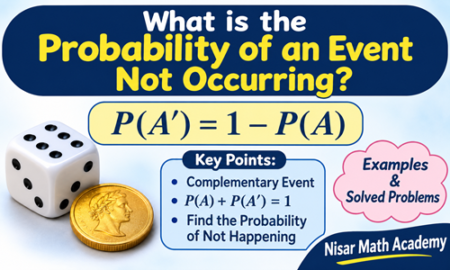
P(A’) = 1 − P(A)
Where:
- P(A’) = Probability of the event not occurring.
- P(A) = Probability of the original event occurring.
- 1 = Total probability of all possible outcomes.
Another way to write the formula is:
P(Not A) = 1 − P(A)
This is called the complement rule of probability.
Why Do We Subtract the Probability from 1?
The probability of all possible outcomes of an experiment is always equal to 1.
An event either occurs or does not occur. These two possibilities cover the entire sample space.
Therefore:
P(A) + P(A’) = 1
Rearranging:
P(A’) = 1 − P(A)
This means that if we know the probability of an event occurring, we can easily find the probability of it not occurring.
Diagram-Based Explanation of Complementary Probability
Consider a rectangle representing the complete sample space S.
Divide the rectangle into two separate regions:
- One region represents event A.
- The remaining region represents the complementary event A’.
The entire rectangle represents all possible outcomes.
Therefore:
S = A ∪ A’
The two regions do not overlap because an event and its complement cannot occur simultaneously.
The relationship can be represented as:
P(A) + P(A’) = 1
For example, if the probability of event A is 0.4, the remaining region has probability:
P(A’) = 1 − 0.4 = 0.6
Thus, the probability of the event not occurring is 0.6.
Important Properties of Complementary Probability
The following properties are useful when solving probability problems.
1. The sum of an event and its complement is 1.
P(A) + P(A’) = 1
2. The probability of an event lies between 0 and 1.
0 ≤ P(A) ≤ 1
3. The probability of its complement also lies between 0 and 1.
0 ≤ P(A’) ≤ 1
4. An impossible event has probability 0.
If P(A) = 0, then:
P(A’) = 1 − 0 = 1
5. A certain event has probability 1.
If P(A) = 1, then:
P(A’) = 1 − 1 = 0
Difference Between an Event and Its Complement
| Event | Complementary Event |
|---|---|
| An event describes an outcome or a group of outcomes. | Its complement describes all outcomes outside that event. |
| Represented by A. | Represented by A’ or Aᶜ. |
| P(A) is its probability. | P(A’) is its probability. |
| It may occur or may not occur. | It occurs when the original event does not occur. |
For example, when rolling a die:
- Event A: Getting a number greater than 3 = {4, 5, 6}.
- Complement A’: Getting a number not greater than 3 = {1, 2, 3}.
Solved Examples: Probability of an Event Not Occurring
The following examples explain how to apply the complement rule step by step.
Example 1: Probability of Not Getting a Head
A fair coin is tossed once. Find the probability of not getting a head.
Solution:
Step 1: Write the sample space.
S = {H, T}
Step 2: Let A be the event of getting a head.
P(A) = 1/2
Step 3: Apply the complement formula.
P(A’) = 1 − P(A)
Step 4: Substitute the value.
P(A’) = 1 − 1/2
P(A’) = 1/2
Answer: The probability of not getting a head is 1/2.
Example 2: Probability of Not Getting a 6
A fair die is rolled once. Find the probability of not getting 6.
Solution:
Step 1: Write the sample space.
S = {1, 2, 3, 4, 5, 6}
Step 2: Probability of getting 6:
P(A) = 1/6
Step 3: Apply the complement formula.
P(A’) = 1 − P(A)
Step 4: Substitute the value.
P(A’) = 1 − 1/6
P(A’) = 5/6
Answer: The probability of not getting 6 is 5/6.
Example 3: Probability of Not Getting an Even Number
A fair die is rolled once. Find the probability of not getting an even number.
Solution:
Step 1: Write the sample space.
S = {1, 2, 3, 4, 5, 6}
Step 2: Identify the even numbers.
A = {2, 4, 6}
Step 3: Calculate the probability of getting an even number.
P(A) = 3/6 = 1/2
Step 4: Find the complementary probability.
P(A’) = 1 − P(A)
P(A’) = 1 − 1/2
P(A’) = 1/2
Answer: The probability of not getting an even number is 1/2.
Example 4: Probability of Not Selecting a Red Ball
A bag contains 5 red balls and 3 blue balls. One ball is selected randomly. Find the probability that the selected ball is not red.
Solution:
Step 1: Find the total number of balls.
Total balls = 5 + 3 = 8
Step 2: Calculate the probability of selecting a red ball.
P(Red) = 5/8
Step 3: Apply the complement formula.
P(Not Red) = 1 − P(Red)
Step 4: Substitute the value.
P(Not Red) = 1 − 5/8
P(Not Red) = 3/8
Answer: The probability of not selecting a red ball is 3/8.
Example 5: Finding the Complement When Probability Is Given as a Decimal
The probability of winning a competition is 0.65. Find the probability of not winning the competition.
Solution:
Given:
P(A) = 0.65
We know:
P(A’) = 1 − P(A)
Substituting:
P(A’) = 1 − 0.65
P(A’) = 0.35
Answer: The probability of not winning the competition is 0.35.
Example 6: Finding the Complement When Probability Is Given as a Percentage
The probability that a student passes an examination is 80%. Find the probability that the student does not pass.
Solution:
Given:
P(A) = 80%
Using the complement formula:
P(A’) = 100% − P(A)
P(A’) = 100% − 80%
P(A’) = 20%
Answer: The probability that the student does not pass is 20%.
Example 7: Finding an Unknown Probability
The probability of an event not occurring is 3/7. Find the probability of the event occurring.
Solution:
Given:
P(A’) = 3/7
We know:
P(A) + P(A’) = 1
Therefore:
P(A) = 1 − P(A’)
Substituting:
P(A) = 1 − 3/7
P(A) = 7/7 − 3/7
P(A) = 4/7
Answer: The probability of the event occurring is 4/7.
Example 8: Probability of Not Selecting a Particular Card
A card is selected randomly from a standard deck of 52 playing cards. Find the probability that the selected card is not an ace.
Solution:
Step 1: Total number of cards = 52.
Step 2: Number of aces = 4.
Step 3: Probability of selecting an ace:
P(Ace) = 4/52 = 1/13
Step 4: Apply the complement formula.
P(Not Ace) = 1 − P(Ace)
P(Not Ace) = 1 − 1/13
P(Not Ace) = 12/13
Answer: The probability of not selecting an ace is 12/13.
Real-Life Applications of the Probability of an Event Not Occurring
The complement rule is useful in many everyday situations.
1. Weather Forecasting
Suppose the probability of rain tomorrow is 30%.
The probability that it will not rain is:
P(No Rain) = 1 − 0.30 = 0.70
Therefore, the probability of no rain is 70%.
2. Examination Results
If the probability that a student passes an examination is 0.85, the probability that the student does not pass is:
1 − 0.85 = 0.15
3. Games and Sports
If the probability of winning a particular game is 0.6, the probability of not winning is:
1 − 0.6 = 0.4
4. Quality Control
Suppose the probability that a manufactured product is defective is 0.04.
The probability that it is not defective is:
1 − 0.04 = 0.96
These examples show how complementary probability helps us calculate the likelihood of an event not happening.
Common Mistakes Students Make
Students should avoid the following mistakes when solving complementary probability questions.
1. Forgetting to subtract from 1
The correct formula is:
P(A’) = 1 − P(A)
Do not subtract the probability from 100 unless the probability is expressed as a percentage.
2. Confusing an event with its complement
If the event is getting an even number, its complement is getting an odd number, not getting another even number.
3. Using the wrong total number of outcomes
Always identify the complete sample space before calculating probability.
4. Ignoring the meaning of the question
Words such as not, never, and does not indicate that the complementary event may be required.
5. Making calculation errors
When subtracting fractions, make sure they have the same denominator.
For example:
1 − 2/5 = 5/5 − 2/5 = 3/5
Frequently Asked Questions About the Probability of an Event Not Occurring
1. What is the probability of an event not occurring?
It is the probability that a particular event will not happen. It is calculated by subtracting the probability of the event from 1.
2. What is the formula for the probability of an event not occurring?
The formula is:
P(A’) = 1 − P(A)
3. What is a complementary event in probability?
A complementary event consists of all outcomes in the sample space that are not included in the original event.
4. Can the probability of an event not occurring be zero?
Yes. If the original event is certain and has probability 1, its complementary event has probability 0.
5. Can the probability of an event not occurring be 1?
Yes. If the original event is impossible and has probability 0, its complement has probability 1.
6. What is the sum of the probabilities of an event and its complement?
Their sum is always equal to 1.
P(A) + P(A’) = 1
7. Is the probability of an event not occurring the same as its complement?
Yes. Both expressions describe the probability of the complementary event.
Conclusion
The probability of an event not occurring is an important concept in probability. It is calculated by using the complement rule:
P(A’) = 1 − P(A)
The main idea is that the total probability of all possible outcomes is always 1. Therefore, subtracting the probability of an event from 1 gives the probability of its complement.
Students should practise different numerical problems involving coins, dice, cards, and everyday situations to understand this concept clearly.
For more learning resources, visit Nisar Math Academy. Students can explore Class 9 Maths Notes, recorded video lectures, solved questions, worksheets, and assessments. Free learning resources are also available, while additional courses and materials can be accessed through website membership.
3. Short Notes: Probability of an Event Not Occurring
Definition
The probability of an event not occurring is the probability that the event will not happen. It is called the probability of the complementary event.
Important Symbols
- A = Original event
- A’ or Aᶜ = Complementary event
- P(A) = Probability of event A
- P(A’) = Probability of event A not occurring
Important Formulas
- Probability of an event:P(A) = Number of favourable outcomes / Total number of equally likely outcomes
- Probability of an event not occurring:P(A’) = 1 − P(A)
- Sum of an event and its complement:P(A) + P(A’) = 1
- Probability in percentage form:P(A’) = 100% − P(A)
Important Points
- The probability of an event always lies between 0 and 1.
- An event and its complement cannot occur simultaneously.
- Together, an event and its complement cover the entire sample space.
- The sum of their probabilities is always 1.
- The complement rule can be used with fractions, decimals, and percentages.
Quick Examples
| Given Probability | Complementary Probability |
|---|---|
| 1/2 | 1/2 |
| 1/3 | 2/3 |
| 2/5 | 3/5 |
| 0.7 | 0.3 |
| 80% | 20% |
4. Multiple-Choice Questions (MCQs)
Q1. What is the probability of an event not occurring called?
A. Certain probability
B. Complementary probability
C. Impossible probability
D. Equal probability
Correct Answer: B. Complementary probability
Q2. Which formula is used to calculate the probability of an event not occurring?
A. P(A’) = 1 + P(A)
B. P(A’) = P(A) − 1
C. P(A’) = 1 − P(A)
D. P(A’) = 1 × P(A)
Correct Answer: C. P(A’) = 1 − P(A)
Q3. What is the sum of the probabilities of an event and its complement?
A. 0
B. 1
C. 2
D. 10
Correct Answer: B. 1
Q4. A fair coin is tossed once. What is the probability of not getting a head?
A. 0
B. 1/4
C. 1/2
D. 1
Correct Answer: C. 1/2
Q5. A fair die is rolled once. What is the probability of not getting 6?
A. 1/6
B. 2/6
C. 5/6
D. 6/6
Correct Answer: C. 5/6
Q6. If P(A) = 0.4, what is P(A’)?
A. 0.2
B. 0.4
C. 0.6
D. 1.4
Correct Answer: C. 0.6
Q7. If the probability of an event is 1, what is the probability of its complement?
A. 0
B. 1/2
C. 1
D. 2
Correct Answer: A. 0
Q8. If P(A’) = 3/8, find P(A).
A. 3/8
B. 5/8
C. 1/8
D. 7/8
Correct Answer: B. 5/8
Q9. A bag contains 4 red balls and 6 blue balls. What is the probability of not selecting a red ball?
A. 2/5
B. 3/5
C. 4/5
D. 1/5
Correct Answer: B. 3/5
Q10. If the probability of rain is 25%, what is the probability of no rain?
A. 25%
B. 50%
C. 75%
D. 100%
Correct Answer: C. 75%
Q11. What is the complement of getting an even number when rolling a die?
A. Getting a prime number
B. Getting an odd number
C. Getting a number greater than 3
D. Getting 6 only
Correct Answer: B. Getting an odd number
Q12. If P(A) = 0, what is P(A’)?
A. 0
B. 1/2
C. 1
D. 2
Correct Answer: C. 1
Q13. A card is selected from a standard deck of 52 cards. What is the probability of not selecting a king?
A. 1/13
B. 4/13
C. 12/13
D. 1/4
Correct Answer: C. 12/13
Q14. If the probability of an event not occurring is 0.35, what is the probability of the event occurring?
A. 0.25
B. 0.35
C. 0.65
D. 1.35
Correct Answer: C. 0.65
Q15. Which of the following is the correct range of probability?
A. P(A) > 1
B. P(A) < 0
C. 0 ≤ P(A) ≤ 1
D. P(A) = 2
Correct Answer: C. 0 ≤ P(A) ≤ 1
5. Worksheet / Assignment
Topic: Probability of an Event Not Occurring
Instructions: Attempt all questions. Show complete working for numerical problems.
Section A: Definitions and Concepts
Q1. Define the probability of an event not occurring.
Q2. What is meant by a complementary event?
Q3. Write the formula for the probability of an event not occurring.
Q4. What is the sum of the probabilities of an event and its complement?
Section B: Conceptual Questions
Q5. A coin is tossed once. Write the sample space and identify the complement of getting a head.
Q6. A die is rolled once. Write the complementary event of getting a number greater than 4.
Q7. If the probability of an event is zero, what is the probability of its complement? Explain.
Section C: Numerical Problems
Q8. If the probability of an event occurring is 2/7, find the probability of it not occurring.
Q9. If P(A) = 0.72, calculate P(A’).
Q10. The probability of winning a competition is 65%. Find the probability of not winning.
Q11. A fair die is rolled once. Find the probability of not getting an odd number.
Q12. A bag contains 7 green balls and 5 yellow balls. One ball is selected randomly. Find the probability of not selecting a yellow ball.
Section D: Word Problems
Q13. The probability that a student passes an examination is 0.9. Find the probability that the student does not pass.
Q14. A standard deck contains 52 playing cards, including 4 queens. Find the probability of selecting a card that is not a queen.
Q15. According to a weather forecast, the probability of rain on a particular day is 0.35. Find the probability that it will not rain on that day.
Worksheet Answer Key
Q1. The probability that a particular event will not happen.
Q2. The event containing all outcomes in the sample space that are not included in the original event.
Q3. P(A’) = 1 − P(A)
Q4. 1
Q5.
Sample space:
S = {H, T}
Complement of getting a head = {T}
Q6.
Sample space:
S = {1, 2, 3, 4, 5, 6}
Complement of getting a number greater than 4:
A’ = {1, 2, 3, 4}
Q7.
If P(A) = 0:
P(A’) = 1 − 0 = 1
The complement is a certain event.
Q8.
P(A’) = 1 − 2/7
= 7/7 − 2/7
= 5/7
Q9.
P(A’) = 1 − 0.72
= 0.28
Q10.
P(A’) = 100% − 65%
= 35%
Q11.
Odd numbers on a die = {1, 3, 5}
Not getting an odd number means getting an even number.
P(A’) = 3/6 = 1/2
Q12.
Total balls = 7 + 5 = 12
Probability of not selecting a yellow ball:
P(Not Yellow) = 7/12
Q13.
P(Not Pass) = 1 − 0.9
= 0.1
Q14.
Total cards = 52
Queens = 4
Cards that are not queens = 52 − 4 = 48
P(Not Queen) = 48/52
= 12/13
Q15.
P(No Rain) = 1 − 0.35
= 0.65
6. Frequently Asked Questions (FAQs)
Q1. What is the probability of an event not occurring?
It is the probability that an event will not happen. It is calculated using P(A’) = 1 − P(A).
Q2. What is the complement rule in probability?
The complement rule states that the probability of an event and its complement add up to 1.
Q3. How do you find the probability of an event not happening?
Subtract the probability of the event happening from 1.
Q4. What is the symbol for a complementary event?
A’ or Aᶜ is commonly used to represent the complement of event A.
Q5. Can complementary events occur at the same time?
No. An event and its complement cannot occur simultaneously.
Q6. What is the probability of not getting a 6 when rolling a fair die?
There are five outcomes other than 6 out of six possible outcomes. Therefore, the probability is 5/6.
Q7. Why is the complement rule useful?
It provides a simple way to calculate the probability of an event not happening when the probability of the original event is already known.
You May be Interested In:
What Is Probability of Single Event? Definition, Formula and Solved Examples
Mean, Median and Mode: Definitions, Formulas, Examples and Real-Life Applications
Measures of Central Tendency – Definition, Types, Formulas and Solved Examples

Leave a Reply