Loci and Construction: Definitions, Rules, Solved Examples, and Class 9 Maths Notes
Introduction
Loci and construction are important topics in geometry. They help students understand the paths followed by moving points and how to draw accurate geometrical figures using mathematical rules.
In mathematics, a locus is a path or set of points that satisfy a particular condition. The word loci is the plural of locus. Geometrical construction means drawing points, lines, angles, triangles, and other figures accurately, traditionally using a ruler and compass.
In this guide, you will learn the meaning of loci and construction, important rules, geometrical examples, step-by-step construction methods, and practice questions. These notes are designed to help Class 9 Maths students understand the concepts and prepare for examinations.
1. What Is a Locus in Mathematics?
A locus is the set of all points that satisfy a given geometrical condition.
For example, imagine moving a point around a fixed point while keeping the distance between them constant. The moving point traces a circle. Therefore, a circle is the locus of points at a fixed distance from a given point.
Examples of loci
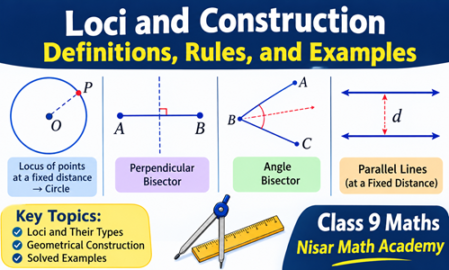
- A circle is the locus of points at a fixed distance from a fixed point.
- The perpendicular bisector of a line segment is the locus of points equidistant from its two endpoints.
- The angle bisector is the locus of points inside an angle that are equidistant from its two arms.
- Two parallel lines can represent the locus of points at a fixed perpendicular distance from a given straight line, one on each side.
Important terms
| Term | Meaning |
|---|---|
| Locus | A set or path of points satisfying a condition |
| Loci | Plural of locus |
| Fixed point | A point that remains in the same position |
| Equidistant | At equal distances |
| Perpendicular | Meeting at an angle of (90 degrees) |
| Bisector | A line or ray that divides an angle or segment into two equal parts |
| Geometrical construction | Accurate drawing of geometrical figures using mathematical rules |
2. What Is Geometrical Construction?
Geometrical construction is the process of drawing geometrical figures accurately according to given conditions. In traditional geometry, a ruler and compass are used to construct figures such as perpendicular bisectors, angle bisectors, and triangles.
Instruments used in construction
- Ruler: Used to draw straight lines and line segments.
- Compass: Used to draw circles and arcs and to transfer distances.
- Protractor: Used to measure and draw angles when the question permits it.
- Set squares: Used to draw perpendicular and parallel lines when permitted.
In classical ruler-and-compass construction, a straightedge without measurement markings and a compass are the main instruments.
3. Important Rules of Loci and Construction
Rule 1: Locus at a fixed distance from a point
The locus of a point that remains at a fixed distance r from a fixed point O is a circle with centre O and radius r.
OP = r
Here, P is any point on the circle.
Rule 2: Locus equidistant from two points
The locus of points equidistant from two fixed points A and B is the perpendicular bisector of line segment AB.
For any point P on this locus:
PA = PB
Rule 3: Locus equidistant from two intersecting lines
The locus of points equidistant from two intersecting straight lines consists of the two angle bisectors formed by those lines.
For points inside a particular angle, the relevant locus is its internal angle bisector.
Rule 4: Locus at a fixed distance from a straight line
The locus of points at a fixed perpendicular distance d from a straight line consists of two lines parallel to the given line, one on each side.
If only one side of the given line is allowed, the locus is a single parallel line.
Rule 5: Locus on a line segment
If a point must remain at equal distances from the endpoints of a line segment, it lies on the perpendicular bisector of that segment.
Rule 6: Intersection of two loci
If a point must satisfy two geometrical conditions simultaneously, it must lie on both loci. Therefore, the required point is found at their intersection.
For example, the intersection of two circles may give the possible points that satisfy two fixed-distance conditions.
4. Diagram-Based Explanation of Loci
The following descriptions explain how to draw and understand common loci. You can use them to create diagrams for your mathematics notes.
Diagram 1: Circle as a locus
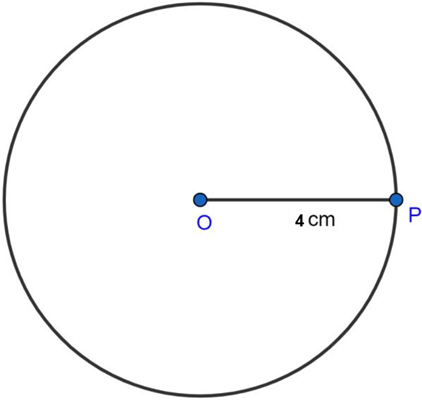
Explanation:
- Mark a fixed point O.
- Choose a fixed radius, for example 4 cm.
- Place the compass point at O and draw a circle.
- Every point P on the circumference is 4 cm from O.
Therefore, the circle is the locus of points at a distance of 4 cm from O.
Diagram 2: Perpendicular bisector as a locus
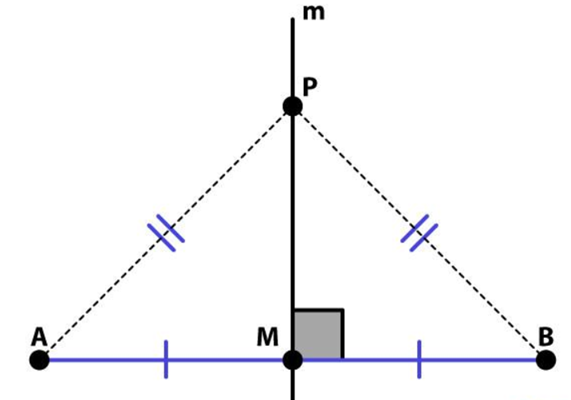
Explanation:
- Draw line segment AB.
- Find its midpoint M.
- Draw a line through M at 90 degrees to AB.
- Every point on this perpendicular bisector is equidistant from A and B.
Thus,
PA = PB
Diagram 3: Angle bisector as a locus
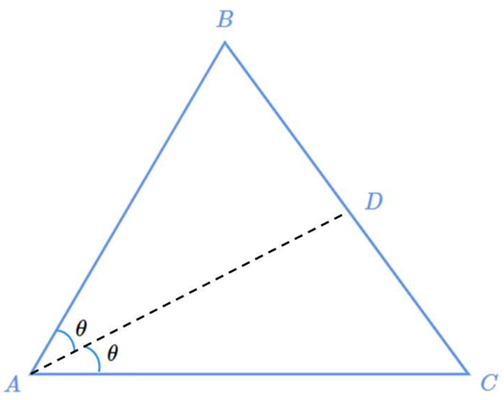
Explanation:
- Draw an angle < ABC.
- Construct a ray BD inside the angle.
- Divide the angle into two equal parts.
If BD is the angle bisector, then
< ABD = < DBC
Every point on the internal angle bisector is equidistant from the two arms of the angle, measured perpendicularly.
5. Step-by-Step Construction Methods
Construction 1: Construct the perpendicular bisector of a line segment
Given: A line segment AB = 6 cm.
Required: Construct its perpendicular bisector using a ruler and compass.
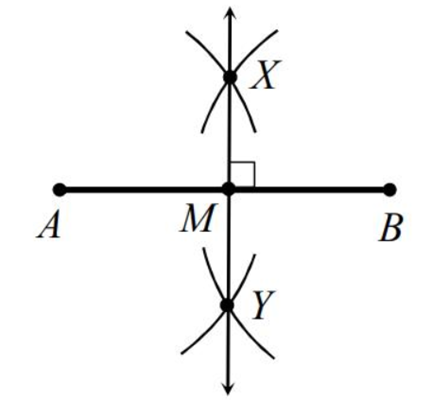
Steps:
- Draw a line segment AB = 6 cm.
- Open the compass to a radius greater than half the length of AB, so greater than 3 cm.
- Place the compass at A and draw arcs above and below the segment.
- Without changing the compass width, place it at B and draw arcs that intersect the first pair.
- Label the two intersection points P and Q.
- Draw the straight line PQ.
The line PQ is the perpendicular bisector of AB.
Verification:
- AM = MB = 3 cm, where M is the intersection of PQ and AB.
- PQ is perpendicular to AB.
- Every point on PQ is equidistant from A and B.
Construction 2: Construct an angle bisector
Given: An angle < ABC.
Required: Bisect the angle using a ruler and compass.
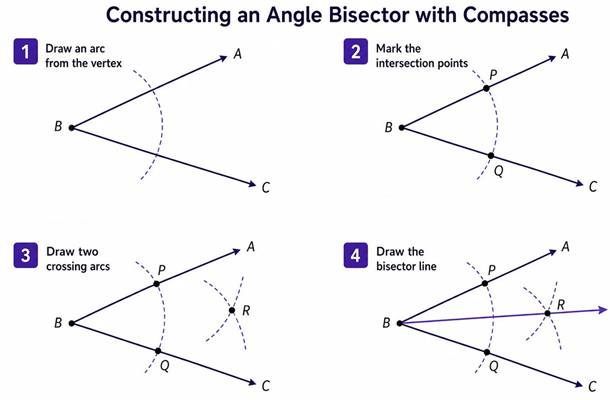
Steps:
- Draw the angle < ABC.
- Place the compass at B and draw an arc cutting BA and BC at E and F, respectively.
- Keeping the compass at a suitable width, draw an arc from E.
- With the same width, draw another arc from F, intersecting the previous arc at D.
- Draw ray BD.
Ray BD is the angle bisector.
Verification:
< ABD = < DBC
For example, if < ABC = 80 degrees, each half is 80/2 = 40 degrees
Construction 3: Construct a circle with a given radius
Given: A fixed point O and radius 5 cm.
Required: Draw the locus of points at a distance of 5 cm from O.
Steps:
- Mark point O.
- Measure 5 cm using a ruler and set the compass opening to that length.
- Place the compass point at O.
- Rotate the compass through a complete turn to draw a circle.
Result: The circle is the required locus.
OP = 5 cm
for every point P on its circumference.
6. Worked Examples of Loci and Construction
Example 1: Find the radius of a circle
A point P moves so that its distance from a fixed point O is always 7 cm. Identify its locus and radius.
Solution:
Step 1: The distance from O remains constant.
Step 2: The locus of points at a fixed distance from a fixed point is a circle.
Step 3: The fixed distance is 7 cm.
Answer: The locus is a circle with centre O and radius 7 cm.
Example 2: Find the midpoint of a line segment
A line segment AB has a length of 10 cm. Find the distance of its midpoint M from each endpoint.
Solution:
The midpoint divides the segment into two equal parts.
AM = MB = AB/2
Substitute AB = 10 cm:
AM = MB = 10/2 = 5 cm
Answer:
AM = 5 cm and MB = 5 cm.
The perpendicular bisector passes through M at 90 degrees to AB.
Example 3: Find an angle bisector’s angle
Construct the bisector of an angle of 120 degrees. Find the size of each smaller angle.
Solution:
An angle bisector divides an angle into two equal parts.
< angle = 120 / 2
= 60 degrees
Answer: Each smaller angle is 60 degrees.
Example 4: Find the locus of points equidistant from two points
Two fixed points A and B are 8 cm apart. Describe the locus of a point P for which PA = PB.
Solution:
Step 1: The condition PA = PB means that P is equally distant from A and B.
Step 2: The locus of points equidistant from two fixed points is the perpendicular bisector of the segment joining them.
Step 3: The perpendicular bisector passes through the midpoint of AB.
AM = MB = 8 / 2 = 4 cm
Answer:
The locus is the perpendicular bisector of AB, passing through its midpoint M.
Example 5: Find the locus at a fixed distance from a straight line
A point moves so that its perpendicular distance from a straight line l is always 3 cm. Describe its locus.
Solution:
Step 1: The perpendicular distance must remain constant.
Step 2: Draw one line parallel to l, 3 cm away on one side.
Step 3: Draw another parallel line 3 cm away on the opposite side.
Answer:
The complete locus consists of two lines parallel to l, each at a perpendicular distance of 3 cm. If the point is restricted to one side, only one parallel line is required.
Example 6: Locate a point satisfying two conditions
A point P is 4 cm from a fixed point A and 3 cm from another fixed point B. The distance AB is 5 cm. How can the possible positions of P be found?
Solution:
Step 1: Draw the segment AB = 5 cm.
Step 2: Draw a circle centred at A with radius 4 cm.
Step 3: Draw a circle centred at B with radius 3 cm.
Step 4: Mark the intersection points of the two circles.
Each intersection satisfies both conditions:
PA = 4 cm, PB = 3 cm
The circles are tangent because 4 + 3 = 7 and |4-3| = 1, while 1 < 5 < 7 means the circles intersect at two points.
Answer:
There are two possible positions of P, one on either side of AB.
7. Practical Applications of Loci
Loci and construction are useful in many mathematical and real-life situations.
- Navigation: A circle can represent all positions at a fixed distance from a landmark.
- Engineering: Accurate construction helps engineers draw plans and geometric designs.
- Architecture: Perpendicular lines, angle bisectors, and circles are used in layouts and designs.
- Road planning: Parallel lines can represent boundaries maintained at a fixed distance.
- Computer graphics: Geometrical relationships help create shapes and calculate positions.
- Land surveying: Geometrical constructions can help locate points from known distances and directions.
8. Common Mistakes Students Make
- Confusing locus with a single point: A locus generally consists of all points satisfying a condition, not just one point.
- Using the wrong distance: The distance from a point to a line must be measured perpendicularly.
- Drawing an incorrect perpendicular bisector: The line must pass through the midpoint and meet the segment at 90 degrees.
- Confusing an angle bisector with a perpendicular bisector: An angle bisector divides an angle; a perpendicular bisector divides a segment at right angles.
- Changing the compass width unnecessarily: In a perpendicular bisector construction, use the same radius from both endpoints.
- Ignoring both sides of a line: A fixed-distance locus from an unrestricted straight line includes parallel lines on both sides.
- Forgetting to check all conditions: When two loci are involved, the required point must satisfy both.
9. Practice Questions About Loci and Construction
Try answering these questions before checking the MCQs and worksheet below.
- Define a locus and give one example.
- What is the locus of points at a fixed distance from a fixed point?
- Which geometrical locus represents points equidistant from two fixed points?
- What is the difference between an angle bisector and a perpendicular bisector?
- How can you construct the perpendicular bisector of a 7 cm line segment?
- What is the locus of points 2 cm from a straight line?
- How many possible positions can satisfy two intersecting circle loci?
- Why should the compass radius be greater than half the segment when constructing a perpendicular bisector?
For more practice, students can use the Class 9 Maths Notes, solved questions, worksheets, and recorded lessons available through Nisar Math Academy. Some resources are available free, while additional learning materials are offered through membership.
10. Short Notes on Loci and Construction
These revision notes are suitable for Class 9 Maths exam preparation.
Important definitions
- Locus: The set of all points satisfying a given geometrical condition.
- Loci: The plural of locus.
- Construction: Accurate drawing of geometrical figures according to specified conditions.
- Perpendicular bisector: A line that divides a line segment into two equal parts at 90 degrees.
- Angle bisector: A ray or line that divides an angle into two equal angles.
Important loci and rules
| Given condition | Required locus |
|---|---|
| Fixed distance from a point | Circle centred at that point |
| Equal distances from two fixed points | Perpendicular bisector |
| Equal distances from the arms of an angle | Angle bisectors |
| Fixed perpendicular distance from a straight line | Two parallel lines, one on each side |
| Two simultaneous conditions | Intersection of the corresponding loci |
Difference between locus and construction
| Locus | Construction |
|---|---|
| Describes a set of points satisfying a condition | Describes the process of drawing a geometrical figure |
| Explains where a point can lie | Shows how to draw the required figure accurately |
| Example: a circle of radius 4 cm | Example: constructing a perpendicular bisector |
11. Multiple-Choice Questions (MCQs)
Choose the correct answer for each question.
MCQ 1
What is the plural of locus?
- A. Locuses
- B. Loci
- C. Locuss
- D. Locum
Correct answer: B. Loci
MCQ 2
What is the locus of points at a fixed distance from a fixed point in a plane?
- A. A straight line
- B. A triangle
- C. A circle
- D. A rectangle
Correct answer: C. A circle
MCQ 3
Which locus represents points equidistant from two fixed points?
- A. A circle
- B. The perpendicular bisector of the segment joining them
- C. A parallel line
- D. An angle bisector
Correct answer: B. The perpendicular bisector of the segment joining them
MCQ 4
A line segment is 12 cm long. What is the distance from its midpoint to either endpoint?
- A. 3 cm
- B. 4 cm
- C. 6 cm
- D. 12 cm
Correct answer: C. 6 cm
MCQ 5
An angle of 90 degrees is bisected. What is the size of each angle?
- A. 30 degrees
- B. 45 degrees
- C. 60 degrees
- D. 90 degrees
Correct answer: B. 45 degrees
MCQ 6
At what angle does a perpendicular bisector meet the original line segment?
- A. 30 degrees
- B. 45 degrees
- C. 60 degrees
- D. 90 degrees
Correct answer: D. 90 degrees
MCQ 7
A point is always 5 cm from point O. What is the radius of its circular locus?
- A. 2.5 cm
- B. 5 cm
- C. 10 cm
- D. 25 cm
Correct answer: B. 5 cm
MCQ 8
Which instrument is traditionally used to draw arcs in geometrical construction?
- A. Compass
- B. Calculator
- C. Set square only
- D. Divider-free ruler only
Correct answer: A. Compass
MCQ 9
What is the locus of points at a fixed perpendicular distance of \(2\text{ cm}\) from an unrestricted straight line?
- A. One circle
- B. Two perpendicular lines
- C. Two parallel lines
- D. One angle bisector
Correct answer: C. Two parallel lines
MCQ 10
An angle measures 140 degrees. What is the size of each part after bisecting it?
- A. 60 degrees
- B. 70 degrees
- C. 80 degrees
- D. 90 degrees
Correct answer: B. 70 degrees
MCQ 11
If PA = PB, where A and B are fixed points, point P lies on which locus?
- A. The perpendicular bisector of AB
- B. A circle centred at A only
- C. The segment AB only
- D. A line parallel to AB
Correct answer: A. The perpendicular bisector of AB
MCQ 12
Which condition defines an angle bisector?
- A. It divides a line segment into unequal parts.
- B. It divides an angle into two equal angles.
- C. It always forms a 90 degrees angle.
- D. It joins two parallel lines.
Correct answer: B. It divides an angle into two equal angles.
12. Loci and Construction Worksheet with Answers
This worksheet is designed for Class 9 Maths students who want to practise definitions, geometrical rules, constructions, and numerical problems.
Student worksheet
Section A: Definitions and concepts
- Define a locus in mathematics.
- Explain the difference between a locus and geometrical construction.
- State the locus of points equidistant from two fixed points.
- What is an angle bisector?
- State the locus of points at a fixed perpendicular distance from a straight line.
Section B: Numerical questions
- A line segment is 18 cm long. Find the distance from its midpoint to either endpoint.
- An angle of 156 degrees is bisected. Find each resulting angle.
- A point moves at a constant distance of 9 cm from a fixed point. Identify the locus and state its radius.
- A point is equidistant from the endpoints of a line segment AB = 14 cm. Where does the point lie, and how far is the midpoint from either endpoint?
Section C: Construction and applications
- Construct the perpendicular bisector of a line segment AB = 8 cm using a ruler and compass.
- Construct the bisector of an angle of 100 degrees using a ruler and compass. State the size of each resulting angle.
- Describe the construction needed to draw the locus of points 4 cm from a fixed point O.
- A point must be 5 cm from point A and 4 cm from point B, where AB = 6 cm. Describe how to find all possible positions of the point.
- A school wants to mark all positions 3 m from a straight boundary line on either side. Which geometrical locus represents these positions?
- A point must be equidistant from two fixed points and also lie 5 cm from a third fixed point. Explain how to locate the possible positions using loci.
Answer key
- A locus is the set of all points satisfying a given geometrical condition.
- A locus describes the set of possible points; construction is the accurate drawing process used to produce a geometrical figure.
- The perpendicular bisector of the segment joining the two points.
- A ray or line that divides an angle into two equal angles.
- Two parallel lines, one on each side of the given line, at the specified perpendicular distance.
- 18 / 2 = 9 cm.
- 156 degrees / 2 = 78 degrees each.
- A circle centred at the fixed point, with radius 9 cm.
- The point lies on the perpendicular bisector of AB. The midpoint is 14/2 = 7 cm from each endpoint.
- Draw AB = 8 cm. With a compass radius greater than 4 cm, draw intersecting arcs from A and B above and below the segment. Join the arc intersections.
- Draw the angle and construct its internal angle bisector using compass arcs. Each angle is 100 degrees/2 = 50 degrees.
- Set the compass to 5 cm, place its point at O, and draw a complete circle. This is the required locus.
- Draw a circle centred at A with radius 5 cm and another centred at B with radius 4 cm. Their two intersection points are the possible positions.
- Two parallel lines, each 3 m from the boundary line, one on either side.
- Construct the perpendicular bisector of the segment joining the two fixed points. Draw a circle of radius 5 cm centred at the third point. The intersection points of the line and circle are the possible positions, if intersections exist.
13. Frequently Asked Questions (FAQs)
1. What are loci and construction in mathematics?
Loci describe sets of points that satisfy particular geometrical conditions, while construction is the process of accurately drawing geometrical figures using specified instruments and rules.
2. What is the difference between locus and loci?
Locus is singular and refers to one set of points. Loci is the plural form and refers to multiple sets of points.
3. What is the locus of points equidistant from two fixed points?
It is the perpendicular bisector of the line segment joining those points.
4. What is the locus of points at a fixed distance from a point?
It is a circle centred at the fixed point, with a radius equal to the specified distance.
5. What instruments are used for geometrical construction?
A ruler and compass are the traditional instruments used for many geometrical constructions. A protractor and set squares may also be used when permitted by the question.
6. How do you construct a perpendicular bisector?
Draw arcs of equal radius from both endpoints of a line segment, using a compass radius greater than half the segment’s length. Join the two arc intersection points to obtain the perpendicular bisector.
7. Where can I find Class 9 Maths notes and lectures on loci and construction?
You can explore Nisar Math Academy for Class 9 Maths notes, recorded video lectures, solved questions, worksheets, and other mathematics learning resources. Some resources are free, and additional materials are available through membership.
Conclusion
Loci and construction help students understand the relationship between geometrical conditions and the positions of points. The most important loci include circles, perpendicular bisectors, angle bisectors, and parallel lines at fixed distances.
To prepare effectively for Class 9 Maths, learn the definitions, practise compass-and-ruler constructions, understand why each construction works, and solve numerical and application-based questions. Regular practice with these concepts will help you develop accuracy and confidence in geometry.
Nisar Math Academy provides mathematics notes, recorded lectures, assessments, lesson plans, and worksheets to support students in their learning and examination preparation.
You May be Interested In:
Altitudes of Triangle: Definition, Properties, Formulas and Solved Examples
Angle Bisectors of a Triangle: Definition, Properties, Examples & MCQs
How Many Types of Triangles Are There? Perpendicular Bisectors and Medians of a Triangle
Leave a Reply