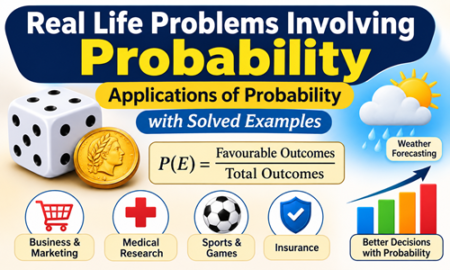
Real Life Problems Involving Probability: Applications of Probability with Solved Examples
Introduction
Probability is an important branch of mathematics that helps us understand how likely an event is to happen. We use probability in many everyday situations, such as predicting weather conditions, playing games, conducting surveys, checking the quality of products, and making decisions under uncertainty.
The applications of probability help us make predictions and understand situations in which the outcome is uncertain. For example, weather forecasts use probability to estimate the chances of rain, while games involving dice and coins use probability to calculate the chances of winning.
In this article, we will explore the application of probability in real life, learn the important formulas, and solve practical problems step by step. These explanations and examples will help Class 9 students understand how probability is used beyond mathematics textbooks.
What Is Probability?
Probability is the mathematical measure of the likelihood that an event will occur.
It tells us how likely or unlikely an event is to happen.
The probability of an event is always between 0 and 1.
- Probability 0 means the event is impossible.
- Probability 1 means the event is certain.
- Probability between 0 and 1 means the event may or may not occur.
For example:
- Getting a head when tossing a fair coin is possible.
- Getting a 7 when rolling a standard six-sided die is impossible.
- Getting a number less than 7 when rolling a standard die is certain.
Formula for Probability
When all outcomes are equally likely, the probability of an event is calculated by:
P(E) = Number of favourable outcomes / Total number of possible outcomes
Where:
- P(E) = Probability of event E.
- Favourable outcomes = Outcomes that satisfy the required condition.
- Total possible outcomes = All outcomes in the sample space.
Example
A fair coin is tossed once. Find the probability of getting a head.
Solution:
Possible outcomes:
S = {Head, Tail}
Total possible outcomes = 2
Favourable outcomes = 1 (Head)
Using the formula:
P(Head) = 1/2
Therefore, the probability of getting a head is 1/2.
Important Formulas Used in Probability Problems
The following formulas are useful for solving probability problems.
1. Probability of an Event
P(E) = n(E) / n(S)
Where:
- n(E) = Number of favourable outcomes.
- n(S) = Total number of outcomes in the sample space.
2. Probability of an Impossible Event
P(E) = 0
An impossible event is an event that cannot happen.
Example: Getting an 8 when rolling a standard six-sided die.
3. Probability of a Certain Event
P(E) = 1
A certain event is an event that must happen.
Example: Getting a number less than 7 when rolling a standard six-sided die.
4. Probability of the Complementary Event
P(not E) = 1 − P(E)
This formula is used to find the probability that an event will not happen.
Example: If the probability of rain is 0.3, the probability of no rain is:
P(No rain) = 1 − 0.3 = 0.7
5. Probability in Percentage Form
Probability (%) = P(E) × 100
For example:
P(E) = 1/4
Probability (%) = 1/4 × 100 = 25%
Real Life Applications of Probability
Probability has many practical applications in different areas of life. Some important real life applications of probability are explained below.
1. Probability in Weather Forecasting
Weather forecasting is one of the most common applications of probability.
Meteorologists use weather data and mathematical models to estimate the likelihood of rain, snowfall, storms, and other weather conditions.
For example, if a weather forecast reports a 70% chance of rain, it indicates a 70% probability of rain under the forecasting model.
Practical example:
Suppose the probability of rain on a particular day is 0.6.
Find the probability that it will not rain.
Solution:
Given:
P(Rain) = 0.6
Using the complementary probability formula:
P(No rain) = 1 − P(Rain)
= 1 − 0.6
= 0.4
Therefore, the probability of no rain is 0.4 or 40%.
2. Probability in Games and Sports
Probability is widely used in games and sports to study possible outcomes.
In games involving coins, dice, cards, and other random events, probability helps calculate the chances of different results.
In sports, statistical analysis can also help estimate the likelihood of winning, losing, or achieving a particular result.
Practical example:
A player rolls a fair six-sided die. Find the probability of getting an even number.
Solution:
Possible outcomes:
S = {1, 2, 3, 4, 5, 6}
Total outcomes = 6
Even numbers = {2, 4, 6}
Favourable outcomes = 3
Using the probability formula:
P(Even number) = 3/6
= 1/2
Therefore, the probability of getting an even number is 1/2.
3. Probability in Medical Research
Probability is used in medical research to study the effectiveness of treatments, understand the frequency of diseases, and analyse research results.
Researchers collect information from patients and use statistical methods to understand patterns and estimate possible outcomes.
For example, researchers may study how frequently a particular condition occurs in a selected population.
Probability helps them interpret the collected data, although it cannot guarantee the result for an individual patient.
4. Probability in Business and Marketing
Businesses use probability to estimate customer behaviour, product demand, and possible sales outcomes.
For example, a company may analyse previous sales records to estimate the likelihood of selling a particular number of products in the next month.
These estimates help businesses plan production, manage stock, and make better decisions.
Practical example:
A shopkeeper estimates that the probability of selling a particular product on a given day is 0.8.
Find the probability that the product will not be sold.
Solution:
Given:
P(Selling the product) = 0.8
P(Not selling the product) = 1 − 0.8
= 0.2
Therefore, the probability that the product will not be sold is 0.2 or 20%.
5. Probability in Quality Control
Factories use probability and statistics to monitor product quality.
For example, a manufacturer may randomly select products from a production batch to check whether they meet the required standards.
The results help estimate the proportion of defective products and identify possible quality problems.
Practical example:
A factory produces 1000 bulbs. During inspection, 20 defective bulbs are found.
If a bulb is selected randomly from the inspected batch, find the experimental probability of selecting a defective bulb.
Solution:
Total inspected bulbs = 1000
Number of defective bulbs = 20
Experimental probability:
P(Defective bulb) = 20/1000
= 1/50
= 0.02
Therefore, the experimental probability of selecting a defective bulb is 0.02 or 2%.
6. Probability in Education
Probability can also be used in educational research and school administration.
Teachers and researchers may analyse examination results, attendance records, and survey responses to understand student performance and classroom trends.
For example, a school may use previous examination results to estimate the proportion of students likely to achieve a particular grade. Such estimates are useful for planning but do not determine an individual student’s result.
7. Probability in Insurance
Insurance companies use probability and statistical information to estimate the likelihood of certain events, such as accidents, property damage, and other insured losses.
These estimates help companies assess financial risks and determine suitable insurance premiums.
For example, historical accident data may help an insurance company estimate the frequency of accidents among a particular group of drivers.
8. Probability in Transportation
Probability is useful in transportation planning.
Transport authorities may analyse traffic records to estimate congestion, study accident patterns, and predict possible delays.
For example, previous traffic data can help estimate the likelihood of heavy traffic during particular hours.
This information helps in planning routes and improving transportation systems.
Solved Real Life Problems Involving Probability
Let us solve some additional numerical problems to understand how the application of probability works in everyday situations.
Example 1: Selecting a Red Ball from a Bag
A bag contains 5 red balls, 3 blue balls, and 2 green balls. One ball is selected randomly. Find the probability of selecting a red ball.
Solution:
Step 1: Find the total number of balls.
Total balls = 5 + 3 + 2 = 10
Step 2: Find the favourable outcomes.
Number of red balls = 5
Step 3: Apply the probability formula.
P(Red ball) = 5/10
= 1/2
Answer: The probability of selecting a red ball is 1/2.
Example 2: Selecting a Student from a Class
A class contains 30 students, including 18 boys and 12 girls. If one student is selected randomly, find the probability of selecting a girl.
Solution:
Total students = 30
Number of girls = 12
Using the probability formula:
P(Girl) = 12/30
= 2/5
Answer: The probability of selecting a girl is 2/5.
Example 3: Probability of Getting a Number Greater Than 4
A fair six-sided die is rolled once. Find the probability of getting a number greater than 4.
Solution:
Sample space:
S = {1, 2, 3, 4, 5, 6}
Total outcomes = 6
Numbers greater than 4 = {5, 6}
Favourable outcomes = 2
P(Number greater than 4) = 2/6
= 1/3
Answer: The required probability is 1/3.
Example 4: Probability of Selecting a Particular Card
A standard deck contains 52 playing cards. One card is selected randomly. Find the probability of selecting a king.
Solution:
Total cards = 52
Number of kings = 4
P(King) = 4/52
= 1/13
Answer: The probability of selecting a king is 1/13.
Example 5: Probability of Getting at Least One Head
A fair coin is tossed twice. Find the probability of getting at least one head.
Solution:
Step 1: Write all possible outcomes.
S = {HH, HT, TH, TT}
Total outcomes = 4
Step 2: Identify favourable outcomes.
Outcomes containing at least one head:
{HH, HT, TH}
Favourable outcomes = 3
Step 3: Apply the formula.
P(At least one head) = 3/4
Answer: The required probability is 3/4.
Example 6: Probability of Selecting a Defective Product
A shop has 50 electronic items, of which 5 are defective. One item is selected randomly. Find the probability of selecting a non-defective item.
Solution:
Total items = 50
Defective items = 5
Non-defective items = 50 − 5 = 45
Using the probability formula:
P(Non-defective item) = 45/50
= 9/10
Answer: The probability of selecting a non-defective item is 9/10.
Diagram-Based Explanation of Probability
A diagram can make probability problems easier to understand.
Consider a bag containing 4 red balls and 6 blue balls.
Imagine a rectangular box representing the bag. Inside it, draw 10 circles:
- 4 circles coloured red.
- 6 circles coloured blue.
The total number of circles represents all possible outcomes.
If one ball is selected randomly, the probability of selecting a red ball is:
P(Red) = 4/10 = 2/5
Similarly:
P(Blue) = 6/10 = 3/5
The sum of these probabilities is:
2/5 + 3/5 = 1
This shows that the probabilities of all possible mutually exclusive outcomes add up to 1.
Common Mistakes Students Make While Solving Probability Problems
Students sometimes make mistakes when identifying favourable outcomes or applying probability formulas.
The following points can help avoid common errors.
- Using the wrong denominator: Always use the total number of possible outcomes in the denominator when outcomes are equally likely.
- Counting favourable outcomes incorrectly: Carefully identify which outcomes satisfy the given condition.
- Ignoring the word “not”: If a question asks for the probability of an event not happening, use the complementary probability formula.
- Forgetting to simplify fractions: Reduce the final probability to its simplest form whenever possible.
- Confusing probability with certainty: A probability of 0.8 does not mean an event is guaranteed to happen.
- Ignoring the equally likely condition: The basic formula P(E) = n(E)/n(S) applies directly when all possible outcomes are equally likely.
- Confusing experimental and theoretical probability: Theoretical probability is calculated using possible outcomes, whereas experimental probability is based on actual observations.
Related Questions About Applications of Probability
Students often search for the following questions when studying this topic:
- What are the applications of probability in daily life?
- How is probability used in weather forecasting?
- What is the importance of probability in mathematics?
- How is probability used in games and sports?
- What is the difference between theoretical and experimental probability?
- How do we solve real life problems involving probability?
- What is the probability of an impossible event?
- Why is probability important in decision-making?
Understanding these questions helps students connect mathematical concepts with everyday situations.
Conclusion
Probability is an important mathematical concept that helps us understand uncertainty and estimate the likelihood of different events.
The applications of probability can be found in weather forecasting, sports, medical research, business, quality control, education, insurance, and transportation.
By learning probability formulas and practising numerical problems, students can develop a better understanding of how mathematics is used in everyday life.
For more Class 9 Maths notes, recorded video lectures, solved questions, worksheets, and assessments, visit Nisar Math Academy at https://nisarmathacademy.com/. Students can explore free learning resources and access additional educational material through website membership.
3. Short Notes – Applications of Probability
Applications of Probability – Short Revision Notes
1. Definition
Probability is the mathematical measure of the likelihood that an event will occur.
2. Important Concepts
- Experiment: An activity that produces an outcome, such as tossing a coin.
- Outcome: A possible result of an experiment.
- Sample Space: The set of all possible outcomes.
- Event: A particular outcome or group of outcomes.
- Favourable Outcomes: Outcomes that satisfy the required condition.
- Impossible Event: An event that cannot happen.
- Certain Event: An event that must happen.
3. Important Formulas
Probability of an event:
P(E) = n(E) / n(S)
Complementary probability:
P(not E) = 1 − P(E)
Probability of an impossible event:
P(E) = 0
Probability of a certain event:
P(E) = 1
Probability in percentage:
P(E) × 100%
4. Range of Probability
0 ≤ P(E) ≤ 1
- P(E) = 0: Impossible event.
- P(E) = 1: Certain event.
- 0 < P(E) < 1: Event may or may not occur.
5. Important Real-Life Applications
- Weather forecasting
- Games and sports
- Medical research
- Business and marketing
- Quality control
- Education
- Insurance
- Transportation
6. Theoretical and Experimental Probability
Theoretical Probability: Calculated using the possible outcomes of an experiment.
Experimental Probability: Calculated using actual observations or experimental results.
Experimental Probability = Number of times an event occurs / Total number of trials
7. Important Points to Remember
- Probability cannot be negative.
- Probability cannot be greater than 1.
- The sum of probabilities of all possible outcomes is 1.
- The basic favourable-outcomes formula applies directly to equally likely outcomes.
- The probability of an event not happening is 1 minus the probability of that event.
8. Quick Example
A die is rolled once. Find the probability of getting a 3.
Total outcomes = 6
Favourable outcomes = 1
P(3) = 1/6
Remember: Always identify the total outcomes and favourable outcomes before applying the probability formula.
4. Multiple-Choice Questions (MCQs)
MCQs: Real Life Problems Involving Probability
Question 1: What does probability measure?
A. Size of an object
B. Likelihood of an event
C. Distance between two points
D. Speed of an object
Correct Answer: B. Likelihood of an event
Question 2: What is the probability of an impossible event?
A. 1
B. 1/2
C. 0
D. 2
Correct Answer: C. 0
Question 3: A fair coin is tossed once. What is the probability of getting a tail?
A. 1
B. 1/2
C. 1/3
D. 0
Correct Answer: B. 1/2
Question 4: A standard die has how many possible outcomes?
A. 4
B. 5
C. 6
D. 8
Correct Answer: C. 6
Question 5: What is the probability of getting an even number when rolling a fair die?
A. 1/6
B. 1/3
C. 1/2
D. 2/3
Correct Answer: C. 1/2
Question 6: A bag contains 3 red balls and 7 blue balls. What is the probability of selecting a red ball?
A. 3/7
B. 7/10
C. 3/10
D. 1/2
Correct Answer: C. 3/10
Question 7: If the probability of an event is 0.4, what is the probability that it will not happen?
A. 0.4
B. 0.6
C. 1.4
D. 0.2
Correct Answer: B. 0.6
Question 8: Which of the following is a practical application of probability?
A. Weather forecasting
B. Drawing a straight line
C. Measuring a triangle
D. Finding the perimeter of a square
Correct Answer: A. Weather forecasting
Question 9: What is the probability of getting a number greater than 4 when rolling a standard die?
A. 1/6
B. 1/3
C. 1/2
D. 2/3
Correct Answer: B. 1/3
Question 10: A standard deck contains 52 cards. What is the probability of selecting an ace?
A. 1/4
B. 1/13
C. 1/26
D. 1/52
Correct Answer: B. 1/13
Question 11: What is the probability of a certain event?
A. 0
B. 1/2
C. 1
D. 2
Correct Answer: C. 1
Question 12: A class contains 20 boys and 30 girls. What is the probability of selecting a boy randomly?
A. 2/5
B. 3/5
C. 1/2
D. 1/5
Correct Answer: A. 2/5
Question 13: Which probability is based on actual observations?
A. Theoretical probability
B. Experimental probability
C. Impossible probability
D. Certain probability
Correct Answer: B. Experimental probability
Question 14: If the probability of an event is 1/4, what is its percentage?
A. 20%
B. 25%
C. 40%
D. 50%
Correct Answer: B. 25%
Question 15: A bag contains 4 green balls and 6 yellow balls. What is the probability of selecting a yellow ball?
A. 2/5
B. 3/5
C. 1/5
D. 1/2
Correct Answer: B. 3/5
5. Worksheet / Assignment
Worksheet: Real Life Problems Involving Probability
Subject: Mathematics
Topic: Applications of Probability
Class: 9
Instructions: Attempt all questions. Show complete working for numerical problems and simplify your answers where possible.
Part A: Definitions
Q1. Define probability.
Q2. What is a sample space? Give one example.
Q3. Define a favourable outcome.
Part B: Conceptual Questions
Q4. What is the difference between theoretical probability and experimental probability?
Q5. Write any four real-life applications of probability.
Q6. What is the probability of an impossible event and a certain event?
Part C: Formula-Based Questions
Q7. Write the formula for calculating the probability of an event when all outcomes are equally likely.
Q8. If the probability of an event is 0.35, calculate the probability that the event will not happen.
Q9. Express the probability 3/5 as a percentage.
Part D: Numerical Problems
Q10. A fair coin is tossed once. Find the probability of getting a head.
Q11. A fair die is rolled once. Find the probability of getting a number less than 3.
Q12. A bag contains 4 red balls, 5 blue balls, and 3 green balls. One ball is selected randomly. Find the probability of selecting a blue ball.
Q13. A class contains 24 boys and 16 girls. One student is selected randomly. Find the probability of selecting a girl.
Q14. A box contains 100 bulbs, of which 8 are defective. One bulb is selected randomly. Find the probability of selecting a non-defective bulb.
Q15. A fair coin is tossed twice. Find the probability of getting exactly one head.
Answer Key
Part A: Definitions
Answer 1: Probability is the mathematical measure of the likelihood that an event will occur.
Answer 2: A sample space is the set of all possible outcomes of an experiment. For example, the sample space of tossing a coin is {H, T}.
Answer 3: A favourable outcome is an outcome that satisfies the condition given in a probability question.
Part B: Conceptual Questions
Answer 4:
- Theoretical probability is calculated using possible outcomes.
- Experimental probability is calculated using actual observations.
Answer 5: Any four of the following:
- Weather forecasting
- Games and sports
- Medical research
- Business and marketing
- Quality control
- Insurance
- Transportation
- Education
Answer 6:
- Probability of an impossible event = 0.
- Probability of a certain event = 1.
Part C: Formula-Based Questions
Answer 7:
P(E) = n(E) / n(S)
Answer 8:
P(Not E) = 1 − P(E)
= 1 − 0.35
= 0.65
Answer 9:
3/5 × 100 = 60%
Part D: Numerical Problems
Answer 10:
Total outcomes = 2
Favourable outcomes = 1
P(Head) = 1/2
Answer 11:
Possible outcomes = {1, 2, 3, 4, 5, 6}
Numbers less than 3 = {1, 2}
P(Number less than 3) = 2/6 = 1/3
Answer 12:
Total balls = 4 + 5 + 3 = 12
Blue balls = 5
P(Blue) = 5/12
Answer 13:
Total students = 24 + 16 = 40
Girls = 16
P(Girl) = 16/40 = 2/5
Answer 14:
Total bulbs = 100
Defective bulbs = 8
Non-defective bulbs = 100 − 8 = 92
P(Non-defective bulb) = 92/100 = 23/25
Answer 15:
Sample space = {HH, HT, TH, TT}
Total outcomes = 4
Exactly one head = {HT, TH}
Favourable outcomes = 2
P(Exactly one head) = 2/4 = 1/2
6. Frequently Asked Questions (FAQs)
Frequently Asked Questions About Applications of Probability
1. What are the applications of probability?
Probability is used in weather forecasting, sports, medical research, business, quality control, insurance, education, and transportation to estimate the likelihood of uncertain events.
2. What is the application of probability in real life?
Probability helps people estimate the chances of different events. For example, weather forecasting uses probability to estimate the likelihood of rain.
3. Why is probability important in mathematics?
Probability is important because it helps us understand uncertainty, analyse possible outcomes, and make informed decisions.
4. What is the basic formula of probability?
When all outcomes are equally likely, the formula is:
P(E) = Number of favourable outcomes / Total number of possible outcomes.
5. What is the probability of an impossible event?
The probability of an impossible event is 0 because the event cannot occur.
6. What is the probability of a certain event?
The probability of a certain event is 1 because the event must occur.
7. What is the difference between theoretical and experimental probability?
Theoretical probability is calculated using possible outcomes, whereas experimental probability is based on actual observations or experimental results.
8. Can probability predict the future accurately?
Probability can estimate the likelihood of future events, but it cannot guarantee that a particular event will happen.
You May be Interested In:
What Is the Probability of an Event Not Occurring? Definition, Formula and Solved Examples
What Is Probability of Single Event? Definition, Formula and Solved Examples
Mean, Median and Mode: Definitions, Formulas, Examples and Real-Life Applications

Leave a Reply