What Is Probability of Single Event? Definition, Formula and Solved Examples
Introduction
Probability is an important branch of mathematics that deals with the chance or likelihood of an event occurring. It helps us understand how likely something is to happen in different situations.
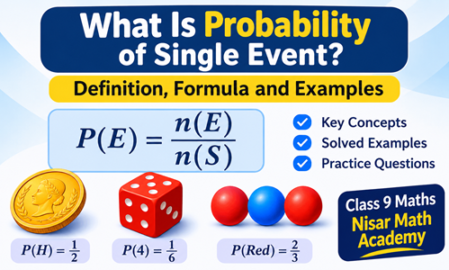
The probability of a single event refers to the chance of a particular event occurring in a single experiment or trial. For example, getting a head when tossing a coin, rolling a 4 on a die, or selecting a red ball from a bag are examples of single events.
In this article, we will learn the definition of probability, the meaning of a single event, its mathematical formula, and how to calculate probability through step-by-step solved examples. These concepts will help Class 9 students understand basic probability and solve related mathematical problems.
What Is Probability?
Probability is the branch of mathematics that measures the likelihood or chance of an event occurring.
It tells us whether an event is certain, impossible, or somewhere between these two possibilities.
For example:
- When we toss a coin, there is a chance of getting a head or a tail.
- When we roll a standard six-sided die, there is a chance of getting any number from 1 to 6.
- When we select a ball from a bag containing different coloured balls, there is a chance of selecting a particular colour.
Probability is generally expressed as a fraction, decimal, or percentage.
What Is a Single Event in Probability?
A single event is a particular outcome or a specified group of outcomes that we are interested in observing in one experiment.
In simple words, when we perform an experiment and focus on one particular event, we study its probability.
Examples of single events:
- Getting a head when tossing a coin.
- Getting a 5 when rolling a die.
- Selecting a red ball from a bag.
- Drawing an ace from a standard deck of playing cards.
For example, when a coin is tossed once, getting a head is one event, while getting a tail is another event.
The probability of each event can be calculated separately.
Definition of Probability of a Single Event
The probability of a single event is the ratio of the number of favourable outcomes to the total number of equally likely possible outcomes of an experiment.
Mathematical Definition:
The probability of an event is the ratio of favourable outcomes to the total number of possible equally likely outcomes.
Formula for Probability of a Single Event
The mathematical formula used to calculate the probability of a single event is:
P(E) = Number of Favourable Outcomes / Total Number of Equally Likely Outcomes
Where:
- P(E) = Probability of event E
- Favourable outcomes = Outcomes that satisfy the required event.
- Total outcomes = All possible outcomes of the experiment.
In symbols:
P(E) = n(E) / n(S)
Where:
- n(E) = Number of favourable outcomes.
- n(S) = Total number of outcomes in the sample space.
Important: This formula applies directly when the experiment has a finite number of equally likely outcomes.
Important Terms Used in Probability
Before solving probability problems, students should understand the following terms.
1. Experiment
An experiment is an activity or process that produces an outcome.
Examples:
- Tossing a coin.
- Rolling a die.
- Drawing a card from a deck.
2. Outcome
An outcome is a possible result of an experiment.
For example, when a coin is tossed, the possible outcomes are head and tail.
3. Sample Space
The sample space is the set of all possible outcomes of an experiment.
It is usually represented by the symbol S.
Example:
When a standard die is rolled once:
S = {1, 2, 3, 4, 5, 6}
Therefore, the total number of outcomes is:
n(S) = 6
4. Event
An event is a particular outcome or a collection of outcomes from the sample space.
For example, when a die is rolled, getting an even number is an event.
E = {2, 4, 6}
5. Favourable Outcomes
Favourable outcomes are the results that satisfy the condition of a given event.
For example, when a die is rolled, the favourable outcomes for getting an even number are:
E = {2, 4, 6}
Therefore:
n(E) = 3
Diagram-Based Explanation of Probability
Consider a standard six-sided die with the numbers 1, 2, 3, 4, 5 and 6.
Suppose we want to find the probability of getting an even number.
The sample space is:
S = {1, 2, 3, 4, 5, 6}
The favourable outcomes are:
E = {2, 4, 6}
We can imagine six equal-sized boxes arranged in a row, each representing one possible outcome.
- Box 1 represents the number 1.
- Box 2 represents the number 2.
- Box 3 represents the number 3.
- Box 4 represents the number 4.
- Box 5 represents the number 5.
- Box 6 represents the number 6.
The boxes containing 2, 4 and 6 represent favourable outcomes.
Thus:
Total outcomes = 6
Favourable outcomes = 3
Probability of getting an even number:
P(E) = 3/6 = 1/2
Therefore, the required probability is 1/2.
Important Formulas and Properties of Probability
The following formulas and properties are useful for solving basic probability problems.
1. Probability Formula
P(E) = n(E) / n(S)
2. Probability of an Impossible Event
An impossible event is an event that cannot occur.
Its probability is:
P(E) = 0
Example: Getting a 7 when rolling a standard six-sided die.
3. Probability of a Certain Event
A certain event is an event that must occur.
Its probability is:
P(E) = 1
Example: Getting a number less than 7 when rolling a standard six-sided die.
4. Range of Probability
The probability of any event always lies between 0 and 1.
0 ≤ P(E) ≤ 1
5. Probability of the Complementary Event
The complement of an event means that the event does not occur.
If E is an event, its complement is represented by E’.
The formula is:
P(E’) = 1 − P(E)
6. Sum of Probabilities of an Event and Its Complement
P(E) + P(E’) = 1
These properties help students check whether their answers are reasonable.
Step-by-Step Solved Examples of Probability of Single Event
The following examples explain how to calculate the probability of different events using the probability formula.
Example 1: Probability of Getting a Head When Tossing a Coin
Question: A coin is tossed once. Find the probability of getting a head.
Solution:
Step 1: Write the sample space.
S = {H, T}
Step 2: Find the total number of outcomes.
n(S) = 2
Step 3: Identify the favourable outcomes.
E = {H}
n(E) = 1
Step 4: Apply the probability formula.
P(E) = n(E) / n(S)
P(H) = 1/2
Answer: The probability of getting a head is 1/2.
Example 2: Probability of Getting a 4 When Rolling a Die
Question: A standard die is rolled once. Find the probability of getting a 4.
Solution:
Step 1: Write the sample space.
S = {1, 2, 3, 4, 5, 6}
Step 2: Find the total number of outcomes.
n(S) = 6
Step 3: Identify the favourable outcome.
E = {4}
n(E) = 1
Step 4: Apply the formula.
P(E) = n(E) / n(S)
P(4) = 1/6
Answer: The required probability is 1/6.
Example 3: Probability of Getting an Even Number on a Die
Question: A standard die is rolled once. Find the probability of getting an even number.
Solution:
Step 1: Write the sample space.
S = {1, 2, 3, 4, 5, 6}
Step 2: Find the total outcomes.
n(S) = 6
Step 3: Identify the favourable outcomes.
The even numbers are 2, 4 and 6.
E = {2, 4, 6}
n(E) = 3
Step 4: Apply the formula.
P(E) = n(E) / n(S)
P(E) = 3/6
P(E) = 1/2
Answer: The probability of getting an even number is 1/2.
Example 4: Probability of Selecting a Red Ball
Question: A bag contains 5 red balls and 3 blue balls. One ball is selected at random. Find the probability of selecting a red ball.
Solution:
Step 1: Find the total number of balls.
Total balls = 5 + 3 = 8
Step 2: Find the number of favourable outcomes.
Number of red balls = 5
Step 3: Apply the probability formula.
P(Red) = Number of red balls / Total number of balls
P(Red) = 5/8
Answer: The probability of selecting a red ball is 5/8.
Example 5: Probability of Drawing an Ace from a Deck of Cards
Question: One card is drawn randomly from a standard deck of 52 playing cards. Find the probability of drawing an ace.
Solution:
Step 1: Find the total number of cards.
n(S) = 52
Step 2: Find the number of favourable outcomes.
There are 4 aces in a standard deck.
n(E) = 4
Step 3: Apply the formula.
P(E) = n(E) / n(S)
P(E) = 4/52
P(E) = 1/13
Answer: The probability of drawing an ace is 1/13.
Example 6: Probability of Getting a Number Greater Than 4
Question: A standard die is rolled once. Find the probability of getting a number greater than 4.
Solution:
Step 1: Write the sample space.
S = {1, 2, 3, 4, 5, 6}
Step 2: Identify the favourable outcomes.
Numbers greater than 4 are 5 and 6.
E = {5, 6}
Step 3: Count the outcomes.
n(S) = 6
n(E) = 2
Step 4: Apply the formula.
P(E) = 2/6
P(E) = 1/3
Answer: The required probability is 1/3.
Example 7: Probability of Not Getting a Head
Question: A coin is tossed once. Find the probability of not getting a head.
Solution:
Step 1: Write the sample space.
S = {H, T}
Step 2: The event of not getting a head means getting a tail.
E’ = {T}
Step 3: Find the favourable and total outcomes.
Favourable outcomes = 1
Total outcomes = 2
Step 4: Apply the formula.
P(Not getting a head) = 1/2
Answer: The probability of not getting a head is 1/2.
Real-Life Applications of Probability
Probability is not limited to mathematical exercises. It is also used in everyday situations and different fields.
1. Weather Forecasting
Weather forecasts use probability to communicate the likelihood of rain, storms and other weather conditions.
2. Games and Sports
Probability helps us understand the chances of different outcomes in games involving dice, cards and other random events.
3. Education
Students can use probability to understand the chances of different possible results in simple experiments and activities.
4. Business
Businesses use probability and statistical methods to study uncertainty, customer behaviour and possible risks.
5. Medical Research
Probability and statistics are used in medical research to analyse results and study the effectiveness of treatments.
Common Mistakes Students Make
Students should avoid the following mistakes while solving probability questions.
- Using the wrong total outcomes: Always count all possible outcomes before applying the formula.
- Identifying incorrect favourable outcomes: Carefully read the question to determine which outcomes satisfy the given condition.
- Forgetting to simplify fractions: Reduce the final fraction to its simplest form whenever possible.
- Confusing outcomes with events: An outcome is one possible result, whereas an event may contain one or more outcomes.
- Ignoring equally likely outcomes: The basic formula of favourable outcomes divided by total outcomes applies directly when all possible outcomes are equally likely.
- Writing probability greater than 1: The probability of an event cannot be greater than 1 or less than 0.
Frequently Asked Questions
What is the probability of a single event?
It is the chance of a particular event occurring in an experiment. It is calculated by dividing the number of favourable outcomes by the total number of equally likely outcomes.
What is the formula for probability?
The formula is:
P(E) = n(E) / n(S)
What is the probability of an impossible event?
The probability of an impossible event is zero.
What is the probability of a certain event?
The probability of a certain event is one.
Can probability be greater than 1?
No. The probability of an event always lies between 0 and 1, inclusive.
Conclusion
The probability of a single event measures the chance of a particular event occurring in an experiment. It is calculated by dividing the number of favourable outcomes by the total number of equally likely possible outcomes.
Understanding the sample space, events, favourable outcomes and probability formula is essential for solving probability problems correctly.
Class 9 students should practise different examples involving coins, dice, cards and coloured balls to strengthen their understanding of this topic.
For additional learning support, students can explore Nisar Math Academy, which provides Class 9 maths notes, recorded video lectures, solved questions, assessments, worksheets and other mathematics learning resources. Some free learning materials are also available, while complete courses and additional resources can be accessed through membership.
3. Short Notes – Probability of Single Event
Probability of Single Event – Short Revision Notes
1. Definition of Probability
Probability is the branch of mathematics that measures the chance or likelihood of an event occurring.
2. Single Event
A single event is a particular event whose probability is being determined in an experiment.
Examples:
- Getting a head when tossing a coin.
- Getting a 6 when rolling a die.
- Selecting a red ball from a bag.
3. Important Terms
- Experiment: An activity that produces an outcome.
- Outcome: A possible result of an experiment.
- Sample Space: The set of all possible outcomes.
- Event: A particular outcome or group of outcomes.
- Favourable Outcomes: Outcomes that satisfy the required event.
4. Probability Formula
P(E) = n(E) / n(S)
Where:
- P(E) = Probability of event E.
- n(E) = Number of favourable outcomes.
- n(S) = Total number of equally likely outcomes.
5. Important Properties
- Probability of an impossible event = 0.
- Probability of a certain event = 1.
- Probability always lies between 0 and 1.
0 ≤ P(E) ≤ 1
- Probability of the complementary event:
P(E’) = 1 − P(E)
- Sum of probabilities of an event and its complement:
P(E) + P(E’) = 1
6. Important Examples
Coin Toss:
S = {H, T}
P(H) = 1/2
Rolling a Die:
S = {1, 2, 3, 4, 5, 6}
P(4) = 1/6
Getting an Even Number:
E = {2, 4, 6}
P(E) = 3/6 = 1/2
7. Important Points to Remember
- Probability measures the likelihood of an event.
- Favourable outcomes must satisfy the given condition.
- All possible outcomes must be counted correctly.
- The basic probability formula applies directly to equally likely outcomes.
- Always simplify the final fraction.
4. Multiple-Choice Questions (MCQs)
The following 15 MCQs cover definitions, concepts, formulas and numerical problems.
MCQs – Probability of Single Event
Q1. What is probability?
A. Measurement of length
B. Measurement of the likelihood of an event
C. Measurement of area
D. Measurement of volume
Correct Answer: B. Measurement of the likelihood of an event
Q2. Which symbol is commonly used to represent the sample space?
A. E
B. P
C. S
D. n
Correct Answer: C. S
Q3. What is the formula for the probability of an event?
A. Total outcomes / Favourable outcomes
B. Favourable outcomes / Total equally likely outcomes
C. Favourable outcomes × Total outcomes
D. Total outcomes − Favourable outcomes
Correct Answer: B. Favourable outcomes / Total equally likely outcomes
Q4. What is the probability of getting a head when a fair coin is tossed once?
A. 0
B. 1
C. 1/2
D. 2
Correct Answer: C. 1/2
Q5. How many possible outcomes are there when a standard die is rolled once?
A. 2
B. 4
C. 5
D. 6
Correct Answer: D. 6
Q6. What is the probability of getting a 3 when a standard die is rolled once?
A. 1/2
B. 1/3
C. 1/6
D. 1
Correct Answer: C. 1/6
Q7. What is the probability of getting an even number on a standard die?
A. 1/6
B. 1/3
C. 1/2
D. 1
Correct Answer: C. 1/2
Q8. The probability of an impossible event is:
A. 0
B. 1
C. 1/2
D. 2
Correct Answer: A. 0
Q9. The probability of a certain event is:
A. 0
B. 1
C. 1/2
D. 3
Correct Answer: B. 1
Q10. Which of the following can be the probability of an event?
A. −1/2
B. 3/2
C. 5/4
D. 3/4
Correct Answer: D. 3/4
Q11. A bag contains 4 red balls and 6 blue balls. What is the probability of selecting a red ball?
A. 2/5
B. 3/5
C. 1/2
D. 4/6
Correct Answer: A. 2/5
Q12. How many aces are there in a standard deck of 52 cards?
A. 2
B. 3
C. 4
D. 5
Correct Answer: C. 4
Q13. What is the probability of drawing an ace from a standard deck of cards?
A. 1/4
B. 1/13
C. 1/26
D. 1/52
Correct Answer: B. 1/13
Q14. If P(E) = 0.3, what is the probability of its complementary event?
A. 0.3
B. 0.5
C. 0.7
D. 1.3
Correct Answer: C. 0.7
Q15. Which of the following represents favourable outcomes?
A. All possible outcomes
B. Outcomes that satisfy the given event
C. Impossible outcomes only
D. Outcomes that cannot occur
Correct Answer: B. Outcomes that satisfy the given event
5. Worksheet / Assignment
Worksheet – Probability of Single Event
Subject: Mathematics
Class: 9
Topic: Probability of Single Event
Instructions: Attempt all questions. Show complete working for numerical problems.
Part A: Definitions
Q1. Define probability.
Q2. What is meant by a single event?
Q3. Define sample space and give one example.
Part B: Conceptual Questions
Q4. What is the difference between an outcome and an event?
Q5. What are favourable outcomes?
Q6. Why does the probability of an impossible event equal zero?
Q7. State the range of probability.
Part C: Formula-Based Questions
Q8. Write the formula for the probability of a single event.
Q9. If P(E) = 0.4, calculate the probability of its complementary event.
Part D: Numerical Problems
Q10. A coin is tossed once. Find the probability of getting a tail.
Q11. A standard die is rolled once. Find the probability of getting:
a) A 5.
b) An odd number.
c) A number less than 3.
Q12. A bag contains 7 red balls, 5 blue balls and 3 green balls. One ball is selected randomly. Find the probability of selecting:
a) A red ball.
b) A blue ball.
c) A green ball.
Q13. One card is drawn randomly from a standard deck of 52 playing cards. Find the probability of drawing:
a) A king.
b) A queen.
c) A heart.
Q14. A box contains 10 white bulbs and 15 yellow bulbs. One bulb is selected randomly. Find the probability of selecting a white bulb.
Part E: Word Problems
Q15. A school has 30 students in a class. There are 18 boys and 12 girls. If one student is selected randomly, find the probability of selecting:
a) A boy.
b) A girl.
c) A student who is not a girl.
Q16. A box contains 20 numbered cards bearing the numbers from 1 to 20. One card is selected randomly. Find the probability of selecting a number that is:
a) Even.
b) Odd.
c) Greater than 15.
d) A multiple of 5.
Answer Key
Part A: Definitions
A1. Probability is the branch of mathematics that measures the likelihood of an event occurring.
A2. A single event is a particular event whose probability is being determined in an experiment.
A3. A sample space is the set of all possible outcomes of an experiment. Example: S = {H, T} when a coin is tossed once.
Part B: Conceptual Questions
A4. An outcome is one possible result of an experiment, whereas an event is a particular outcome or a collection of outcomes.
A5. Favourable outcomes are the outcomes that satisfy the condition of a given event.
A6. An impossible event cannot occur, so it has zero favourable outcomes.
A7. The range of probability is:
0 ≤ P(E) ≤ 1
Part C: Formula-Based Questions
A8.
P(E) = n(E) / n(S)
A9.
P(E’) = 1 − P(E)
= 1 − 0.4
= 0.6
Part D: Numerical Problems
A10.
S = {H, T}
P(T) = 1/2
A11.
a) P(5) = 1/6
b) P(Odd number) = 3/6 = 1/2
c) P(Number less than 3) = 2/6 = 1/3
A12.
Total balls = 7 + 5 + 3 = 15
a) P(Red) = 7/15
b) P(Blue) = 5/15 = 1/3
c) P(Green) = 3/15 = 1/5
A13.
Total cards = 52
a) P(King) = 4/52 = 1/13
b) P(Queen) = 4/52 = 1/13
c) P(Heart) = 13/52 = 1/4
A14.
Total bulbs = 10 + 15 = 25
P(White bulb) = 10/25 = 2/5
Part E: Word Problems
A15.
Total students = 30
a) P(Boy) = 18/30 = 3/5
b) P(Girl) = 12/30 = 2/5
c) P(Not a girl) = 18/30 = 3/5
A16.
Total cards = 20
a) Even numbers = 10
P(Even) = 10/20 = 1/2
b) Odd numbers = 10
P(Odd) = 10/20 = 1/2
c) Numbers greater than 15 = {16, 17, 18, 19, 20}
P(Number greater than 15) = 5/20 = 1/4
d) Multiples of 5 = {5, 10, 15, 20}
P(Multiple of 5) = 4/20 = 1/5
6. Additional FAQs for SEO
These FAQs can also be used in an FAQ section or FAQ schema on the webpage.
Frequently Asked Questions About Probability of Single Event
1. How do you calculate the probability of a single event?
Divide the number of favourable outcomes by the total number of equally likely possible outcomes using the formula P(E) = n(E)/n(S).
2. What is an example of a single event in probability?
Getting a 6 when rolling a standard die once is an example of a single event.
3. What are equally likely outcomes?
Equally likely outcomes are outcomes that have the same chance of occurring. For example, getting a head and getting a tail when tossing a fair coin.
4. What is the difference between a single event and a compound event?
A single event focuses on one specified event, while a compound event involves combining two or more events. For example, getting a 4 on a die is a single event, whereas getting an even number or a number greater than 4 involves combining events.
5. What is the maximum value of probability?
The maximum value of probability is 1, which represents a certain event.
6. What is the minimum value of probability?
The minimum value of probability is 0, which represents an impossible event.
7. Is probability expressed as a fraction or percentage?
Probability can be expressed as a fraction, decimal or percentage. For example, 1/2 = 0.5 = 50%.
You May be Interested In:
Mean, Median and Mode: Definitions, Formulas, Examples and Real-Life Applications
Measures of Central Tendency – Definition, Types, Formulas and Solved Examples
Ungrouped and Grouped Data: Definitions, Differences and Examples

Leave a Reply