Angle Bisectors of a Triangle: Definition, Properties, Examples & MCQs
Introduction
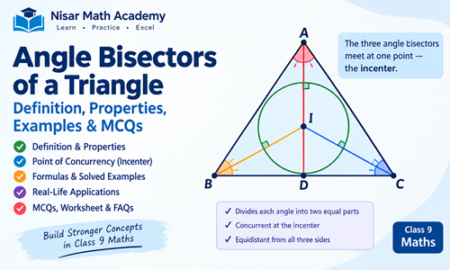
An angle bisector is an important concept in geometry. It divides an angle into two equal angles and helps us understand the properties of triangles. The angle bisectors of a triangle have a special property: all three internal angle bisectors meet at a single point called the incenter.
In this article, you will learn the definition of an angle bisector, its important properties, the point of concurrency of angle bisectors in a triangle, and how to solve related mathematical problems step by step.
These notes are suitable for Class 9 Maths students who want to strengthen their understanding of triangle geometry through definitions, formulas, solved examples, and practice questions.
1. What Is an Angle Bisector of a Triangle?
An angle bisector of a triangle is a line segment or ray that divides one of the triangle’s interior angles into two equal angles.
Consider triangle ABC. If AD is the angle bisector of angle A and D lies on side BC, then:
∠BAD = ∠DAC
This means that AD divides angle A into two equal parts.
For example, if ∠A = 60°, then:
∠BAD = ∠DAC = 60° ÷ 2 = 30°
Similarly, the angle bisectors of angles B and C divide those angles into two equal parts.
2. Diagram-Based Explanation
Imagine a triangle ABC with A at the top and B and C at the bottom.
- Draw a line segment from vertex A to a point D on side BC.
- Make sure that AD divides angle A into two equal angles.
- Label the two angles as ∠BAD and ∠DAC.
- Write ∠BAD = ∠DAC to show that AD is an angle bisector.
Now draw the angle bisectors of angles B and C. These three internal angle bisectors meet at one common point inside the triangle.
This common point is called the incenter, usually represented by the letter I.
3. Important Properties of Angle Bisectors of a Triangle
Property 1: An angle bisector divides an angle into two equal parts
If AD bisects angle A, then:
∠BAD = ∠DAC
Therefore, each smaller angle is half of the original angle.
Property 2: The three internal angle bisectors are concurrent
The three internal angle bisectors of any triangle meet at a single point.
In mathematical language, we say that the angle bisectors of a triangle are concurrent.
Their common point is called the incenter.
Property 3: The incenter is equidistant from all three sides
The incenter has equal perpendicular distances from the three sides of a triangle.
If I is the incenter, and perpendicular distances from I to sides AB, BC, and CA are ID, IE, and IF, respectively, then:
ID = IE = IF
These distances are measured at right angles to the sides, not along the sides themselves.
Property 4: The incenter is the center of the incircle
An incircle is a circle that touches all three sides of a triangle internally.
The incenter is the center of this circle, and the perpendicular distance from the incenter to any side is the radius of the incircle.
Property 5: The incenter always lies inside the triangle
For every non-degenerate triangle, the intersection of the three internal angle bisectors lies inside the triangle.
This is true for acute-angled, right-angled, and obtuse-angled triangles.
4. Formulas Used in Angle Bisector Problems
Formula 1: Finding half of an angle
If an angle A is divided into two equal angles by an angle bisector, then:
∠BAD = ∠DAC = ½∠A
Formula 2: Finding the original angle
If the two equal angles are each x°, then:
∠A = 2x°
Formula 3: Angle sum of a triangle
The sum of the three interior angles of a triangle is 180°.
∠A + ∠B + ∠C = 180°
Formula 4: Angle bisector theorem
The angle bisector theorem states that an internal angle bisector divides the opposite side into two segments proportional to the adjacent sides.
In triangle ABC, if AD bisects angle A and D lies on BC, then:
BD/DC = AB/AC
This formula can be written as:
BD = (AB × BC)/(AB + AC)
DC = (AC × BC)/(AB + AC)
These formulas are useful when the lengths of the sides are known.
5. Solved Examples
Example 1: Finding the two equal angles
In triangle ABC, AD bisects angle A. If ∠A = 80°, find ∠BAD and ∠DAC.
Solution
Step 1: Use the angle bisector property.
∠BAD = ∠DAC
Step 2: Divide the original angle by 2.
∠BAD = 80° ÷ 2 = 40°
Step 3: Therefore:
∠BAD = 40°
∠DAC = 40°
Answer: Both angles are 40°.
Example 2: Finding an unknown angle
In triangle PQR, PS bisects angle P. If ∠QPS = (3x + 5)° and ∠SPR = (5x − 15)°, find x and the two equal angles.
Solution
Step 1: Since PS is an angle bisector, the two angles are equal.
3x + 5 = 5x − 15
Step 2: Rearrange the equation.
20 = 2x
x = 10
Step 3: Substitute x = 10 into either expression.
∠QPS = 3(10) + 5 = 35°
∠SPR = 5(10) − 15 = 35°
Answer: x = 10, and each angle is 35°.
Example 3: Finding an angle using the triangle angle sum
In triangle ABC, ∠A = 70° and ∠B = 50°. AD bisects angle A. Find ∠C, ∠BAD, and ∠DAC.
Solution
Step 1: Find angle C.
∠C = 180° − (70° + 50°)
∠C = 60°
Step 2: Find the two parts of angle A.
∠BAD = 70° ÷ 2 = 35°
∠DAC = 70° ÷ 2 = 35°
Answer: ∠C = 60°, ∠BAD = 35°, and ∠DAC = 35°.
Example 4: Applying the angle bisector theorem
In triangle ABC, AD bisects angle A. If AB = 6 cm, AC = 9 cm, and BC = 10 cm, find BD and DC.
Solution
Step 1: Apply the angle bisector theorem.
BD/DC = AB/AC
BD/DC = 6/9 = 2/3
Step 2: Let BD = 2k and DC = 3k.
Since BC = BD + DC:
2k + 3k = 10
5k = 10
k = 2
Step 3: Calculate the two segments.
BD = 2k = 4 cm
DC = 3k = 6 cm
Answer: BD = 4 cm and DC = 6 cm.
Example 5: Finding a missing side using the angle bisector theorem
In triangle ABC, AD bisects angle A. If AB = 8 cm, AC = 12 cm, and BD = 6 cm, find DC.
Solution
Step 1: Apply the angle bisector theorem.
BD/DC = AB/AC
6/DC = 8/12
Step 2: Simplify the ratio.
6/DC = 2/3
Step 3: Cross-multiply.
2 × DC = 18
DC = 9 cm
Answer: DC = 9 cm.
Example 6: Finding the third angle when two angles are bisected
In triangle ABC, AD and BE bisect angles A and B, respectively. If ∠A = 80° and ∠B = 60°, find ∠C and the four smaller angles at A and B.
Solution
Step 1: Find angle C.
∠C = 180° − (80° + 60°)
∠C = 40°
Step 2: Find the two equal parts of angle A.
∠BAD = ∠DAC = 80° ÷ 2 = 40°
Step 3: Find the two equal parts of angle B.
∠ABE = ∠EBC = 60° ÷ 2 = 30°
Answer: ∠C = 40°, each part of angle A is 40°, and each part of angle B is 30°.
6. Point of Concurrency of Angle Bisectors in a Triangle
The point of concurrency of angle bisectors in a triangle is the point where all three internal angle bisectors intersect.
This point is called the incenter.
The incenter has three important features:
- It lies inside the triangle.
- It is equidistant from all three sides.
- It is the center of the triangle’s incircle.
The incircle touches each side of the triangle at exactly one point.
Why are angle bisectors concurrent?
The internal angle bisectors of angles A and B meet at a point I. A point on an angle bisector is equidistant from the two sides of that angle.
Therefore, I is equidistant from sides AB and AC, and also from sides AB and BC. Consequently, its perpendicular distances from AC and BC are equal as well.
Thus, I lies on the internal angle bisector of angle C. All three internal angle bisectors pass through the same point.
This establishes that the angle bisectors of a triangle are concurrent.
7. Difference Between Altitude, Median and Angle Bisector of a Triangle
Students often confuse an altitude, a median, and an angle bisector because all three can be drawn from a vertex to the opposite side.
| Feature | Altitude | Median | Angle bisector |
|---|---|---|---|
| Definition | Perpendicular from a vertex to the opposite side or its extension | Segment joining a vertex to the midpoint of the opposite side | Segment dividing a vertex angle into two equal angles |
| Main property | Forms a 90° angle with the opposite side or its extension | Divides the opposite side into two equal lengths | Divides the vertex angle into two equal angles |
| Opposite side | Need not be divided equally | Always divided equally | Generally divided in a ratio of adjacent sides |
| Point of concurrency | Orthocenter | Centroid | Incenter |
Important: In an equilateral triangle, the altitude, median, and angle bisector drawn from the same vertex lie along the same line. In a general triangle, they are not necessarily the same line.
8. Real-Life Applications of Angle Bisectors
Angle bisectors are useful in geometry and practical design.
- Architecture: They help divide corners into equal angles when planning geometric layouts.
- Engineering and construction: They can be used to create symmetrical arrangements and determine equal-angle directions.
- Geometric design: They help construct the incircle of a triangle, which fits inside the triangle and touches all three sides.
- Technical drawing: They help divide angles accurately using geometric construction methods.
- Mathematical problem-solving: They are used to calculate unknown angles, side lengths, and proportional segments in triangles.
9. Common Mistakes Students Make
- Assuming the opposite side is always divided equally: An angle bisector does not generally divide the opposite side into two equal parts. A median does.
- Forgetting the angle bisector property: The two angles created by an angle bisector must be equal.
- Using the wrong ratio: The angle bisector theorem gives BD/DC = AB/AC, not AB/BC.
- Confusing the incenter with the centroid: The incenter is where the angle bisectors meet, while the centroid is where the medians meet.
- Adding angles incorrectly: The three interior angles of a triangle must add up to 180°.
- Measuring distance along a side instead of perpendicularly: The incenter’s equal distances from the sides are perpendicular distances.
10. Learning Angle Bisectors with Class 9 Maths Resources
Students can improve their understanding by combining textbook practice with worked examples and visual explanations.
At Nisar Math Academy, students can explore Class 9 Maths notes, recorded video lectures, worksheets, assessments, and solved questions. Free resources include selected notes, lesson plans, assessments, and lectures covering a question from each exercise. Additional resources and full courses are available through website membership.
These resources can help students revise the properties of triangles, practise mathematical reasoning, and prepare for examinations.
Conclusion
The angle bisectors of a triangle divide its three interior angles into equal parts. All three internal angle bisectors meet at one point called the incenter, which is equidistant from the triangle’s three sides and serves as the center of its incircle.
Remember the key formulas:
- Angle bisector: ∠BAD = ∠DAC
- Triangle angle sum: ∠A + ∠B + ∠C = 180°
- Angle bisector theorem: BD/DC = AB/AC
Understanding these properties will help you solve geometry questions more accurately and confidently.
3. Short Notes for Quick Revision
Angle Bisectors of a Triangle — Revision Notes
Definition: An angle bisector divides an angle into two equal angles.
Example: If AD bisects ∠A, then:
\[ \angle BAD=\angle DAC=\frac{\angle A}{2} \]
Important properties
- Each angle bisector divides its vertex angle into two equal angles.
- The three internal angle bisectors of a triangle are concurrent.
- Their common point is called the incenter.
- The incenter lies inside the triangle.
- The incenter is equidistant from all three sides.
- The incenter is the center of the incircle.
Important formulas
| Concept | Formula |
|---|---|
| Half of an angle | \(\frac{\angle A}{2}\) |
| Sum of triangle angles | \(A+B+C=180^\circ\) |
| Angle bisector theorem | \(\frac{BD}{DC}=\frac{AB}{AC}\) |
| Length of BD | \(\frac{AB\times BC}{AB+AC}\) |
| Length of DC | \(\frac{AC\times BC}{AB+AC}\) |
Remember the difference:
- Altitude: Perpendicular to the opposite side or its extension.
- Median: Divides the opposite side into two equal segments.
- Angle bisector: Divides the vertex angle into two equal angles.
- Incenter: Point where the three internal angle bisectors meet.
4. Multiple-Choice Questions (MCQs)
Test your understanding of angle bisectors with these 12 Class 9 Maths questions.
Class 9 Maths Quiz
0 of 12 answered
1. What is an angle bisector?A. A line that divides a side into two equal partsB. A line that divides an angle into two equal anglesC. A line perpendicular to a sideD. A line parallel to a side
2. If an angle of 80° is bisected, what is the measure of each smaller angle?A. 20°B. 30°C. 40°D. 80°
3. What is the point of concurrency of the internal angle bisectors called?A. CentroidB. OrthocenterC. CircumcenterD. Incenter
4. Where does the incenter lie?A. Always inside the triangleB. Always outside the triangleC. Always on a sideD. Always at a vertex
5. If ∠A = 100° and AD bisects it, what is ∠BAD?A. 25°B. 40°C. 50°D. 100°
6. The sum of the interior angles of a triangle is:A. 90°B. 180°C. 270°D. 360°
7. In triangle ABC, AD bisects ∠A. Which relation is correct?A. BD/DC = AB/ACB. BD/DC = AC/ABC. BD = DC in every triangleD. AB/BC = BD/DC
8. If AB = 4 cm, AC = 6 cm, and BC = 15 cm, what is BD when AD bisects ∠A?A. 5 cmB. 6 cmC. 9 cmD. 10 cm
9. Which point is the center of a triangle’s incircle?A. CentroidB. OrthocenterC. IncenterD. Circumcenter
10. Which line segment divides the opposite side into two equal parts?A. AltitudeB. Angle bisectorC. MedianD. Perpendicular bisector only
11. If an angle bisector divides an angle into (3x + 5)° and (5x − 15)°, what is x?A. 5B. 10C. 15D. 20
12. The perpendicular distances from the incenter to the three sides are:A. Always differentB. EqualC. Always zeroD. Equal to the side lengths
Check Answers
5. Worksheet / Assignment
Topic: Angle Bisectors of a Triangle
Class: 9 Maths
Instructions: Attempt all questions. Show your working for numerical problems.
Section A: Definitions and Concepts
- Define an angle bisector of a triangle.
- What is the incenter of a triangle?
- What does it mean to say that the angle bisectors of a triangle are concurrent?
- State two properties of the incenter.
- Differentiate between a median and an angle bisector.
Section B: Numerical Problems
6. An angle of a triangle measures \(76^\circ\). Find the two angles formed by its angle bisector.
7. In triangle ABC, AD bisects angle A. If \(\angle BAD=(4x+10)^\circ\) and \(\angle DAC=(6x-20)^\circ\), find \(x\) and both smaller angles.
8. In triangle PQR, \(\angle P=64^\circ\) and \(\angle Q=48^\circ\). Find angle R.
9. In triangle ABC, AD bisects angle A. Given \(AB=8\) cm, \(AC=12\) cm, and \(BC=15\) cm, find BD and DC.
10. In triangle ABC, AD bisects angle A. If \(AB=10\) cm, \(AC=15\) cm, and \(BD=8\) cm, calculate DC.
Section C: Application and Reasoning
11. A triangular garden has an angle of \(90^\circ\) at vertex A. An internal angle bisector divides this angle into two equal parts. Find both angles.
12. Explain why the three internal angle bisectors of a triangle meet at a single point.
13. A student claims that an angle bisector always divides the opposite side into two equal lengths. Is the claim correct? Explain.
14. In triangle ABC, AD bisects angle A. If \(BD=6\) cm, \(DC=9\) cm, and \(AB=8\) cm, find AC.
15. Explain how the incenter can be used to construct an incircle inside a triangle.
Worksheet Answer Key
Try to solve all questions before opening the answers.Show Answer Key
6. Frequently Asked Questions (FAQs)
1. What is an angle bisector of a triangle?
It is a line segment or ray that divides one of the triangle’s interior angles into two equal angles.
2. What is the point of concurrency of angle bisectors in a triangle?
It is called the incenter, the common intersection point of the three internal angle bisectors.
3. Are the angle bisectors of a triangle concurrent?
Yes. The three internal angle bisectors of every non-degenerate triangle meet at one point inside the triangle.
4. What is the angle bisector theorem?
It states that an internal angle bisector divides the opposite side in the ratio of the two adjacent sides. For AD bisecting angle A:
\[ \frac{BD}{DC}=\frac{AB}{AC} \]
5. What is the difference between an altitude, median and angle bisector of a triangle?
An altitude is perpendicular to the opposite side or its extension, a median joins a vertex to the midpoint of the opposite side, and an angle bisector divides a vertex angle into two equal angles.
6. Is the incenter always inside a triangle?
Yes. The incenter, formed by the three internal angle bisectors, always lies inside a non-degenerate triangle.
7. What is the relationship between the incenter and the incircle?
The incenter is the center of the incircle. The perpendicular distance from the incenter to any side is the radius of the incircle.
8. Where can I find Class 9 Maths notes and video lectures?
You can explore notes, recorded lectures, worksheets, assessments, and other learning resources at Nisar Math Academy: www.nisarmathacademy.com. Some resources are free, while additional materials are available through membership.
You May be Interested In:
How Many Types of Triangles Are There? Perpendicular Bisectors and Medians of a Triangle
How Many Types of Triangles Are There? Names, Properties & Examples
Construction of Triangles: Steps, Rules, and Solved Examples for Class 9

Leave a Reply