Maximum and Minimum Values in Feasible Solution of Linear Inequalities
Introduction
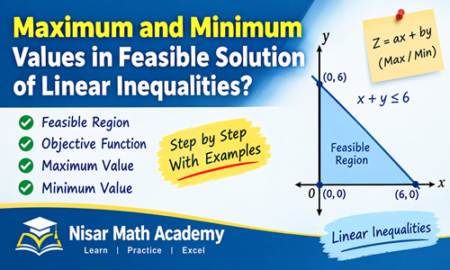
In linear inequalities, we often have to find the maximum and minimum values of a particular expression subject to a given set of conditions. These conditions are represented by linear inequalities, and their common solution forms a region called the feasible region.
Finding the maximum or minimum value of an expression within this region is an important application of linear inequalities. It is also closely related to linear programming, which is used to solve many real-life problems involving limited resources, production, cost, profit, and transportation.
In this article, we will learn how to find the maximum value of a feasible solution and the minimum value using a simple graphical method.
What Are Linear Inequalities?
A linear inequality is an inequality involving variables of degree one.
Examples include:
When two or more linear inequalities are given together, they form a system of linear inequalities.
The solutions that satisfy all the inequalities simultaneously are called feasible solutions.
What Is a Feasible Solution?
A feasible solution is a point that satisfies all the given constraints or linear inequalities.
For example, consider:
and
Any point in the first quadrant that lies on or below the line satisfies these conditions.
Therefore, all such points are feasible solutions.
The collection of all feasible solutions is called the feasible region.
What Is a Feasible Region?
The region common to all the inequalities in a system is called the feasible region.
To find the feasible region:
- Convert each inequality into an equation.
- Draw the corresponding boundary line.
- Determine the appropriate half-plane for each inequality.
- Identify the common shaded region.
- This common region is the feasible region.
What Is an Objective Function?
The expression whose maximum or minimum value is required is called the objective function.
For example:
If we are asked to find the maximum value of , then is the objective function.
Similarly, if we are asked to find the minimum value, we use the same objective function and determine its smallest possible value within the feasible region.
Maximum and Minimum Values
The maximum value is the greatest value that the objective function can attain within the feasible region.
The minimum value is the smallest value that the objective function can attain within the feasible region.
In many graphical linear programming problems, these values occur at the corner points (vertices) of the feasible region.
Therefore, after finding the feasible region, we usually:
- Find all corner points.
- Substitute each corner point into the objective function.
- Compare the resulting values.
- The greatest value is the maximum value.
- The smallest value is the minimum value.
Example: Finding the Maximum and Minimum Values
Consider the following constraints:
Suppose the objective function is:
We need to find the maximum and minimum values of .
Step 1: Find the Corner Points
The feasible region has the corner points:
Step 2: Calculate the Objective Function
At :
At :
At :
Step 3: Compare the Values
The values of are:
Therefore:
at
and
at
This is the basic procedure for finding maximum and minimum values in a feasible solution.
Another Example
Consider:
and the objective function:
The corner points of the feasible region are:
Now calculate .
At :
At :
At :
Therefore:
at .
The minimum value is:
at .
Why Are Corner Points Important?
For a linear objective function over a bounded feasible region, the maximum or minimum value occurs at a corner point of the feasible region.
This means that we do not normally need to test every point in the feasible region. We only need to calculate the objective function at its corner points.
This makes the solution much easier and faster.
Steps to Find Maximum and Minimum Values
The following steps can be used to solve most graphical problems.
Step 1: Write the Constraints
Write all the given linear inequalities clearly.
Step 2: Draw the Boundary Lines
Replace each inequality sign with an equal sign and draw the corresponding lines.
Step 3: Identify the Feasible Region
Determine the region satisfying all the inequalities simultaneously.
Step 4: Find the Corner Points
Determine the coordinates of all vertices of the feasible region.
Step 5: Write the Objective Function
Identify the expression whose maximum or minimum value is required.
For example:
Step 6: Substitute the Corner Points
Put every corner point into the objective function.
Step 7: Compare the Results
The largest value gives the maximum value, while the smallest value gives the minimum value.
Maximum Value of Feasible Solution
The maximum value of a feasible solution means the greatest value of the objective function among all feasible solutions.
For example, if the values obtained at the corner points are:
then:
The point at which 15 occurs is the optimal feasible solution for the maximization problem.
Minimum Value of a Feasible Solution
The minimum value is the smallest value of the objective function among all feasible solutions.
If the values obtained at the corner points are:
then:
The corresponding corner point gives the optimal feasible solution for the minimization problem.
Important Terms
Constraint
A linear inequality that limits the possible values of variables is called a constraint.
Feasible Solution
A solution satisfying all constraints is called a feasible solution.
Feasible Region
The common region satisfying all the constraints is called the feasible region.
Objective Function
The linear expression that is to be maximized or minimized is called the objective function.
Optimal Solution
A feasible solution that gives the maximum or minimum value of the objective function is called an optimal solution.
Corner Point
A point where two or more boundary lines meet is called a corner point or vertex of the feasible region.
Maximum and Minimum Values in Real-Life Problems
Maximum and minimum values are useful in many practical situations.
For example, a factory may want to:
- Maximize profit.
- Minimize production cost.
- Maximize the number of products manufactured.
- Minimize transportation expenses.
- Use available resources efficiently.
Such problems can be represented mathematically using linear inequalities and an objective function.
Common Mistakes to Avoid
Students should avoid the following mistakes while solving maximum and minimum problems:
- Forgetting to consider all the inequalities.
- Drawing a boundary line incorrectly.
- Shading the wrong side of an inequality.
- Missing a corner point.
- Substituting coordinates incorrectly in the objective function.
- Comparing only some of the values.
- Giving the maximum or minimum value without stating the corresponding point.
Always check that the final point satisfies all the given constraints.
Short Notes
Maximum and Minimum Values
The greatest value of an objective function in the feasible region is called its maximum value.
The smallest value of an objective function in the feasible region is called its minimum value.
Feasible Solution
A point satisfying all given linear inequalities is called a feasible solution.
Feasible Region
The common region satisfying all constraints is called the feasible region.
Objective Function
The expression to be maximized or minimized is called the objective function.
Example:
Main Method
To find maximum and minimum values:
- Graph the inequalities.
- Find the feasible region.
- Determine its corner points.
- Substitute each corner point in the objective function.
- Compare the resulting values.
- Greatest value = maximum.
- Smallest value = minimum.
Important Result
For a linear objective function over a bounded feasible region, an optimum value occurs at a corner point of the feasible region.
Frequently Asked Questions
What is a feasible solution?
A feasible solution is a point that satisfies all the given linear inequalities.
What is a feasible region?
The common region satisfying all the constraints is called the feasible region.
What is an objective function?
An objective function is a linear expression that is required to be maximized or minimized.
How do we find the maximum value?
Find the corner points of the feasible region, substitute them into the objective function, and choose the greatest resulting value.
How do we find the minimum value?
Find the corner points, calculate the objective function at each point, and choose the smallest resulting value.
Where does the maximum or minimum usually occur?
For a linear objective function over a bounded feasible region, the maximum or minimum occurs at a corner point.
Conclusion
The concept of maximum and minimum values is an important application of linear inequalities. The main idea is to find the feasible region, identify its corner points, and evaluate the objective function at those points.
Students should remember the simple rule:
Find the feasible region → Find corner points → Calculate objective-function values → Compare them.
The greatest value is the maximum value, and the smallest value is the minimum value.
For more mathematics notes, recorded lectures, assessments, lesson plans, and educational resources, students can visit Nisar Math Academy. Some learning resources and selected Class 9 Maths Notes are available free of charge, while full-course access is available through membership.
MCQs on Maximum and Minimum Values
- A solution satisfying all the given constraints is called:
A. Boundary solution
B. Feasible solution
C. Impossible solution
D. Negative solution
Answer: B. Feasible solution
- The common region satisfying all linear inequalities is called:
A. Objective region
B. Boundary region
C. Feasible region
D. Maximum region
Answer: C. Feasible region
- The expression that is to be maximized or minimized is called:
A. Constraint
B. Objective function
C. Feasible solution
D. Boundary line
Answer: B. Objective function
- Which of the following can be an objective function?
A.
B.
C.
D.
Answer: A. 3x+2y3x+2y
- The greatest value of an objective function is called:
A. Minimum value
B. Feasible value
C. Maximum value
D. Boundary value
Answer: C. Maximum value
- The smallest value of an objective function is called:
A. Maximum value
B. Minimum value
C. Feasible value
D. Corner value
Answer: B. Minimum value
- In the graphical method, maximum or minimum values for a linear objective function over a bounded feasible region are found by checking:
A. Only the origin
B. All points in the plane
C. Corner points
D. Only boundary lines
Answer: C. Corner points
- If the objective-function values at the corner points are and , the maximum value is:
A. 4
B. 7
C. 9
D. 12
Answer: D. 12
- If the objective-function values are and 6, the minimum value is:
A. 3
B. 6
C. 8
D. 11
Answer: A. 3
- Which of the following is a constraint?
A.
B.
C.
D.
Answer: B. x+y≤10x+y\leq10
Worksheet / Assignment
Part A: Fill in the Blanks
- A solution satisfying all constraints is called a __________ solution.
- The common region satisfying all inequalities is called the __________ region.
- The expression to be maximized or minimized is called the __________ function.
- The greatest value of an objective function is called the __________ value.
- The smallest value of an objective function is called the __________ value.
- The vertices of a feasible region are also called __________ points.
Part B: True or False
- Every feasible solution satisfies all the given constraints.
- The objective function represents the expression to be optimized.
- The feasible region is always outside all the constraints.
- Corner points are important when finding maximum and minimum values.
- The minimum value is always greater than the maximum value.
Part C: Solve the Following
Question 1
Given:
Find the maximum and minimum values of:
Question 2
Given:
Find the maximum and minimum values of:
Question 3
Given:
Find the maximum and minimum values of:
Question 4
Draw the feasible region for:
and identify its corner points.
Question 5
Explain the following terms in your own words:
a. Linear inequality
b. Feasible solution
c. Feasible region
d. Objective function
e. Maximum value
f. Minimum value
You May be Interested In:
Feasible Solution of Linear Inequalities
Solution of Two Linear Equations in Two Variables
Solution of Linear Inequality in Two Variables | Solving Linear Inequality Graphically

Leave a Reply