Solution of Two Linear Equations in Two Variables
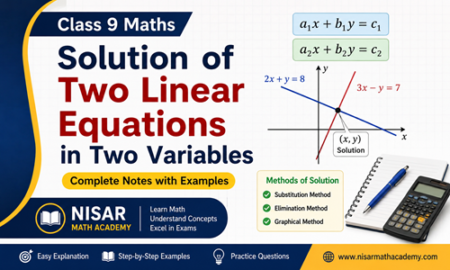
Introduction
A linear equation in two variables is an equation that can be written in the form
ax + by = c
where a, b, and c are constants and x and y are variables.
When we have two linear equations involving the same two variables, we can find the values of x and y that satisfy both equations. This is called the solution of two linear equations in two variables.
For example:
2x + y = 7
x − y = 2
The values of x and y that satisfy both equations simultaneously are called the solution of the pair of linear equations.
Students studying Class 9 Mathematics often encounter these equations and need to understand different methods for finding their solutions.
General Form of Two Linear Equations
Two linear equations in two variables can generally be written as:
a₁x + b₁y = c₁
a₂x + b₂y = c₂
Here:
- x and y are the variables.
- a₁, b₁, c₁, a₂, b₂, and c₂ are constants.
- The values of x and y satisfying both equations form the solution.
Methods for Solving Linear Equations in Two Variables
There are several methods used to find the solution of two linear equations in two variables. The commonly used methods are:
- Substitution Method
- Elimination Method
- Graphical Method
In this article, we will understand these methods with examples.
1. Substitution Method
In the substitution method, we first express one variable in terms of the other variable. We then substitute this value into the second equation.
Example
Solve:
x + y = 7
x − y = 1
Step 1: Find one variable from the first equation
From:
x + y = 7
we get:
x = 7 − y
Step 2: Substitute this value in the second equation
The second equation is:
x − y = 1
Substituting x = 7 − y:
(7 − y) − y = 1
7 − 2y = 1
−2y = 1 − 7
−2y = −6
Therefore:
y = 3
Step 3: Find x
Using:
x = 7 − y
we get:
x = 7 − 3
x = 4
Therefore, the solution is:
x = 4, y = 3
or
(4, 3)
Verification
Put x = 4 and y = 3 in the first equation:
x + y = 4 + 3 = 7
The first equation is satisfied.
Put the values in the second equation:
x − y = 4 − 3 = 1
The second equation is also satisfied.
Hence, (4, 3) is the solution.
2. Elimination Method
The elimination method is another important method for solving linear equations.
In this method, we add or subtract the equations so that one of the variables is eliminated.
Example
Solve:
2x + y = 8
3x − y = 7
Step 1: Add the equations
2x + y = 8
3x − y = 7
Adding both equations:
5x = 15
Therefore:
x = 3
Step 2: Find y
Substitute x = 3 in:
2x + y = 8
2(3) + y = 8
6 + y = 8
Therefore:
y = 2
Hence, the solution is:
x = 3, y = 2
or
(3, 2)
Verification
First equation:
2(3) + 2 = 8
6 + 2 = 8
Correct.
Second equation:
3(3) − 2 = 7
9 − 2 = 7
Correct.
Therefore, (3, 2) is the required solution.
3. Graphical Method
In the graphical method, each linear equation is represented by a straight line on the coordinate plane.
The solution of the two equations is represented by the point where the two lines intersect.
For example:
x + y = 5
x − y = 1
The two equations represent two straight lines. Their point of intersection gives the common solution of the equations.
For these equations, the solution is:
x = 3, y = 2
Thus, the point of intersection is:
(3, 2)
Types of Solutions
A pair of linear equations in two variables may have:
1. Unique Solution
When two lines intersect at exactly one point, the equations have one unique solution.
For example:
x + y = 5
x − y = 1
The solution is:
(3, 2)
2. No Solution
When two lines are parallel and never meet, the equations have no solution.
For example:
x + y = 4
x + y = 7
These equations represent parallel lines. Therefore, there is no common solution.
3. Infinitely Many Solutions
When two equations represent the same line, they have infinitely many solutions.
For example:
x + y = 5
2x + 2y = 10
The second equation is simply twice the first equation. Therefore, both equations represent the same line and have infinitely many common solutions.
Important Points to Remember
- A linear equation in two variables generally has the form ax + by = c.
- A pair of linear equations contains two equations involving the same variables.
- The solution must satisfy both equations simultaneously.
- Substitution and elimination are important algebraic methods.
- The graphical method uses the intersection of two straight lines.
- Two intersecting lines have one unique solution.
- Parallel lines have no solution.
- Coincident lines have infinitely many solutions.
- Always verify your answer by putting the values of x and y into both original equations.
Solving Linear Equalities: Quick Example
Consider:
2x + y = 9
x + y = 6
Subtract the second equation from the first:
(2x + y) − (x + y) = 9 − 6
x = 3
Now substitute x = 3 into:
x + y = 6
3 + y = 6
Therefore:
y = 3
So the solution is:
(3, 3)
Verification:
2(3) + 3 = 9
and
3 + 3 = 6
Both equations are satisfied.
Short Notes on Solution of Two Linear Equations in Two Variables
A linear equation in two variables contains two variables, usually x and y, and can be written as:
ax + by = c
A pair of linear equations can be represented as:
a₁x + b₁y = c₁
a₂x + b₂y = c₂
The common values of x and y satisfying both equations are called the solution of the pair of linear equations.
Main Methods
Substitution Method:
Find one variable in terms of the other and substitute it into the second equation.
Elimination Method:
Add or subtract the equations to eliminate one variable.
Graphical Method:
Draw the two equations as straight lines. The point of intersection gives the solution.
Possible Results
Intersecting lines → One solution
Parallel lines → No solution
Same line → Infinitely many solutions
Multiple Choice Questions (MCQs)
MCQ 1
Which of the following is a linear equation in two variables?
A. x² + y = 5
B. 2x + 3y = 7
C. xy = 6
D. x² + y² = 9
Answer: B
MCQ 2
The general form of a linear equation in two variables is:
A. ax² + by = c
B. ax + by = c
C. xy = c
D. ax² + by² = c
Answer: B
MCQ 3
The solution of:
x + y = 7
x − y = 1
is:
A. (3, 4)
B. (4, 3)
C. (5, 2)
D. (2, 5)
Answer: B
MCQ 4
Which method involves expressing one variable in terms of another?
A. Graphical method
B. Substitution method
C. Factorization method
D. Division method
Answer: B
MCQ 5
In the elimination method, we try to:
A. Increase both variables
B. Eliminate one variable
C. Square both equations
D. Factorize both variables
Answer: B
MCQ 6
The graphical solution of two linear equations is represented by:
A. The midpoint of two lines
B. The point of intersection of the lines
C. The slope only
D. The x-axis
Answer: B
MCQ 7
Two parallel lines have:
A. One solution
B. Two solutions
C. No solution
D. Infinitely many solutions
Answer: C
MCQ 8
Two coincident lines have:
A. No solution
B. One solution
C. Two solutions
D. Infinitely many solutions
Answer: D
MCQ 9
If x = 2 and y = 3, then the value of x + y is:
A. 1
B. 5
C. 6
D. 9
Answer: B
MCQ 10
Which of the following is NOT a method for solving a pair of linear equations?
A. Substitution
B. Elimination
C. Graphical
D. Differentiation
Answer: D
Worksheet / Assignment
Part A: Identify Linear Equations
Identify which of the following are linear equations in two variables:
- 2x + 3y = 10
- x² + y = 8
- 5x − 2y = 7
- xy = 12
- 4x + y − 9 = 0
Part B: Solve by Substitution Method
Solve the following pairs of equations using the substitution method:
- x + y = 9
x − y = 3 - 2x + y = 11
x + y = 7 - x + 2y = 8
x − y = 2 - 3x + y = 13
x + y = 7
Part C: Solve by Elimination Method
Solve:
- 2x + y = 9
3x − y = 11 - x + y = 10
2x − y = 5 - 3x + 2y = 16
3x − 2y = 8 - 5x + 2y = 19
3x − 2y = 5
Part D: Word Problems
- The sum of two numbers is 20 and their difference is 6. Find the numbers.
- The sum of two numbers is 15. Three times the first number plus the second number is 25. Find the numbers.
- The cost of two notebooks and one pen is Rs. 170. The cost of one notebook and one pen is Rs. 100. Find the cost of each item.
Part E: Conceptual Questions
- Define a linear equation in two variables.
- What is meant by the solution of two linear equations?
- Explain the substitution method.
- Explain the elimination method.
- What does the intersection point of two straight lines represent?
- What type of solution is obtained when two lines are parallel?
- What happens when two equations represent the same line?
Answers to Selected Worksheet Questions
Part A
- Linear equation
- Not a linear equation
- Linear equation
- Not a linear equation
- Linear equation
Part B
- x = 6, y = 3
- x = 4, y = 3
- x = 4, y = 2
- x = 3, y = 4
Part C
- x = 4, y = 1
- x = 5, y = 5
- x = 4, y = 2
- x = 3, y = 2
Learning Summary
After studying this topic, students should be able to:
- Define a linear equation in two variables.
- Recognize linear equations.
- Solve a pair of linear equations.
- Apply the substitution method.
- Apply the elimination method.
- Understand the graphical method.
- Identify unique, no, and infinitely many solutions.
- Verify the solution of a pair of equations.
- Apply linear equations to simple word problems.
Learn More with Nisar Math Academy
Nisar Math Academy provides students with recorded mathematics lectures, notes, assessments, lesson plans, and other useful educational material.
Students can access selected Class 9 Maths Notes, free lectures, assessments, and other learning resources. For students who want complete access to the course material, membership is available through the website.
Visit Nisar Math Academy at:
Conclusion
The solution of two linear equations in two variables is an important topic in algebra. Students can solve these equations using the substitution, elimination, and graphical methods.
The most important point is that the final values of x and y must satisfy both equations simultaneously. With regular practice, students can easily solve linear equations and apply them to mathematical and real-life problems.
You May be Interested In:
Solution of Linear Inequality in Two Variables | Solving Linear Inequality Graphically
Linear Equations and Inequalities – Complete Notes, Examples, MCQs & Worksheet

Leave a Reply