Feasible Solution of Linear Inequalities
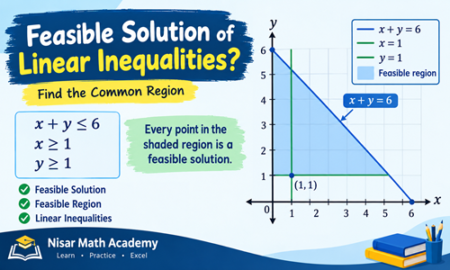
Introduction
A feasible solution is a value or set of values that satisfies all the given conditions or inequalities. In mathematics, when we solve a system of linear inequalities, the values that satisfy all the inequalities simultaneously are called the feasible solutions.
The concept of a feasible solution of linear inequalities is important because it helps us identify the common region where all the given inequalities are true.
At Nisar Math Academy, students can learn mathematical concepts through recorded lectures, notes, assessments, and lesson plans designed to make mathematics easier to understand.
What is a Linear Inequality?
A linear inequality is an inequality involving one or more variables in which the highest power of each variable is 1.
Common inequality symbols are:
<means less than>means greater than≤means less than or equal to≥means greater than or equal to
Examples
Some examples of linear inequalities are:
- (x+3>7)
- (x+y<6)
What is a Feasible Solution?
A feasible solution is a solution that satisfies all the given inequalities simultaneously.
Feasible Solution of Linear Inequalities in Two Variables
When linear inequalities contain two variables, such as (x) and (y), their solutions can be represented graphically on the Cartesian plane.
The boundary divides the coordinate plane into two regions. One of these regions represents the solutions of the inequality.
To determine the correct region, we can use a test point.
Usually, the origin ((0,0)) is convenient if it does not lie on the boundary line.
Substitute (x=0) and (y=0):
If this statement is true, (0,0) represents the solution of the inequality.
Feasible Region
The feasible region is the region of the coordinate plane containing all feasible solutions of a system of linear inequalities.
In other words:
The common region satisfying all the given linear inequalities is called the feasible region.
Every point inside this region is a feasible solution.
Note: A point must satisfy every inequality in the system to be a feasible solution.
Steps to Find the Feasible Solution
The following steps can be used to find the feasible solution of linear inequalities:
Step 1: Write the given inequalities
Clearly write all the inequalities in the system.
Step 2: Convert each inequality into its boundary equation
Step 3: Draw the boundary line
Step 4: Select a test point
Choose a convenient point, usually (0,0), if it is not on the boundary line.
Step 5: Test the point
Substitute the coordinates into the inequality.
Step 6: Shade the correct region
Shade the side that satisfies the inequality.
Step 7: Find the common region
When there are several inequalities, the region common to all the inequalities is the feasible region.
Important Points to Remember
- A feasible solution satisfies all the given inequalities.
- A feasible solution may be a single point or one of many points.
- In two variables, feasible solutions are represented by points on the coordinate plane.
- The common region satisfying all inequalities is called the feasible region.
- For (<) and (>), the boundary line is not included.
- A point that fails even one inequality is not a feasible solution.
- Graphical methods are useful for finding feasible regions.
Difference Between Feasible and Non-Feasible Solutions
A feasible solution satisfies every inequality in the system.
A non-feasible solution fails to satisfy at least one of the inequalities.
Conclusion
The concept of a feasible solution of linear inequalities is fundamental in solving systems of inequalities. A feasible solution is any value or ordered pair that satisfies all the given inequalities simultaneously.
When inequalities involve two variables, their solutions can be represented graphically. The common shaded region is called the feasible region, and every point in this region represents a feasible solution.
Students should practice checking different points and identifying the common region to develop a strong understanding of linear inequalities.
Short Notes
Feasible Solution: A solution that satisfies all the given linear inequalities simultaneously.
Feasible Region: The common region satisfying all the inequalities in a system.
Boundary Line: The line obtained by replacing the inequality sign with an equality sign.
Solid Line: Used for:
Dashed Line: Used for:
Important Rule: A point is a feasible solution only if it satisfies every inequality in the system.
Quick Example
Given:
Check :
All are true, so (2,2)(2,2) is a feasible solution.
MCQs
1. What is a feasible solution?
A. A solution satisfying none of the inequalities
B. A solution satisfying only one inequality
C. A solution satisfying all the given inequalities
D. A solution that contains no variables
Answer: C
2. The common region satisfying all inequalities is called:
A. Boundary line
B. Feasible region
C. Coordinate axis
D. Intercept
Answer: B
3. Which symbol includes the boundary line?
A.
B.
C.
D. Both A and B
Answer: C
4. Which type of line is generally used for ?
A. Dashed line
B. Solid line
C. Curved line
D. Vertical line only
Answer: B
5. Which point satisfies ?
A.
B.
C.
D.
Answer: C
6. A point that does not satisfy even one inequality is:
A. A feasible solution
B. A feasible region
C. A non-feasible solution
D. A boundary solution
Answer: C
7. For , the boundary line is:
A.
B.
C.
D.
Answer: C
8. Which inequality includes its boundary?
A.
B.
C.
D. Both A and B
Answer: C
9. In a system of inequalities, a feasible solution must satisfy:
A. Only the first inequality
B. Only the last inequality
C. All inequalities
D. No inequality
Answer: C
10. Graphical representation of linear inequalities is especially useful for finding:
A. Feasible region
B. Prime numbers
C. Square roots only
D. Fractions only
Answer: A
Worksheet / Assignment
Part A: Short Questions
- Define a feasible solution.
- What is a feasible region?
- What is the difference between a feasible and a non-feasible solution?
- When do we use a solid boundary line?
- When do we use a dashed boundary line?
Part B: Identify Feasible Solutions
For each system, determine whether the given point is a feasible solution.
1.
Check:
2.
Check:
3.
Check:
4.
Check:
5.
Check:
Part C: Graphical Practice
Graph the following systems of linear inequalities and identify the feasible region:
1.
2.
3.
Part D: Challenge Question
Consider:
Find three different feasible solutions.
You May be Interested In:
Solution of Two Linear Equations in Two Variables
Solution of Linear Inequality in Two Variables | Solving Linear Inequality Graphically

Leave a Reply