How Many Types of Triangles Are There? Perpendicular Bisectors and Medians of a Triangle
Introduction
Triangles are among the most important shapes in geometry. They are used in mathematics, architecture, engineering, construction, and many everyday applications. A triangle is a closed geometric figure formed by three line segments, three sides, and three interior angles.
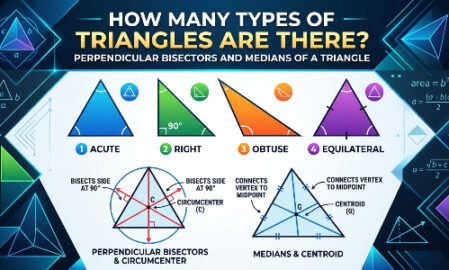
There are six commonly taught types of triangles, classified into two groups: three types based on their sides and three types based on their angles. The classifications are equilateral, isosceles, scalene, acute-angled, right-angled, and obtuse-angled triangles.
In this guide, you will learn the types of triangles and their names, their important properties, and the formulas used to solve triangle problems. You will also study two important geometry concepts: perpendicular bisectors and medians of a triangle.
These concepts are useful for students studying Class 9 Maths and preparing for mathematics examinations.
What Is a Triangle?
A triangle is a polygon with three sides, three vertices, and three interior angles.
A triangle is usually named using its three vertices. For example, triangle ABC is written as △ABC.
In △ABC:
- AB, BC, and CA are the three sides.
- ∠A, ∠B, and ∠C are the three interior angles.
- A, B, and C are the three vertices.
Angle Sum Property of a Triangle
The sum of the three interior angles of every triangle is 180°.
Formula:
∠A + ∠B + ∠C = 180°
For example, if two angles of a triangle are 50° and 60°, the third angle is:
Third angle = 180° − (50° + 60°)
Third angle = 180° − 110°
Third angle = 70°
This property is used in many questions involving the types of triangles in geometry.
How Many Types of Triangles Are There?
Triangles are classified according to their side lengths and interior angles.
1. Types of Triangles Based on Sides
There are three types of triangles based on their sides: equilateral, isosceles, and scalene.
Equilateral Triangle
An equilateral triangle has three equal sides and three equal interior angles.
Properties:
- All three sides are equal.
- Each interior angle measures 60°.
- All three angles are equal.
- It has three lines of symmetry.
Example: If AB = BC = CA = 6 cm, then △ABC is an equilateral triangle.
The perimeter is:
P = 6 + 6 + 6 = 18 cm
Isosceles Triangle
An isosceles triangle has at least two equal sides. In the usual school classification, it is described as a triangle with exactly two equal sides.
Properties:
- Two sides are equal.
- The angles opposite the equal sides are equal.
- The third side may have a different length.
Example: Suppose AB = AC = 5 cm and BC = 6 cm.
Since two sides are equal, △ABC is an isosceles triangle.
If ∠B = 50°, then ∠C = 50°.
Therefore:
∠A = 180° − (50° + 50°) = 80°
Scalene Triangle
A scalene triangle has three sides of different lengths.
Properties:
- No two sides are equal.
- All three interior angles are different.
- It has no line of symmetry.
Example: A triangle with sides 4 cm, 5 cm, and 6 cm is scalene.
Its perimeter is:
P = 4 + 5 + 6 = 15 cm
These are the three main types of triangle by sides.
2. Types of Triangles Based on Angles
Triangles can also be classified according to the sizes of their interior angles.
Acute-Angled Triangle
An acute-angled triangle has three angles smaller than 90°.
Example: A triangle with angles 50°, 60°, and 70° is acute-angled because all three angles are less than 90°.
Check:
50° + 60° + 70° = 180°
Right-Angled Triangle
A right-angled triangle has exactly one interior angle equal to 90°.
Properties:
- One angle is 90°.
- The side opposite the right angle is called the hypotenuse.
- The hypotenuse is the longest side.
The Pythagorean theorem applies to right-angled triangles.
Formula:
a² + b² = c²
Here, a and b are the perpendicular sides, and c is the hypotenuse.
Example: If the perpendicular sides are 3 cm and 4 cm:
c² = 3² + 4²
c² = 9 + 16 = 25
c = √25 = 5 cm
Therefore, the hypotenuse is 5 cm.
Obtuse-Angled Triangle
An obtuse-angled triangle has exactly one interior angle greater than 90°.
Example: A triangle with angles 110°, 40°, and 30° is obtuse-angled.
Check:
110° + 40° + 30° = 180°
A triangle cannot have two obtuse angles because their sum would already exceed 180°.
Summary Table: Types of Triangles and Their Names
| Type | Classification | Main property |
|---|---|---|
| Equilateral | By sides | Three equal sides |
| Isosceles | By sides | At least two equal sides |
| Scalene | By sides | Three unequal sides |
| Acute-angled | By angles | All angles less than 90° |
| Right-angled | By angles | One angle equals 90° |
| Obtuse-angled | By angles | One angle greater than 90° |
Important: These six names represent two different ways of classifying triangles. A triangle can belong to one category from each group. For example, a right-angled triangle can also be scalene or isosceles.
An equilateral triangle is always acute-angled because each angle measures 60°.
Important Formulas Used in Triangle Problems
Students studying Class 9 Maths should remember the following formulas.
1. Perimeter of a Triangle
The perimeter is the total length of the three sides.
P = a + b + c
Here, a, b, and c represent the side lengths.
2. Area of a Triangle
The area of a triangle is half the product of its base and perpendicular height.
A = ½ × base × height
Or:
A = ½bh
3. Angle Sum Property
A + B + C = 180°
4. Pythagorean Theorem
For a right-angled triangle:
a² + b² = c²
5. Heron’s Formula
When all three side lengths are known, the area can be calculated using Heron’s formula.
First, calculate the semi-perimeter:
s = (a + b + c)/2
Then:
Area = √[s(s − a)(s − b)(s − c)]
The side lengths must satisfy the triangle inequality: the sum of any two sides must be greater than the third side.
Perpendicular Bisectors and Medians of a Triangle
Perpendicular bisectors and medians of a triangle are important concepts in geometry. Although both involve the sides or vertices of a triangle, they have different definitions and properties.
What Is a Median of a Triangle?
A median of a triangle is a line segment joining a vertex to the midpoint of the opposite side.
Consider △ABC. Let D be the midpoint of side BC.
Then:
BD = DC
The line segment AD is a median of △ABC.
Properties of a median:
- Every triangle has three medians.
- Each median joins a vertex to the midpoint of the opposite side.
- The three medians meet at one point called the centroid.
- The centroid divides each median in the ratio 2:1, measured from the vertex.
- A median divides a triangle into two smaller triangles of equal area.
What Is a Perpendicular Bisector?
A perpendicular bisector of a line segment is a line that passes through the midpoint of the segment and meets it at an angle of 90°.
Suppose D is the midpoint of BC and line l passes through D at a right angle to BC.
Then:
BD = DC
and
l ⟂ BC
Therefore, line l is the perpendicular bisector of BC.
Properties of a perpendicular bisector:
- It divides a line segment into two equal parts.
- It intersects the segment at 90°.
- Every point on the perpendicular bisector is equally distant from the two endpoints of the segment.
- The three perpendicular bisectors of a triangle’s sides meet at a point called the circumcenter.
- The circumcenter is equally distant from all three vertices.
Diagram-Based Explanation
Imagine a triangle ABC drawn on a sheet of paper.
For a median:
- Mark the midpoint D of side BC.
- Draw a line segment from vertex A to D.
- The segment AD is the median. It does not have to meet BC at 90°.
For a perpendicular bisector:
- Mark the midpoint D of side BC.
- Draw a line through D perpendicular to BC.
- The new line is the perpendicular bisector of BC. It does not have to pass through vertex A.
This distinction is essential when solving geometry questions.
Difference Between a Median and a Perpendicular Bisector
| Median | Perpendicular bisector |
|---|---|
| Starts at a vertex and ends at the opposite side’s midpoint | Passes through the midpoint of a side |
| Divides the opposite side into two equal parts | Divides a segment into two equal parts |
| Does not necessarily form a 90° angle | Always forms a 90° angle with the segment |
| The three medians meet at the centroid | The three perpendicular bisectors meet at the circumcenter |
| Divides a triangle into two equal-area triangles | Does not necessarily divide the triangle into equal-area triangles |
A median and a perpendicular bisector can be the same line in special cases, such as the line drawn from the vertex of an isosceles triangle to the midpoint of its base.
Other Important Triangle Centers
Two related terms often appear in geometry lessons.
Centroid: The point where the three medians meet. It is located two-thirds of the way from each vertex along its median.
Circumcenter: The point where the three perpendicular bisectors meet. It is the center of the circle passing through all three vertices.
For an acute triangle, the circumcenter lies inside the triangle. For a right triangle, it lies at the midpoint of the hypotenuse. For an obtuse triangle, it lies outside the triangle.
Step-by-Step Solved Examples
Example 1: Find the Missing Angle
Two angles of a triangle are 45° and 65°. Find the third angle.
Step 1: Write the angle sum property.
A + B + C = 180°
Step 2: Substitute the known angles.
45° + 65° + C = 180°
Step 3: Add the known angles.
110° + C = 180°
Step 4: Solve for C.
C = 180° − 110°
Answer: C = 70°
All three angles are less than 90°, so the triangle is acute-angled.
Example 2: Identify a Triangle by Its Sides
A triangle has sides of 7 cm, 7 cm, and 10 cm. Identify its type and find its perimeter.
Step 1: Compare the side lengths.
Two sides are equal: 7 cm = 7 cm.
Step 2: Identify the triangle.
It is an isosceles triangle.
Step 3: Calculate the perimeter.
P = 7 + 7 + 10
P = 24 cm
Answer: The triangle is isosceles, and its perimeter is 24 cm.
Example 3: Find the Hypotenuse
A right-angled triangle has perpendicular sides of 5 cm and 12 cm. Find the hypotenuse.
Step 1: Apply the Pythagorean theorem.
c² = a² + b²
Step 2: Substitute the values.
c² = 5² + 12²
c² = 25 + 144
c² = 169
Step 3: Take the square root.
c = √169
Answer: c = 13 cm
Example 4: Find the Lengths Created by a Median
In △ABC, AD is a median to side BC. If BC = 14 cm, find BD and DC.
Step 1: Use the definition of a median.
A median divides the opposite side into two equal parts.
Step 2: Divide the side length by 2.
BD = DC = 14 ÷ 2
Answer: BD = 7 cm and DC = 7 cm
Example 5: Find an Unknown Length Using a Perpendicular Bisector
Point P lies on the perpendicular bisector of segment AB. If PA = 9 cm, find PB.
Step 1: Apply the perpendicular bisector property.
Every point on a segment’s perpendicular bisector is equally distant from the segment’s endpoints.
Therefore:
PA = PB
Step 2: Substitute the given length.
PB = 9 cm
Answer: PB = 9 cm
Example 6: Find the Area of a Triangle
A triangle has a base of 10 cm and a perpendicular height of 6 cm. Find its area.
Step 1: Write the area formula.
Area = ½ × base × height
Step 2: Substitute the values.
Area = ½ × 10 × 6
Area = 5 × 6
Answer: Area = 30 cm²
Example 7: Check Whether Three Lengths Can Form a Triangle
Can 3 cm, 4 cm, and 8 cm form a triangle?
Step 1: Apply the triangle inequality.
The sum of any two sides must be greater than the third side.
Step 2: Check the two smaller sides.
3 + 4 = 7
But 7 is less than 8.
Answer: No. These lengths cannot form a triangle.
Real-Life Applications of Triangles
Triangles are widely used because their shape is rigid and provides structural stability.
- Construction: Roof trusses and steel frameworks use triangular arrangements for support.
- Engineering: Bridges and towers often use triangular structures to distribute forces.
- Navigation and surveying: Triangle measurements help calculate distances and positions.
- Architecture: Triangles appear in roof designs, decorative patterns, and structural layouts.
- Computer graphics: Triangles are used to represent surfaces in three-dimensional models.
- Land measurement: Triangle formulas help calculate the area of triangular plots.
Medians and perpendicular bisectors also have practical uses. The centroid can help locate a triangular plate’s balance point when its mass is uniformly distributed, while perpendicular bisectors help identify the center of a circle passing through three non-collinear points.
Common Mistakes Students Make
- Confusing a median with a perpendicular bisector: A median does not necessarily meet the opposite side at 90°.
- Forgetting the angle sum: The interior angles of a triangle must add up to 180°.
- Calling every triangle with equal sides equilateral: An equilateral triangle has all three sides equal, while an isosceles triangle has at least two equal sides.
- Misidentifying a right triangle: A right triangle must have exactly one 90° interior angle.
- Using the wrong area formula: The height must be perpendicular to the chosen base.
- Ignoring the triangle inequality: The sum of any two sides must be greater than the third side.
- Mixing up the centroid and circumcenter: The centroid is the intersection of medians; the circumcenter is the intersection of perpendicular bisectors.
How to Prepare for Class 9 Maths
Students can improve their understanding of triangles by following a consistent study routine.
- Learn the definitions and properties of all six triangle classifications.
- Memorize the angle sum property, perimeter formula, and area formula.
- Practise drawing medians and perpendicular bisectors.
- Solve numerical questions step by step and include the correct units.
- Review textbook exercises and practise questions without looking at the solutions first.
Nisar Math Academy offers mathematics learning resources, including recorded lectures, notes, worksheets, assessments, and solved questions. Students looking for Class 9 maths notes, class 9 maths video lectures, or online math academy notes can explore the resources available at www.nisarmathacademy.com.
Some free resources are available, including notes for the first exercise of each chapter, selected assessments, lesson plans, and lectures covering one question from each exercise. Additional materials and full courses are available through website membership.
Conclusion
There are six commonly taught types of triangles when classification by sides and angles is combined. Equilateral, isosceles, and scalene triangles are classified by their side lengths, while acute-angled, right-angled, and obtuse-angled triangles are classified by their angles.
Understanding perpendicular bisectors and medians of a triangle is equally important. A median joins a vertex to the midpoint of the opposite side, whereas a perpendicular bisector passes through a segment’s midpoint at 90°. Their intersection points, the centroid and circumcenter, have different properties.
With clear definitions, accurate diagrams, and regular practice, students can build a strong foundation in geometry and solve Class 9 maths questions with confidence.
Frequently Asked Questions
1. How many types of triangles are there?
There are six commonly taught types when triangles are classified by sides and angles: equilateral, isosceles, scalene, acute-angled, right-angled, and obtuse-angled.
2. What are the three types of triangles based on sides?
The three types are equilateral, isosceles, and scalene triangles.
3. What are the three types of triangles based on angles?
They are acute-angled, right-angled, and obtuse-angled triangles.
4. What is the difference between a median and a perpendicular bisector?
A median joins a vertex to the midpoint of the opposite side. A perpendicular bisector passes through a segment’s midpoint at 90°.
5. What is the angle sum property of a triangle?
The sum of the three interior angles of any triangle is 180°.
6. What is the centroid of a triangle?
The centroid is the point where the three medians of a triangle meet. It divides each median in a 2:1 ratio measured from the vertex.
7. What is the circumcenter of a triangle?
The circumcenter is the point where the three perpendicular bisectors meet. It is equally distant from all three vertices.
8. Where can students find Class 9 maths notes and lectures?
Students can visit www.nisarmathacademy.com to explore mathematics notes, recorded lectures, worksheets, assessments, and other learning resources.
Short Notes for Revision
Writing
Types of Triangles: Class 9 Revision Notes
1. Types Based on Sides
- Equilateral: Three equal sides; each angle is 60°.
- Isosceles: At least two equal sides; angles opposite equal sides are equal.
- Scalene: Three unequal sides; all three angles are different.
2. Types Based on Angles
- Acute-angled: All angles are less than 90°.
- Right-angled: One angle is exactly 90°.
- Obtuse-angled: One angle is greater than 90°.
3. Important Formulas
- Angle sum: A + B + C = 180°
- Perimeter: P = a + b + c
- Area: A = ½bh
- Pythagorean theorem: a² + b² = c²
- Semi-perimeter: s = (a + b + c)/2
- Heron’s formula: Area = √[s(s − a)(s − b)(s − c)]
4. Median of a Triangle
- Joins a vertex to the midpoint of the opposite side.
- Every triangle has three medians.
- The medians meet at the centroid.
- The centroid divides each median in a 2:1 ratio from the vertex.
- A median divides a triangle into two equal-area triangles.
5. Perpendicular Bisector
- Passes through the midpoint of a segment.
- Meets the segment at 90°.
- Every point on it is equally distant from the segment’s endpoints.
- The three perpendicular bisectors meet at the circumcenter.
6. Centroid vs Circumcenter
| Centroid | Circumcenter |
|---|---|
| Intersection of medians | Intersection of perpendicular bisectors |
| Divides medians in a 2:1 ratio | Equidistant from all vertices |
| Always inside a non-degenerate triangle | May lie inside, on, or outside the triangle |
7. Key Facts
- The sum of any two side lengths must exceed the third side.
- A triangle has at most one right or one obtuse interior angle.
- Every equilateral triangle is acute-angled.
- In a right triangle, the hypotenuse is opposite the 90° angle.
- In an isosceles triangle, the median from the vertex between the equal sides to the base is also the base’s perpendicular bisector.
Multiple-Choice Questions (MCQs)
Test your understanding
0 of 12 answered
1. How many commonly taught triangle types are there when classification by sides and angles is combined?A. ThreeB. FourC. SixD. Nine
2. Which triangle has three equal sides?A. ScaleneB. EquilateralC. IsoscelesD. Obtuse-angled
3. What is the sum of the interior angles of a triangle?A. 90°B. 180°C. 270°D. 360°
4. Which triangle has exactly one 90° angle?A. Acute-angledB. Right-angledC. Obtuse-angledD. Equilateral
5. A triangle has sides 5 cm, 5 cm, and 8 cm. What type is it by sides?A. EquilateralB. ScaleneC. IsoscelesD. Equiangular only
6. Which point is the intersection of the three medians?A. CircumcenterB. CentroidC. VertexD. Midpoint
7. Which point is equidistant from all three vertices of a triangle?A. CentroidB. OrthocenterC. CircumcenterD. Any midpoint
8. A triangle has angles 35°, 65°, and 80°. What is its angle classification?A. Right-angledB. Obtuse-angledC. Acute-angledD. Equilateral
9. A median divides a side of length 18 cm into which lengths?A. 6 cm and 12 cmB. 9 cm and 9 cmC. 8 cm and 10 cmD. 18 cm and 0 cm
10. Which statement about a perpendicular bisector is correct?A. It always starts at a vertexB. It meets a segment at 45°C. It passes through the midpoint at 90°D. It divides a triangle into equal angles
11. The perpendicular sides of a right triangle are 6 cm and 8 cm. Find its hypotenuse.A. 10 cmB. 12 cmC. 14 cmD. 16 cm
12. What is the perimeter of a triangle with sides 4 cm, 7 cm, and 9 cm?A. 16 cmB. 18 cmC. 20 cmD. 22 cm
View all explanations Reset
Worksheet / Assignment
Writing
Worksheet: Types of Triangles, Medians, and Perpendicular Bisectors
Subject: Class 9 Mathematics
Instructions: Attempt all questions. Show your working for numerical problems and include appropriate units.
Section A: Definitions
- Define a triangle and state the angle sum property.
- Define an equilateral triangle and write two of its properties.
- What is a median of a triangle?
- Define the perpendicular bisector of a line segment.
Section B: Conceptual Questions
- Name the three types of triangles based on their sides.
- Name the three types of triangles based on their angles.
- Explain two differences between a median and a perpendicular bisector.
- What are the centroid and circumcenter of a triangle?
Section C: Numerical Problems
- Two angles of a triangle are 48° and 72°. Find the third angle and classify the triangle by its angles.
- Find the perimeter of a triangle with side lengths 8 cm, 8 cm, and 11 cm. State its type by sides.
- A right-angled triangle has perpendicular sides of 9 cm and 12 cm. Calculate the hypotenuse.
- A triangle has a base of 15 cm and a perpendicular height of 8 cm. Find its area.
- A median divides a side of a triangle into two equal parts. If the side is 22 cm long, find the length of each part.
Section D: Word Problems and Applications
- A triangular garden has side lengths of 13 m, 14 m, and 15 m. Find its perimeter and classify it by sides.
- A triangular metal plate has a uniform thickness and density. Explain how its centroid can help identify its balance point, and state which triangle construction identifies the centroid.
Worksheet Answer Key
Writing
Worksheet Answer Key
Section A: Definitions
1. A triangle is a polygon with three sides, three vertices, and three interior angles. Its angle sum property is A + B + C = 180°.
2. An equilateral triangle has three equal sides. Each interior angle is 60°, and it has three lines of symmetry.
3. A median is a line segment joining a vertex to the midpoint of the opposite side.
4. A perpendicular bisector is a line that passes through the midpoint of a segment at 90°.
Section B: Conceptual Questions
5. Equilateral, isosceles, and scalene triangles.
6. Acute-angled, right-angled, and obtuse-angled triangles.
7. A median starts at a vertex and reaches the midpoint of the opposite side; it need not be perpendicular to that side. A perpendicular bisector passes through a segment’s midpoint at 90° and need not pass through a vertex.
8. The centroid is the intersection of the three medians. The circumcenter is the intersection of the three perpendicular bisectors.
Section C: Numerical Problems
9.
Third angle = 180° − (48° + 72°)
= 180° − 120°
= 60°
All angles are less than 90°, so the triangle is acute-angled.
10.
Perimeter = 8 + 8 + 11 = 27 cm
Two sides are equal, so it is isosceles.
11.
c² = 9² + 12²
c² = 81 + 144 = 225
c = √225 = 15 cm
12.
Area = ½ × base × height
= ½ × 15 × 8
= 60 cm²
13.
Each part = 22 ÷ 2 = 11 cm
Section D: Word Problems and Applications
14.
Perimeter = 13 + 14 + 15 = 42 m
All three sides are different, so the triangle is scalene.
15.
For a uniform triangular plate, the centroid is its balance point. Draw the three medians of the triangle; their intersection gives the centroid.
Additional FAQs
Writing
Frequently Asked Questions About Triangles
1. Can a triangle be both isosceles and right-angled?
Yes. An isosceles right triangle has two equal perpendicular sides and angles of 45°, 45°, and 90°.
2. Can an equilateral triangle be right-angled?
No. Every equilateral triangle has three 60° angles, so none is a right angle.
3. Is every median a perpendicular bisector?
No. A median joins a vertex to the opposite side’s midpoint but does not necessarily form a 90° angle.
4. Does every triangle have three medians?
Yes. Each of the three vertices has one median joining it to the midpoint of the opposite side.
5. Where is the circumcenter of a right-angled triangle?
It lies at the midpoint of the hypotenuse.
6. What is the ratio in which the centroid divides a median?
The centroid divides each median in a 2:1 ratio, measured from the vertex toward the midpoint of the opposite side.
7. What is the easiest way to identify a triangle?
Compare the side lengths to classify it by sides, or examine the interior angles to classify it by angles.
You May be Interested In:
How Many Types of Triangles Are There? Names, Properties & Examples
Construction of Triangles: Steps, Rules, and Solved Examples for Class 9
Applications of Graph in Real Life: Examples, Uses and Solved Questions
Leave a Reply