How to Find Area of Similar Figures: Formula, Examples, Notes & Worksheet
Introduction
Similar figures are geometric figures that have the same shape but not necessarily the same size. Their corresponding angles are equal, and their corresponding sides are proportional.
One important property of similar figures is the relationship between their side lengths and areas. If the lengths of corresponding sides of two similar figures are known, we can use the scale factor to find the area of one figure from the area of the other.
The most important rule to remember is:
The ratio of the areas of two similar figures is equal to the square of the ratio of their corresponding side lengths.
In this article, you will learn:
- What similar figures are
- How corresponding sides are related
- How to find the scale factor
- The area of similar figures formula
- How to find an unknown area
- How to solve problems involving triangles, rectangles, and other similar figures
- Common mistakes students make
- Practice questions and a worksheet
What Are Similar Figures?
Two figures are called similar figures if they have the same shape but may have different sizes.
For two similar figures:
- Their corresponding angles are equal.
- Their corresponding sides are proportional.
- They have the same shape.
- Their side lengths may be different.
- Their areas are related by the square of the scale factor.
For example, two squares with side lengths 4 cm and 8 cm are similar because both are squares.
The ratio of their corresponding sides is:
Therefore, the larger square is an enlargement of the smaller square by a scale factor of 2.
However, their areas are not in the ratio . Their areas are in the ratio:
This is the key idea behind finding the area of similar figures.
How Are Similar Figures Related?
Suppose two similar figures have corresponding side lengths and .
Their side-length ratio is:
If the scale factor from the first figure to the second figure is , then:
The areas change by the square of the scale factor.
Therefore:
where:
- = area of the first figure
- = area of the second figure
- = scale factor
Area of Similar Figures Formula
The main formula is:
where:
- and are the areas of two similar figures.
- and are corresponding side lengths.
If the scale factor is , then:
This is the most useful formula for problems involving the areas of similar figures.
Why Is the Scale Factor Squared?
Area is measured in two dimensions: length and width.
Suppose every length of a figure is multiplied by 3.
Then both dimensions are multiplied by 3:
Therefore, the area becomes 9 times as large.
Similarly:
- Scale factor → area factor
- Scale factor → area factor
- Scale factor → area factor
- Scale factor → area factor
So:
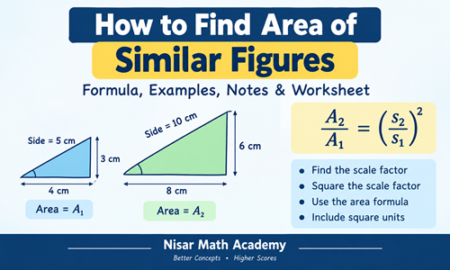
Diagram-Based Explanation
Imagine two similar triangles.
The smaller triangle has a corresponding side of 5 cm, while the larger triangle has the corresponding side of 10 cm.
A simple diagram can be described as:
Small triangle: corresponding side = 5 cm, area =
Large triangle: corresponding side = 10 cm, area =
The scale factor is:
Therefore:
So the larger triangle has four times the area of the smaller triangle.
How to Find the Area of Similar Figures
Use the following steps.
Step 1: Identify corresponding sides
Make sure that the two side lengths you are comparing correspond to each other.
Step 2: Find the scale factor
Use:
Step 3: Square the scale factor
Calculate:
Step 4: Apply the area formula
If the original area is known:
Step 5: Include the correct square units
Area must be written in units such as:
Worked Example 1: Finding the Larger Area
Two similar triangles have corresponding side lengths of 6 cm and 9 cm. The area of the smaller triangle is . Find the area of the larger triangle.
Solution
First, find the scale factor:
Square the scale factor:
Now multiply the original area by :
Therefore:
Worked Example 2: Finding the Smaller Area
Two similar rectangles have corresponding lengths of 12 cm and 8 cm. The area of the larger rectangle is . Find the area of the smaller rectangle.
Solution
The scale factor from the larger rectangle to the smaller rectangle is:
Therefore:
The smaller area is:
Therefore:
Worked Example 3: Finding the Area Ratio
Two similar figures have corresponding sides in the ratio:
Find the ratio of their areas.
Solution
For similar figures, area ratio is the square of the side ratio.
Therefore:
Therefore:
The figure with corresponding side 5 units has an area that is times the area of the figure with corresponding side 3 units.
Worked Example 4: Finding an Unknown Area
Two similar figures have corresponding sides of 7 cm and 14 cm. The area of the smaller figure is . Find the area of the larger figure.
Solution
Scale factor:
Area factor:
Therefore:
Hence:
Worked Example 5: Finding an Unknown Side from Areas
Two similar figures have areas of and . A corresponding side of the smaller figure is 6 cm. Find the corresponding side of the larger figure.
Solution
First find the ratio of the areas:
The area ratio is the square of the side ratio:
Therefore:
The corresponding side of the larger figure is:
Therefore:
Worked Example 6: Similar Triangles
Two similar triangles have corresponding bases of 4 cm and 10 cm. The area of the smaller triangle is . Find the area of the larger triangle.
Solution
Scale factor:
Area factor:
Therefore:
Hence:
Worked Example 7: A Real-Life Scale Problem
A small map drawing and a larger similar map have corresponding lengths of 5 cm and 15 cm. The area represented by the smaller drawing is . Find the corresponding area represented by the larger drawing.
Solution
Scale factor:
Area factor:
Therefore:
So the corresponding area is:
Area Ratio and Side Ratio of Similar Figures
One of the most important relationships to remember is:
For example, if the side ratio is:
then the area ratio is:
Similarly:
| Ratio of Corresponding Sides | Ratio of Areas |
|---|---|
Similar Figures and Scale Factor
The scale factor tells us how much larger or smaller one similar figure is compared with another.
If:
the second figure is an enlargement.
If:
the second figure is a reduction.
For example, if:
the corresponding lengths become three times as large, but the area becomes:
times as large.
If:
the corresponding lengths become half as large, but the area becomes:
of the original area.
Similar Figures vs Congruent Figures
Students sometimes confuse similar and congruent figures.
| Similar Figures | Congruent Figures |
|---|---|
| Same shape | Same shape |
| Size may be different | Same size |
| Corresponding sides are proportional | Corresponding sides are equal |
| Corresponding angles are equal | Corresponding angles are equal |
| Area may be different | Area is equal |
Every pair of congruent figures is also similar, because their corresponding side lengths have a ratio of 1.
However, similar figures do not have to be congruent.
Real-Life Applications of Similar Figures
Similar figures are useful in many practical situations.
Maps and Plans
Maps use scale to represent large areas on a smaller surface. Similarity helps relate distances and areas between the drawing and the actual location.
Models
Architectural and engineering models can represent buildings or structures at a smaller scale.
Photography and Images
Changing the size of an image while maintaining its proportions involves the same idea of a scale factor.
Geometry and Construction
Similar shapes can be used to estimate lengths, heights, and areas that are difficult to measure directly.
Technical Drawings
Engineers and designers often use scaled drawings to represent large objects on paper.
Common Mistakes Students Make
1. Using the Scale Factor Directly for Area
A common mistake is to multiply the area by instead of .
Incorrect:
Correct:
2. Using Non-Corresponding Sides
The side lengths must correspond to the same positions in the two similar figures.
3. Forgetting to Square a Fraction
If:
then:
not .
4. Confusing Area Ratio with Side Ratio
If the side ratio is:
the area ratio is:
not .
5. Forgetting Square Units
Area should be expressed using square units, such as:
A Quick Method for Exam Questions
When solving an area problem involving similar figures, remember:
Corresponding sides → Scale factor → Square it → Multiply area
For example:
Then:
Finally:
This method works for similar triangles, rectangles, squares, circles, and other similar plane figures.
Frequently Asked Related Questions
How do you find the area of similar figures?
Find the scale factor using corresponding side lengths and then square the scale factor:
What is the area of similar figures formula?
The main formula is:
or:
If the sides of similar figures are doubled, what happens to the area?
If the side lengths are doubled, the area becomes:
times as large.
If the side ratio is 3:4, what is the area ratio?
The area ratio is:
Can similar figures have different areas?
Yes. Similar figures can have different sizes and therefore different areas.
Are all similar figures congruent?
No. Similar figures have the same shape, but their sizes may be different. Congruent figures have both the same shape and the same size.
Short Notes: Area of Similar Figures
Definition
Similar figures have the same shape, corresponding angles equal, and corresponding sides proportional.
Main Formula
Using Scale Factor
If:
then:
Important Rule
Examples
If side ratio is:
area ratio is:
If side ratio is:
area ratio is:
Remember
- Length changes by .
- Area changes by .
- Always use corresponding sides.
- Always square the scale factor.
- Area requires square units.
MCQs: Similar Figures and Their Areas
1. What is true about two similar figures?
A. They always have the same size
B. Their corresponding angles are equal
C. Their areas must be equal
D. Their corresponding sides must be equal
Correct Answer: B
2. If the scale factor between two similar figures is 3, what is the area factor?
A. 3
B. 6
C. 9
D. 12
Correct Answer: C
3. Two similar figures have corresponding sides in the ratio . What is the ratio of their areas?
A.
B.
C.
D.
Correct Answer: C
4. A similar figure has a scale factor of 4. How many times larger is its area?
A. 4
B. 8
C. 12
D. 16
Correct Answer: D
5. Two similar triangles have corresponding sides 6 cm and 12 cm. What is the scale factor from the smaller triangle to the larger triangle?
A. 1
B. 2
C. 3
D. 6
Correct Answer: B
6. If the area of a smaller similar figure is and the scale factor is 3, what is the area of the larger figure?
A.
B.
C.
D.
Correct Answer: C
7. Two similar figures have side ratio . Their area ratio is:
A.
B.
C.
D.
Correct Answer: C
8. If the corresponding sides of two similar figures are 5 cm and 15 cm, the area factor is:
A. 3
B. 5
C. 9
D. 15
Correct Answer: C
9. The area of a larger similar figure is , and the area of the smaller figure is . What is the scale factor from smaller to larger?
A. 2
B. 3
C. 4
D. 5
Correct Answer: A
10. If the side lengths of a similar figure are reduced by a scale factor of , its area becomes:
A. of the original
B. of the original
C. of the original
D. 2 times the original
Correct Answer: B
11. Which formula gives the relationship between areas of similar figures?
A.
B.
C.
D.
Correct Answer: C
12. Two similar rectangles have corresponding sides in the ratio . Their areas are in the ratio:
A.
B.
C.
D.
Correct Answer: C
Worksheet / Assignment: Area of Similar Figures
Part A: Definitions and Concepts
1. Define similar figures.
2. State two properties of similar figures.
3. What is meant by corresponding sides?
4. What is a scale factor?
5. State the formula for the ratio of the areas of two similar figures.
Part B: Formula-Based Questions
6. Two similar figures have corresponding sides in the ratio . Find the ratio of their areas.
7. Two similar triangles have corresponding sides of 5 cm and 15 cm. Find the scale factor and area factor.
8. The scale factor between two similar figures is 4. By what factor does the area change?
Part C: Numerical Problems
9. Two similar triangles have corresponding sides of 6 cm and 12 cm. The area of the smaller triangle is . Find the area of the larger triangle.
10. Two similar rectangles have corresponding lengths of 8 cm and 12 cm. If the area of the smaller rectangle is , find the area of the larger rectangle.
11. Two similar figures have corresponding sides of 9 cm and 15 cm. The area of the smaller figure is . Find the area of the larger figure.
12. Two similar figures have areas of and . If a corresponding side of the smaller figure is 8 cm, find the corresponding side of the larger figure.
Part D: Word Problems
13. A model of a rectangular garden is similar to the actual garden. A corresponding length on the model is 4 m, while the corresponding length of the actual garden is 12 m. If the area represented by the model is , find the corresponding actual area.
14. A photograph is enlarged so that every length is multiplied by 2.5. By what factor does its area increase?
15. Two similar triangular plots of land have corresponding side lengths in the ratio . If the area of the smaller plot is , find the area of the larger plot.
Answer Key
1. Figures having the same shape, with equal corresponding angles and proportional corresponding sides.
2. Any two valid properties, such as equal corresponding angles and proportional corresponding sides.
3. Sides that occupy matching positions in two similar figures.
4. The ratio between corresponding lengths of two similar figures.
5.
6.
7.
Area factor:
8.
The area changes by a factor of 16.
9.
Answer: 72 cm272\text{ cm}^2
10.
Answer: 54 cm254\text{ cm}^2
11.
Answer: 75 cm275\text{ cm}^2
12.
Therefore:
Corresponding larger side:
Answer: 12 cm
13.
Answer: 135 m2135\text{ m}^2
14.
Answer: The area increases by a factor of 6.25.
15.
Area factor:
Therefore:
Answer: 147 m2147\text{ m}^2
FAQs About Similar Figures
1. What are similar figures?
Similar figures are figures with the same shape. Their corresponding angles are equal and their corresponding side lengths are proportional.
2. What is the formula for the area of similar figures?
The formula is:
3. Why do we square the scale factor for area?
Area is two-dimensional. When every length is multiplied by , both dimensions are multiplied by , giving an area factor of .
4. If the side length is doubled, does the area double?
No. If the side length is doubled, the area becomes four times as large:
5. Can two similar figures have different areas?
Yes. Similar figures can have different sizes, so their areas can also be different.
6. What is the difference between similar and congruent figures?
Similar figures have the same shape but may have different sizes. Congruent figures have the same shape and the same size.
7. How do I solve an area-of-similar-figures question?
Identify corresponding sides, calculate the scale factor, square the scale factor, and use it to calculate the unknown area.
8. Where can I find more mathematics notes and practice resources?
Students can find mathematics notes, recorded lectures, assessments, worksheets, lesson plans, and solved questions at Nisar Math Academy. Some resources are available free, while additional courses and resources are provided through membership.
Conclusion
The area of similar figures can be found easily once the relationship between side lengths, scale factor, and area is understood.
The most important rule is:
If the scale factor is , then:
Remember that lengths change by the scale factor, while areas change by the square of the scale factor. Always identify corresponding sides carefully and give the final area in square units.
For students looking for additional online math academy notes, recorded mathematics lectures, assessments, worksheets, and other learning resources, Nisar Math Academy provides a range of resources designed to support mathematics learning.
You May be Interested In:
What Is Similarity of Quadrilaterals? Definition, Properties, Criteria, Examples and Notes
What Are Similar Triangles? Definition, Properties, Formulas, Examples and Notes
Similarity of Polygons in Mathematics: Definition, Rules, Examples and Formulas
Leave a Reply