How Many Types of Triangles Are There? Names, Properties & Examples
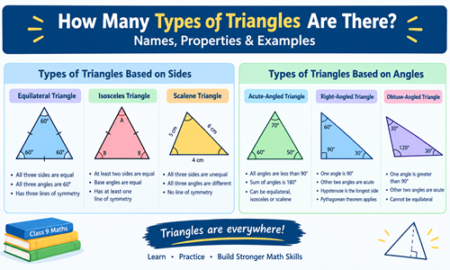
A triangle is one of the most important shapes in geometry. It has three sides, three vertices, and three interior angles. Triangles are classified into different types according to the lengths of their sides and the sizes of their angles.
There are six main types of triangles commonly studied in elementary geometry: three based on their sides and three based on their angles. These classifications help students understand geometric shapes, solve mathematical problems, and learn important concepts in Class 9 Maths.
In this article, you will learn the types of triangles and their names, their definitions and properties, important formulas, worked examples, and practice questions. However if you want class 9 maths video lectures, you may visit Nisar Math Academy.
What Is a Triangle?
A triangle is a closed, two-dimensional geometric shape formed by three straight line segments.
A triangle has:
- Three sides
- Three vertices
- Three interior angles
- Three exterior angles, one at each vertex when formed using an extended side
The sum of the three interior angles of every triangle is 180°.
For a triangle ABC, this property is written as:
∠A + ∠B + ∠C = 180°
For example, if two angles of a triangle are 60° and 70°, the third angle is:
Third angle = 180° − (60° + 70°)
Third angle = 180° − 130° = 50°
How Many Types of Triangles Are There?
Triangles are classified in two main ways:
- According to their sides: Equilateral, isosceles, and scalene triangles.
- According to their angles: Acute-angled, right-angled, and obtuse-angled triangles.
These are two different classification systems. A triangle can be described by one type from each system. For example, a triangle can be both isosceles and acute-angled.
1. Types of Triangles Based on Sides
The types of triangles based on sides are determined by comparing the lengths of their three sides.
1.1 Equilateral Triangle
An equilateral triangle is a triangle in which all three sides are equal.
If the sides of triangle ABC are AB, BC, and CA, then:
AB = BC = CA
Properties:
- All three sides are equal.
- All three interior angles are equal.
- Each interior angle measures 60°.
- It has three lines of symmetry.
Example:
If each side of an equilateral triangle is 6 cm, its perimeter is:
Perimeter = 6 + 6 + 6 = 18 cm
1.2 Isosceles Triangle
An isosceles triangle is a triangle in which at least two sides are equal. Under this inclusive definition, an equilateral triangle is also a special type of isosceles triangle.
If AB = AC, then triangle ABC is isosceles, and BC is its base.
Properties:
- Two sides are equal.
- The angles opposite the equal sides are equal.
- It has at least one line of symmetry.
- The third side may be shorter or longer than the equal sides, subject to the triangle inequality.
Example:
An isosceles triangle has two equal sides of 5 cm each and a base of 6 cm.
Perimeter = 5 + 5 + 6 = 16 cm
If the vertex angle is 40°, each base angle is:
Base angle = (180° − 40°) ÷ 2
Base angle = 140° ÷ 2 = 70°
1.3 Scalene Triangle
A scalene triangle is a triangle in which all three sides have different lengths.
For example:
AB = 4 cm, BC = 5 cm, and CA = 6 cm.
Properties:
- All three sides have different lengths.
- All three interior angles have different measures.
- It has no line of symmetry.
Example:
If the sides of a scalene triangle are 4 cm, 5 cm, and 6 cm, its perimeter is:
Perimeter = 4 + 5 + 6 = 15 cm
2. Types of Triangles on the Basis of Angles
The types of triangles on the basis of angles are determined by the measures of their interior angles.
2.1 Acute-Angled Triangle
An acute-angled triangle is a triangle in which all three interior angles are less than 90°.
Properties:
- Every interior angle is less than 90°.
- The sum of its interior angles is 180°.
- It can be equilateral, isosceles, or scalene.
Example:
A triangle has angles of 50°, 60°, and 70°.
Since all three angles are less than 90°, it is an acute-angled triangle.
Verification:
50° + 60° + 70° = 180°
2.2 Right-Angled Triangle
A right-angled triangle is a triangle that has exactly one interior angle equal to 90°.
Properties:
- One angle measures 90°.
- The other two angles are acute.
- The side opposite the right angle is called the hypotenuse.
- The hypotenuse is the longest side.
- The Pythagorean theorem applies to its side lengths.
The Pythagorean theorem is:
a² + b² = c²
Here, a and b are the perpendicular sides, and c is the hypotenuse.
Example:
A right-angled triangle has perpendicular sides of 3 cm and 4 cm.
Using the Pythagorean theorem:
c² = 3² + 4²
c² = 9 + 16 = 25
c = √25 = 5 cm
Therefore, the hypotenuse is 5 cm.
2.3 Obtuse-Angled Triangle
An obtuse-angled triangle is a triangle in which one interior angle is greater than 90°.
Properties:
- One angle is greater than 90° but less than 180°.
- The other two angles are acute.
- It can be isosceles or scalene, but it cannot be equilateral.
Example:
A triangle has angles of 110°, 40°, and 30°.
Since one angle is greater than 90°, it is an obtuse-angled triangle.
Verification:
110° + 40° + 30° = 180°
Quick Comparison of the Six Main Types of Triangles
| Type | Classification | Main property |
|---|---|---|
| Equilateral | By sides | Three equal sides |
| Isosceles | By sides | At least two equal sides |
| Scalene | By sides | Three unequal sides |
| Acute-angled | By angles | All angles are less than 90° |
| Right-angled | By angles | One angle is exactly 90° |
| Obtuse-angled | By angles | One angle is greater than 90° |
How to Identify a Triangle from a Diagram
Suppose a diagram shows triangle ABC.
To classify it by sides:
- Look for equal-length markings on the sides.
- If all three sides are equal, it is equilateral.
- If exactly two sides are equal, it is isosceles.
- If all three sides have different lengths, it is scalene.
To classify it by angles:
- Measure or inspect the three interior angles.
- If all are less than 90°, it is acute-angled.
- If one is exactly 90°, it is right-angled.
- If one is greater than 90°, it is obtuse-angled.
A small square at a vertex usually indicates a right angle. Matching tick marks on sides indicate equal lengths.
Important Formulas Related to Triangles
1. Sum of Interior Angles
For every triangle:
∠A + ∠B + ∠C = 180°
2. Perimeter
The perimeter is the total length of all three sides.
Perimeter = a + b + c
3. Area
The area of a triangle is:
Area = ½ × base × height
The height must be perpendicular to the selected base.
4. Pythagorean Theorem
For a right-angled triangle:
a² + b² = c²
Here, c is the hypotenuse.
5. Isosceles Triangle Base Angles
If the vertex angle is θ, each base angle is:
Base angle = (180° − θ) ÷ 2
Step-by-Step Solved Examples
Example 1: Find the Missing Angle
Two angles of a triangle are 45° and 65°. Find the third angle and classify the triangle by angles.
Step 1: Write the angle-sum formula.
A + B + C = 180°
Step 2: Substitute the known angles.
45° + 65° + C = 180°
Step 3: Calculate.
C = 180° − 110°
C = 70°
Answer: The angles are 45°, 65°, and 70°. All are less than 90°, so the triangle is acute-angled.
Example 2: Identify a Triangle from Its Sides
A triangle has side lengths of 7 cm, 7 cm, and 10 cm. Identify its type by sides.
Step 1: Compare the side lengths.
Two sides are 7 cm, while the third is 10 cm.
Step 2: Apply the definition.
A triangle with at least two equal sides is isosceles.
Answer: It is an isosceles triangle.
Example 3: Find the Perimeter of an Equilateral Triangle
Each side of an equilateral triangle measures 9 cm. Find its perimeter.
Step 1: Write the formula.
Perimeter = a + b + c
Step 2: Substitute the side lengths.
Perimeter = 9 + 9 + 9
Step 3: Calculate.
Perimeter = 27 cm
Example 4: Find the Base Angles of an Isosceles Triangle
The vertex angle of an isosceles triangle is 36°. Find each base angle.
Step 1: Subtract the vertex angle from 180°.
Sum of base angles = 180° − 36° = 144°
Step 2: Divide by 2 because the base angles are equal.
Each base angle = 144° ÷ 2 = 72°
Answer: The base angles are 72° each.
Example 5: Identify a Triangle from Its Angles
A triangle has angles of 25°, 65°, and 90°. Classify it by angles.
Step 1: Identify the largest angle.
The largest angle is 90°.
Step 2: Apply the definition.
A triangle with one 90° angle is right-angled.
Answer: It is a right-angled triangle.
Example 6: Calculate the Area of a Triangle
A triangle has a base of 12 cm and a perpendicular height of 5 cm. Find its area.
Step 1: Write the formula.
Area = ½ × base × height
Step 2: Substitute the values.
Area = ½ × 12 × 5
Step 3: Calculate.
Area = 6 × 5 = 30 cm²
Example 7: Find the Hypotenuse
A right-angled triangle has perpendicular sides of 8 cm and 15 cm. Find its hypotenuse.
Step 1: Apply the Pythagorean theorem.
c² = a² + b²
Step 2: Substitute the values.
c² = 8² + 15²
c² = 64 + 225 = 289
Step 3: Find the square root.
c = √289 = 17 cm
Example 8: Can These Sides Form a Triangle?
Can line segments of lengths 3 cm, 4 cm, and 8 cm form a triangle?
Step 1: Apply the triangle inequality.
The sum of any two sides must be greater than the third side.
Step 2: Check the two shorter sides.
3 + 4 = 7
Since 7 is less than 8, the condition is not satisfied.
Answer: No, these lengths cannot form a triangle.
Can a Triangle Belong to Two Types at the Same Time?
Yes. A triangle can have one classification based on its sides and another based on its angles.
For example:
- An equilateral triangle is always acute-angled because each angle is 60°.
- An isosceles triangle can be acute-angled, right-angled, or obtuse-angled.
- A scalene triangle can also be acute-angled, right-angled, or obtuse-angled.
Therefore, the two classification systems complement each other rather than compete with each other.
Real-Life Applications of Triangles
Triangles are used in many practical situations.
- Buildings and bridges: Triangular frames help provide structural stability.
- Roof structures: Triangular supports are used in many roof designs.
- Road signs: Warning signs often use triangular shapes.
- Land surveying: Triangulation helps determine distances and locations.
- Navigation and mapping: Triangle relationships help calculate positions and distances.
- Engineering and design: Engineers use triangle geometry when analyzing structures and components.
Understanding triangle types helps students connect classroom geometry with the world around them.
Common Mistakes Students Make
- Confusing side and angle classifications: Equilateral, isosceles, and scalene describe sides; acute, right, and obtuse describe angles.
- Forgetting the angle sum: The three interior angles of a triangle always total 180°.
- Calling a 90° triangle acute: A triangle containing a right angle is right-angled, not acute.
- Assuming every isosceles triangle has only two equal sides: An equilateral triangle also satisfies the inclusive definition of isosceles.
- Using the wrong height in the area formula: Height must be perpendicular to the base.
- Applying the Pythagorean theorem to every triangle: This theorem applies directly only to right-angled triangles.
- Ignoring the triangle inequality: The sum of any two side lengths must exceed the third.
How to Prepare This Topic for Class 9 Maths
Students should be able to define the six common types of triangles, identify them from diagrams, use the angle-sum property, calculate perimeter and area, and apply the Pythagorean theorem to right-angled triangles.
For further practice, Nisar Math Academy provides mathematics notes, recorded video lectures, worksheets, assessments, and other learning resources. Students can explore the available Class 9 Maths notes PDF, free introductory lectures, and additional course resources on the academy’s website.
Conclusion
There are six main types of triangles commonly taught in geometry: equilateral, isosceles, scalene, acute-angled, right-angled, and obtuse-angled. The first three are classified by their sides, while the remaining three are classified by their angles.
Remember the angle-sum property, the perimeter and area formulas, and the Pythagorean theorem for right-angled triangles. With regular practice, identifying triangle types and solving related geometry questions becomes much easier.
3. Short Notes for Revision
Types of Triangles — Quick Revision Notes
Definition
A triangle is a closed geometric figure formed by three straight line segments.
Classification by Sides
| Type | Definition | Example |
|---|---|---|
| Equilateral | All three sides are equal | 5 cm, 5 cm, 5 cm |
| Isosceles | At least two sides are equal | 5 cm, 5 cm, 8 cm |
| Scalene | All three sides are unequal | 4 cm, 5 cm, 6 cm |
Classification by Angles
| Type | Definition | Example of angles |
|---|---|---|
| Acute-angled | All angles are less than 90° | 50°, 60°, 70° |
| Right-angled | One angle is exactly 90° | 30°, 60°, 90° |
| Obtuse-angled | One angle is greater than 90° | 30°, 40°, 110° |
Important Formulas
- Angle sum: A + B + C = 180°
- Perimeter: P = a + b + c
- Area: A = ½ × base × perpendicular height
- Pythagorean theorem: a² + b² = c²
- Isosceles base angles: Each base angle = (180° − vertex angle) ÷ 2
Important Facts
- An equilateral triangle has three 60° angles.
- The hypotenuse is the longest side of a right-angled triangle.
- An equilateral triangle is always acute-angled.
- A triangle can be classified by both its sides and its angles.
- The sum of any two side lengths must be greater than the third side.
- A triangle cannot have two right angles or two obtuse angles.
Quick Memory Tip
Sides: Equilateral, Isosceles, Scalene.
Angles: Acute, Right, Obtuse.
4. Multiple-Choice Questions (MCQs)
These questions cover definitions, properties, angle calculations, and numerical applications. They are suitable for Class 9 Maths practice.
Practice Quiz
0 of 15 answered
1. How many sides does a triangle have?
A. Two
B. Three
C. Four
D. Five
2. Which triangle has three equal sides?
A. Scalene
B. Isosceles
C. Equilateral
D. Obtuse-angled
3. What is the sum of the interior angles of a triangle?
A. 90°
B. 180°
C. 270°
D. 360°
4. A triangle with sides 6 cm, 6 cm, and 9 cm is:
A. Scalene
B. Isosceles
C. Equilateral
D. Right-angled
5. Which triangle has all three angles less than 90°?
A. Acute-angled
B. Right-angled
C. Obtuse-angled
D. None of these
6. A triangle with angles 40°, 50°, and 90° is:
A. Acute-angled
B. Right-angled
C. Obtuse-angled
D. Equilateral
7. Two angles of a triangle are 55° and 65°. Find the third angle.
A. 50°
B. 60°
C. 70°
D. 80°
8. What is the perimeter of an equilateral triangle with side 8 cm?
A. 16 cm
B. 24 cm
C. 32 cm
D. 64 cm
9. Which side is opposite the right angle in a right-angled triangle?
A. Base only
B. Altitude only
C. Hypotenuse
D. Median
10. A triangle has angles 120°, 30°, and 30°. It is:
A. Acute-angled
B. Right-angled
C. Obtuse-angled
D. Scalene only
11. Which set of side lengths cannot form a triangle?
A. 3 cm, 4 cm, 5 cm
B. 5 cm, 5 cm, 6 cm
C. 2 cm, 3 cm, 6 cm
D. 6 cm, 7 cm, 8 cm
12. What is the area of a triangle with base 10 cm and perpendicular height 6 cm?
A. 16 cm²
B. 30 cm²
C. 60 cm²
D. 120 cm²
13. An equilateral triangle has each angle equal to:
A. 45°
B. 60°
C. 90°
D. 120°
14. Which theorem is used to find the hypotenuse of a right-angled triangle?
A. Angle-sum theorem
B. Pythagorean theorem
C. Triangle inequality only
D. Midpoint theorem
15. Can a triangle be both isosceles and right-angled?
A. Yes
B. No
C. Only if equilateral
D. Only if scalene
Check Answers
5. Worksheet / Assignment
Worksheet: Types of Triangles
Subject: Mathematics
Level: Class 9
Topic: Classification and Properties of Triangles
Section A: Definitions
- Define a triangle.
- Define an equilateral triangle and write two of its properties.
- What is an isosceles triangle?
- Define acute-angled, right-angled, and obtuse-angled triangles.
Section B: Conceptual Questions
- Explain the difference between an isosceles triangle and a scalene triangle.
- Can an equilateral triangle be right-angled? Give a reason.
- Can a triangle be both isosceles and obtuse-angled? Explain.
- State the triangle inequality rule.
Section C: Numerical Problems
- Two angles of a triangle are 48° and 72°. Find the third angle and classify the triangle by angles.
- An isosceles triangle has a vertex angle of 44°. Calculate each base angle.
- Find the perimeter of a triangle whose sides are 7 cm, 9 cm, and 12 cm.
- Find the area of a triangle with a base of 14 cm and a perpendicular height of 8 cm.
Section D: Application and Reasoning
- A right-angled triangle has perpendicular sides of 9 cm and 12 cm. Calculate its hypotenuse.
- A student claims that sides of lengths 4 cm, 5 cm, and 10 cm can form a triangle. Is the student correct? Justify your answer.
- A triangular sign has three equal sides, each measuring 20 cm. Identify the triangle by sides, state each interior angle, and calculate its perimeter.
Worksheet Answer Key
Answers for teachers and self-assessment
- A closed geometric figure formed by three straight line segments.
- All three sides are equal; all three angles are 60°.
- A triangle with at least two equal sides.
- Acute: all angles below 90°. Right: one angle is 90°. Obtuse: one angle is above 90°.
- Isosceles has at least two equal sides; scalene has three unequal sides.
- No. An equilateral triangle has three 60° angles.
- Yes. For example, its angles could be 100°, 40°, and 40°.
- The sum of any two side lengths must be greater than the third side.
- Third angle = 180° − 48° − 72° = 60°. Acute-angled.
- Each base angle = (180° − 44°) ÷ 2 = 68°.
- Perimeter = 7 + 9 + 12 = 28 cm.
- Area = ½ × 14 × 8 = 56 cm².
- Hypotenuse = √(9² + 12²) = √225 = 15 cm.
- No. 4 + 5 = 9, which is less than 10.
- Equilateral triangle; each angle = 60°; perimeter = 3 × 20 = 60 cm.
6. Frequently Asked Questions (FAQs)
1. How many types of triangles are there?
There are six main types commonly studied in geometry: equilateral, isosceles, scalene, acute-angled, right-angled, and obtuse-angled.
2. What are the three types of triangles based on sides?
They are equilateral, isosceles, and scalene triangles.
3. What are the three types of triangles based on angles?
They are acute-angled, right-angled, and obtuse-angled triangles.
4. What is the sum of the angles of a triangle?
The sum of its three interior angles is always 180°.
5. What is the difference between an equilateral and an isosceles triangle?
An equilateral triangle has three equal sides, while an isosceles triangle has at least two equal sides.
6. Can a triangle be both scalene and right-angled?
Yes. A triangle can have three unequal sides and one 90° angle.
7. What is the formula for the area of a triangle?
Area = ½ × base × perpendicular height.
8. Which triangle is the most useful for learning the Pythagorean theorem?
The right-angled triangle, because the theorem relates its two perpendicular sides to its hypotenuse.
You May be Interested In:
Construction of Triangles: Steps, Rules, and Solved Examples for Class 9
Applications of Graph in Real Life: Examples, Uses and Solved Questions
Graph of Exponential Functions: Examples and Step-by-Step Guide
Leave a Reply