Construction of Triangles: Steps, Rules, and Solved Examples for Class 9
Introduction
The construction of triangles is an important topic in geometry. It involves drawing a triangle accurately using a ruler, compass, protractor, and other geometrical instruments according to given measurements.
In Class 9 Mathematics, students learn how to construct triangles when their sides, angles, or a combination of these measurements are given. They also learn to construct special lines, such as medians and perpendicular bisectors.
In this guide, you will learn the basic rules of triangle construction, the steps of construction of an equilateral triangle, how to construct a median of a triangle, and how to solve common geometrical construction problems.
These explanations are suitable for students looking for construction of triangles class 9 notes, solved examples, and examination preparation.
1. What Is the Construction of a Triangle?
The construction of a triangle is the process of drawing a triangle accurately using geometrical instruments according to specified conditions.
A triangle has three sides, three vertices, and three interior angles. The sum of its interior angles is always (180 degrees).
We can construct triangle ABC using a ruler and compass by drawing one side first and locating the third vertex using arcs.
Instruments required
- Ruler: To draw straight line segments and measure lengths.
- Compass: To draw arcs and circles with a specified radius.
- Protractor: To measure and construct angles when required.
- Pencil and eraser: To make accurate drawings and correct mistakes.
A compass-and-ruler construction uses geometrical steps rather than simply drawing a shape by estimation.
2. Basic Rules for the Construction of Triangles
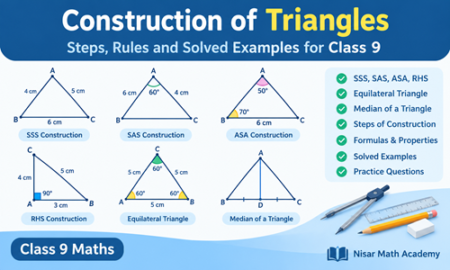
A triangle can be constructed uniquely when sufficient independent measurements are given. The most common construction methods are SSS, SAS, ASA, and RHS.
2.1 SSS (Side-Side-Side)
In the SSS method, all three sides of the triangle are given.
For example:
m AB = 5 cm, m AC = 4 cm, m BC = 6 cm
Construction steps:
- Draw AB = 5 cm.
- With A as the center and radius 4 cm, draw an arc.
- With B as the center and radius 6 cm, draw another arc intersecting the first at C.
- Join AC and BC.
Triangle ABC is now constructed.

2.2 SAS (Side-Angle-Side)
In the SAS method, two sides and the included angle between them are given.
For example:
AB = 6 cm, AC = 4 cm, angle BAC = 60 degrees
Construction steps:
- Draw AB = 6 cm.
- At A, construct an angle of 60 degrees.
- On the new ray, mark AC = 4 cm.
- Join B to C.
The required triangle is constructed.
2.3 ASA (Angle-Side-Angle)
In the ASA method, two angles and the side between them are given.
For example:
angle A = 50 degrees, AB = 6 cm, angle B = 70 degrees
Construction steps:
- Draw AB = 6 cm.
- At A, construct an angle of 50 degrees.
- At B, construct an angle of 70 degrees, on the same side of AB.
- Extend the two rays until they intersect at C.
Triangle ABC is constructed. Its third angle is 60 degrees, because the angles of a triangle add up to 180 degrees.
2.4 RHS (Right Angle-Hypotenuse-Side)
The RHS method applies to right-angled triangles. The hypotenuse and one corresponding side are given.
For example:
angle A = 90 degrees, AB = 3 cm, BC = 5 cm
Here, BC is the hypotenuse because it is opposite the right angle.
Construction steps:
- Draw AB = 3 cm.
- At A, construct a perpendicular to AB.
- With B as the center and radius 5 cm, draw an arc cutting the perpendicular at C.
- Join BC.
Triangle ABC is the required right-angled triangle.
3. Steps of Construction of an Equilateral Triangle
An equilateral triangle is a triangle whose three sides are equal. Each interior angle measures 60 degrees.
If each side is 5 cm, then:
AB = BC = CA = 5 cm
Construction procedure

- Draw a line segment AB = 5 cm.
- Open the compass to 5 cm.
- Place the compass point at A and draw an arc above AB.
- Without changing the compass width, place the point at B and draw another arc intersecting the first at C.
- Join AC and BC.
The resulting triangle ABC is equilateral because all three sides have the same length.
Important properties
- All three sides are equal.
- All three angles are 60 degrees.
- Each median is also an altitude and a perpendicular bisector of the opposite side.
- The perimeter is three times the length of one side.
4. How to Construct a Median of a Triangle
A median of a triangle is a line segment joining a vertex to the midpoint of the opposite side.
For example, in triangle ABC, if D is the midpoint of BC, then AD is a median.
This means:
BD = DC
A triangle has three medians, one from each vertex.
Construction steps
Suppose triangle ABC is already drawn.
- Identify side BC, opposite vertex A.
- Measure BC and divide its length by two.
- Mark the midpoint D of BC, so that BD = DC.
- Join A to D.
The line segment AD is the required median.

Example
Suppose BC = 8 cm. Find the lengths BD and DC if AD is a median.
Solution:
Since D is the midpoint of BC,
BD = DC = BC/2
Substituting BC = 8 cm:
BD = DC = 8/2 = 4 cm
Answer:
BD = 4 cm and DC = 4 cm.
Remember that a median does not necessarily meet the opposite side at a right angle. It only divides that side into two equal parts.
5. Construction of a Triangle Using Three Given Sides
Let us solve a complete example using the SSS method.
Example 1: Construct a triangle with sides 4 cm, 5 cm, and 6 cm
Given:
AB = 6 cm, AC = 4 cm, BC = 5 cm
Required:
Construct triangle ABC.
Solution:
- Draw AB = 6 cm.
- Set the compass radius to 4 cm. With center A, draw an arc.
- Set the compass radius to 5 cm. With center B, draw an arc intersecting the previous arc at C.
- Join AC and BC.
- Label all three vertices and verify the side lengths.
The intersection point C satisfies both given distances, so the triangle meets all the conditions.
Why is the construction possible?
The sum of any two sides of a triangle must be greater than the third side.
Here:
4 + 5 > 6, 4 + 6 > 5, 5 + 6 > 4
Therefore, the triangle can be constructed.
6. Construction Using Two Sides and the Included Angle
Example 2: Construct a triangle with two sides of 5 cm and 7 cm and an included angle of 60 degrees.
Given:
AB = 7 cm, AC = 5 cm, angle BAC = 60 degrees
Construction steps:
- Draw AB = 7 cm.
- At point A, construct an angle of 60 degrees.
- Along the second ray, mark point C such that AC = 5.
- Join B to C.
The triangle is now complete.
7. Construction of a Right-Angled Triangle
A right-angled triangle contains one angle of 90 degrees.
Example 3: Construct a right triangle with perpendicular sides 3 cm and 4 cm.
Given:
AB = 3 cm,\quad AC = 4 cm, angle BAC = 90 degrees
Construction steps:
- Draw AB = 3 cm.
- Construct a perpendicular to AB at A.
- Measure AC = 4 cm along the perpendicular.
- Join B to C.
8. Important Formulas Used in Triangle Construction
Triangle construction mainly uses geometrical properties. The following formulas are helpful for checking measurements and solving related numerical questions.
| Concept | Formula or property |
|---|---|
| Sum of interior angles | A + B + C = 180 degrees |
| Perimeter | P = a + b + c |
| Equilateral triangle perimeter | P = 3a |
| Triangle area | b * h / 2 |
| Pythagorean theorem | c^2 = a^2 + b^2 |
| Median to a side | Divides that side into two equal parts |
| Triangle inequality | a + b > c, a + c > b, b + c > a |
Here, a, b, c represent side lengths, b is the base, h is the corresponding perpendicular height, and c is the hypotenuse in the Pythagorean theorem.
Important: These formulas help verify or analyse a construction, but they do not replace the required geometrical construction steps.
9. When Is a Triangle Not Possible to Construct?
Not every set of measurements produces a triangle.
For three given side lengths, the sum of any two sides must be greater than the third side.
Example 4: Can a triangle be constructed with sides 2 cm, 3 cm, and 6 cm?
Check the triangle inequality:
2 + 3 = 5 < 6
The sum of the two shorter sides is less than the longest side.
Therefore, the triangle cannot be constructed.
Another important condition
Some sets of measurements are insufficient to determine a unique triangle. For example, knowing only the three angles determines the shape but not its size. Multiple similar triangles can have the same angles.
For a unique triangle, the measurements must provide enough information to determine its size and shape, such as SSS, SAS, ASA, or RHS.
10. Real-Life Applications of Triangle Construction
Triangle construction is useful in mathematics and practical fields.
- Architecture: Triangular shapes help designers plan roofs and structural frameworks.
- Engineering: Triangular frameworks are used in bridges, towers, and support structures.
- Land surveying: Triangulation helps determine positions and distances.
- Technical drawing: Accurate triangles are used in geometric designs and plans.
- Mathematics: Construction develops precision, spatial reasoning, and problem-solving skills.
For example, an engineer may use triangular frameworks because a triangle made from rigid members is geometrically stable. Actual structural safety, however, also depends on materials, joints, loads, and engineering design.
11. Common Mistakes Students Make
Students can improve their construction accuracy by avoiding these mistakes.
- Changing the compass width: In an SSS construction, each arc must use its specified side length.
- Measuring from the wrong vertex: Always check which side or angle is given.
- Drawing an inaccurate angle: Use a protractor carefully when constructing a specified angle.
- Confusing a median with an altitude: A median joins a vertex to the midpoint of the opposite side; an altitude is perpendicular to that side.
- Ignoring the triangle inequality: Check whether three given sides can form a triangle before constructing it.
- Drawing thick arcs: Use light, clear arcs so the intersection point can be identified accurately.
- Forgetting labels: Label vertices and mark given lengths and angles in the final diagram.
- Using a ruler alone for compass constructions: Follow the specified geometrical method when the question requires a compass-and-ruler construction.
12. Related Questions for Class 9 Mathematics
Students studying construction of triangles class 9 should practise the following types of questions:
- Construct a triangle when all three sides are given.
- Construct a triangle when two sides and their included angle are given.
- Construct a triangle when two angles and the included side are given.
- Construct a right-angled triangle when the hypotenuse and one side are given.
- Construct an equilateral triangle of a specified side length.
- Draw the median of a given triangle.
- Construct the perpendicular bisector of a line segment.
- Determine whether three given side lengths can form a triangle.
- Calculate a missing angle using the angle-sum property.
- Verify a constructed right triangle using the Pythagorean theorem.
For additional practice, students can use class 9 maths notes, solved questions, worksheets, and math lecture class 9 resources. Nisar Math Academy provides mathematics learning materials, including selected free resources and additional learning materials through membership.
Students looking for class 9 maths video lectures, class 9 maths notes PDF, or a maths guide for class 9 can explore the relevant resources at Nisar Math Academy. You may also find math lecture class 9 from here.
13. Short Revision Notes
These notes summarise the main concepts for quick revision before a Class 9 Mathematics test.
Definitions
- Triangle construction: Drawing a triangle accurately using geometrical instruments and given measurements.
- Equilateral triangle: A triangle with three equal sides and three angles of 60 degrees.
- Median: A line segment joining a vertex to the midpoint of the opposite side.
- Altitude: A perpendicular line segment from a vertex to the opposite side or its extension.
- Perpendicular bisector: A line that divides a segment into two equal parts at 90 degrees.
- Hypotenuse: The longest side of a right-angled triangle, opposite the right angle.
Construction rules
| Rule | Given measurements |
|---|---|
| SSS | Three sides |
| SAS | Two sides and their included angle |
| ASA | Two angles and the included side |
| RHS | Right angle, hypotenuse, and one side |
Important differences
| Median | Altitude |
|---|---|
| Divides the opposite side into two equal parts. | Meets the opposite side at 90 degrees. |
| Does not necessarily form a right angle. | Always forms a right angle with the opposite side or its extension. |
Exam tip: Always write the given measurements, draw the construction carefully, label the vertices, and state the required result.
14. Multiple-Choice Questions (MCQs)
Test your understanding of the construction of triangles with these 15 questions.
Class 9 Maths Practice
1. What is the sum of the interior angles of a triangle?
A. 90°
B. 180°
C. 270°
D. 360°
2. Which method uses three given side lengths?
A. SAS
B. ASA
C. SSS
D. RHS
3. How many equal sides does an equilateral triangle have?
A. One
B. Two
C. Three
D. Four
4. Each angle of an equilateral triangle measures:
A. 30°
B. 45°
C. 60°
D. 90°
5. A median joins a vertex to the:
A. Opposite angle
B. Midpoint of the opposite side
C. Nearest vertex
D. Perpendicular line only
6. If BC = 10 cm and AD is a median, with D on BC, what is BD?
A. 2 cm
B. 4 cm
C. 5 cm
D. 10 cm
7. Which instrument is commonly used to draw arcs in geometrical construction?
A. Compass
B. Set square only
C. Calculator
D. Divider-free ruler
8. Which condition is required for a triangle with sides 3 cm, 4 cm and x cm?
A. x = 7 only
B. x must be greater than 7
C. 1 < x < 7
D. x must be less than 1
9. What is the perimeter of an equilateral triangle with side 6 cm?
A. 12 cm
B. 18 cm
C. 24 cm
D. 36 cm
10. Which method is used for a right-angled triangle when the hypotenuse and one side are given?
A. SSS only
B. ASA only
C. RHSD. AAA
11. A triangle has angles 50° and 60°. Its third angle is:
A. 60°
B. 70°
C. 80°
D. 90°
12. Can a triangle with sides 2 cm, 3 cm and 6 cm be constructed?
A. Yes, always
B. Yes, if it is equilateral
C. No, because 2 + 3 < 6
D. No, because all triangles have equal sides
13. Which statement about an altitude is correct?
A. It always bisects a side
B. It is perpendicular to the opposite side or its extension
C. It always has half the side’s length
D. It joins two midpoints
14. What is the hypotenuse of a right triangle with perpendicular sides 3 cm and 4 cm?
A. 5 cm
B. 6 cm
C. 7 cm
D. 12 cm
15. How many medians does every triangle have?
A. One
B. Two
C. Three
D. Six
Check answers
MCQ Answer Key
| Question | Correct answer |
|---|---|
| 1 | B |
| 2 | C |
| 3 | C |
| 4 | C |
| 5 | B |
| 6 | C |
| 7 | A |
| 8 | C |
| 9 | B |
| 10 | C |
| 11 | B |
| 12 | C |
| 13 | B |
| 14 | A |
| 15 | C |
15. Worksheet / Assignment
Topic: Construction of Triangles
Class: 9
Instructions: Answer all questions. Use a ruler, compass, and protractor where necessary. Show construction arcs and label all required points.
Part A: Definitions and Concepts
- Define the construction of a triangle.
- What is an equilateral triangle? State the measure of each interior angle.
- Define the median of a triangle.
- Differentiate between a median and an altitude.
- State the SSS, SAS, ASA, and RHS triangle construction rules.
Part B: Formula-Based Questions
- Find the third angle of a triangle whose other two angles are 45 degrees and 65 degrees.
- Find the perimeter of an equilateral triangle with a side length of 8 cm.
- A median divides side BC into two equal parts. If BC = 14 cm, find BD and DC.
Part C: Construction Problems
- Construct triangle ABC with AB = 5 cm, AC = 4 cm, and BC = 6 cm, using SSS.
- Construct an equilateral triangle with each side equal to 6 cm.
- Construct a triangle with AB = 6 cm, AC = 4 cm, and angle BAC = 60 degrees.
- Construct a right-angled triangle with perpendicular sides of 3 cm and 4 cm.
Part D: Reasoning and Word Problems
- Determine whether a triangle can be constructed with sides 3 cm, 4 cm, and 8 cm. Give a reason.
- A triangular garden has sides of 5 m, 7 m, and 9 m. Find its perimeter.
- A triangular sign has three equal sides of 12 cm. Find its perimeter and each interior angle.
17. Frequently Asked Questions (FAQs)
1. What is the construction of triangles?
The construction of triangles is the accurate drawing of a triangle using geometrical instruments according to given side lengths, angles, or other conditions.
2. What are the four main methods of triangle construction?
The four commonly taught methods are SSS, SAS, ASA, and RHS. Each method uses a different combination of given sides and angles.
3. How do you construct an equilateral triangle?
Draw a line segment of the required length. Using each endpoint as a compass centre, draw arcs with the same radius as the line segment. Join the intersection of the arcs to both endpoints.
4. How do you construct a median of a triangle?
Find the midpoint of one side and join it to the opposite vertex. The resulting line segment is the median.
5. Can a triangle be constructed using three angles only?
The angles determine the triangle’s shape but not its size. Therefore, three angles alone do not determine a unique triangle.
6. What is the difference between SSS and SAS construction?
SSS uses three given side lengths. SAS uses two given side lengths and the angle between them.
7. Which instruments are needed for triangle construction in Class 9?
A ruler, compass, pencil, and eraser are commonly required. A protractor is also useful when the construction involves specified angles.
8. Where can I find Class 9 Maths notes and video lectures?
You can explore Nisar Math Academy for mathematics notes, recorded lectures, assessments, worksheets, and other learning resources. Some resources are available free of charge, while additional materials are offered through membership.
18. Conclusion
The construction of triangles becomes easier when students understand the given measurements, choose the correct construction method, and follow the steps carefully. Practising SSS, SAS, ASA, and RHS constructions helps develop accuracy and confidence in geometry.
Students should also learn how to construct an equilateral triangle, draw a median, check the triangle inequality, and distinguish between medians and altitudes.
For further practice, use your Class 9 Maths notes, solve construction problems independently, and review relevant lessons before examinations. Nisar Math Academy can serve as an additional learning resource for notes, video lectures, assessments, and mathematics practice.
You May be Interested In:
Applications of Graph in Real Life: Examples, Uses and Solved Questions
Graph of Exponential Functions: Examples and Step-by-Step Guide

Leave a Reply