What Is a Quadratic Function? Definition, Formula, Graph, Domain and Range of Quadratic Function
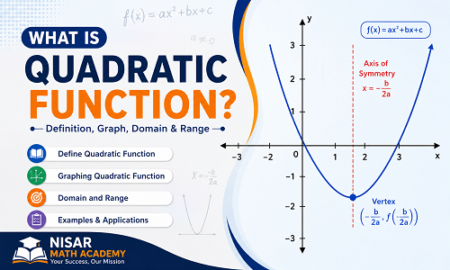
What Is a Quadratic Function?
A quadratic function is one of the most important topics in algebra. It is widely used in mathematics, physics, engineering, economics, and computer science. Students study quadratic functions to understand curved graphs, maximum and minimum values, and many real-life situations involving motion and optimization.
A quadratic function is a function whose highest power of the variable is 2. Unlike a linear function, which produces a straight-line graph, the graph of a quadratic function is always a curved shape called a parabola.
Understanding the quadratic function helps students solve mathematical problems involving equations, graphing, and practical applications.
Define Quadratic Function
To define quadratic function, we use the following standard form:f(x)=ax2+bx+c
Where
- a, b, and c are real numbers.
- a=0.
- x is the independent variable.
- f(x) is the dependent variable.
The condition a=0 is necessary because if a=0, the equation becomes linear instead of quadratic.
Examples
Example 1f(x)=x2+5x+6
This is a quadratic function because the highest power of x is 2.
Example 2f(x)=3×2−7x+4
This is also a quadratic function.
Example 3f(x)=−2×2+8
This is a quadratic function since the coefficient of x2 is not zero.
Standard Form of a Quadratic Function
The standard form isf(x)=ax2+bx+c
Where
- a is the coefficient of x2.
- b is the coefficient of x.
- c is the constant term.
Examplef(x)=2×2+3x−5
Here
- a=2
- b=3
- c=−5
Characteristics of a Quadratic Function
The following are the main characteristics of a quadratic function.
- Highest exponent is 2.
- Graph is always a parabola.
- May open upward or downward.
- Has one vertex.
- Has one axis of symmetry.
- Can have zero, one, or two real roots.
Graphing Quadratic Function
Graphing quadratic function means drawing the parabola on the coordinate plane.
The shape of the graph depends mainly on the value of a.
Case 1: Positive Value of a
Ifa>0
the parabola opens upward.
Examplef(x)=x2
The graph has a minimum point.
Case 2: Negative Value of a
Ifa<0
the parabola opens downward.
Examplef(x)=−x2
The graph has a maximum point.
Steps for Graphing Quadratic Function
- Write the function.
- Find the vertex.
- Find the axis of symmetry.
- Calculate several points.
- Plot the points.
- Draw a smooth parabola through the points.
Vertex of a Quadratic Function
The vertex is the turning point of the parabola.
Its x-coordinate isx=2a−b
After finding the x-coordinate, substitute it into the function to obtain the y-coordinate.
Examplef(x)=x2−6x+5
Herea=1,b=−6
So,x=2(1)−(−6)=3
Now,f(3)=9−18+5=−4
Therefore, the vertex is(3,−4)
Axis of Symmetry
The axis of symmetry divides the parabola into two equal parts.
Its equation isx=2a−b
Domain and Range of Quadratic Function
Domain of Quadratic Function
The domain and range of quadratic function are important concepts.
The domain of every quadratic function is(−∞,∞)
This means every real number can be substituted for x.
Range of Quadratic Function
The range depends on the direction of the parabola.
If the parabola opens upward,y≥minimum value
If the parabola opens downward,y≤maximum value
Examplef(x)=x2
Domain(−∞,∞)
Range[0,∞)
Real-Life Applications of Quadratic Functions
Quadratic functions are used in many fields.
- Projectile motion
- Bridge construction
- Satellite dishes
- Economics
- Business profit analysis
- Engineering
- Architecture
- Sports science
- Computer graphics
Difference Between Linear and Quadratic Function
| Linear Function | Quadratic Function |
|---|---|
| Highest power is 1 | Highest power is 2 |
| Graph is a straight line | Graph is a parabola |
| Constant rate of change | Variable rate of change |
| Standard form: ax+b | Standard form: ax2+bx+c |
Importance of Learning Quadratic Functions
Quadratic functions form the foundation for higher mathematics. Students studying algebra, calculus, engineering, statistics, economics, and computer science frequently use quadratic functions. A strong understanding of this topic makes solving equations and graphing much easier.
Students can also explore more mathematics concepts through Nisar Math Academy, where recorded lectures, lesson plans, assessments, and downloadable notes are available. Free Class 9 Mathematics notes for the first exercise of each chapter and selected free lectures are provided. Students who want complete access to all recorded lectures, notes, assessments, and premium learning material can join the website membership.
Conclusion
A quadratic function is a polynomial function of degree two written as f(x)=ax2+bx+c, where a=0. Its graph is a parabola that may open upward or downward depending on the sign of a. Learning how to define quadratic function, perform graphing quadratic function, and determine the domain and range of quadratic function helps students solve algebraic problems and understand many real-world applications.
Short Notes
Quadratic Function Short Notes
- A quadratic function has degree 2.
- Standard form is f(x)=ax2+bx+c.
- Here, a=0.
- Its graph is called a parabola.
- If a>0, the parabola opens upward.
- If a<0, the parabola opens downward.
- Vertex is the turning point.
- Axis of symmetry is x=2a−b.
- Domain is all real numbers.
- Range depends on the vertex and direction of the parabola.
MCQs
1. A quadratic function has highest power equal to
A) 1
B) 2
C) 3
D) 4
Answer: B
2. Standard form of a quadratic function is
A) ax+b
B) ax2+bx+c
C) a+x
D) a2+b2
Answer: B
3. The graph of a quadratic function is called
A) Circle
B) Ellipse
C) Parabola
D) Triangle
Answer: C
4. If a>0a>0a>0, the parabola opens
A) Downward
B) Upward
C) Left
D) Right
Answer: B
5. Domain of a quadratic function is
A) Positive numbers
B) Negative numbers
C) All real numbers
D) Integers only
Answer: C
6. The axis of symmetry is
A) x=2a−b
B) x=a+b
C) y=ax
D) y=x
Answer: A
7. Which is a quadratic function?
A) 2x+5
B) x3+1
C) 4×2−3x+7
D) 5
Answer: C
8. The turning point of a parabola is called
A) Root
B) Vertex
C) Intercept
D) Origin
Answer: B
9. If a<0a<0a<0, the parabola opens
A) Upward
B) Downward
C) Left
D) Right
Answer: B
10. Which coefficient must not be zero?
A) b
B) c
C) a
D) None
Answer: C
Worksheet / Assignment
Part A: Fill in the Blanks
- A quadratic function has degree ______.
- The graph of a quadratic function is called ______.
- The standard form is ______.
- The domain of every quadratic function is ______.
- The turning point is called the ______.
Part B: Short Questions
- Define quadratic function.
- Write the standard form of a quadratic function.
- What is a parabola?
- What is the domain of a quadratic function?
- What is the range of f(x)=x2?
- Write the formula of the axis of symmetry.
- What happens when a<0?
- State two real-life applications of quadratic functions.
Part C: Solve the Following
- Identify whether the following are quadratic functions.
- x2+4x+1
- 5x+3
- 2×2−9
- x3+2
- Find the vertex of
- f(x)=x2−4x+3
- Find the axis of symmetry of
- f(x)=2×2+8x+5
- State the domain and range of
- f(x)=x2+1
You May Also be Interested In:
What is a Linear Function? Definition, Graph, Characteristics, Formula and Examples
Function: Definition, Domain, Range of a Function and Its Types
Binary Relations: Definition, Examples, Types and Properties | Complete Student Notes

Leave a Reply