What is a Linear Function? Definition, Graph, Characteristics, Formula and Examples
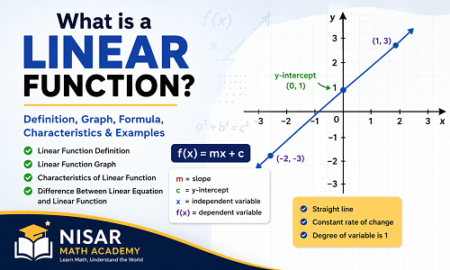
What is a Linear Function?
A linear function is one of the most important concepts in mathematics. It represents a relationship between two variables in which the rate of change remains constant. The graph of a linear function is always a straight line.
Students use linear functions in algebra, geometry, economics, physics, engineering, and everyday life to solve practical problems.
In these notes, you will learn the linear function definition, meaning, formula, graph, characteristics, examples, and the difference between a linear equation and a linear function.
Linear Function Definition
A linear function is a function whose highest power of the variable is 1. It can be written in the standard form
f(x) = mx + c
where
- m = slope or rate of change
- c = y-intercept
- x = independent variable
- f(x) = dependent variable
The value of the function changes at a constant rate as the value of x changes.
Meaning of Linear Function
The word linear means “forming a straight line.”
Therefore, the meaning of a linear function is a function whose graph is a straight line and whose rate of change remains constant.
Whenever one variable increases or decreases by equal amounts, the other variable also changes by equal amounts.
Formula of a Linear Function
The general formula is
f(x) = mx + c
Examples
- f(x) = 2x + 5
- f(x) = 4x − 3
- f(x) = −x + 8
- f(x) = 7x
Each of these represents a linear function.
Parts of a Linear Function
Independent Variable
The variable that can be chosen freely is called the independent variable.
Usually, x is the independent variable.
Dependent Variable
The value that depends upon x is called the dependent variable.
It is represented by f(x) or y.
Slope
The slope tells how quickly the function changes.
- Positive slope → line rises from left to right.
- Negative slope → line falls from left to right.
- Zero slope → horizontal line.
Y-Intercept
The y-intercept is the point where the graph crosses the y-axis.
It is represented by c.
Characteristics of Linear Function
Some important characteristics of a linear function are:
- The graph is always a straight line.
- The degree of the variable is one.
- The rate of change is constant.
- It has exactly one slope.
- It can increase or decrease depending upon the slope.
- It has one y-intercept.
- It is easy to represent using a table of values.
These characteristics help students identify linear functions quickly.
Linear Function Graph
The linear function graph is always a straight line.
For example,
f(x) = 2x + 1
Choose values of x.
| x | f(x) |
|---|---|
| -2 | -3 |
| -1 | -1 |
| 0 | 1 |
| 1 | 3 |
| 2 | 5 |
Plot these points on graph paper and join them with a straight line.
This forms the graph of the linear function.
Examples of Linear Functions
Example 1
Determine whether
f(x) = 5x − 7
is a linear function.
Solution
The highest power of x is 1.
Therefore,
It is a linear function.
Example 2
Find
f(4)
if
f(x) = 3x + 2
Solution
Substitute x = 4
f(4) = 3(4) + 2
= 12 + 2
= 14
Answer:
f(4) = 14
Example 3
Find the slope and y-intercept.
f(x) = −2x + 6
Solution
Slope = −2
Y-intercept = 6
Difference Between Linear Equation and Linear Function
Many students confuse these two terms.
| Linear Equation | Linear Function |
|---|---|
| An equation containing variables of degree one | A function that assigns exactly one output to each input |
| Written as ax + by = c | Written as f(x) = mx + c |
| May represent many solutions | Gives one output for every input |
| Used to solve unknown values | Used to describe relationships between variables |
Every linear function is a linear equation, but not every linear equation is written as a function.
Applications of Linear Functions
Linear functions are used in many real-life situations.
Examples include:
- Calculating monthly salary
- Finding total shopping cost
- Measuring speed and distance
- Business profit calculations
- Engineering designs
- Scientific experiments
- Population studies
- Economics
- Construction work
- Computer programming
Importance of Learning Linear Functions
Linear functions form the foundation of algebra.
Understanding them helps students learn:
- Linear equations
- Coordinate geometry
- Quadratic functions
- Calculus
- Statistics
- Mathematical modeling
Therefore, every mathematics student should master this topic.
Summary
A linear function is a function whose graph is a straight line and whose degree is one. It is written in the form f(x)=mx+c, where m is the slope and c is the y-intercept. Linear functions have a constant rate of change and are widely used in mathematics and everyday life.
Students who understand linear functions can easily solve many higher-level mathematics problems.
At Nisar Math Academy, students can access free mathematics blog posts, download selected Class 9 Mathematics notes, lesson plans, and assessments, and watch free lectures on one question from each exercise. To unlock complete recorded courses, detailed notes, assessments, and premium learning resources, students can become members of the website.
You May:
Read our free notes (class 9 math notes)
Watch our free recorded lectures (class 9 math)

Leave a Reply