Binary Relations: Definition, Examples, Types and Properties | Complete Student Notes
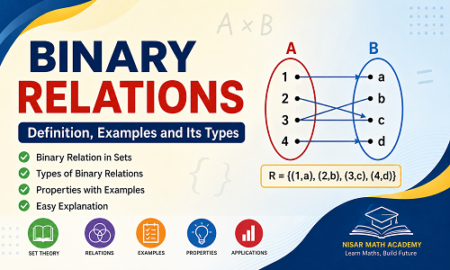
A binary relation is one of the most important concepts in set theory and discrete mathematics. It explains how the elements of one set are connected or related to the elements of the same set or another set. Binary relations are widely used in mathematics, computer science, databases, graph theory, and logic.
In this article, you will learn the binary relation, binary relation in sets, what is binary relation, what are binary relations, their definition, notation, types, examples, properties, and practice questions in simple student-friendly language.
What is Binary Relation?
A binary relation is a relationship between the elements of two sets or within the same set. It is represented as a set of ordered pairs.
In simple words, if one element is connected to another element, we say that a binary relation exists between them.
Suppose
A = {1, 2, 3}
B = {a, b}
Then
R = {(1, a), (2, b), (3, a)}
is a binary relation from set A to set B.
This means:
- 1 is related to a
- 2 is related to b
- 3 is related to a
Binary Relation Definition
A binary relation from set A to set B is any subset of the Cartesian product A × B.
Mathematically,
R ⊆ A × B
where R is the binary relation.
Binary Relation in Sets
A binary relation in sets is formed by selecting some ordered pairs from the Cartesian product of two sets.
Example:
Let
A = {1,2}
B = {x,y,z}
Then
A × B =
{(1,x),(1,y),(1,z),(2,x),(2,y),(2,z)}
A possible binary relation is
R = {(1,x),(2,y)}
Since R is a subset of A × B, it is a binary relation.
What are Binary Relations?
Binary relations are simply collections of ordered pairs that describe how elements are related.
Examples include:
- Equality (=)
- Less than (<)
- Greater than (>)
- Divisibility
- Friendship
- Parent-child relationship
- Employee-manager relationship
All these describe relationships between two objects.
Notation of Binary Relation
If element a is related to b, we write
aRb
If they are not related, we write
aR̸b
Examples of Binary Relations
Example 1
A = {1,2,3}
B = {a,b}
Relation
R = {(1,a),(2,b)}
This is a binary relation from A to B.
Example 2
A = {1,2,3}
Relation
R = {(1,1),(2,2),(3,3)}
This is the equality relation.
Example 3
A = {1,2,3}
Relation
R = {(1,2),(2,3)}
This relation shows that one number is less than another.
Types of Binary Relations
There are several important types of binary relations.
Empty Relation
A relation having no ordered pair.
Example:
R = {}
Universal Relation
A relation containing every ordered pair of A × A.
Example:
If
A = {1,2}
Then
R = {(1,1),(1,2),(2,1),(2,2)}
Identity Relation
Each element is related only to itself.
Example:
R = {(1,1),(2,2),(3,3)}
Inverse Relation
If
R = {(1,a),(2,b)}
then
R⁻¹ = {(a,1),(b,2)}
Reflexive Relation
Every element is related to itself.
Example:
(1,1), (2,2), (3,3)
are included.
Irreflexive Relation
No element is related to itself.
Example:
(1,1), (2,2), (3,3)
are absent.
Symmetric Relation
If
(a,b)
belongs to R,
then
(b,a)
must also belong to R.
Asymmetric Relation
If
(a,b)
belongs to R,
then
(b,a)
cannot belong to R.
Antisymmetric Relation
If
(a,b)
and
(b,a)
both belong to R,
then
a = b.
Transitive Relation
If
(a,b)
and
(b,c)
belong to R,
then
(a,c)
must also belong to R.
Properties of Binary Relations
The important properties are:
- Reflexive
- Irreflexive
- Symmetric
- Asymmetric
- Antisymmetric
- Transitive
These properties help classify relations in mathematics.
Real-Life Examples of Binary Relations
Some common binary relations include:
- Teacher teaches student
- Father of child
- Friend of another person
- Employee reports to manager
- City connected to another city
- Student enrolled in a course
These relationships can all be represented using ordered pairs.
Applications of Binary Relations
Binary relations are used in many fields, including:
- Set theory
- Discrete mathematics
- Database management
- Computer programming
- Artificial intelligence
- Graph theory
- Network analysis
- Logic
- Software engineering
- Data science
Difference Between Cartesian Product and Binary Relation
| Cartesian Product | Binary Relation |
|---|---|
| Contains all ordered pairs | Contains selected ordered pairs |
| A × B | R ⊆ A × B |
| Fixed | Can have any subset |
| Larger set | Usually smaller subset |
Key Points
- A binary relation is a subset of the Cartesian product.
- It consists of ordered pairs.
- Binary relations can exist between two different sets or within the same set.
- Every relation is formed from the Cartesian product.
- Relations have different properties such as reflexive, symmetric, and transitive.
Conclusion
A binary relation is a mathematical concept that describes how elements of one set are connected to elements of another set. It is represented by ordered pairs and is always a subset of the Cartesian product. Understanding binary relation in sets helps students learn advanced topics such as functions, equivalence relations, partial order relations, graph theory, and discrete mathematics. Mastering the definition, types, properties, and examples of binary relations builds a strong foundation for higher mathematics.
Short Notes
Binary Relation
A binary relation is a subset of the Cartesian product of two sets.
Formula
R ⊆ A × B
Representation
Set of ordered pairs
Examples
- Equality
- Less than
- Greater than
- Divisibility
Types
- Empty relation
- Universal relation
- Identity relation
- Inverse relation
- Reflexive relation
- Irreflexive relation
- Symmetric relation
- Asymmetric relation
- Antisymmetric relation
- Transitive relation
Applications
- Mathematics
- Computer science
- Databases
- Graph theory
- Logic
MCQs
1. A binary relation is a subset of
A) Union
B) Intersection
C) Cartesian Product
D) Complement
Answer: C
2. A binary relation consists of
A) Numbers
B) Sets
C) Ordered pairs
D) Functions
Answer: C
3. Which relation contains no ordered pair?
A) Identity
B) Empty
C) Universal
D) Reflexive
Answer: B
4. Identity relation relates
A) Every element to every element
B) Each element to itself
C) No element
D) Random elements
Answer: B
5. If R ⊆ A × B, then R is
A) Function
B) Binary relation
C) Equation
D) Matrix
Answer: B
6. Which property requires every element to be related to itself?
A) Symmetric
B) Reflexive
C) Antisymmetric
D) Transitive
Answer: B
7. If (a,b) ∈ R implies (b,a) ∈ R, then R is
A) Reflexive
B) Symmetric
C) Transitive
D) Empty
Answer: B
8. The inverse relation reverses
A) Sets
B) Ordered pairs
C) Numbers
D) Functions
Answer: B
9. Binary relations are represented by
A) Fractions
B) Ordered pairs
C) Angles
D) Polynomials
Answer: B
10. Binary relations are used in
A) Databases
B) Graph theory
C) Computer science
D) All of these
Answer: D
Worksheet / Assignment
Q1. Define a binary relation.
Q2. What is meant by binary relation in sets?
Q3. Explain the notation of a binary relation.
Q4. Give three examples of binary relations.
Q5. Define identity relation with an example.
Q6. Differentiate between Cartesian product and binary relation.
Q7. Explain reflexive and symmetric relations.
Q8. Define transitive relation with an example.
Q9. Let
A = {1,2}
B = {x,y}
Write the Cartesian product A × B.
Q10. Write any four applications of binary relations.
You May be Interested In:
Operations on Sets – Definition, Examples, Basic Operations
Types of Sets in Mathematics: Definition, Examples and Different Types of Sets
Concept of Antilogarithm: Definition, Rules, Formula and Applications of Logarithm in Daily Life

Leave a Reply