Types of Sets in Mathematics: Definition, Examples and Different Types of Sets
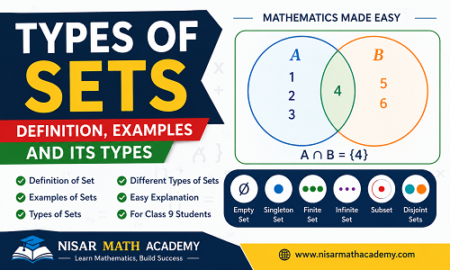
What is a Set?
A set is a well-defined collection of distinct objects, numbers, symbols, or items called elements.
The elements of a set are written inside curly brackets { }.
Examples
A = {2, 4, 6, 8}
B = {January, February, March}
C = {a, e, i, o, u}
In these examples, each object is called an element of the set.
Representation of Sets
Sets can be represented in two ways.
1. Roster Form
In roster form, all elements are written inside curly brackets.
Example
A = {1, 2, 3, 4, 5}
2. Set Builder Form
In set builder form, the property of the elements is described.
Example
A = {x | x is a natural number less than 6}
Types of Sets
Students often ask how many types of sets are there. There are several different types of sets used in mathematics. The most common types are explained below.
1. Empty Set (Null Set)
A set having no element is called an empty set or null set.
It is represented by ∅ or { }.
Example
A = {Months having 32 days}
Since no month has 32 days,
A = ∅
2. Singleton Set
A set containing exactly one element is called a singleton set.
Example
A = {7}
B = {Prime number between 8 and 12}
B = {11}
3. Finite Set
A set having a limited number of elements is called a finite set.
Example
A = {2, 4, 6, 8}
This set contains four elements.
4. Infinite Set
A set having unlimited elements is called an infinite set.
Example
N = {1, 2, 3, 4, 5, …}
The natural numbers continue forever.
5. Equal Sets
Two sets are equal if they have exactly the same elements.
Example
A = {1, 2, 3}
B = {3, 2, 1}
Since both contain the same elements,
A = B
6. Equivalent Sets
Two sets having the same number of elements are called equivalent sets.
Example
A = {2, 4, 6}
B = {a, b, c}
Both have three elements.
Therefore,
A ≈ B
7. Subset
A set A is called a subset of set B if every element of A is also an element of B.
Symbol
A ⊆ B
Example
A = {2, 4}
B = {2, 4, 6, 8}
Therefore,
A ⊆ B
8. Proper Subset
A proper subset contains some but not all elements of another set.
Symbol
A ⊂ B
Example
A = {1, 2}
B = {1, 2, 3}
Therefore,
A ⊂ B
9. Universal Set
The universal set contains all elements under discussion.
It is usually represented by U.
Example
U = {1, 2, 3, 4, 5, 6, 7, 8, 9, 10}
10. Disjoint Sets
Two sets having no common element are called disjoint sets.
Example
A = {1, 3, 5}
B = {2, 4, 6}
There is no common element.
Therefore,
A ∩ B = ∅
11. Overlapping Sets
Two sets having one or more common elements are called overlapping sets.
Example
A = {1, 2, 3}
B = {3, 4, 5}
Common element = 3
Therefore,
A and B are overlapping sets.
Summary of Types of Sets
| Type of Set | Description |
|---|---|
| Empty Set | No elements |
| Singleton Set | One element |
| Finite Set | Limited elements |
| Infinite Set | Unlimited elements |
| Equal Sets | Same elements |
| Equivalent Sets | Same number of elements |
| Subset | Every element belongs to another set |
| Proper Subset | Subset but not equal |
| Universal Set | Contains all elements |
| Disjoint Sets | No common element |
| Overlapping Sets | One or more common elements |
Solved Examples
Example 1
Identify the type of set.
A = {2, 4, 6, 8}
Solution
The set has four elements.
Therefore, A is a finite set.
Example 2
Find whether the following sets are equal.
A = {1, 2, 3}
B = {3, 2, 1}
Solution
Both sets have exactly the same elements.
Therefore,
A = B
Example 3
Determine whether the following sets are disjoint.
A = {1, 3, 5}
B = {2, 4, 6}
Solution
No element is common.
Therefore,
A and B are disjoint sets.
Importance of Studying Types of Sets
Learning the types of sets in mathematics helps students understand relations, functions, probability, statistics, and many other mathematical topics. It also improves logical thinking and problem-solving skills.
Conclusion
Understanding the types of sets, their definitions, and examples is essential for every mathematics student. Whether you are studying Class 9 Mathematics or preparing for competitive examinations, knowing the different types of sets makes advanced mathematical concepts much easier to understand. Practice identifying sets regularly to strengthen your concepts.
Students can download free Class 9 Mathematics notes, lesson plans, assessments, and watch free lectures from Nisar Math Academy. To access complete recorded courses, detailed notes, and premium learning resources, become a member of www.nisarmathacademy.com.
Short Notes
Set: A well-defined collection of distinct objects.
Element: An object belonging to a set.
Notation: Curly brackets { }
Types of Sets
• Empty Set
• Singleton Set
• Finite Set
• Infinite Set
• Equal Sets
• Equivalent Sets
• Subset
• Proper Subset
• Universal Set
• Disjoint Sets
• Overlapping Sets
MCQs
1. A well-defined collection of objects is called
A) Function
B) Relation
C) Set
D) Number
Answer: C
2. Which symbol represents an empty set?
A) ⊂
B) ∅
C) ∩
D) ⊆
Answer: B
3. Which set contains only one element?
A) Finite Set
B) Universal Set
C) Singleton Set
D) Infinite Set
Answer: C
4. Which of the following is an infinite set?
A) {1,2,3}
B) {2,4,6}
C) Natural Numbers
D) {10}
Answer: C
5. Two sets having the same elements are called
A) Equivalent Sets
B) Equal Sets
C) Universal Sets
D) Disjoint Sets
Answer: B
6. Two sets having the same number of elements are called
A) Equal Sets
B) Equivalent Sets
C) Infinite Sets
D) Proper Subsets
Answer: B
7. Which symbol represents subset?
A) ⊆
B) ∩
C) ∪
D) ∅
Answer: A
8. Disjoint sets have
A) Same elements
B) One common element
C) No common element
D) Infinite elements
Answer: C
9. Universal set is represented by
A) U
B) A
C) B
D) S
Answer: A
10. A = {1,2} and B = {1,2,3}. Then A is
A) Equal Set
B) Proper Subset
C) Empty Set
D) Infinite Set
Answer: B
Worksheet / Assignment
Part A: Define
- Set
- Empty Set
- Finite Set
- Infinite Set
- Universal Set
Part B: Identify the Type of Set
- {5}
- {2,4,6,8}
- Natural Numbers
- {Months having 35 days}
- {1,3,5} and {2,4,6}
Part C: True or False
- An empty set contains one element.
- Equal sets have the same elements.
- Infinite sets have unlimited elements.
- Every proper subset is also a subset.
- Disjoint sets have no common element.
Part D: Short Questions
- What is a set?
- Write two examples of finite sets.
- Differentiate between equal sets and equivalent sets.
- What is a subset?
- Explain overlapping sets with an example.
Part E: Long Questions
- Explain all major types of sets in mathematics with suitable examples.
- Differentiate between finite and infinite sets.
- Explain equal sets, equivalent sets, and disjoint sets with examples.
- Describe universal set and subset with examples.
- Write the importance of studying sets in mathematics.
WordPress Tags
Concept of Antilogarithm: Definition, Rules, Formula and Applications of Logarithm in Daily Life
Antilogarithm: Definition, Formula, Rules, Examples & Applications
Common Logarithm – Definition, Formula, Examples and Applications
You May:
Read our free notes (class 9 math notes)
Watch our free recorded lectures (class 9 math)
Leave a Reply