Concept of Antilogarithm: Definition, Rules, Formula and Applications of Logarithm in Daily Life
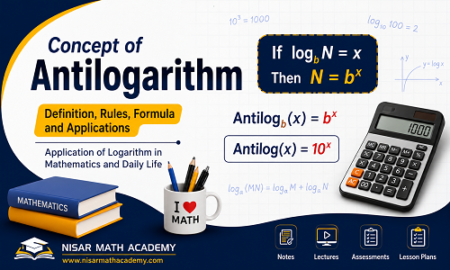
Concept of Antilogarithm
Antilogarithm is one of the most important concepts in mathematics. It is the inverse operation of a logarithm. If a logarithm tells us the power to which a base is raised, then an antilogarithm helps us find the original number. Understanding antilogarithms becomes easier when students have a strong understanding of logarithms and their properties.
At Nisar Math Academy (www.nisarmathacademy.com), students can access notes, recorded lectures, assessments, lesson plans, and free educational resources to strengthen their mathematical concepts.
Introduction to Antilogarithm
Suppose we have:
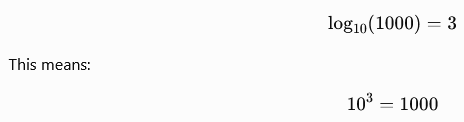
Therefore, the antilogarithm of 3 to the base 10 is 1000.
In simple words:
Antilogarithm is the process of finding the original number from its logarithm.
Definition of Antilogarithm
If
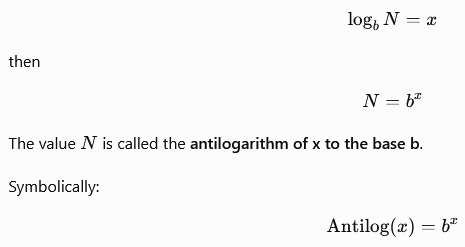
Formula of Antilogarithm
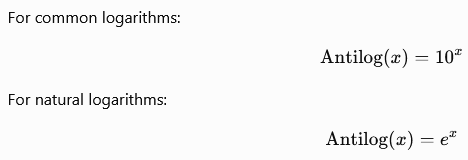
Examples of Antilogarithms
Example 1:
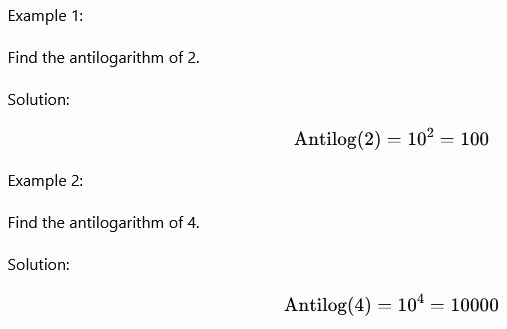
Example 3:
Find the antilogarithm of 0.
Solution:

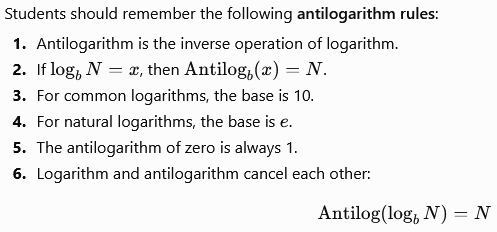
Antilogarithm Rules
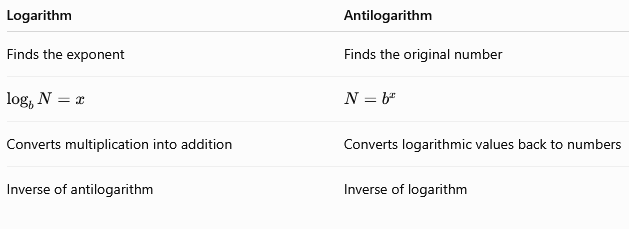
Relationship Between Logarithm and Antilogarithm
Application of Logarithm
The application of logarithm is very broad. Logarithms simplify calculations involving very large and very small numbers. Before calculators became common, scientists and engineers relied heavily on logarithmic tables to perform difficult computations.
Some important applications include:
- Astronomy
- Engineering calculations
- Physics
- Chemistry
- Finance
- Computer science
- Statistics
- Earthquake measurements
- Sound intensity measurements
Application of Logarithmic Function
The application of logarithmic function is found in many scientific models. Logarithmic functions are useful when quantities grow or decrease rapidly.
Examples include:
- Population growth analysis
- Radioactive decay
- Measuring acidity using pH
- Data compression in computer science
- Measuring sound intensity in decibels
- Compound interest calculations
Application of Logarithms in Daily Life
Students often ask about the application of logarithms in daily life. Logarithms are used in many real-world situations.
- Measuring earthquake strength using the Richter scale.
- Measuring sound intensity in decibels.
- Calculating pH levels in chemistry.
- Determining compound interest in banking.
- Studying population growth.
- Data analysis and computer algorithms.
- Scientific calculations involving very large numbers.
Importance of Learning Antilogarithms
Antilogarithms help students:
- Solve exponential equations.
- Understand scientific calculations.
- Use logarithmic tables effectively.
- Study higher mathematics, physics, and engineering.
- Develop problem-solving skills.
Conclusion
Antilogarithm is the inverse of logarithm and helps us find the original number from a logarithmic value. By understanding the formula, examples, and antilogarithm rules, students can easily solve related questions. Logarithms and antilogarithms also have numerous practical uses, and the application of logarithm can be seen in science, engineering, finance, and everyday life.
Students who wish to learn logarithms and antilogarithms in greater detail can explore recorded lectures, notes, assessments, and full mathematics courses available at www.nisarmathacademy.com.
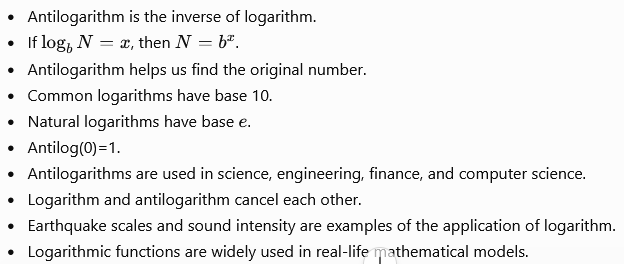
Short Notes on Antilogarithm
MCQs
1. Antilogarithm is the inverse of:
A. Addition
B. Multiplication
C. Logarithm
D. Division
Answer: C
2. If (\log_{10} N=3), then (N) equals:
A. 30
B. 300
C. 1000
D. 100
Answer: C
3. Antilog(2) is:
A. 20
B. 100
C. 200
D. 10
Answer: B
4. The antilogarithm of 0 is:
A. 0
B. 10
C. 1
D. 100
Answer: C
5. The base of common logarithm is:
A. 2
B. 5
C. 10
D. e
Answer: C
6. Natural logarithm has base:
A. e
B. 10
C. 2
D. 100
Answer: A
7. Richter scale is an example of:
A. Trigonometry
B. Logarithm application
C. Algebraic identity
D. Set theory
Answer: B
8. Antilogarithm of 4 is:
A. 4000
B. 1000
C. 10000
D. 100
Answer: C
9. Which field uses logarithms?
A. Chemistry
B. Physics
C. Engineering
D. All of these
Answer: D
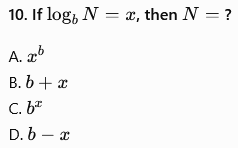
Answer: C
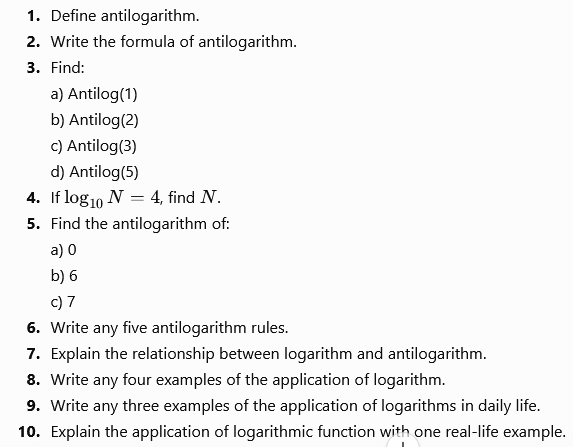
Worksheet / Assignment
Name: ____________________
Class: ____________________
Date: ____________________
You May be Interested In:
Antilogarithm: Definition, Formula, Rules, Examples & Applications
Common Logarithm – Definition, Formula, Examples and Applications
What is Logarithm of a Number? | Logarithm Meaning, Log 10, Natural Log & Log Rules
You May:
Read our free notes (class 9 math notes)
Watch our free recorded lectures (class 9 math)

Leave a Reply