Antilogarithm: Definition, Formula, Rules, Examples & Applications
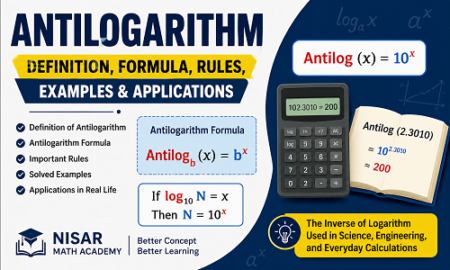
Antilogarithm
Antilogarithm is one of the most important concepts in mathematics, especially in logarithms. It is the reverse process of finding a logarithm. If a logarithm converts a number into its logarithmic value, then an antilogarithm converts the logarithmic value back into the original number.
Understanding the antilogarithm helps students solve exponential equations, scientific calculations, engineering problems, and calculator-based computations. Before calculators became common, antilogarithm tables were widely used to perform complex calculations.
What is Antilogarithm?
The antilogarithm of a number is the original number whose logarithm is given.
In simple words:
Antilogarithm = Reverse of Logarithm
If
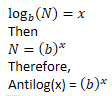
This is the basic antilogarithm definition.
Define Antilogarithm
To define antilogarithm, we can say:
Antilogarithm is the inverse operation of a logarithm. It is used to find the original number from its logarithmic value.
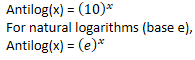
For common logarithms (base 10),
Antilogarithm Formula
The basic antilogarithm formula is
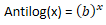
For any base (b),
Special cases are
Common logarithm:
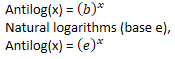
Relationship Between Logarithm and Antilogarithm
If

Similarly,
If
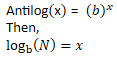
Thus, logarithm and antilogarithm are inverse operations.
Antilogarithm Rules
The following are the important antilogarithm rules.
Rule 1
The antilogarithm is the inverse of a logarithm.

Rule 2
For common logarithms,
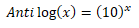
Rule 3
For natural logarithms,
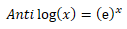
Rule 4
The base of the logarithm and the antilogarithm must be the same.
Rule 5
Antilogarithm always gives a positive number.
Steps to Find Antilogarithm
- Identify the logarithmic value.
- Determine the base.
- Raise the base to the given logarithmic value.
- Simplify the result.
Antilogarithm Examples
Example 1
Find the antilogarithm of 2.
Solution

Answer:
100
Example 2
Find the antilogarithm of 3.
Solution

Answer:
1000
Example 3
Find the antilogarithm of 0.
Solution

Answer:
1
Example 4
Find the antilogarithm of 1.5.
Solution
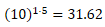
Answer:
Approximately 31.62
Example 5
Find the antilogarithm of 0.3010.
Solution

Answer:
2
Example 6
Find the antilogarithm of 2.6990.
Solution

Answer:
500
Antilogarithm Table (Common Values)
| Logarithm | Antilogarithm |
|---|---|
| 0 | 1 |
| 0.3010 | 2 |
| 0.4771 | 3 |
| 0.6021 | 4 |
| 0.6990 | 5 |
| 1 | 10 |
| 2 | 100 |
| 3 | 1000 |
Applications of Antilogarithm
Antilogarithms are used in many fields including:
- Scientific calculations
- Engineering
- Physics
- Chemistry
- Statistics
- Computer science
- Financial mathematics
- Population growth calculations
- Radioactivity calculations
- Exponential growth and decay
Importance of Learning Antilogarithm
Students should understand antilogarithms because they:
- Help solve logarithmic equations.
- Explain exponential growth.
- Improve calculator skills.
- Prepare students for higher mathematics.
- Are useful in engineering and science.
Difference Between Logarithm and Antilogarithm
| Logarithm | Antilogarithm |
|---|---|
| Converts a number into its logarithm | Converts a logarithm into the original number |
| Example: log₁₀(100) = 2 | Antilog(2) = 100 |
| Inverse operation | Reverse operation |
| Output is logarithmic value | Output is original number |
Conclusion
The antilogarithm is the inverse of a logarithm and is used to recover the original number from its logarithmic value. The antilogarithm formula is (b^x), where (b) is the base and (x) is the logarithmic value. By understanding the antilogarithm definition, antilogarithm rules, and solving several antilogarithm examples, students can easily master this important mathematical concept and apply it in science, engineering, and advanced mathematics.
Short Notes (Revision Notes)
Topic: Antilogarithm
- Antilogarithm is the inverse of logarithm.
- It gives the original number from its logarithm.
- Formula:
- Antilog(x) = (b^x)
- Common logarithm: (10^x)
- Natural logarithm: (e^x)
- Antilog(2) = 100
- Antilog(3) = 1000
- Antilog(0) = 1
- Base must remain the same.
- Antilogarithm always produces a positive value.
- Used in science, engineering, statistics, and exponential calculations.
MCQs
1. Antilogarithm is the inverse of
- A) Addition
- B) Multiplication
- C) Logarithm
- D) Division
Answer: C
2. Antilog(2) is
- A) 20
- B) 10
- C) 100
- D) 1000
Answer: C
3. The common antilogarithm uses which base?
- A) 2
- B) 5
- C) 10
- D) e
Answer: C
4. Antilog(0) equals
- A) 10
- B) 0
- C) 1
- D) 2
Answer: C
5. The formula for antilogarithm is
- A) log(x)
- B) x²
- C) (b^x)
- D) √x
Answer: C
6. If log₁₀(N)=3, then N equals
- A) 30
- B) 300
- C) 1000
- D) 100
Answer: C
7. Antilogarithm is commonly used in
- A) Geometry only
- B) Science and Engineering
- C) Grammar
- D) Drawing
Answer: B
8. Antilog(1)=
- A) 1
- B) 5
- C) 10
- D) 100
Answer: C
9. Antilogarithm always returns
- A) A negative number
- B) A positive number
- C) Zero only
- D) An imaginary number
Answer: B
10. Which operation reverses logarithm?
- A) Square root
- B) Exponentiation
- C) Division
- D) Addition
Answer: B
Worksheet / Assignment
Name: ____________________
Class: ____________________
Q1. Define antilogarithm.
Q2. Write the antilogarithm formula.
Q3. Find the following:
- Antilog(1)
- Antilog(2)
- Antilog(3)
- Antilog(0)
- Antilog(0.3010)
Q4. Complete the table.
| Logarithm | Antilogarithm |
|---|---|
| 1 | ______ |
| 2 | ______ |
| 3 | ______ |
| 0 | ______ |
| 0.6990 | ______ |
Q5. State any five applications of antilogarithms.
Q6. Write any four antilogarithm rules.
Q7. Explain the difference between logarithm and antilogarithm with examples.
Q8. Solve:
- If log₁₀(N) = 4, find N.
- If log₁₀(N) = 5, find N.
- Find Antilog(1.5).
- Find Antilog(2.3010).
You May be Interested In:
Common Logarithm – Definition, Formula, Examples and Applications
What is Logarithm of a Number? | Logarithm Meaning, Log 10, Natural Log & Log Rules
Conversion of Numbers from Ordinary Notation to Scientific Notation
You May:
Read our free notes (class 9 math notes)
Watch our free recorded lectures (class 9 math)

Leave a Reply