Common Logarithm – Definition, Formula, Examples and Applications
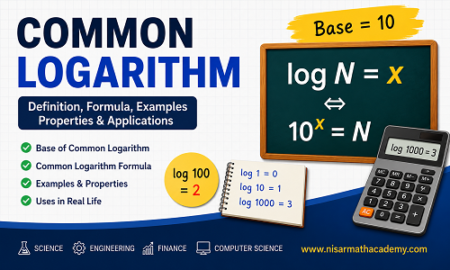
The common logarithm is one of the most important concepts in mathematics. It is widely used in algebra, science, engineering, statistics, finance, and computer science. Understanding the common logarithm makes it easier to solve exponential equations and perform calculations involving very large or very small numbers.
In these notes, you will learn the definition of the common logarithm, its formula, properties, examples, and practical applications in an easy-to-understand student-friendly style.
What is a Common Logarithm?
A common logarithm is a logarithm whose base is 10.
If
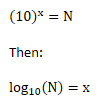
Since base 10 is used so frequently, mathematicians usually write
log (N)
instead of

Definition
The common logarithm of a positive number is the exponent to which 10 must be raised to obtain that number.
Base of Common Logarithm
The base of common logarithm is always 10
Examples:
log 10=1
because

log 100 = 2
because

log 1000 = 3
because

Common Logarithm Formula
The basic common logarithm formula is
log N = x
if

where
- Base = 10
- N = Positive number
- x = Logarithm of N
Common Logarithm Properties
Product Rule
log(AB) = log A + log B
Example
log(100 * 1000) = log100 + log1000
i.e. 2 + 3 = 5
Quotient Rule
log(A/B) = log A – log B
Example
log(1000/100) = 3 – 2 = 1
Power Rule
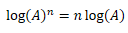
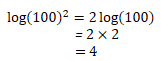
Example
Logarithm of One
log1 = 0
because

Logarithm of Base
log10 = 1
Examples
Example 1
Find
log100
Solution
Since

Therefore,
log100 = 2
Example 2
Find
log10000
Solution
Since
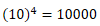
Therefore,
log10000 = 4
Example 3
Find
log0.01
Solution
Since

Therefore,
log0.01 = -2
Example 4
Find
log100000
Solution
Since
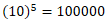
Therefore,
log100000 = 5
Common Logarithm Calculator
A common logarithm calculator is an online tool that calculates the logarithm of a positive number with base 10 instantly.
Students can use a calculator to:
- Verify manual calculations.
- Solve lengthy numerical problems.
- Check homework answers.
- Learn logarithmic concepts more efficiently.
Although calculators are useful, students should first understand the definition and formula before relying on them.
Applications of Common Logarithm
The common logarithm has many practical uses.
Science
Scientists use logarithms to represent very large and very small quantities.
Engineering
Engineers use logarithms in electrical circuits and signal processing.
Earthquake Measurement
The Richter Scale uses logarithmic calculations to measure earthquake intensity.
Chemistry
The pH scale is based on logarithms.
Finance
Logarithms help calculate compound growth and investment returns.
Computer Science
Algorithms and computational complexity often involve logarithms.
Important Points to Remember
- The common logarithm always has base 10.
- Only positive numbers have real logarithms.
- (log1 = 0)
- (log10 = 1)
- Logarithms convert multiplication into addition.
- They also convert division into subtraction.
Conclusion
The common logarithm is one of the most useful mathematical concepts for solving exponential problems and simplifying calculations. By learning the definition, formula, properties, and applications of common logarithms, students build a strong foundation for higher mathematics, science, and engineering.
Short Notes
Common Logarithm (Short Notes)
- A common logarithm is a logarithm with base 10.
- It tells the exponent to which 10 must be raised to obtain a given number.
- Formula:
log N = x
iff
- Base of common logarithm = 10
- (log1 = 0)
- (log10 = 1)
- Product Rule:

- Quotient Rule:
log(A/B) = log A – log B
- Power Rule:
- Used in science, engineering, chemistry, finance, and computer science.
MCQs
1. The base of the common logarithm is:
A) 2
B) e
C) 10
D) 5
Answer: C
2. What is (log100)?
A) 1
B) 2
C) 3
D) 10
Answer: B
3. What is (\log1)?
A) 0
B) 1
C) −1
D) 10
Answer: A
4. Which formula is correct?
A) log(AB) = log A – log B
B) log(A+B) = log A + log B
C) log(AB) = log A + log B
D) None of these
Answer: C
5. What is (log1000)?
A) 2
B) 3
C) 4
D) 5
Answer: B
6. Which number has a common logarithm of 4?
A) 100
B) 1000
C) 10000
D) 100000
Answer: C
7. Which of the following numbers has a negative common logarithm?
A) 100
B) 10
C) 0.1
D) 1000
Answer: C
8. The common logarithm is mainly used with which base?
A) 5
B) 8
C) 10
D) 12
Answer: C
9. Which field commonly uses logarithms?
A) Chemistry
B) Engineering
C) Finance
D) All of these
Answer: D
10. Logarithms help convert multiplication into:
A) Division
B) Addition
C) Subtraction
D) Powers
Answer: B
Worksheet / Assignment
Part A: Fill in the Blanks
- The base of the common logarithm is ________.
- (log1 = ) ________.
- (log100 = ) ________.
- (log1000 = ) ________.
- Common logarithm is written simply as ________.
Part B: Solve the Following
- Find (log10).
- Find (log10000).
- Find (log0.001).
- Evaluate (log(100 * 1000)).
- Evaluate (log(1000 / 100)).
Part C: Short Questions
- Define the common logarithm.
- What is the base of the common logarithm?
- Write the common logarithm formula.
- State the product rule of logarithms.
- List any three applications of common logarithms.
Part D: Thinking Questions
- Explain why (log1 = 0).
- Why are logarithms useful in science and engineering?
- How does a common logarithm simplify multiplication?
You May be Interested In:
What is Logarithm of a Number? | Logarithm Meaning, Log 10, Natural Log & Log Rules
Conversion of Numbers from Ordinary Notation to Scientific Notation
Scientific Notation: Application of Real Numbers in Daily Life
You May:
Read our free notes (class 9 math notes)
Watch our free recorded lectures (class 9 math)

Leave a Reply