Linear Equations and Inequalities – Complete Notes, Examples, MCQs & Worksheet
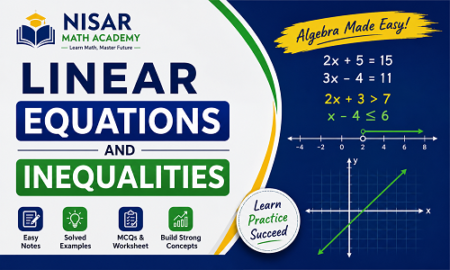
Linear Equations and Inequalities
Mathematics becomes much easier when we understand the basic rules behind equations and inequalities. Linear equations and linear inequalities are important topics in algebra and are used to solve many mathematical and real-life problems.
In this article, students will learn the meaning of linear equations, methods of solving them, linear inequalities, rules for solving inequalities, solved examples, short notes, MCQs, and a practice worksheet.
At Nisar Math Academy, students can find mathematics lectures, notes, assessments, lesson plans, and other useful learning material. Students can also access selected free learning resources, while the complete course is available through website membership.
What is a Linear Equation?
A linear equation is an equation in which the highest power of the variable is 1.
For example:
Here, is the variable and its highest power is 1. Therefore, it is a linear equation.
Other examples include:
A linear equation can have one or more variables, but in basic algebra we commonly study linear equations involving one variable.
General Form of a Linear Equation
The general form of a linear equation in one variable is:
where and are constants and:
For example:
Here:
How to Solve Linear Equations
The main purpose of solving a linear equation is to find the value of the variable.
We use the following basic principle:
Whatever operation we perform on one side of an equation, we must perform the same operation on the other side.
Example 1
Solve:
Subtract 6 from both sides:
Therefore:
So, the solution is:
Example 2
Solve:
Divide both sides by 3:
Therefore:
So:
Example 3
Solve:
Subtract 5 from both sides:
Divide by 2:
Hence:
Linear Equations with Variables on Both Sides
Sometimes the variable appears on both sides of an equation.
Example
Solve:
Subtract from both sides:
Subtract 3:
Divide by 3:
Therefore:
Linear Equations Containing Brackets
To solve equations containing brackets, first use the distributive property.
Example
Solve:
Expand the bracket:
Subtract 6:
Divide by 3:
Therefore:
Linear Equations Containing Fractions
Fractions can also occur in linear equations.
Example
Solve:
Subtract 2:
Multiply both sides by 3:
Therefore:
Checking the Solution
It is always useful to check the answer by substituting the value back into the original equation.
For example:
We obtained:
Substitute :
Therefore, the solution is correct.
What are Linear Inequalities?
A linear inequality is similar to a linear equation, but instead of an equality sign, it uses an inequality symbol.
The common inequality symbols are:
Their meanings are:
| Symbol | Meaning |
|---|---|
| Less than | |
| Greater than | |
| Less than or equal to | |
| Greater than or equal to |
Examples of linear inequalities include:
Difference Between Linear Equations and Linear Inequalities
A linear equation normally uses the equality sign:
For example:
A linear inequality uses symbols such as:
For example:
An equation generally gives specific solution values, whereas an inequality can give a range of possible values.
How to Solve Linear Inequalities
Linear inequalities can be solved using many of the same steps used for equations.
Example 1
Solve:
Subtract 4 from both sides:
Therefore:
Example 2
Solve:
Divide both sides by 3:
Therefore:
Important Rule for Inequalities
There is one very important difference between equations and inequalities.
When we multiply or divide an inequality by a negative number, the inequality sign must be reversed.
For example:
Divide both sides by .
Because we are dividing by a negative number, reverse the sign:
Therefore:
Another Example
Solve:
Divide by and reverse the inequality sign:
Therefore:
Solving a Linear Inequality with Variables on Both Sides
Consider:
Subtract from both sides:
Subtract 2:
Therefore:
Number Line Representation of Inequalities
Linear inequalities can also be represented on a number line.
For:
we use an open circle at 3 because 3 is not included, and the solution extends to the right.
For:
we use a closed circle at 3 because 3 is included.
For:
we use an open circle at 3 and shade toward the left.
For:
we use a closed circle at 3 and shade toward the left.
Common Mistakes in Linear Equations
Students often make the following mistakes while solving linear equations:
- Changing a sign incorrectly when moving a term.
- Forgetting to perform the same operation on both sides.
- Making calculation errors.
- Not applying the distributive property correctly.
- Forgetting to check the final answer.
- Making mistakes while simplifying fractions.
A good practice is to solve each step carefully and check the answer at the end.
Common Mistakes in Linear Inequalities
Some common mistakes in linear inequalities are:
- Forgetting to reverse the inequality sign when multiplying or dividing by a negative number.
- Confusing with .
- Confusing with .
- Using the wrong direction on a number line.
- Forgetting whether the endpoint is included.
Remember:
Multiplication or division by a negative number → reverse the inequality sign.
Short Notes on Linear Equations and Inequalities
Linear Equation
An equation in which the highest power of the variable is 1 is called a linear equation.
General form:
Example:
Linear Inequality
An inequality involving a variable whose highest power is 1 is called a linear inequality.
Examples:
Inequality Symbols
Important Rule
When multiplying or dividing an inequality by a negative number, reverse the inequality sign.
Equation Rule
Perform the same operation on both sides of an equation.
Checking
Substitute the obtained value into the original equation to verify the answer.
Quick Revision Table
| Topic | Key Point |
|---|---|
| Linear equation | Highest power of variable is 1 |
| General form | |
| Equation symbol | |
| Less than | |
| Greater than | |
| Less than or equal | |
| Greater than or equal | |
| Negative multiplication/division | Reverse inequality sign |
| Solution checking | Substitute the answer into the original equation |
MCQs on Linear Equations and Inequalities
MCQ 1
Which of the following is a linear equation?
A.
B.
C.
D.
Answer: B
MCQ 2
The general form of a linear equation in one variable is:
A.
B.
C.
D.
Answer: B
MCQ 3
Solve:
A. 5
B. 6
C. 7
D. 8
Answer: C
MCQ 4
Solve:
A. 4
B. 6
C. 8
D. 10
Answer: C
MCQ 5
Which symbol means “less than”?
A.
B.
C.
D.
Answer: B
MCQ 6
Which symbol means “greater than or equal to”?
A.
B.
C.
D.
Answer: D
MCQ 7
Solve:
A.
B.
C.
D.
Answer: B
MCQ 8
When an inequality is multiplied by a negative number, the inequality sign:
A. Remains the same
B. Disappears
C. Is reversed
D. Becomes equal to
Answer: C
MCQ 9
Solve:
A.
B.
C.
D.
Answer: B
MCQ 10
Which one is a linear inequality?
A.
B.
C.
D.
Answer: B
Worksheet / Assignment
Part A: Solve the Linear Equations
Part B: Solve the Linear Inequalities
Part C: Conceptual Questions
- Define a linear equation.
- Define a linear inequality.
- Write the general form of a linear equation in one variable.
- Write four common inequality symbols and their meanings.
- What happens to the inequality sign when both sides are divided by a negative number?
Part D: Challenge Questions
- Solve:
- Solve:
- Solve:
- Solve:
- Solve:
Answers to Worksheet
Part A
Part B
Part D
Why Learn Linear Equations and Inequalities?
Understanding linear equations and linear inequalities provides an important foundation for higher-level mathematics. These concepts are used in algebra, coordinate geometry, functions, graphs, word problems, and many other mathematical topics.
Students should focus not only on memorizing rules but also on understanding why each step is performed. Regular practice with equations, inequalities, and word problems can significantly improve algebraic skills.
Learn Mathematics with Nisar Math Academy
Nisar Math Academy provides useful educational resources for students, including recorded lectures, mathematics notes, assessments, lesson plans, and other learning material.
Students can also find selected free resources on the website, including Class 9 Maths Notes, free lectures covering selected questions, lesson plans, and assessments. Students who want access to the complete course can take the website membership.
Whether you are preparing for your school examinations or building your mathematical foundation, practicing topics such as linear equations and linear inequalities is an important step toward improving your mathematics.
Conclusion
Linear equations are equations in which the highest power of the variable is 1. They can be solved by performing equal operations on both sides of the equation.
Linear inequalities use symbols such as , , , and . Their solution represents a range of values rather than necessarily one specific value.
The most important rule to remember is:
When multiplying or dividing an inequality by a negative number, reverse the inequality sign.
With regular practice, students can become confident in solving both linear equations and linear inequalities.
You May be Interested In:
How to Find Least Common Multiple (LCM) Using Factorization | Real World Problems of Factorization
Scientific Notation: Definition, Meaning, Examples & How to Convert a Number from Standard Form
How to Find Least Common Multiple (LCM)? Formula, Examples, and Worksheet

Leave a Reply