Operations on Sets – Definition, Examples, Basic Operations
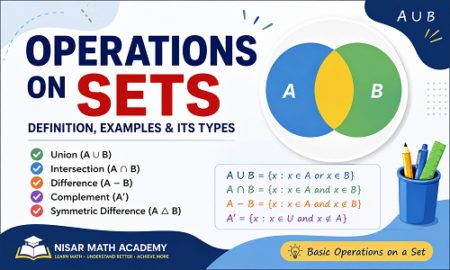
Operations on Sets
Sets are one of the most important concepts in mathematics. They are used in algebra, probability, statistics, computer science, and many other branches of mathematics. Once we understand what a set is, the next step is to learn operations on sets, which help us combine, compare, and analyze different sets.
In this article, you will learn the definition of operations on sets, basic operations on a set, binary operation on a set, examples, important properties, solved questions, short notes, MCQs, and a worksheet.
Students can also visit Nisar Math Academy at www.nisarmathacademy.com to access free Class 9 Maths notes, lesson plans, assessments, and sample lectures. Full recorded lectures, complete notes, and assessments are available through the website membership.
Learning Objectives
After studying this lesson, students will be able to:
- Define operations on sets.
- Identify different types of set operations.
- Perform union, intersection, difference, and complement.
- Solve problems involving set operations.
- Apply set operations in everyday situations.
What are Operations on Sets?
Operations on sets are mathematical processes used to combine, compare, or modify two or more sets according to specific rules.
Just as addition and subtraction are operations on numbers, union, intersection, difference, and complement are operations on sets.
Definition of Operations on Sets
Definition:
Operations on sets are mathematical rules that produce a new set by using one or more given sets.
Example:
Let
A = {1, 2, 3}
B = {3, 4, 5}
Different operations can be performed on these sets to obtain new sets.
Basic Operations on a Set
The basic operations on a set are:
- Union
- Intersection
- Difference
- Complement
- Symmetric Difference
These operations are widely used in mathematics and computer science.
1. Union of Sets
Definition
The union of two sets contains all elements that belong to either set or both sets.
Symbol
A ∪ B
Formula
A ∪ B = {x : x belongs to A or B}
Example
A = {1,2,3}
B = {3,4,5}
A ∪ B = {1,2,3,4,5}
2. Intersection of Sets
Definition
The intersection of two sets contains only the common elements.
Symbol
A ∩ B
Formula
A ∩ B = {x : x belongs to both A and B}
Example
A = {1,2,3}
B = {3,4,5}
A ∩ B = {3}
3. Difference of Sets
Definition
The difference of two sets contains elements that belong to the first set but not the second.
Symbol
A − B
Example
A = {1,2,3,4}
B = {3,4,5}
A − B = {1,2}
Similarly,
B − A = {5}
4. Complement of a Set
Definition
The complement of a set contains all elements of the universal set that are not in the given set.
Symbol
A’
or
Aᶜ
Example
Universal Set
U = {1,2,3,4,5,6,7}
A = {2,4,6}
A’ = {1,3,5,7}
5. Symmetric Difference
Definition
The symmetric difference consists of elements that belong to either set but not both.
Symbol
A △ B
Formula
(A − B) ∪ (B − A)
Example
A = {1,2,3}
B = {3,4,5}
A △ B = {1,2,4,5}
All Operations on Sets at a Glance
| Operation | Symbol | Meaning |
|---|---|---|
| Union | ∪ | Elements in either set |
| Intersection | ∩ | Common elements |
| Difference | − | Elements of first set only |
| Complement | A’ | Elements not in the set |
| Symmetric Difference | △ | Elements in one set only |
Binary Operation on a Set
A binary operation on a set is an operation that combines two elements of the same set and produces another element belonging to that same set.
Examples include:
- Addition on integers
- Multiplication on integers
- Maximum of two numbers
- Minimum of two numbers
Example:
On the set of integers,
5 + 3 = 8
Since 8 is also an integer, addition is a binary operation on integers.
Properties of Set Operations
Commutative Law
A ∪ B = B ∪ A
A ∩ B = B ∩ A
Associative Law
(A ∪ B) ∪ C = A ∪ (B ∪ C)
(A ∩ B) ∩ C = A ∩ (B ∩ C)
Distributive Law
A ∩ (B ∪ C) = (A ∩ B) ∪ (A ∩ C)
A ∪ (B ∩ C) = (A ∪ B) ∩ (A ∪ C)
Identity Laws
A ∪ ∅ = A
A ∩ U = A
Complement Laws
A ∪ A’ = U
A ∩ A’ = ∅
Real-Life Applications of Operations on Sets
Operations on sets are used in:
- Student survey analysis
- Database management
- Computer programming
- Search engines
- Medical research
- Business statistics
- Probability
- Artificial Intelligence
Solved Examples
Example 1
A = {2,4,6}
B = {4,6,8}
Find A ∪ B.
Solution
A ∪ B = {2,4,6,8}
Example 2
Find A ∩ B.
Solution
A ∩ B = {4,6}
Example 3
Find A − B.
Solution
A − B = {2}
Example 4
Universal Set
U = {1,2,3,4,5,6}
A = {2,4,6}
Find A’.
Solution
A’ = {1,3,5}
Operations on Sets Exercises
Exercise 1
Find the union of
A = {1,3,5}
B = {2,3,6}
Exercise 2
Find A ∩ B.
Exercise 3
Find A − B.
Exercise 4
Find B − A.
Exercise 5
If
U = {1,2,3,4,5,6,7}
A = {2,5}
Find A’.
Exercise 6
Find the symmetric difference of
A = {1,2,3}
B = {3,4,5}
Exercise 7
Verify
A ∪ B = B ∪ A
using suitable sets.
Exercise 8
Verify
A ∩ B = B ∩ A
Exercise 9
State whether addition on integers is a binary operation.
Exercise 10
Write any two applications of set operations.
Conclusion
Understanding operations on sets is essential for mastering mathematics. The concepts of union, intersection, difference, complement, and symmetric difference form the foundation of many advanced topics in mathematics and computer science. Students should practice a variety of problems to strengthen their understanding of these operations.
Short Notes
Operations on Sets
Operations on sets are mathematical rules used to create a new set from one or more given sets.
Types
- Union
- Intersection
- Difference
- Complement
- Symmetric Difference
Union
Contains all elements of both sets.
Intersection
Contains only common elements.
Difference
Contains elements of one set excluding those of another.
Complement
Contains elements not present in the given set.
Binary Operation
An operation that combines two elements of the same set to produce another element of the same set.
MCQs
1. Which operation contains all elements of two sets?
A) Difference
B) Union
C) Complement
D) Intersection
Answer: B
2. The symbol of intersection is
A) ∪
B) ∩
C) −
D) △
Answer: B
3. The complement of a set is taken with respect to
A) Empty Set
B) Universal Set
C) Equal Set
D) Singleton Set
Answer: B
4. Which operation contains only common elements?
A) Union
B) Difference
C) Intersection
D) Complement
Answer: C
5. A binary operation combines
A) One element
B) Two elements
C) Three elements
D) Four elements
Answer: B
6. Which law states A ∪ B = B ∪ A?
A) Identity
B) Commutative
C) Associative
D) Distributive
Answer: B
7. Which set operation removes common elements?
A) Symmetric Difference
B) Union
C) Intersection
D) Complement
Answer: A
8. The complement of A is represented by
A) A’
B) A∩B
C) A−B
D) A∪B
Answer: A
9. Which operation is represented by ∪?
A) Difference
B) Union
C) Complement
D) Intersection
Answer: B
10. Set operations are useful in
A) Computer Science
B) Statistics
C) Probability
D) All of these
Answer: D
Student Worksheet / Assignment
Part A: Definitions
- Define operations on sets.
- Define union.
- Define intersection.
- Define complement.
- Define binary operation on a set.
Part B: Solve the Following
- A = {2,4,6}, B = {4,5,6}
- Find A ∪ B
- Find A ∩ B
- Find A − B
- Find B − A
- U = {1,2,3,4,5,6,7,8}
A = {2,4,6}
Find A’. - Find the symmetric difference of
A = {1,3,5}
B = {3,4,6} - Verify the commutative law for union.
- Verify the distributive law using suitable examples.
Part C: Thinking Questions
- Why are set operations important in mathematics?
- Give two real-life applications of set operations.
- Explain the difference between union and intersection with examples.
- Is subtraction of sets commutative? Justify your answer.
- Explain binary operation with one example.
You May be Interested In:
Types of Sets in Mathematics: Definition, Examples and Different Types of Sets
Concept of Antilogarithm: Definition, Rules, Formula and Applications of Logarithm in Daily Life
Antilogarithm: Definition, Formula, Rules, Examples & Applications

Leave a Reply