What is Logarithm of a Number? | Logarithm Meaning, Log 10, Natural Log & Log Rules
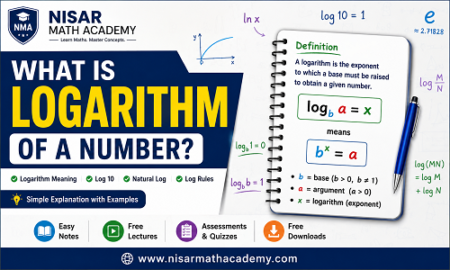
Introduction
A logarithm is one of the most important concepts in mathematics. It helps us determine the power (or exponent) to which a number must be raised to obtain another number. Logarithms are widely used in algebra, science, engineering, computer science, economics, and statistics.
Understanding the logarithm meaning, log 10, natural log, and log rules makes solving exponential equations much easier. In this article, we will explain logarithms in simple student-friendly language with definitions, examples, notes, MCQs, and a worksheet.
What is Logarithm?
A logarithm is the exponent to which a base must be raised to obtain a given number.
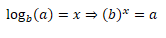
Mathematically,
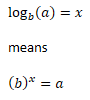
where
- b = base (b > 0 and b ≠ 1)
- a = number (a > 0)
- x = logarithm or exponent
Example

Similarly,
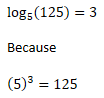
Logarithm Meaning
The logarithm meaning is simply the exponent or power.
For example,
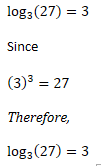
Parts of a Logarithm
In the expression

- b is called the base.
- a is called the argument.
- x is called the logarithm.
Common Logarithm (Log 10)
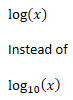
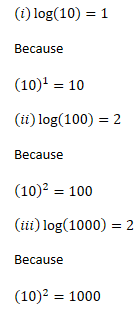
A logarithm with base 10 is called the common logarithm.
It is written as
Examples
Natural Log
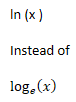
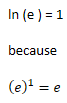
A logarithm whose base is e (Euler’s number approximately equal to 2.71828) is called the natural log.
It is written as
Examples
Natural logarithms are widely used in calculus, probability, economics, and physics.
Relationship Between Exponential and Logarithmic Form
Exponential Form
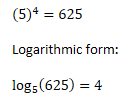
Both statements have exactly the same meaning.
Log Rules
The following log rules are very useful when simplifying logarithmic expressions.
Product Rule

Example
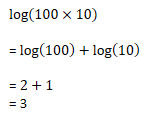
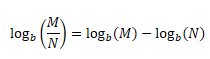
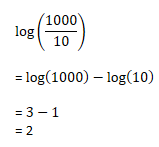
Quotient Rule
Example
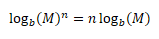
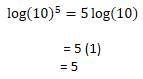
Power Rule
Example
Log of One

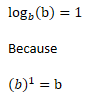
Log of the Base
Conditions for Logarithms
A logarithm exists only when:
- Base must be positive.
- Base cannot be equal to 1.
- Argument must be positive.
For example,
log(-5)
is not defined in real numbers.
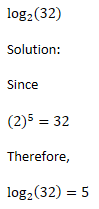
Examples
Example 1
Find
Example 2
Find
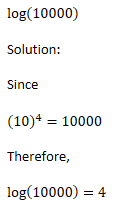
Example 3
Find
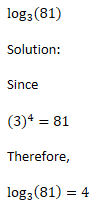
Applications of Logarithms
Logarithms are used in many real-life situations.
- Solving exponential equations
- Measuring earthquakes (Richter Scale)
- Measuring sound intensity (Decibel Scale)
- Computer algorithms
- Population growth
- Compound interest
- Chemistry (pH scale)
- Data science and statistics
Importance of Learning Logarithms
Learning logarithms helps students:
- Understand exponents more deeply.
- Solve difficult mathematical problems.
- Prepare for higher mathematics.
- Learn calculus and advanced algebra.
- Apply mathematics in science and engineering.
Conclusion
A logarithm tells us the exponent needed to obtain a number from a given base. The most common logarithms are log 10 (common logarithm) and natural log (base e). By understanding the basic definition and important log rules, students can solve many mathematical problems quickly and accurately. Logarithms are an essential topic for higher studies in mathematics and science.
Short Notes
Definition: A logarithm is the exponent to which a base is raised to obtain a given number.
Formula
Common Log: Base 10
Natural Log: Base e
Important Log Rules
- Product Rule: log(MN) = log(M) + log(N)
- Quotient Rule: log(M/N) = log(M) − log(N)
- Power Rule: log(Mⁿ) = n log(M)
- log₍b₎1 = 0
- log₍b₎b = 1
Conditions
- Base > 0
- Base ≠ 1
- Argument > 0
MCQs
1. A logarithm represents the
A. Product
B. Quotient
C. Exponent
D. Remainder
Answer: C
2. The base of the common logarithm is
A. 2
B. 5
C. 10
D. e
Answer: C
3. Natural logarithm has base
A. 2
B. 5
C. 10
D. e
Answer: D
4. log₁₀(100) equals
A. 1
B. 2
C. 3
D. 10
Answer: B
5. log₂(16) equals
A. 2
B. 3
C. 4
D. 5
Answer: C
6. log₅(125) equals
A. 2
B. 3
C. 4
D. 5
Answer: B
7. log₍b₎1 equals
A. 0
B. 1
C. b
D. −1
Answer: A
8. Which log rule is correct?
A. log(MN)=log(M)+log(N)
B. log(MN)=log(M)-log(N)
C. log(MN)=log(M)×log(N)
D. None
Answer: A
9. Which expression is undefined in real numbers?
A. log(10)
B. log(100)
C. log(-5)
D. log(1)
Answer: C
10. log₁₀(1000) equals
A. 1
B. 2
C. 3
D. 4
Answer: C
Worksheet / Assignment
Q1. Define logarithm.
Q2. Explain the logarithm meaning with an example.
Q3. Convert the following into logarithmic form.
a) 2⁵ = 32
b) 3⁴ = 81
c) 10² = 100
Q4. Convert the following into exponential form.
a) log₂32 = 5
b) log₅125 = 3
c) log1000 = 3
Q5. Evaluate.
a) log₂64
b) log₃27
c) log₄64
d) log₁₀10000
e) log₇49
Q6. Write the product rule of logarithms.
Q7. Write the quotient rule of logarithms.
Q8. Write the power rule of logarithms.
Q9. State three conditions that must be satisfied for a logarithm to exist.
Q10. Write five practical applications of logarithms.
You May Be Interested In:
Conversion of Numbers from Ordinary Notation to Scientific Notation
Scientific Notation: Application of Real Numbers in Daily Life
Application of Real Numbers in Daily Life
You May:
Read our free notes (class 9 math notes)
Watch our free recorded lectures (class 9 math)

Leave a Reply