Conversion of Numbers from Ordinary Notation to Scientific Notation
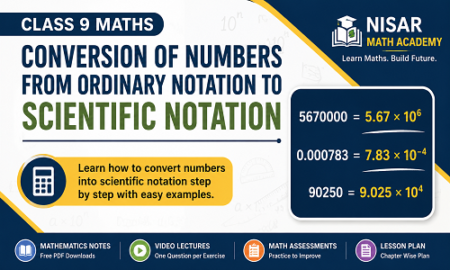
Introduction to Scientific Notation
Scientific notation is a mathematical method used to express very large or very small numbers in a simplified and standardized form. It is widely used in science, engineering, and everyday calculations where dealing with extremely large or tiny values becomes impractical in ordinary notation. At Nisar Math Academy, we make learning scientific notation simple and accessible through our class 9 maths notes, video lectures, and online Mathematics Learning resources available at nisarmathacademy.com.
What is Scientific Notation
Scientific notation is a way of writing numbers that are too large or too small to be conveniently written in decimal form. A number written in scientific notation is expressed as the product of a number between 1 and 10 and a power of 10.
General Form of Scientific Notation
The general form of scientific notation is:
N × 10ⁿ
Where:
- N is called the coefficient or mantissa. It must satisfy the condition: 1 ≤ N < 10 (N is a number greater than or equal to 1 but less than 10)
- 10 is the base
- n is an integer (positive, negative, or zero) called the exponent or power of 10
Rules for Converting Ordinary Notation to Scientific Notation
To convert a number from ordinary notation to scientific notation, follow these steps:
Rule 1: Identify the Position of the Decimal Point
Locate the decimal point in the given number. If there is no visible decimal point, it is understood to be at the end of the number.
Rule 2: Move the Decimal Point
Move the decimal point to the left or right until there is only one non-zero digit to the left of the decimal point. This gives you the coefficient N where 1 ≤ N < 10.
Rule 3: Determine the Exponent
Count the number of places you moved the decimal point. This count becomes the exponent n.
- If you moved the decimal point to the left, the exponent n is positive.
- If you moved the decimal point to the right, the exponent n is negative.
- If the decimal point was not moved, the exponent n is zero.
Rule 4: Write in Scientific Notation Form
Express the number in the form N × 10ⁿ.
Examples of Converting Large Numbers to Scientific Notation
Example 1: Convert 5400000 to scientific notation
Step 1: The number is 5400000. The decimal point is at the end: 5400000.
Step 2: Move the decimal point to the left until there is one digit before it: 5.400000
Step 3: The decimal point was moved 6 places to the left, so n = +6
Step 4: Scientific notation: 5.4 × 10⁶
Example 2: Convert 320000000 to scientific notation
Step 1: The number is 320000000.
Step 2: Move the decimal point to the left: 3.20000000
Step 3: The decimal point was moved 8 places to the left, so n = +8
Step 4: Scientific notation: 3.2 × 10⁸
Example 3: Convert 70000 to scientific notation
Step 1: The number is 70000.
Step 2: Move the decimal point to the left: 7.0000
Step 3: The decimal point was moved 4 places to the left, so n = +4
Step 4: Scientific notation: 7 × 10⁴
Example 4: Convert 9650000000 to scientific notation
Step 1: The number is 9650000000.
Step 2: Move the decimal point to the left: 9.650000000
Step 3: The decimal point was moved 9 places to the left, so n = +9
Step 4: Scientific notation: 9.65 × 10⁹
Examples of Converting Small Numbers (Decimals) to Scientific Notation
Example 5: Convert 0.0000045 to scientific notation
Step 1: The number is 0.0000045. The decimal point is already visible.
Step 2: Move the decimal point to the right until there is one non-zero digit before it: 4.5
Step 3: The decimal point was moved 6 places to the right, so n = -6
Step 4: Scientific notation: 4.5 × 10⁻⁶
Example 6: Convert 0.000000032 to scientific notation
Step 1: The number is 0.000000032.
Step 2: Move the decimal point to the right: 3.2
Step 3: The decimal point was moved 8 places to the right, so n = -8
Step 4: Scientific notation: 3.2 × 10⁻⁸
Example 7: Convert 0.00782 to scientific notation
Step 1: The number is 0.00782.
Step 2: Move the decimal point to the right: 7.82
Step 3: The decimal point was moved 3 places to the right, so n = -3
Step 4: Scientific notation: 7.82 × 10⁻³
Example 8: Convert 0.0000000001 to scientific notation
Step 1: The number is 0.0000000001.
Step 2: Move the decimal point to the right: 1
Step 3: The decimal point was moved 10 places to the right, so n = -10
Step 4: Scientific notation: 1 × 10⁻¹⁰
Examples with Numbers Between 1 and 10
Example 9: Convert 5.6 to scientific notation
Step 1: The number is 5.6.
Step 2: The decimal point does not need to be moved as there is already one digit before it.
Step 3: The decimal point was moved 0 places, so n = 0
Step 4: Scientific notation: 5.6 × 10⁰ or simply 5.6 (since 10⁰ = 1)
Example 10: Convert 8 to scientific notation
Step 1: The number is 8.
Step 2: The decimal point is at the end: 8. No movement needed.
Step 3: n = 0
Step 4: Scientific notation: 8 × 10⁰
Real-Life Applications of Scientific Notation
Scientific notation is used extensively in various fields:
Astronomy: The distance from Earth to the Sun is approximately 149600000000 meters, which is written as 1.496 × 10¹¹ meters in scientific notation.
Physics: The mass of an electron is about 0.000000000000000000000000000000911 kg, which is written as 9.11 × 10⁻³¹ kg.
Chemistry: Avogadro’s number is 602000000000000000000000, written as 6.02 × 10²³.
Biology: The diameter of a red blood cell is about 0.000007 meters, written as 7 × 10⁻⁶ meters.
Engineering: The speed of light is 300000000 m/s, written as 3 × 10⁸ m/s.
Common Mistakes to Avoid
Mistake 1: Making the coefficient greater than or equal to 10. Remember, 1 ≤ N < 10. For example, 45 × 10³ is incorrect. The correct form is 4.5 × 10⁴.
Mistake 2: Forgetting to change the sign of the exponent when converting small numbers. Moving the decimal to the right gives a negative exponent.
Mistake 3: Counting the number of places moved incorrectly. Always count carefully, including zeros.
Mistake 4: Writing the exponent as a decimal. The exponent must always be an integer.
Practice Tips for Students
At Nisar Math Academy, we recommend students practice converting at least 20 numbers daily from ordinary notation to scientific notation. Our Mathematics notes and video lectures provide step-by-step guidance. Students can download free Class 9 Maths Notes of the first exercise of each chapter from nisarmathacademy.com. For full access to all exercises, lesson plans, Math assessments, and Mathematics PDFs, students can take a membership of our website.
Short Notes on Conversion of Numbers from Ordinary Notation to Scientific Notation
Definition: Scientific notation is a method of writing very large or very small numbers as N × 10ⁿ where 1 ≤ N < 10 and n is an integer.
General Form: N × 10ⁿ
Key Points:
- N (coefficient) must be between 1 and 10 (including 1 but excluding 10)
- n (exponent) is a positive integer for large numbers
- n (exponent) is a negative integer for small decimal numbers
- n is zero when the original number is between 1 and 10
Steps to Convert:
- Place the decimal point after the first non-zero digit
- Count the number of places the decimal point was moved
- If moved left, exponent is positive
- If moved right, exponent is negative
- Write as N × 10ⁿ
Examples:
- 5600000 = 5.6 × 10⁶
- 0.000034 = 3.4 × 10⁻⁵
- 8.9 = 8.9 × 10⁰
Applications: Used in science, engineering, astronomy, physics, chemistry, and biology for handling extremely large or small measurements.
Multiple Choice Questions (MCQs)
Question 1: The scientific notation of 450000 is:
(a) 45 × 10⁴
(b) 4.5 × 10⁵
(c) 0.45 × 10⁶
(d) 450 × 10³
Answer: (b) 4.5 × 10⁵
Question 2: The scientific notation of 0.0000067 is:
(a) 67 × 10⁻⁷
(b) 6.7 × 10⁻⁶
(c) 0.67 × 10⁻⁵
(d) 6.7 × 10⁶
Answer: (b) 6.7 × 10⁻⁶
Question 3: In scientific notation N × 10ⁿ, the value of N must satisfy:
(a) 0 < N < 1 (b) 1 ≤ N < 10 (c) 10 ≤ N < 100 (d) N > 10
Answer: (b) 1 ≤ N < 10
Question 4: The scientific notation of 3200000000 is:
(a) 32 × 10⁸
(b) 3.2 × 10⁹
(c) 0.32 × 10¹⁰
(d) 3.2 × 10⁻⁹
Answer: (b) 3.2 × 10⁹
Question 5: The scientific notation of 0.00000009 is:
(a) 9 × 10⁻⁸
(b) 9 × 10⁻⁷
(c) 0.9 × 10⁻⁸
(d) 90 × 10⁻⁹
Answer: (a) 9 × 10⁻⁸
Question 6: The ordinary notation of 5.4 × 10⁴ is:
(a) 540
(b) 5400
(c) 54000
(d) 540000
Answer: (c) 54000
Question 7: The ordinary notation of 3.7 × 10⁻⁵ is:
(a) 0.000037
(b) 0.00037
(c) 0.0037
(d) 0.037
Answer: (a) 0.000037
Question 8: Which of the following is written in correct scientific notation?
(a) 12.5 × 10³
(b) 0.8 × 10⁴
(c) 7.2 × 10⁵
(d) 100 × 10²
Answer: (c) 7.2 × 10⁵
Question 9: The scientific notation of 0.000000000056 is:
(a) 5.6 × 10⁻¹¹
(b) 5.6 × 10⁻¹⁰
(c) 56 × 10⁻¹²
(d) 0.56 × 10⁻¹⁰
Answer: (a) 5.6 × 10⁻¹¹
Question 10: The ordinary notation of 8.25 × 10⁻³ is:
(a) 8250
(b) 0.825
(c) 0.0825
(d) 0.00825
Answer: (d) 0.00825
Question 11: The scientific notation of 1000000000 is:
(a) 1 × 10⁸
(b) 1 × 10⁹
(c) 10 × 10⁸
(d) 0.1 × 10¹⁰
Answer: (b) 1 × 10⁹
Question 12: The scientific notation of 0.00123 is:
(a) 1.23 × 10⁻²
(b) 1.23 × 10⁻³
(c) 12.3 × 10⁻⁴
(d) 0.123 × 10⁻²
Answer: (b) 1.23 × 10⁻³
Question 13: If a number is written as 6.02 × 10²³, the exponent indicates that the decimal point was moved:
(a) 23 places to the right
(b) 23 places to the left
(c) 6 places to the left
(d) 2 places to the right
Answer: (a) 23 places to the right
Question 14: The scientific notation of 7000000000000 is:
(a) 7 × 10¹¹
(b) 7 × 10¹²
(c) 70 × 10¹¹
(d) 0.7 × 10¹³
Answer: (b) 7 × 10¹²
Question 15: The ordinary notation of 2.5 × 10⁻⁶ is:
(a) 0.0000025
(b) 0.000025
(c) 0.00025
(d) 0.0025
Answer: (a) 0.0000025
Worksheet / Assignment for Students
Name: _____________ Date: _____________
Class: 9 Topic: Conversion of Numbers from Ordinary Notation to Scientific Notation
Part A: Convert the following numbers from ordinary notation to scientific notation.
- 56000 = _____________
- 0.00045 = _____________
- 890000000 = _____________
- 0.0000000078 = _____________
- 1230000000000 = _____________
- 0.000000000009 = _____________
- 705000 = _____________
- 0.00000065 = _____________
- 30000000000 = _____________
- 0.00000892 = _____________
- 640000000000 = _____________
- 0.000000000123 = _____________
- 25000 = _____________
- 0.0000004 = _____________
- 9870000000 = _____________
Part B: Convert the following numbers from scientific notation to ordinary notation.
- 4.5 × 10⁵ = _____________
- 7.2 × 10⁻⁴ = _____________
- 3.8 × 10⁹ = _____________
- 9.1 × 10⁻⁷ = _____________
- 2.0 × 10¹² = _____________
- 6.75 × 10⁻⁵ = _____________
- 1.4 × 10⁸ = _____________
- 8.3 × 10⁻¹⁰ = _____________
- 5.6 × 10⁶ = _____________
- 4.44 × 10⁻³ = _____________
Part C: Identify whether the following are written in correct scientific notation. If not, write the correct form.
- 25 × 10³ _____________
- 0.5 × 10⁴ _____________
- 7.8 × 10⁵ _____________
- 100 × 10² _____________
- 3.45 × 10⁻⁶ _____________
Part D: Word Problems
- The distance from Earth to the Moon is approximately 384000000 meters. Express this distance in scientific notation.
Answer: _____________
- The mass of a hydrogen atom is about 0.00000000000000000000000000167 kg. Express this mass in scientific notation.
Answer: _____________
- The speed of light is approximately 300000000 meters per second. Write this in scientific notation.
Answer: _____________
- The thickness of a sheet of paper is about 0.0001 meters. Express this in scientific notation.
Answer: _____________
- The population of a country is 1400000000. Write this number in scientific notation.
Answer: _____________
You May:
Read our free notes (class 9 math notes)
Watch our free recorded lectures (class 9 math)

Leave a Reply