Angles in Standard Position: Definition, Initial Side and Terminal Side | Complete Notes
I’ll structure this as a student-friendly, SEO-focused WordPress article, with the primary keyword used naturally and the requested notes, MCQs, assignment, and tags included.
Identifying Angles in Standard Position
SEO-Friendly Title
Angles in Standard Position: Definition, Initial Side and Terminal Side | Complete Notes
Introduction
Understanding angles in standard position is an important concept in trigonometry. Before learning about trigonometric ratios and functions, students should know how an angle is placed on the coordinate plane and how to identify its initial side and terminal side.
In this article, we will learn the angles in standard position definition, how to identify the initial and terminal sides of an angle, and how to determine the quadrant in which the terminal side lies.
These notes are prepared in a simple student notes style so that students can easily understand and revise the topic.
What Is an Angle?
An angle is formed when a ray rotates about its fixed endpoint.
An angle can be represented by the symbol θ (theta) or by other letters such as α and β.
When an angle is drawn on a coordinate plane, its position can be described according to the x-axis and y-axis.
Angles in Standard Position Definition
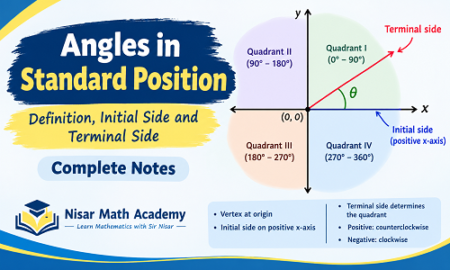
An angle is said to be in standard position when it is drawn on the coordinate plane in such a way that:
- Its vertex is at the origin .
- Its initial side lies along the positive x-axis.
Thus, an angle in standard position always starts from the positive x-axis and rotates about the origin.
Example
If an angle of is drawn in standard position, its vertex is at the origin and its initial side lies on the positive x-axis. The ray obtained after rotating counterclockwise is called its terminal side.
Initial Side of an Angle
The ray from which the rotation of an angle begins is called the initial side.
For an angle in standard position, the initial side always lies along the positive x-axis.
Therefore:
Initial side = Positive x-axis
Terminal Side of an Angle in Standard Position
The ray obtained after rotating the initial side through the given angle is called the terminal side.
Therefore, the terminal side of an angle in standard position is the ray that indicates the final position of the rotating side.
For example, when an angle of is measured counterclockwise from the positive x-axis, the ray in the second quadrant represents its terminal side.
Positive Angles
When an angle is measured counterclockwise from the positive x-axis, it is called a positive angle.
For example:
are positive angles.
Important Point
Positive angles are measured in the counterclockwise direction.
Negative Angles
When an angle is measured clockwise from the positive x-axis, it is called a negative angle.
For example:
are negative angles.
Important Point
Negative angles are measured in the clockwise direction.
Quadrants of the Coordinate Plane
The coordinate plane is divided into four quadrants:
- Quadrant I:
- Quadrant II:
- Quadrant III:
- Quadrant IV:
The position of the terminal side helps us identify the quadrant of an angle.
Identifying the Quadrant of an Angle
To identify the quadrant of a positive angle between and , compare the angle with the following ranges.
Quadrant I
If
the terminal side lies in Quadrant I.
Example:
Quadrant II
If
the terminal side lies in Quadrant II.
Example:
Quadrant III
If
the terminal side lies in Quadrant III.
Example:
Quadrant IV
If
the terminal side lies in Quadrant IV.
Example:
Angles on the Coordinate Axes
Some angles do not lie inside a quadrant. Their terminal sides lie directly on one of the coordinate axes.
For example:
- → positive x-axis
- → positive y-axis
- → negative x-axis
- → negative y-axis
- → positive x-axis
Therefore, these angles are not located inside a quadrant.
Examples of Angles in Standard Position
Example 1:
The initial side lies on the positive x-axis. Since
the terminal side lies in Quadrant I.
Example 2:
Since
the terminal side lies in Quadrant II.
Example 3:
Since
the terminal side lies in Quadrant III.
Example 4:
Since
the terminal side lies in Quadrant IV.
How to Identify an Angle in Standard Position
Follow these simple steps:
Step 1: Locate the origin .
Step 2: Draw the initial side along the positive x-axis.
Step 3: Determine whether the angle rotates clockwise or counterclockwise.
Step 4: Rotate the initial side through the given angle.
Step 5: Identify the final ray as the terminal side.
Step 6: Determine whether the terminal side lies in Quadrant I, II, III, IV, or on an axis.
Important Points to Remember
- The vertex of an angle in standard position is always at the origin.
- The initial side always lies on the positive x-axis.
- The terminal side is the final position of the rotating ray.
- Counterclockwise rotation represents a positive angle.
- Clockwise rotation represents a negative angle.
- The coordinate plane has four quadrants.
- Angles whose terminal sides lie on an axis are not considered to be inside any quadrant.
Short Notes on Angles in Standard Position
Definition
An angle is in standard position if its vertex is at the origin and its initial side lies along the positive x-axis.
Initial Side
The initial side is the ray from which the angle starts.
In standard position:
Initial side = Positive x-axis
Terminal Side
The terminal side is the ray obtained after rotating the initial side through the given angle.
Positive Angle
A positive angle is measured counterclockwise.
Negative Angle
A negative angle is measured clockwise.
Quadrants
- to → Quadrant I
- to → Quadrant II
- to → Quadrant III
- to → Quadrant IV
Axis Angles
and have their terminal sides on coordinate axes.
Quick Revision Table
| Angle Range | Terminal Side |
|---|---|
| Quadrant I | |
| Quadrant II | |
| Quadrant III | |
| Quadrant IV |
MCQs on Angles in Standard Position
1. Where is the vertex of an angle in standard position?
A. On the positive x-axis
B. At the origin
C. On the positive y-axis
D. In Quadrant I
Answer: B. At the origin
2. Where does the initial side of an angle in standard position lie?
A. Negative x-axis
B. Positive y-axis
C. Positive x-axis
D. Negative y-axis
Answer: C. Positive x-axis
3. The terminal side of an angle is:
A. Its starting ray
B. Its final ray
C. Its vertex
D. The origin
Answer: B. Its final ray
4. A positive angle is measured:
A. Clockwise
B. Counterclockwise
C. Vertically
D. Horizontally
Answer: B. Counterclockwise
5. A negative angle is measured:
A. Counterclockwise
B. Clockwise
C. Upward only
D. Downward only
Answer: B. Clockwise
6. In which quadrant does lie?
A. I
B. II
C. III
D. IV
Answer: A. I
7. In which quadrant does lie?
A. I
B. II
C. III
D. IV
Answer: B. II
8. In which quadrant does lie?
A. I
B. II
C. III
D. IV
Answer: C. III
9. In which quadrant does lie?
A. I
B. II
C. III
D. IV
Answer: D. IV
10. The terminal side of lies on the:
A. Positive x-axis
B. Negative x-axis
C. Positive y-axis
D. Negative y-axis
Answer: C. Positive y-axis
Worksheet / Assignment
Part A: Fill in the Blanks
- The vertex of an angle in standard position is at the __________.
- The initial side of an angle in standard position lies along the __________.
- A positive angle is measured in the __________ direction.
- A negative angle is measured in the __________ direction.
- The final ray of an angle is called its __________ side.
Part B: Identify the Quadrant
Identify the quadrant in which the terminal side of each angle lies.
Part C: Identify the Axis
State the axis on which the terminal side lies.
Part D: Short Questions
- Define an angle in standard position.
- What is the initial side of an angle in standard position?
- What is the terminal side of an angle?
- Differentiate between positive and negative angles.
- How can you identify the quadrant of an angle?
Part E: Practice Questions
For each angle, state whether it lies in Quadrant I, II, III, IV, or on an axis.
Conclusion
The concept of angles in standard position is fundamental for understanding trigonometry. Remember the two most important conditions: the vertex must be at the origin, and the initial side must lie along the positive x-axis.
Once the initial side is fixed, the direction and amount of rotation determine the terminal side. By examining the terminal side, we can identify the quadrant in which an angle lies.
For more mathematics notes, recorded lectures, assessments, lesson plans, and educational resources, students can explore Nisar Math Academy. The website provides selected free learning resources, while full-course access is available through membership.
Nisar Math Academy — Learn Mathematics with Sir Nisar.
You May be Interested In:
Maximum and Minimum Values in Feasible Solution of Linear Inequalities

Leave a Reply