How to Find Least Common Multiple (LCM)? Formula, Examples, and Worksheet
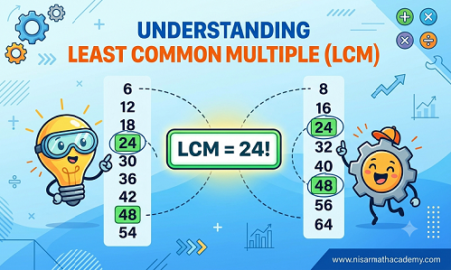
How to Find Least Common Multiple?
The least common multiple (LCM) is an important concept in mathematics. It is especially useful when working with fractions, multiples, number patterns, and problems involving repeated events.
In this article, we will learn how to find the least common multiple, understand the least common multiple formula, solve examples step by step, and practice the concept with MCQs and a worksheet.
What is a Multiple?
Before understanding LCM, we should know what a multiple is.
A multiple of a number is obtained by multiplying that number by a whole number.
For example, the multiples of 4 are:
4, 8, 12, 16, 20, 24, 28, 32, …
These numbers are obtained as:
4 × 1 = 4
4 × 2 = 8
4 × 3 = 12
4 × 4 = 16
4 × 5 = 20
Similarly, the multiples of 6 are:
6, 12, 18, 24, 30, 36, …
What is Least Common Multiple?
The least common multiple of two or more numbers is the smallest positive number that is a multiple of all the given numbers.
For example, consider 4 and 6.
Multiples of 4:
4, 8, 12, 16, 20, 24, …
Multiples of 6:
6, 12, 18, 24, 30, …
The common multiples are:
12, 24, …
The smallest common multiple is 12.
Therefore:
LCM of 4 and 6 = 12
Least Common Multiple Principle
The basic least common multiple principle is:
The LCM is the smallest positive number that is exactly divisible by each of the given numbers.
For example, the LCM of 3 and 5 is 15 because:
15 ÷ 3 = 5
15 ÷ 5 = 3
Also, there is no smaller positive number that is exactly divisible by both 3 and 5.
How to Find Least Common Multiple?
There are several methods for finding the least common multiple.
The most common methods are:
- Listing multiples
- Prime factorization
- Division method
Let us learn each method.
Method 1: Finding LCM by Listing Multiples
In this method, we write the multiples of the given numbers and identify the smallest common multiple.
Example 1: Find the LCM of 3 and 4.
Multiples of 3:
3, 6, 9, 12, 15, 18, …
Multiples of 4:
4, 8, 12, 16, 20, …
The first common multiple is 12.
Therefore:
LCM(3, 4) = 12
Example 2: Find the LCM of 5 and 8.
Multiples of 5:
5, 10, 15, 20, 25, 30, 35, 40, …
Multiples of 8:
8, 16, 24, 32, 40, …
The first common multiple is 40.
Therefore:
LCM(5, 8) = 40
This method is easy when the numbers are small. However, it can become lengthy for larger numbers.
Method 2: Finding LCM by Prime Factorization
Prime factorization is a useful method for finding the LCM of larger numbers.
In this method:
- Write each number as a product of prime factors.
- Take every prime factor that occurs.
- For each prime factor, choose its greatest power.
- Multiply these factors together.
Example 3: Find the LCM of 12 and 18.
Prime factorization of 12:
12 = 2 × 2 × 3
12 = 2² × 3
Prime factorization of 18:
18 = 2 × 3 × 3
18 = 2 × 3²
Now take the greatest power of each prime factor:
2² and 3²
Therefore:
LCM = 2² × 3²
LCM = 4 × 9
LCM = 36
Therefore:
LCM(12, 18) = 36
Method 3: Finding LCM by Division Method
The division method can also be used to find the LCM.
Example 4: Find the LCM of 8 and 12.
We divide the numbers by common prime factors:
2 | 8, 12
2 | 4, 6
2 | 2, 3
3 | 1, 3
| 1, 1
Now multiply all the divisors:
LCM = 2 × 2 × 2 × 3
LCM = 8 × 3
LCM = 24
Therefore:
LCM(8, 12) = 24
Least Common Multiple Formula
There is a useful relationship between LCM and HCF.
For two positive integers:
LCM × HCF = Product of the two numbers
Therefore:
LCM = (First Number × Second Number) ÷ HCF
This is commonly called the least common multiple formula when the HCF is known.
Example 5: Find the LCM of 12 and 18 if their HCF is 6.
Using the formula:
LCM = (12 × 18) ÷ 6
LCM = 216 ÷ 6
LCM = 36
Therefore:
LCM(12, 18) = 36
Another Least Common Multiple Example
Find the LCM of 15 and 20.
Prime factorization:
15 = 3 × 5
20 = 2² × 5
Take the greatest power of each prime factor:
2², 3 and 5
Therefore:
LCM = 2² × 3 × 5
LCM = 4 × 3 × 5
LCM = 60
So:
LCM(15, 20) = 60
How to Find LCM of Three Numbers?
The same principle can be used for three or more numbers.
Example 6: Find the LCM of 6, 8, and 12.
Prime factorization:
6 = 2 × 3
8 = 2³
12 = 2² × 3
Take the greatest power of each prime factor:
2³ and 3
Therefore:
LCM = 2³ × 3
LCM = 8 × 3
LCM = 24
Hence:
LCM(6, 8, 12) = 24
Difference Between LCM and HCF
Students sometimes confuse LCM and HCF.
LCM means Least Common Multiple. It is the smallest positive number that is a multiple of all the given numbers.
HCF means Highest Common Factor. It is the greatest number that divides all the given numbers exactly.
For example, for 8 and 12:
LCM = 24
HCF = 4
So, LCM looks at common multiples, while HCF looks at common factors.
Important Properties of LCM
Remember these important points:
- The LCM is always positive.
- The LCM of two numbers is never smaller than either number.
- If one number divides another number exactly, the larger number is their LCM.
- The LCM of two distinct prime numbers is their product.
- The LCM of 1 and any positive integer is that integer.
- The LCM is useful when finding a common denominator of fractions.
- LCM is also useful in problems involving repeated events or cycles.
Example
Find the LCM of 7 and 21.
Since 7 divides 21 exactly:
21 ÷ 7 = 3
Therefore:
LCM(7, 21) = 21
Applications of LCM in Daily Life
LCM is not only a classroom concept. It can help solve practical problems.
For example, suppose one school bell rings every 6 minutes and another bell rings every 8 minutes. If both bells ring together at the beginning, after how many minutes will they ring together again?
We need to find:
LCM(6, 8)
LCM(6, 8) = 24
Therefore, both bells will ring together again after 24 minutes.
This type of problem is commonly solved using LCM.
Common Mistakes Students Should Avoid
Mistake 1: Choosing the Greatest Common Multiple
There is no greatest multiple because multiples continue indefinitely.
LCM means the least common multiple, so we choose the smallest positive common multiple.
Mistake 2: Confusing Factors and Multiples
For example, the factors of 12 include:
1, 2, 3, 4, 6, 12
But the multiples of 12 include:
12, 24, 36, 48, 60, …
Do not confuse factors with multiples.
Mistake 3: Taking Only Common Prime Factors
When using prime factorization, we must take the greatest power of every prime factor appearing in the numbers, not only the factors common to all numbers.
For example:
12 = 2² × 3
18 = 2 × 3²
LCM = 2² × 3² = 36
Short Notes on Least Common Multiple
Definition:
The least common multiple is the smallest positive number that is a multiple of all the given numbers.
Abbreviation:
LCM = Least Common Multiple
Example:
Multiples of 4: 4, 8, 12, 16, …
Multiples of 6: 6, 12, 18, 24, …
Therefore:
LCM(4, 6) = 12
Prime Factorization Method:
- Find the prime factors of each number.
- Select the greatest power of every prime factor.
- Multiply them.
Formula using HCF:
LCM = (First Number × Second Number) ÷ HCF
Important Principle:
LCM is the smallest positive number that is exactly divisible by each given number.
Quick Revision
- Multiple means the product obtained by multiplying a number by a whole number.
- LCM stands for Least Common Multiple.
- LCM is the smallest positive common multiple.
- LCM can be found by listing multiples.
- LCM can be found using prime factorization.
- LCM can also be found using the division method.
- For two positive integers, LCM × HCF = Product of the two numbers.
- LCM is useful in fractions and real-life problems involving repeated events.
MCQs on Least Common Multiple
MCQ 1
What does LCM stand for?
A. Least Common Multiple
B. Largest Common Multiple
C. Least Common Number
D. Lowest Common Factor
Answer: A. Least Common Multiple
MCQ 2
What is the LCM of 4 and 6?
A. 8
B. 10
C. 12
D. 24
Answer: C. 12
MCQ 3
What is the LCM of 5 and 8?
A. 20
B. 30
C. 35
D. 40
Answer: D. 40
MCQ 4
Which of the following is a multiple of 7?
A. 12
B. 14
C. 16
D. 18
Answer: B. 14
MCQ 5
What is the LCM of 8 and 12?
A. 16
B. 20
C. 24
D. 32
Answer: C. 24
MCQ 6
What is the LCM of 7 and 21?
A. 7
B. 14
C. 21
D. 28
Answer: C. 21
MCQ 7
What is the prime factorization of 12?
A. 2 × 6
B. 2² × 3
C. 3 × 4
D. 2 × 3²
Answer: B. 2² × 3
MCQ 8
What is the LCM of 3 and 5?
A. 8
B. 10
C. 15
D. 20
Answer: C. 15
MCQ 9
Which method can be used to find the LCM?
A. Listing multiples
B. Prime factorization
C. Division method
D. All of these
Answer: D. All of these
MCQ 10
If HCF of two numbers is 4 and their product is 80, what is their LCM?
A. 10
B. 16
C. 20
D. 24
Answer: C. 20
Least Common Multiple Worksheet
Part A: Find the LCM by Listing Multiples
- Find the LCM of 2 and 6.
- Find the LCM of 3 and 8.
- Find the LCM of 4 and 10.
- Find the LCM of 5 and 6.
- Find the LCM of 6 and 9.
Part B: Find the LCM by Prime Factorization
- Find the LCM of 12 and 16.
- Find the LCM of 15 and 25.
- Find the LCM of 18 and 24.
- Find the LCM of 20 and 30.
- Find the LCM of 14 and 21.
Part C: Find the LCM of Three Numbers
- Find the LCM of 4, 6, and 8.
- Find the LCM of 6, 9, and 12.
- Find the LCM of 5, 10, and 15.
- Find the LCM of 8, 12, and 16.
- Find the LCM of 9, 12, and 18.
Part D: Word Problems
- A bell rings every 6 minutes and another bell rings every 8 minutes. If they ring together now, after how many minutes will they ring together again?
- One light flashes every 10 seconds and another flashes every 15 seconds. After how many seconds will they flash together again?
- A bus arrives at a station every 12 minutes, while another bus arrives every 18 minutes. If both buses arrive together now, after how many minutes will they arrive together again?
- Two machines complete a cycle every 8 minutes and 12 minutes respectively. After how many minutes will both complete a cycle at the same time?
- Find the LCM of two numbers whose product is 180 and whose HCF is 6.
Worksheet Answer Key
- 6
- 24
- 20
- 30
- 18
- 48
- 75
- 72
- 60
- 42
- 24
- 36
- 30
- 48
- 36
- 24 minutes
- 30 seconds
- 36 minutes
- 24 minutes
- 30
Conclusion
The least common multiple is the smallest positive number that is a multiple of all the given numbers. It can be found using several methods, including listing multiples, prime factorization, and the division method.
For small numbers, listing multiples can be convenient. For larger numbers, prime factorization or the division method is usually more efficient.
Students should practice different types of questions to become confident with LCM, especially questions involving fractions, HCF, prime factorization, and real-life situations.
For more mathematics learning material, students can explore Nisar Math Academy, where they can find recorded lectures, notes, assessments, lesson plans, and other useful mathematics resources. Students can also access selected free learning material, while the complete course is available through membership.
You May be Interested In:
How to Find Highest Common Factor (HCF)? Complete Method, Examples, Notes & Worksheet
Factorizing Quadratic Expressions: Step-by-Step Method with Examples | Class 9 Maths
What Are Common Factors? Definition, Examples, Methods and Practice Questions

Leave a Reply