Factorizing Quadratic Expressions: Step-by-Step Method with Examples | Class 9 Maths
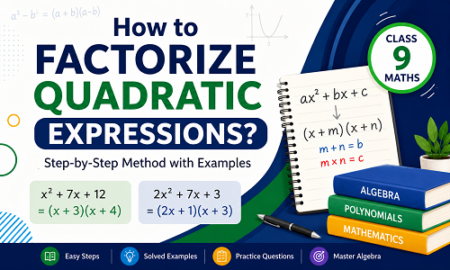
Introduction
Factorizing quadratic expressions is one of the most important topics in algebra. It helps students solve equations, simplify expressions, and understand polynomial concepts. In Class 9 Mathematics, learning the correct method of factorizing quadratic expressions makes many chapters easier.
In this article, you will learn how to factor quadratic expressions using simple steps, solved examples, practice questions, MCQs, and a worksheet.
What is a Quadratic Expression?
A quadratic expression is an algebraic expression whose highest power of the variable is 2.
General form:
ax² + bx + c
Where:
- a ≠ 0
- a, b, and c are constants.
- x is the variable.
Examples
- x² + 7x + 12
- 2x² + 9x + 10
- x² − 5x + 6
- 3x² − 12x + 9
What Does Factorizing Mean?
Factorizing means writing an expression as the product of two or more simpler expressions.
Example:
x² + 5x + 6 = (x + 2)(x + 3)
Both brackets multiply to produce the original quadratic expression.
Why is Factorizing Quadratic Expressions Important?
Students use factorization to:
- Solve quadratic equations.
- Simplify algebraic expressions.
- Understand polynomial operations.
- Prepare for higher mathematics.
- Solve practical mathematical problems.
How to Factorize Quadratic Expressions
There are different methods depending on the expression.
Method 1: Factorizing x² + bx + c
Follow these steps:
Step 1: Write the expression.
Example:
x² + 7x + 12
Step 2: Find two numbers whose:
- Product = 12
- Sum = 7
These numbers are:
3 and 4
Step 3: Write the factors.
x² + 7x + 12 = (x + 3)(x + 4)
Example 1
Factorize:
x² + 9x + 20
Product = 20
Sum = 9
Numbers:
4 and 5
Answer:
(x + 4)(x + 5)
Example 2
Factorize:
x² − 8x + 15
Product = 15
Sum = −8
Numbers:
−3 and −5
Answer:
(x − 3)(x − 5)
Method 2: Factorizing When the Coefficient of x² is Greater Than 1
Example:
2x² + 7x + 3
Step 1:
Multiply:
2 × 3 = 6
Step 2:
Find numbers whose:
Product = 6
Sum = 7
Numbers:
6 and 1
Step 3:
Split the middle term.
2x² + 6x + x + 3
Step 4:
Group terms.
2x(x + 3) + 1(x + 3)
Step 5:
Take common factor.
(x + 3)(2x + 1)
Final Answer:
(2x + 1)(x + 3)
Example 3
Factorize:
3x² + 8x + 4
Product:
3 × 4 = 12
Numbers:
6 and 2
Rewrite:
3x² + 6x + 2x + 4
Group:
3x(x + 2) + 2(x + 2)
Answer:
(3x + 2)(x + 2)
Method 3: Taking Common Factor First
Example:
3x² + 6x
Take common factor:
3x(x + 2)
Method 4: Difference of Squares
Formula:
a² − b² = (a + b)(a − b)
Example:
x² − 25
Answer:
(x + 5)(x − 5)
Common Mistakes Students Make
- Choosing numbers whose product is correct but sum is incorrect.
- Forgetting negative signs.
- Ignoring the common factor.
- Incorrect multiplication while checking the answer.
- Leaving the expression partially factorized.
Tips for Learning Factorization
- Memorize multiplication tables.
- Practice integer pairs regularly.
- Always verify your answer by multiplying the factors.
- Learn common algebraic identities.
- Solve a variety of practice questions every day.
Solved Examples
Example 1
Factorize:
x² + 10x + 21
Solution:
Numbers:
3 and 7
Answer:
(x + 3)(x + 7)
Example 2
Factorize:
x² − 9x + 20
Solution:
Numbers:
−4 and −5
Answer:
(x − 4)(x − 5)
Example 3
Factorize:
4x² + 12x + 9
Answer:
(2x + 3)²
Example 4
Factorize:
x² − 36
Answer:
(x + 6)(x − 6)
Practice Questions
Factorize the following.
- x² + 11x + 24
- x² + 13x + 42
- x² − 12x + 35
- x² − 15x + 56
- 2x² + 5x + 2
- 3x² + 7x + 2
- 5x² + 20x
- x² − 49
- 4x² − 25
- 6x² + 11x + 3
Real-Life Applications
Factorizing quadratic expressions is useful in:
- Engineering calculations.
- Computer programming.
- Construction measurements.
- Physics formulas.
- Financial mathematics.
- Architecture and design.
Conclusion
Learning factorizing quadratic expressions is an essential algebra skill. Once students understand how to find suitable number pairs, split the middle term, and use algebraic identities, factorization becomes simple. Regular practice is the best way to master how to factor quadratic expressions and perform well in examinations.
Students who want complete recorded lectures, detailed notes, assessments, lesson plans, and chapter-wise Mathematics learning resources can visit Nisar Math Academy. The website also provides free Class 9 first-exercise notes, selected assessments, and free lectures on one question from every exercise, while the complete course is available through membership.
Short Notes
Factorizing Quadratic Expressions
- Quadratic expression has degree 2.
- General form: ax² + bx + c
- Factorization means writing an expression as a product of factors.
- For x² + bx + c, find two numbers whose product is c and sum is b.
- For ax² + bx + c, multiply a and c first, then split the middle term.
- Always check your answer by multiplying the factors.
- Remember the identity:
a² − b² = (a + b)(a − b)
MCQs
1. A quadratic expression has highest power
A) 1
B) 2
C) 3
D) 4
Answer: B
2. Factorize x² + 5x + 6
A) (x + 1)(x + 6)
B) (x + 2)(x + 3)
C) (x + 5)(x + 1)
D) (x + 4)(x + 2)
Answer: B
3. Factorize x² − 9
A) (x − 9)
B) (x + 9)
C) (x + 3)(x − 3)
D) (x − 3)²
Answer: C
4. Factorize 3x² + 6x
A) 3(x² + 2)
B) 3x(x + 2)
C) x(3x + 6)
D) 6x(x + 1)
Answer: B
5. Factorize x² − 7x + 12
A) (x − 2)(x − 6)
B) (x − 3)(x − 4)
C) (x + 3)(x + 4)
D) (x − 1)(x − 12)
Answer: B
6. Factorize 2x² + 7x + 3
A) (2x + 3)(x + 1)
B) (2x + 1)(x + 3)
C) (2x + 7)(x + 3)
D) (x + 3)²
Answer: B
7. Which identity is used for x² − 25?
A) Perfect square
B) Difference of squares
C) Cube identity
D) Common factor only
Answer: B
8. Product of factors always equals
A) Variable
B) Constant
C) Original expression
D) Coefficient
Answer: C
9. Factorize x² + 8x + 15
A) (x + 3)(x + 5)
B) (x + 1)(x + 15)
C) (x + 8)(x + 15)
D) (x + 2)(x + 7)
Answer: A
10. The first step in factorizing 6x² + 12x is
A) Difference of squares
B) Take common factor
C) Split middle term
D) Expand brackets
Answer: B
Worksheet / Assignment
Part A: Factorize
- x² + 6x + 8
- x² + 9x + 20
- x² − 11x + 24
- x² − 13x + 42
- x² − 16
- 2x² + 9x + 10
- 2x² + 5x + 3
- 3x² + 10x + 8
- 4x² + 8x
- 5x² − 45
Part B: State the Method Used
- x² − 49
- 6x² + 18x
- x² + 12x + 35
- 3x² + 8x + 4
- 9x² − 25
Part C: Challenge Questions
- Factorize completely:
2x² − 8x - Factorize:
4x² − 36 - Factorize:
6x² + 17x + 12 - Factorize:
x² − 14x + 49 - Verify your answers by multiplication.
You May
Read our free notes (class 9 math notes)
Watch our free recorded lectures (class 9 math)

Leave a Reply