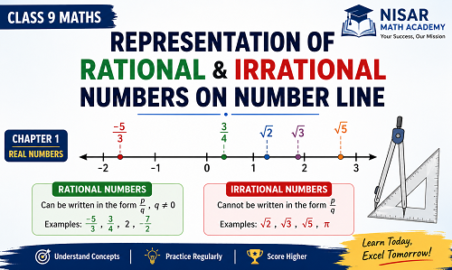
Representation of Rational and Irrational Numbers on Number Line | Class 9 Maths Notes Chapter 1
Introduction
The concept of representing numbers on a number line is one of the most important topics in Chapter 1 (Real Numbers) of Class 9 Mathematics. Students learn how to locate both rational and irrational numbers accurately on a number line.
Understanding this topic helps students visualize numbers and strengthens their foundation for higher mathematics. These class 9 maths notes explain the representation of rational and irrational numbers in a simple and student-friendly manner.
What is a Number Line?
A number line is a straight line on which numbers are represented at equal intervals.
Important Features
- Zero (0) is located at the center.
- Positive numbers are placed on the right side.
- Negative numbers are placed on the left side.
- Every point on the number line represents a unique real number.
Example:
← -3  -2  -1   0   1   2   3 →

Representation of Rational Numbers on Number Line
What are Rational Numbers?

A rational number is any number that can be expressed in the form:

p/q where p and q are integers and q ≠ 0.

Examples:
1/2 , 3/4 , -5/2 , 2
Method to Represent Rational Numbers
Example 1: Represent 3/4 on Number Line
Step 1
Mark 0 and 1 on the number line.
Step 2
Divide the distance between 0 and 1 into 4 equal parts.
Step 3
Move 3 parts to the right of 0.
The obtained point represents:
3/4
Example 2: Represent -5/3 on Number Line
Step 1
Mark integers on the number line.
Step 2
Since:

locate the interval between -1 and -2.
Step 3
Divide the interval into 3 equal parts.
Step 4
Move 2 parts left from -1.
The point obtained represents:

Representation of Irrational Numbers on Number Line
What are Irrational Numbers?
Numbers that cannot be expressed in the form:
p/q are called irrational numbers.
Their decimal expansions are non-terminating and non-repeating.
Examples:

Representing √2 on Number Line
The representation of √2 is based on the Pythagoras Theorem.
Construction Steps
- Draw a number line.
- Mark O(0) and A(1).
- At point A, draw a perpendicular AB of length 1 unit.
- Join O and B.
- Using a compass, take radius OB.
- Cut the number line at point P.
The point P represents:

Representation of √3 on Number Line
Steps
- Construct √2 first.
- At the endpoint of √2, draw a perpendicular of length 1 unit.
- Join the new endpoint with the origin.
- Transfer this distance to the number line using a compass.
The resulting point represents:

Representation of √5 on Number Line
Construct √4 first and then draw a perpendicular of length 1 unit.
Key Differences Between Rational and Irrational Numbers
| Rational Numbers | Irrational Numbers |
|---|---|
| Can be written as p/q | Cannot be written as p/q |
| Decimal expansion terminates or repeats | Decimal expansion neither terminates nor repeats |
| Easy to represent by division | Represented using geometrical constructions |
| Examples: 1/2, 3/4, 5 | Examples: √2, √3, π |
Exam Tips
- Always divide intervals accurately while locating rational numbers.
- Use a ruler and compass carefully for irrational numbers.
- Learn the construction of √2, √3, and √5 thoroughly.
- Remember the Pythagoras Theorem used in constructions.
- Practice diagrams regularly.
Short Notes for Students
Representation of Rational Numbers
- Rational numbers are of the form p/q.
- Divide the interval according to the denominator.
- Count parts according to the numerator.
Representation of Irrational Numbers
- Irrational numbers cannot be written as p/q.
- Use geometrical constructions.
- Apply Pythagoras Theorem.
- Common examples: √2, √3, √5.
Important Facts
- Every rational number has a fixed position on the number line.
- Every irrational number also corresponds to a unique point.
- Together they form the set of real numbers.
Multiple Choice Questions (MCQs)
1. Which of the following is a rational number?
A) √2
B) π
C) 3/5
D) √7
Answer: C
2. Which number is irrational?
A) 2
B) 5/8
C) 0.75
D) √3
Answer: D
3. The decimal expansion of an irrational number is:
A) Terminating
B) Repeating
C) Non-terminating and non-repeating
D) Integer
Answer: C
4. Which theorem is used to construct √2 on the number line?
A) Euclid’s Theorem
B) Pythagoras Theorem
C) Fundamental Theorem
D) Binomial Theorem
Answer: B
5. Which of the following is not irrational?
A) √5
B) √7
C) 9/4
D) π
Answer: C
6. √2 lies between:
A) 0 and 1
B) 1 and 2
C) 2 and 3
D) 3 and 4
Answer: B
7. Which set contains both rational and irrational numbers?
A) Natural Numbers
B) Integers
C) Real Numbers
D) Whole Numbers
Answer: C
8. The point representing √5 lies between:
A) 1 and 2
B) 2 and 3
C) 3 and 4
D) 4 and 5
Answer: B
9. Every point on the number line represents:
A) A rational number only
B) An irrational number only
C) A real number
D) An integer only
Answer: C
10. Which of the following is irrational?
A) 0.25
B) 4/9
C) √11
D) 7
Answer: C
Worksheet / Assignment
Part A: Short Questions
- Define a rational number.
- Define an irrational number.
- Give three examples of irrational numbers.
- Write the steps to represent 3/4 on a number line.
- Why is √2 irrational?
Part B: Practical Constructions
Construct the following on a number line:
- 1/2
- 5/4
- -7/3
- √2
- √3
- √5
Part C: Long Questions
- Explain the representation of rational numbers on a number line with examples.
- Describe the construction of √2 on a number line.
- Explain how √3 is represented geometrically.
- Differentiate between rational and irrational numbers.
Conclusion
The representation of rational and irrational numbers on a number line helps students understand the concept of real numbers visually. Rational numbers are represented through equal divisions, while irrational numbers are located using geometric constructions based on the Pythagoras Theorem. Mastering these concepts is essential for success in Class 9 Mathematics and higher-level mathematics.
You may be interested in:
An Introduction to Real Numbers – Complete Notes for Class 9
Decimal Representation of Rational Numbers – Complete Notes
Decimal Representation of Irrational Numbers – Complete Notes

Leave a Reply