An Introduction to Real Numbers – Complete Notes, Examples, and Practice Questions for Class 9
Introduction
Numbers are an essential part of mathematics and everyday life. We use numbers for counting, measuring, comparing, and solving problems. The set of numbers used in mathematics has expanded over time, resulting in different types of numbers. Among these, Real Numbers form one of the most important number systems.
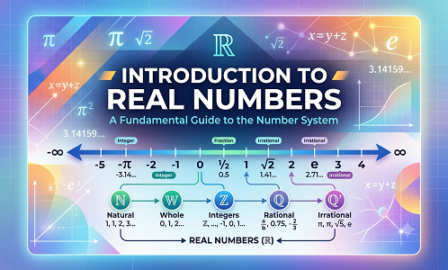
A real number is any number that can be represented on a number line. Real numbers include natural numbers, whole numbers, integers, rational numbers, and irrational numbers.
What are Real Numbers?
Real Numbers are all the numbers that can be found on the number line.
The set of real numbers is represented by R.
Examples:
- -5
- -2
- 0
- 3
- 7
- 1/2
- -3/4
- 0.75
- √2
- π
All of these numbers belong to the set of real numbers.
Classification of Real Numbers
Real numbers are divided into two main categories:
1. Rational Numbers (Q)
A rational number can be written in the form:
a/b
where:
- a and b are integers
- b ≠ 0
Examples:
- 1/2
- 3/4
- -5/8
- 7
- 0.25
- -3
Characteristics:
- Terminating decimals
- Repeating decimals
Examples:
- 0.5 = 1/2
- 0.333… = 1/3
- 0.727272… = 8/11
2. Irrational Numbers
Numbers that cannot be expressed as a fraction of two integers are called irrational numbers.
Examples:
- √2
- √3
- √5
- π
Characteristics:
- Non-terminating decimals
- Non-repeating decimals
Examples:
√2 = 1.41421356…
π = 3.14159265…
Relationship Between Rational and Irrational Numbers
Real Numbers
│
├── Rational Numbers
│
└── Irrational Numbers
Therefore:
Real Numbers = Rational Numbers + Irrational Numbers
Subsets of Rational Numbers
Natural Numbers (N)
Counting numbers:
1, 2, 3, 4, 5, …
Whole Numbers (W)
Natural numbers together with zero:
0, 1, 2, 3, 4, …
Integers (Z)
Positive numbers, negative numbers, and zero:
…, -3, -2, -1, 0, 1, 2, 3, …
Number Line Representation
Every real number has a unique position on the number line.
Examples:
- Positive numbers lie to the right of zero.
- Negative numbers lie to the left of zero.
- Fractions and decimals lie between integers.
Example:
-2 —— -1 —— 0 —— 1 —— 2 —— 3
Properties of Real Numbers
1. Closure Property
If a and b are real numbers, then:
- a + b is a real number
- a − b is a real number
- a × b is a real number
Example:
3 + 5 = 8
2. Commutative Property
a + b = b + a
a × b = b × a
Example:
4 + 7 = 7 + 4
3. Associative Property
(a + b) + c = a + (b + c)
(a × b) × c = a × (b × c)
Example:
(2 + 3) + 4 = 2 + (3 + 4)
4. Distributive Property
a(b + c) = ab + ac
Example:
3(2 + 5)
= 3×2 + 3×5
= 6 + 15
= 21
Decimal Representation of Real Numbers
Rational Numbers
- Terminating decimals
- Repeating decimals
Examples:
- 0.5
- 0.75
- 0.333…
Irrational Numbers
- Non-terminating
- Non-repeating
Examples:
- √2
- π
Importance of Real Numbers
Real numbers are widely used in:
- Mathematics
- Engineering
- Physics
- Statistics
- Economics
- Computer Science
They help us measure distance, time, temperature, weight, and many other quantities.
Summary
- Real numbers include all numbers on the number line.
- They are divided into rational and irrational numbers.
- Rational numbers can be written as fractions.
- Irrational numbers cannot be written as fractions.
- Natural numbers, whole numbers, and integers are subsets of rational numbers.
- Real numbers are used extensively in mathematics and daily life.
Understanding real numbers is the foundation for advanced mathematical concepts and problem-solving.
Short Notes for Class 9
Real Numbers – Quick Notes
- Real numbers are all numbers that can be represented on a number line.
- Symbol: R
- Real numbers are divided into:
- Rational Numbers (Q)
- Irrational Numbers
- Rational numbers can be expressed as a/b, where b ≠ 0.
- Examples of rational numbers:
- 1/2, 5, -3, 0.75
- Irrational numbers cannot be expressed as fractions.
- Examples:
- √2, √3, π
- Natural Numbers: 1, 2, 3, …
- Whole Numbers: 0, 1, 2, 3, …
- Integers: …, -2, -1, 0, 1, 2, …
- Every real number has a unique position on the number line.
MCQs
Choose the correct answer.
1. Which of the following is a real number?
A) √2
B) 5
C) -3/4
D) All of these
Answer: D
2. Which number is irrational?
A) 0.25
B) 3/5
C) √7
D) -2
Answer: C
3. Which set contains counting numbers?
A) Integers
B) Whole Numbers
C) Natural Numbers
D) Rational Numbers
Answer: C
4. Which of the following is a whole number?
A) -1
B) 1/2
C) 0
D) √2
Answer: C
5. π is an example of:
A) Rational Number
B) Integer
C) Whole Number
D) Irrational Number
Answer: D
6. The decimal 0.333… is:
A) Irrational
B) Rational
C) Whole Number
D) Natural Number
Answer: B
7. Which of the following is an integer?
A) -5
B) 2/3
C) √3
D) π
Answer: A
8. Real numbers consist of:
A) Rational Numbers only
B) Irrational Numbers only
C) Rational and Irrational Numbers
D) Integers only
Answer: C
9. Which of the following is not irrational?
A) √2
B) √3
C) 3/4
D) π
Answer: C
10. The symbol for the set of real numbers is:
A) Z
B) N
C) Q
D) R
Answer: D
Worksheet / Assignment
Part A: Fill in the Blanks
- The set of real numbers is represented by ______.
- A rational number can be written in the form ______.
- π is an example of an ______ number.
- Whole numbers include ______ and natural numbers.
- Every real number can be represented on a ______.
Part B: State Whether True or False
- √2 is a rational number. ______
- Every integer is a real number. ______
- Irrational numbers can be expressed as fractions. ______
- 0 is a whole number. ______
- Real numbers include rational and irrational numbers. ______
Part C: Classify the Following Numbers
Identify whether each number is Rational or Irrational:
- 5
- √11
- 0.75
- π
- -8
- √3
- 7/9
- 0.444…
Part D: Short Questions
- Define a real number.
- Define a rational number with examples.
- Define an irrational number with examples.
- Differentiate between rational and irrational numbers.
- Draw a number line and locate -2, 0, 1, and 3.
Part E: Long Question
Explain the classification of real numbers with a suitable diagram and examples.
You May be Interested In:
⦁ Combination of Rational and Irrational Numbers
⦁ Class 9 Mathematics Exercise 1.2 Complete Solution
⦁ Short Notes: Development of Number System
⦁ Class 9 Mathematics Unit 1 Important Questions

Leave a Reply