Decimal Representation of Irrational Numbers – Complete Notes, Examples, MCQs, and Worksheet
Introduction
In mathematics, numbers can be classified into different categories such as natural numbers, integers, rational numbers, and irrational numbers. One important way to identify a number is by observing its decimal representation.
The decimal representation of irrational numbers is unique because it neither terminates nor repeats. Understanding this concept helps students distinguish irrational numbers from rational numbers and strengthens their knowledge of the real number system.
What are Irrational Numbers?
An irrational number is a number that cannot be expressed in the form:
p/q where (p) and (q) are integers and q is not 0.
The decimal expansion of an irrational number continues forever without forming any repeating pattern.
Examples of Irrational Numbers
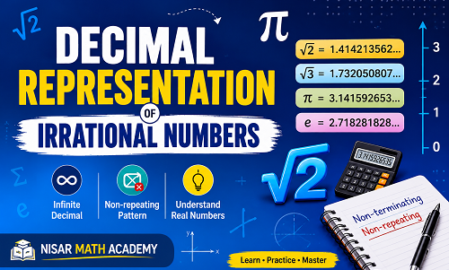
- √2 = 1.414213562…
- √3 = 1.732050807…
- √5 = 2.236067977…
- π = 3.141592653…
- e = 2.718281828…
All these numbers have decimal representations that continue indefinitely and do not repeat.
Decimal Representation of Irrational Numbers
The decimal representation of an irrational number has the following characteristics:
1. Non-Terminating
The decimal digits continue infinitely.
Example:

There is no final digit.
2. Non-Repeating
No fixed sequence of digits repeats throughout the decimal expansion.
Example:

Unlike rational numbers, there is no recurring block of digits.
Comparison with Rational Numbers
| Rational Numbers | Irrational Numbers |
|---|---|
| Can be written as p/q | Cannot be written as p/q |
| Decimal expansion terminates or repeats | Decimal expansion neither terminates nor repeats |
| Examples: 0.5, 0.333…, 2.75 | Examples: √2, √3, π |
| Predictable repeating pattern possible | No repeating pattern |
Examples of Decimal Representation
Example 1
- Non-terminating ✔
- Non-repeating ✔
Therefore, √2 is irrational.
Example 2
- Infinite decimal digits ✔
- No repeating pattern ✔
Therefore, π is irrational.
Example 3

- Non-terminating ✔
- Non-repeating ✔
Therefore, √7 is irrational.
How to Identify an Irrational Number from its Decimal Form
A decimal number is irrational if:
- The digits continue forever.
- No repeating block of digits exists.
- It cannot be converted into a fraction of integers.
Examples
| Decimal Number | Type |
| 0.25 | Rational |
| 0.333… | Rational |
| 2.121212… | Rational |
| 1.414213562… | Irrational |
| 3.141592653… | Irrational |
Important Theorem
If the decimal expansion of a real number is:
- Terminating, then it is rational.
- Non-terminating recurring, then it is rational.
- Non-terminating non-recurring, then it is irrational.
This theorem is extremely useful in identifying the nature of numbers.
Real-Life Importance of Irrational Numbers
Irrational numbers appear in many practical situations:
Geometry
The value of π is used to calculate:
- Circumference of circles
- Area of circles
- Volume of spheres
Engineering
Square roots are frequently used in:
- Construction
- Surveying
- Architecture
Science
Many scientific formulas involve irrational numbers such as π and e.
Summary
The decimal representation of irrational numbers is always non-terminating and non-repeating. Unlike rational numbers, irrational numbers cannot be expressed as fractions of integers. Numbers such as √2, √3, π, and e are common examples. Understanding their decimal representation helps students classify numbers correctly and build a strong foundation in real numbers.
Short Notes for Students
Decimal Representation of Irrational Numbers
- Irrational numbers cannot be written as p/q.
- Their decimal expansion is non-terminating.
- Their decimal expansion is non-repeating.
- Examples:
- √2 = 1.414213562…
- √3 = 1.732050807…
- π = 3.141592653…
- Every irrational number is a real number.
- Non-terminating and non-recurring decimals are irrational.
Key Formula
A decimal number is irrational if it is:
Non-Terminating + Non-Repeating
MCQs
1. Which of the following is an irrational number?
A) 0.75
B) 2/3
C) √2
D) 5
Answer: C
2. The decimal representation of an irrational number is:
A) Terminating
B) Repeating
C) Non-terminating and repeating
D) Non-terminating and non-repeating
Answer: D
3. Which of the following is irrational?
A) 0.333…
B) 2.5
C) π
D) 7
Answer: C
4. Which statement is true?
A) Every irrational number terminates.
B) Every irrational number repeats.
C) Irrational numbers are non-terminating and non-repeating.
D) Irrational numbers can be written as p/q.
Answer: C
5. The number √3 is:
A) Rational
B) Irrational
C) Integer
D) Whole Number
Answer: B
6. Which decimal represents an irrational number?
A) 1.252525…
B) 0.875
C) 3.141592653…
D) 4.666…
Answer: C
7. π is approximately equal to:
A) 2.71
B) 1.41
C) 3.14
D) 4.14
Answer: C
8. A non-terminating recurring decimal is:
A) Irrational
B) Rational
C) Integer
D) Natural Number
Answer: B
9. Which of the following cannot be expressed as p/q?
A) 0.4
B) 0.125
C) √5
D) 2
Answer: C
10. The decimal expansion of √2 is:
A) Terminating
B) Repeating
C) Non-terminating and non-repeating
D) Integer
Answer: C
Worksheet / Assignment
Part A: Identify Rational or Irrational
State whether each number is Rational (R) or Irrational (I).
- √2
- 0.75
- π
- 0.444…
- √7
- 5
- 1.414213562…
- 2/9
- e
- 0.125
Part B: Multiple Choice
- Which number is irrational?
a) 3/4
b) 0.2
c) √11
d) 8 - A decimal that neither terminates nor repeats is:
a) Rational
b) Irrational
c) Integer
d) Whole Number - Which of the following is rational?
a) π
b) √3
c) 0.666…
d) e
Part C: Short Questions
- Define an irrational number.
- Write any three examples of irrational numbers.
- What are the characteristics of the decimal representation of irrational numbers?
- Differentiate between rational and irrational numbers.
- Explain why π is an irrational number.
Part D: Challenge Question
Explain why the decimal number
1.414213562373095…
is considered irrational.
You may be interested in:
Combination of Rational and Irrational Numbers

Leave a Reply