Decimal Representation of Rational Numbers – Complete Notes, Examples, MCQs, and Worksheet
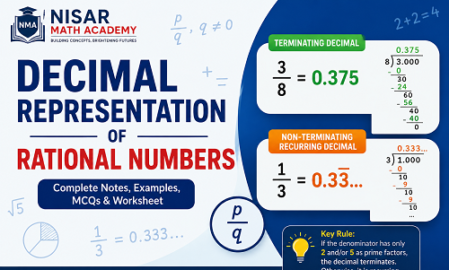
Introduction
A rational number is a number that can be expressed in the form:
p/q where p and q are integers and q ≠ 0.
Every rational number can be written in decimal form. The decimal representation of rational numbers is an important concept in mathematics because it helps us understand how fractions are expressed as decimals.
What is Decimal Representation?
The decimal representation of a rational number is obtained by dividing the numerator by the denominator.
Examples

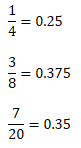
These decimals end after a finite number of digits and are called terminating decimals.
Types of Decimal Representation of Rational Numbers
The decimal expansion of a rational number is always one of the following:
1. Terminating Decimal
A decimal that ends after a finite number of digits.
Examples
Characteristics
- Has a fixed number of decimal places.
- Ends after a certain digit.
- Easy to convert back into fractions.
2. Non-Terminating Recurring Decimal
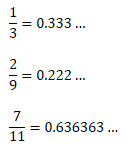
A decimal that continues forever but repeats a pattern of digits.
Examples
Characteristics
- Never ends.
- Has repeating digits or blocks of digits.
- Represented using a bar notation.
How to Determine the Type of Decimal Expansion
Consider a rational number:
p/q where p and q have no common factor other than 1.
Rule
The decimal expansion will terminate if the denominator contains only the prime factors 2 and/or 5.
Examples
Terminating Decimals

(Terminating)
[
\frac{7}{20}
]
[
20 = 2^2 \times 5
]
Only factors 2 and 5 are present.
Therefore, the decimal expansion terminates.
Non-Terminating Recurring Decimals
[
\frac{1}{3}
]
Denominator:
[
3
]
Contains a factor other than 2 or 5.
Therefore:
[
\frac{1}{3}=0.333…
]
(Recurring)
[
\frac{2}{7}
]
Denominator:
[
7
]
Contains a factor other than 2 or 5.
Therefore:
[
\frac{2}{7}=0.285714285714…
]
(Recurring)
Converting Fractions into Decimal Form
Example 1
Convert:
[
\frac{5}{8}
]
Solution:
[
5 \div 8 = 0.625
]
Answer:
[
\frac{5}{8}=0.625
]
Example 2
Convert:
[
\frac{2}{3}
]
Solution:
[
2 \div 3 = 0.666666…
]
Answer:
[
\frac{2}{3}=0.\overline{6}
]
Example 3
Convert:
[
\frac{7}{12}
]
Solution:
[
7 \div 12 = 0.583333…
]
Answer:
[
\frac{7}{12}=0.58\overline{3}
]
Important Facts
- Every rational number has a decimal representation.
- A rational number can have either:
- A terminating decimal, or
- A non-terminating recurring decimal.
- Irrational numbers have non-terminating and non-recurring decimal expansions.
- If the denominator contains only factors 2 and/or 5, the decimal terminates.
- If the denominator contains any other prime factor, the decimal is recurring.
Solved Examples
Example 1
Determine whether:
[
\frac{9}{40}
]
is terminating or recurring.
Solution:
[
40=2^3 \times 5
]
Only factors 2 and 5 are present.
Therefore:
Terminating Decimal
Example 2
Determine whether:
[
\frac{13}{15}
]
is terminating or recurring.
Solution:
[
15=3 \times 5
]
Factor 3 is present.
Therefore:
Non-Terminating Recurring Decimal
Example 3
Determine whether:
[
\frac{11}{125}
]
is terminating or recurring.
Solution:
[
125=5^3
]
Only factor 5 is present.
Therefore:
Terminating Decimal
Conclusion
The decimal representation of rational numbers is obtained by dividing the numerator by the denominator. Every rational number has either a terminating decimal expansion or a non-terminating recurring decimal expansion. The prime factors of the denominator determine the nature of the decimal expansion. Understanding this concept forms the foundation for advanced topics in algebra and number systems.
Short Notes for Students
Rational Number
A number of the form:
[
\frac{p}{q}, \quad q\neq0
]
Decimal Representation
Obtained by dividing numerator by denominator.
Types
Terminating Decimal
- Ends after finite digits.
- Examples:
- 0.25
- 0.375
- 1.4
Non-Terminating Recurring Decimal
- Continues forever.
- Repeats a pattern.
- Examples:
- 0.333…
- 0.636363…
Key Rule
If denominator contains only:
[
2^m \times 5^n
]
then decimal expansion terminates.
Otherwise, it is recurring.
Examples
| Fraction | Decimal | Type |
|---|---|---|
| 1/2 | 0.5 | Terminating |
| 3/8 | 0.375 | Terminating |
| 1/3 | 0.333… | Recurring |
| 2/7 | 0.285714… | Recurring |
MCQs
1. Which of the following is a terminating decimal?
A) 0.333…
B) 0.272727…
C) 0.625
D) 0.142857…
Answer: C
2. The decimal representation of 1/3 is:
A) 0.3
B) 0.33
C) 0.333…
D) 3.33
Answer: C
3. The denominator of a terminating rational number contains only:
A) 2 and 5
B) 3 and 5
C) 2 and 3
D) 7 and 5
Answer: A
4. Which fraction gives a terminating decimal?
A) 1/7
B) 3/11
C) 5/16
D) 2/9
Answer: C
5. The decimal expansion of 2/7 is:
A) Terminating
B) Recurring
C) Irrational
D) Whole Number
Answer: B
6. Which number is rational?
A) π
B) √2
C) 0.4444…
D) √5
Answer: C
7. The decimal form of 3/4 is:
A) 0.75
B) 0.57
C) 0.34
D) 0.43
Answer: A
8. A non-terminating recurring decimal is:
A) Irrational
B) Rational
C) Natural
D) Whole
Answer: B
Worksheet / Assignment
Part A: Convert into Decimal Form
- 1/2
- 3/5
- 7/8
- 9/20
- 11/25
Part B: Determine Whether Terminating or Recurring
- 3/10
- 5/12
- 7/25
- 13/15
- 9/40
Part C: Fill in the Blanks
- Every rational number can be written in ______ form.
- A terminating decimal has a ______ number of digits.
- 1/3 is a ______ decimal.
- Denominators containing only 2 and 5 produce ______ decimals.
- 0.272727… is a ______ decimal.
Part D: True or False
- Every rational number has a decimal representation.
- Irrational numbers have terminating decimals.
- 0.5 is a terminating decimal.
- 2/7 is a recurring decimal.
- 125 = 5³.
Part E: Higher Order Thinking Questions
- Explain why 1/8 has a terminating decimal expansion.
- Explain why 2/11 has a recurring decimal expansion.
- Write two examples each of terminating and recurring decimals.
- State the condition under which a rational number has a terminating decimal expansion.
- Differentiate between terminating and recurring decimals with examples.
You May be Interested In:

Leave a Reply