Properties of Real Numbers – Class 9 Maths Notes Chapter 1 (Complete Guide with MCQs, Worksheet & PDF Notes)
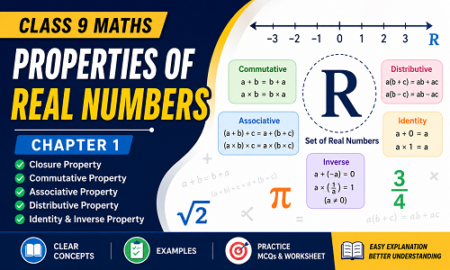
Introduction
Real numbers are one of the most important topics in mathematics. They include all rational and irrational numbers. Understanding the properties of real numbers helps students solve mathematical problems easily and forms the foundation for algebra and higher mathematics.
These notes are designed according to the Class 9 Mathematics syllabus and are helpful for students looking for class 9 maths notes, class 9 maths notes chapter 1, and class 9 maths notes pdf.
What are Real Numbers?
The collection of all rational and irrational numbers is called the set of real numbers.
Examples of Real Numbers
- 2
- -5
- 0
- 1/2
- 3.75
- √2
- π
Symbol
The set of real numbers is represented by:
R
Properties of Real Numbers
1. Closure Property
A set is said to satisfy the closure property if the result of an operation on any two numbers of the set is also a member of the same set.
Addition
If a and b are real numbers, then:
a + b ∈ R
Example:
5 + 7 = 12
Subtraction
a − b ∈ R
Example:
8 − 3 = 5
Multiplication
a × b ∈ R
Example:
4 × 6 = 24
Division
a ÷ b ∈ R, where b ≠ 0
Example:
12 ÷ 3 = 4
2. Commutative Property
Changing the order of numbers does not change the result.
Addition
a + b = b + a
Example:
5 + 3 = 3 + 5 = 8
Multiplication
a × b = b × a
Example:
4 × 2 = 2 × 4 = 8
Note:
Subtraction and division are not commutative.
Example:
7 − 3 ≠ 3 − 7
3. Associative Property
Changing the grouping of numbers does not change the result.
Addition
(a + b) + c = a + (b + c)
Example:
(2 + 3) + 4 = 2 + (3 + 4)
Multiplication
(a × b) × c = a × (b × c)
Example:
(2 × 3) × 4 = 2 × (3 × 4)
Note:
Subtraction and division are not associative.
4. Distributive Property
Multiplication distributes over addition and subtraction.
Formula
a(b + c) = ab + ac
Example
3(4 + 2)
= 3 × 4 + 3 × 2
= 12 + 6
= 18
Similarly,
a(b − c) = ab − ac
5. Identity Property
Additive Identity
Zero is called the additive identity.
a + 0 = a
Example:
9 + 0 = 9
Multiplicative Identity
One is called the multiplicative identity.
a × 1 = a
Example:
8 × 1 = 8
6. Inverse Property
Additive Inverse
For every real number a:
a + (−a) = 0
Example:
5 + (−5) = 0
Multiplicative Inverse
For every non-zero real number a:
a × (1/a) = 1
Example:
4 × (1/4) = 1
Important Facts
- Real numbers include rational and irrational numbers.
- Addition and multiplication are both commutative and associative.
- Subtraction and division are neither commutative nor associative.
- Zero is the additive identity.
- One is the multiplicative identity.
- Every real number has an additive inverse.
- Every non-zero real number has a multiplicative inverse.
Summary
The properties of real numbers make mathematical calculations easier and more systematic. Students should memorize closure, commutative, associative, distributive, identity, and inverse properties because they are frequently used in algebra and higher mathematics.
These notes are highly useful for students searching for class 9 maths notes, class 9 maths notes chapter 1, and class 9 maths notes pdf.
Short Notes for Students
Properties of Real Numbers (Quick Revision)
- Closure Property
- a + b ∈ R
- a − b ∈ R
- a × b ∈ R
- a ÷ b ∈ R (b ≠ 0)
- Commutative Property
- a + b = b + a
- a × b = b × a
- Associative Property
- (a + b) + c = a + (b + c)
- (a × b) × c = a × (b × c)
- Distributive Property
- a(b + c) = ab + ac
- Identity Property
- Additive Identity = 0
- Multiplicative Identity = 1
- Inverse Property
- Additive Inverse of a = −a
- Multiplicative Inverse of a = 1/a
MCQs
Multiple Choice Questions
1. Which of the following is an additive identity?
A) 1
B) 0
C) -1
D) 10
Answer: B
2. Which property is represented by a + b = b + a?
A) Closure
B) Associative
C) Commutative
D) Distributive
Answer: C
3. Which property is represented by (a+b)+c=a+(b+c)?
A) Associative
B) Closure
C) Identity
D) Inverse
Answer: A
4. Multiplicative identity is:
A) 0
B) 2
C) -1
D) 1
Answer: D
5. Which operation is not commutative?
A) Addition
B) Multiplication
C) Subtraction
D) Both A and B
Answer: C
6. The additive inverse of 7 is:
A) 1/7
B) -7
C) 0
D) 7
Answer: B
7. The multiplicative inverse of 5 is:
A) -5
B) 0
C) 1/5
D) 5
Answer: C
8. Which property is shown by a(b+c)=ab+ac?
A) Closure
B) Distributive
C) Associative
D) Identity
Answer: B
Worksheet / Assignment
Part A: Fill in the Blanks
- Zero is the __________ identity.
- One is the __________ identity.
- The additive inverse of 12 is __________.
- The multiplicative inverse of 8 is __________.
- Addition of real numbers satisfies the __________ property.
Answers
- Additive
- Multiplicative
- -12
- 1/8
- Closure
Part B: True / False
- Multiplication is commutative. ______
- Division is associative. ______
- Every real number has an additive inverse. ______
- Zero has a multiplicative inverse. ______
- Addition satisfies closure property. ______
Answers
- True
- False
- True
- False
- True
Part C: Short Questions
- Define real numbers.
- State closure property.
- What is additive identity?
- What is multiplicative identity?
- Explain distributive property with an example.
You may be interested in:
Decimal Representation of Rational Numbers
Decimal Representation of Irrational Numbers
Representation of Rational and Irrational Numbers on Number Line

Leave a Reply