What Are Trigonometric Identities? Definition, Formulas, Examples, Short Notes, MCQs & Worksheet
Introduction
Trigonometric identities are important mathematical relationships involving trigonometric functions such as sine, cosine, and tangent. These identities are true for all values of the angle for which both sides are defined.
Students use trigonometric identities to simplify expressions, prove mathematical statements, solve trigonometric equations, and establish relationships between different trigonometric ratios.
In this article, we will learn what trigonometric identities are, the basic identities, important formulas, examples, short notes, MCQs, and a practice worksheet.
What Are Trigonometric Identities?
A trigonometric identity is an equation involving trigonometric functions that remains true for every permissible value of the angle.
For example:
sin²θ + cos²θ = 1
This is a fundamental trigonometric identity because it is true for every angle θ for which the expressions are defined.
Another example is:
tan θ = sin θ / cos θ
This identity shows the relationship between tangent, sine, and cosine.
Trigonometric Identities and Formula
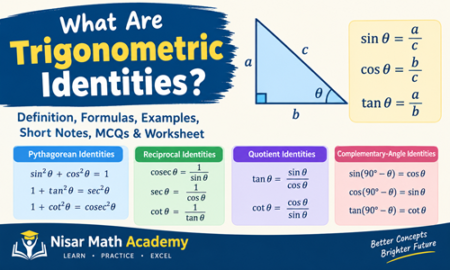
The most commonly used trigonometric identities and formulas can be divided into several groups:
- Reciprocal identities
- Quotient identities
- Pythagorean identities
- Complementary-angle identities
- Even and odd identities
Learning these identities helps students simplify complicated trigonometric expressions and solve problems more efficiently.
Basic Trigonometric Identities
1. Reciprocal Identities
The reciprocal identities are:
cosec θ = 1 / sin θ
sec θ = 1 / cos θ
cot θ = 1 / tan θ
Similarly:
sin θ = 1 / cosec θ
cos θ = 1 / sec θ
tan θ = 1 / cot θ
These identities are obtained from the reciprocal relationships between the six trigonometric ratios.
2. Quotient Identities
The quotient identities connect tangent and cotangent with sine and cosine.
tan θ = sin θ / cos θ
cot θ = cos θ / sin θ
These are among the most frequently used trigonometric identities when simplifying expressions.
3. Pythagorean Trigonometric Identities
The three important Pythagorean identities are:
sin²θ + cos²θ = 1
1 + tan²θ = sec²θ
1 + cot²θ = cosec²θ
These identities are called Pythagorean identities because they are related to the Pythagorean theorem.
From the first identity, we can also write:
sin²θ = 1 − cos²θ
cos²θ = 1 − sin²θ
From the second identity:
tan²θ = sec²θ − 1
From the third identity:
cot²θ = cosec²θ − 1
Trigonometric Angle Identities
Trigonometric angle identities describe relationships between trigonometric functions at different angles.
For complementary angles:
sin(90° − θ) = cos θ
cos(90° − θ) = sin θ
tan(90° − θ) = cot θ
cot(90° − θ) = tan θ
sec(90° − θ) = cosec θ
cosec(90° − θ) = sec θ
These identities are particularly useful when working with complementary angles.
All Trigonometric Identities: Important List
Here is a useful list of trigonometric identities for students.
Reciprocal Identities
sin θ = 1/cosec θ
cos θ = 1/sec θ
tan θ = 1/cot θ
cosec θ = 1/sin θ
sec θ = 1/cos θ
cot θ = 1/tan θ
Quotient Identities
tan θ = sin θ/cos θ
cot θ = cos θ/sin θ
Pythagorean Identities
sin²θ + cos²θ = 1
1 + tan²θ = sec²θ
1 + cot²θ = cosec²θ
Complementary-Angle Identities
sin(90° − θ) = cos θ
cos(90° − θ) = sin θ
tan(90° − θ) = cot θ
cot(90° − θ) = tan θ
sec(90° − θ) = cosec θ
cosec(90° − θ) = sec θ
Examples of Trigonometric Identities
Example 1: Simplify sin²θ + cos²θ
Using the Pythagorean identity:
sin²θ + cos²θ = 1
Therefore:
Answer = 1
Example 2: Simplify 1 + tan²θ
Using the identity:
1 + tan²θ = sec²θ
Therefore:
Answer = sec²θ
Example 3: Express tan θ in terms of sin θ and cos θ
Using the quotient identity:
tan θ = sin θ / cos θ
Therefore:
Answer = sin θ/cos θ
Example 4: Simplify 1 − sin²θ
We know:
sin²θ + cos²θ = 1
Therefore:
1 − sin²θ = cos²θ
Answer = cos²θ
Example 5: Simplify sec²θ − tan²θ
From:
1 + tan²θ = sec²θ
Rearranging:
sec²θ − tan²θ = 1
Therefore:
Answer = 1
How to Prove a Trigonometric Identity
To prove a trigonometric identity, we generally start with one side of the equation and transform it until it becomes equal to the other side.
Important Rules
- Start with the more complicated side.
- Use fundamental trigonometric identities.
- Convert sec, cosec, tan, and cot into sine and cosine when necessary.
- Factor or simplify algebraic expressions carefully.
- Do not assume that the identity is true without showing the mathematical steps.
Example
Prove:
(1 − cos²θ) / sin θ = sin θ
Starting with the left-hand side:
(1 − cos²θ) / sin θ
Using:
1 − cos²θ = sin²θ
we get:
sin²θ / sin θ
Therefore:
= sin θ
Hence:
L.H.S. = R.H.S.
Therefore, the identity is proved.
Why Are Trigonometric Identities Important?
Trigonometric identities are important because they help students:
- Simplify trigonometric expressions
- Prove mathematical identities
- Solve trigonometric equations
- Find unknown trigonometric ratios
- Establish relationships between angles
- Solve geometry and mathematics problems
- Understand advanced trigonometry
A strong understanding of fundamental identities makes many difficult-looking trigonometric problems much easier.
Common Mistakes Students Should Avoid
Students often make mistakes while using trigonometric identities. Some common mistakes are:
- Confusing sec θ with 1/sin θ
- Confusing cosec θ with 1/cos θ
- Forgetting the square in sin²θ and cos²θ
- Using an identity without checking its correct form
- Cancelling terms incorrectly
- Changing both sides of an equation unnecessarily while proving an identity
Students should memorize the fundamental identities and practice applying them in different forms.
Short Notes on Trigonometric Identities
Definition:
A trigonometric identity is an equation involving trigonometric functions that is true for all permissible values of the angle.
Reciprocal identities:
cosec θ = 1/sin θ
sec θ = 1/cos θ
cot θ = 1/tan θ
Quotient identities:
tan θ = sin θ/cos θ
cot θ = cos θ/sin θ
Pythagorean identities:
sin²θ + cos²θ = 1
1 + tan²θ = sec²θ
1 + cot²θ = cosec²θ
Complementary-angle identities:
sin(90° − θ) = cos θ
cos(90° − θ) = sin θ
tan(90° − θ) = cot θ
Main uses: Simplification, proving identities, solving equations, and solving trigonometric problems.
Multiple Choice Questions (MCQs)
1. Which of the following is a trigonometric identity?
A. sin²θ + cos²θ = 1
B. sin θ = 5
C. θ = 30°
D. x + 2 = 5
Answer: A
2. What is the reciprocal of sin θ?
A. sec θ
B. cosec θ
C. cot θ
D. tan θ
Answer: B
3. Which identity is correct?
A. tan θ = cos θ/sin θ
B. tan θ = sin θ/cos θ
C. tan θ = 1/sin θ
D. tan θ = 1/cos θ
Answer: B
4. Which identity is correct?
A. sin²θ + cos²θ = 1
B. sin²θ − cos²θ = 1
C. sin θ + cos θ = 1
D. sin θ − cos θ = 1
Answer: A
5. What is the value of 1 + tan²θ?
A. cosec²θ
B. cot²θ
C. sec²θ
D. sin²θ
Answer: C
6. What is the value of 1 + cot²θ?
A. sec²θ
B. cosec²θ
C. tan²θ
D. cos²θ
Answer: B
7. Which of the following is a quotient identity?
A. tan θ = sin θ/cos θ
B. sin²θ + cos²θ = 1
C. sec θ = 1/cos θ
D. cosec θ = 1/sin θ
Answer: A
8. What is sin(90° − θ)?
A. sin θ
B. cos θ
C. tan θ
D. sec θ
Answer: B
9. What is cos(90° − θ)?
A. sin θ
B. cos θ
C. cot θ
D. cosec θ
Answer: A
10. What is sec²θ − tan²θ?
A. 0
B. 1
C. 2
D. sec θ
Answer: B
Worksheet / Assignment
Part A: Fill in the Blanks
- sin²θ + cos²θ = ______.
- tan θ = ______ / cos θ.
- cot θ = cos θ / ______.
- sec θ = 1 / ______.
- cosec θ = 1 / ______.
- 1 + tan²θ = ______.
- 1 + cot²θ = ______.
- sin(90° − θ) = ______.
- cos(90° − θ) = ______.
- sec²θ − tan²θ = ______.
Part B: Simplify
- sin²θ + cos²θ
- 1 + tan²θ
- 1 + cot²θ
- sec²θ − tan²θ
- 1 − sin²θ
- 1 − cos²θ
- sec θ × cos θ
- cosec θ × sin θ
- tan θ × cot θ
- sin θ / cos θ
Part C: Prove the Identities
- Prove that:
(1 − cos²θ)/sin θ = sin θ
- Prove that:
(sec²θ − 1) = tan²θ
- Prove that:
(cosec²θ − 1) = cot²θ
- Prove that:
tan θ × cot θ = 1
- Prove that:
sin θ × sec θ = tan θ
Part D: Conceptual Questions
- What is a trigonometric identity?
- Write the three Pythagorean trigonometric identities.
- Write the reciprocal identities.
- Write the quotient identities.
- What is the difference between a trigonometric equation and a trigonometric identity?
- Why are trigonometric identities useful?
- Write any three complementary-angle identities.
- Explain how trigonometric identities are used to simplify expressions.
Conclusion
Trigonometric identities are fundamental relationships between trigonometric functions. The most important identities include reciprocal, quotient, Pythagorean, and complementary-angle identities.
The three Pythagorean identities,
sin²θ + cos²θ = 1
1 + tan²θ = sec²θ
1 + cot²θ = cosec²θ
are especially important for simplifying expressions and proving identities.
Students should not only memorize the list of trigonometric identities but also practice applying them to different mathematical problems.
At Nisar Math Academy, students can find mathematics lectures, notes, assessments, lesson plans, and other useful learning resources. Some Class 9 Maths resources and selected lectures are available free, while complete course material is available through membership.
Visit www.nisarmathacademy.com for more mathematics learning resources.
You May be Interested In:
What Are Trigonometric Ratios? Definition, Formulas, Table, Examples & Notes
What is Circular Measure (Radian)?
How to Convert Degrees to Minutes and Seconds? Complete Guide
Leave a Reply