Combination of Rational and Irrational Numbers
Introduction
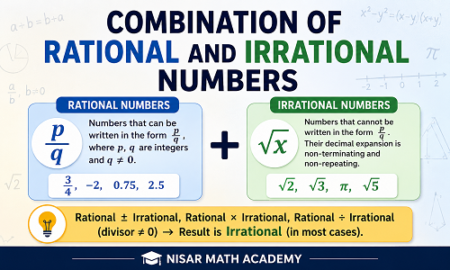
In mathematics, numbers are classified into different categories based on their properties. Two important categories are rational numbers and irrational numbers. Understanding how these numbers combine through addition, subtraction, multiplication, and division is essential for students of Class 9 and higher classes.
This lesson explains the combination of rational and irrational numbers with definitions, rules, examples, and practice questions.
Rational Numbers
A rational number is any number that can be written in the form of , where p and q are integers and .
Examples
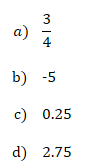
Note: All terminating decimals are rational numbers.
Irrational Numbers
An irrational number cannot be written in the form of , where p and q are integers and .
Its decimal expansion is non-terminating.
Examples
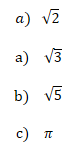
Combination of Rational and Irrational Numbers
When rational and irrational numbers are combined through mathematical operations, the result may be rational or irrational depending on the operation.
1. Addition
Rule
A rational number added to an irrational number gives an irrational number.
Examples

Result: Irrational

Result: Irrational
Explanation
Since the irrational part cannot be expressed as a fraction, the entire sum remains irrational.
2. Subtraction
Rule
A rational number subtracted from an irrational number, or vice versa, gives an irrational number.
Examples

Result: Irrational

Result: Irrational
3. Multiplication
Rule
A non-zero rational number multiplied by an irrational number usually gives an irrational number.
Examples

Result: Irrational

Result: Irrational
Exception

Result: Rational
4. Division
Rule
A rational number divided by an irrational number is generally irrational.
Examples

Result: Irrational

Result: Irrational
Summary Table
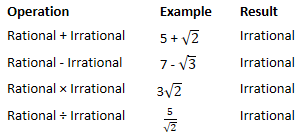
Important Facts
- Rational + Irrational = Irrational
- Rational − Irrational = Irrational
- Non-zero Rational × Irrational = Irrational
- Rational ÷ Irrational = Irrational
- The irrational part usually makes the final answer irrational.
Solved Examples
Example 1
Determine whether the following is rational or irrational.

Solution:
4 is rational and

is irrational.
Therefore,

is irrational.
Example 2
Determine whether

is rational or irrational.
Solution:
6 is rational and

is irrational.
Their product is irrational.
Example 3
Determine whether

is rational or irrational.
Solution:

is irrational.
Dividing by a rational number does not make it rational.
Therefore,

is irrational.
Conclusion
The combination of rational and irrational numbers is an important concept in algebra. In most cases, whenever a rational number is added to, subtracted from, multiplied by, or divided by an irrational number, the result remains irrational. Understanding these rules helps students solve algebraic expressions and number system problems confidently.
Short Notes for Class 9
Combination of Rational and Irrational Numbers
- Rational Number: Can be written as , where .
- Irrational Number: Cannot be written as .
Examples
- Rational: 2,43,0.5
- Irrational:
Rules
- Rational + Irrational = Irrational
- Rational − Irrational = Irrational
- Non-zero Rational × Irrational = Irrational
- Rational ÷ Irrational = Irrational
Examples
- 5+2 → Irrational
- 7−3 → Irrational
- → Irrational
- → Irrational
Key Point: The irrational part usually makes the answer irrational.
MCQs
Multiple Choice Questions
1. Which of the following is irrational?
A)
B) 0.75
C)
D) -5
Answer: C

A) Rational
B) Irrational
C) Integer
D) Whole Number
Answer: B
3. Which statement is true?
A) Rational + Irrational = Rational
B) Rational + Irrational = Irrational
C) Rational + Rational = Irrational
D) Irrational + Irrational = Always Rational
Answer: B

A) Rational
B) Integer
C) Irrational
D) Whole Number
Answer: C
5. Which of the following is a rational number?
A)
B)
C)
D)
Answer: D

A) Rational
B) Irrational
C) Integer
D) Natural Number
Answer: B
7. Which number is irrational?
A) 0.125
B)
C)
D) 4
Answer: C
8. 0×20 is:
A) Irrational
B) Rational
C) Undefined
D) None
Answer: B
Worksheet / Assignment
Part A: Identify Rational or Irrational
Part B: State Whether the Result is Rational or Irrational
-
Part C: Short Questions
- Define a rational number with an example.
- Define an irrational number with an example.
- Why is 4 irrational?
- Is rational or irrational? Give reason.
- Explain the effect of adding a rational number to an irrational number.
Part D: Challenge Questions
- Determine whether is rational or irrational.
- Explain why is irrational.
- Give three examples of combinations of rational and irrational numbers.
- Can a non-zero rational number multiplied by an irrational number become rational? Explain.
- Write five irrational numbers and five rational numbers.
You May be Interested In:
⦁ Class 9 Mathematics Week 1 Lesson Plan
⦁ Class 9 Math Notes PDF Exercise 1.1
⦁ Class 9 Math Unit 1 Assessment 3
⦁ Class 9 Math Unit 1 Important Questions

Leave a Reply