Conversion of Ordinary Notation to Scientific Notation
Introduction
In Mathematics, very large and very small numbers are difficult to read, write, and calculate in their ordinary form. To make these numbers easier to handle, we use scientific notation. Before writing a number in scientific notation, it is usually written in ordinary notation. Learning the conversion of numbers from ordinary notation to scientific notation is an important topic in Class 9 Maths Notes.
At Nisar Math Academy, we explain this topic with simple rules, solved examples, free notes, recorded lectures, and assessments. Visit nisarmathacademy.com for more mathematics learning resources.
What is Ordinary Notation?
Ordinary notation is the standard way of writing numbers using digits without exponents.
Examples
- 6500
- 0.00045
- 987654
- 0.0082
These numbers are written in their usual form and are called numbers in ordinary notation.
What is Scientific Notation?
Scientific notation is a method of writing very large or very small numbers in the form
a × 10ⁿ
where
- 1 ≤ a < 10
- n is an integer (positive, negative, or zero)
The decimal part (a) must contain only one non-zero digit before the decimal point.
Rules for Conversion from Ordinary Notation to Scientific Notation
Rule 1
Move the decimal point so that only one non-zero digit remains to its left.
Rule 2
Count the number of places the decimal point has moved.
Rule 3
If the decimal moves to the left, the exponent of 10 is positive.
Rule 4
If the decimal moves to the right, the exponent of 10 is negative.
Conversion of Large Numbers
Example 1
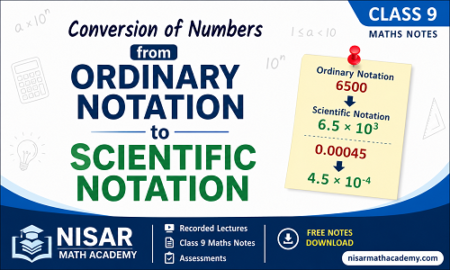
Convert 6500 into scientific notation.
Step 1: Move the decimal after the first digit.
6500 = 6.5
Step 2: Decimal moved 3 places to the left.
Answer:
6500 = 6.5 × 10³
Example 2
Convert 987654 into scientific notation.
987654 = 9.87654 × 10⁵
Conversion of Small Numbers
Example 1
Convert 0.00045 into scientific notation.
Move the decimal to obtain 4.5.
The decimal moves 4 places to the right.
Answer:
0.00045 = 4.5 × 10⁻⁴
Example 2
Convert 0.0082 into scientific notation.
Move the decimal two places to the right.
Answer:
0.0082 = 8.2 × 10⁻³
Solved Examples
Example 1
Convert 72000 into scientific notation.
Solution
72000 = 7.2 × 10⁴
Example 2
Convert 3050000 into scientific notation.
Solution
3050000 = 3.05 × 10⁶
Example 3
Convert 0.0000078 into scientific notation.
Solution
0.0000078 = 7.8 × 10⁻⁶
Example 4
Convert 0.056 into scientific notation.
Solution
0.056 = 5.6 × 10⁻²
Example 5
Convert 91 into scientific notation.
Solution
91 = 9.1 × 10¹
Common Mistakes
- Leaving more than one digit before the decimal point.
- Using the wrong sign of the exponent.
- Counting decimal places incorrectly.
- Forgetting that the first number must be between 1 and 10.
Tips for Students
- Always place the decimal after the first non-zero digit.
- Count the decimal shifts carefully.
- Left movement gives a positive exponent.
- Right movement gives a negative exponent.
- Practice both ordinary notation and conversion to ordinary notation regularly for better understanding.
Importance of Scientific Notation
Scientific notation is widely used in Mathematics, Physics, Chemistry, Engineering, Astronomy, and Computer Science. It makes calculations easier and reduces writing errors when dealing with extremely large or very small numbers.
Students preparing from Class 9 Maths Notes should master this topic because it is frequently tested in examinations.
Conclusion
The conversion of numbers from ordinary notation to scientific notation is a simple process once you understand the movement of the decimal point and the exponent of 10. Regular practice helps students solve questions quickly and accurately. For more solved examples, notes, assessments, recorded lectures, and study material, visit Nisar Math Academy at nisarmathacademy.com.
Short Notes
Topic: Conversion of Numbers from Ordinary Notation to Scientific Notation
- Ordinary notation is the normal way of writing numbers.
- Scientific notation has the form a × 10ⁿ.
- The value of a must satisfy 1 ≤ a < 10.
- Move the decimal after the first non-zero digit.
- Decimal moved left → positive exponent.
- Decimal moved right → negative exponent.
- Count decimal places carefully.
- Scientific notation is useful for writing very large and very small numbers.
MCQs
1. Scientific notation is written in the form
A) a + 10ⁿ
B) a × 10ⁿ
C) a − 10ⁿ
D) a ÷ 10ⁿ
Answer: B
2. Which of the following is written in ordinary notation?
A) 5.2 × 10³
B) 7.1 × 10⁻⁴
C) 4500
D) 9.8 × 10²
Answer: C
3. 6500 in scientific notation is
A) 65 × 10²
B) 6.5 × 10³
C) 0.65 × 10⁴
D) 650 × 10¹
Answer: B
4. 0.00045 in scientific notation is
A) 4.5 × 10⁴
B) 45 × 10⁻⁵
C) 4.5 × 10⁻⁴
D) 0.45 × 10⁻³
Answer: C
5. When the decimal moves to the left, the exponent is
A) Negative
B) Positive
C) Zero
D) Fraction
Answer: B
6. When the decimal moves to the right, the exponent is
A) Positive
B) Negative
C) Zero
D) One
Answer: B
7. Which number is correctly written in scientific notation?
A) 15 × 10²
B) 0.8 × 10⁴
C) 3.6 × 10⁵
D) 12.5 × 10¹
Answer: C
8. 91 in scientific notation is
A) 9.1 × 10¹
B) 91 × 10⁰
C) 0.91 × 10²
D) Both A and B represent the value, but A is the correct scientific notation.
Answer: D
9. 3050000 in scientific notation is
A) 30.5 × 10⁵
B) 3.05 × 10⁶
C) 305 × 10⁴
D) 0.305 × 10⁷
Answer: B
10. Scientific notation is mainly used for
A) Writing fractions
B) Large and small numbers
C) Angles
D) Percentages
Answer: B
Worksheet / Assignment
Q1. Convert the following into scientific notation.
a) 5600
b) 780000
c) 92000000
d) 47
e) 3010
Q2. Convert the following into scientific notation.
a) 0.007
b) 0.00091
c) 0.0000048
d) 0.082
e) 0.00000063
Q3. State whether the exponent will be positive or negative.
a) 65000
b) 0.00034
c) 89
d) 0.0095
e) 7200000
Q4. Correct the following incorrect scientific notation.
a) 35 × 10²
b) 0.45 × 10⁴
c) 18.2 × 10³
d) 0.09 × 10⁵
e) 24 × 10⁻²
Q5. Solve.
a) Write the rule for converting ordinary notation into scientific notation.
b) Why is scientific notation useful?
c) Give two examples of numbers in ordinary notation.
d) Give two examples of numbers in scientific notation.
e) Differentiate between ordinary notation and scientific notation.
You May be Interested In:
Conversion of Numbers from Ordinary Notation to Scientific Notation
Scientific Notation: Application of Real Numbers in Daily Life
Application of Real Numbers in Daily Life
You May:
⦁ Read our free notes (class 9 math notes)
⦁ Watch our free recorded lectures (class 9 math)

Leave a Reply