Important Questions – Chapter 1: Real Numbers (Class 9 PCTB)
The following questions are based on the Punjab Curriculum and Textbook Board (PCTB) syllabus and cover the most important concepts that frequently appear in school examinations.
Short Questions
- Define a Rational Number.
- Define an Irrational Number.
- What are Real Numbers?
- Differentiate between terminating and recurring decimals.
- State the Reflexive Property of Equality.
- State the Symmetric Property of Equality.
- State the Transitive Property of Equality.
- How can you determine whether a number is rational or irrational?
- What is a surd?
- What is a conjugate surd?
Conceptual Questions
- Classify the following numbers as Rational or Irrational:
| (i) | √2 |
| (ii) | √9 |
| (iii) | π |
| (iii) | 0.75 |
| (iv) | 0.333… |
| (v) | 2.121221222… |
2. Explain why every rational number is a real number.
3. Give three examples each of rational and irrational numbers.
4. Explain the importance of real numbers in mathematics.
Number Line Questions
- Represent √2 on the number line.
- Represent √3 on the number line.
- Represent √5 on the number line.
- Locate the following numbers on the number line:
- 1.5
- −2
- 3/4
Exercise-Based Numerical Questions
Rational Numbers
- Write the following decimals in the form p/q:
- 0.25
- 0.125
- 0.75
- Find two rational numbers between:
- 1 and 2
- 3/5 and 4/5
- 7/8 and 1
Surds and Radicals
- Simplify:
- √75
- √108
- √200
- Simplify:
- √75 + √27
- 3√8 − √18
- 2√50 + 3√8
- Multiply:
- √3 × √12
- (2 + √5)(2 − √5)
Rationalization
- Rationalize the denominator:
- 1/√2
- 3/√5
- 5/√7
- Rationalize:
- 1/(2 + √3)
- 3/(5 − √2)
- 4/(√7 + √5)
Long Questions
Question No.1:

Question No.2:

Question No.3:
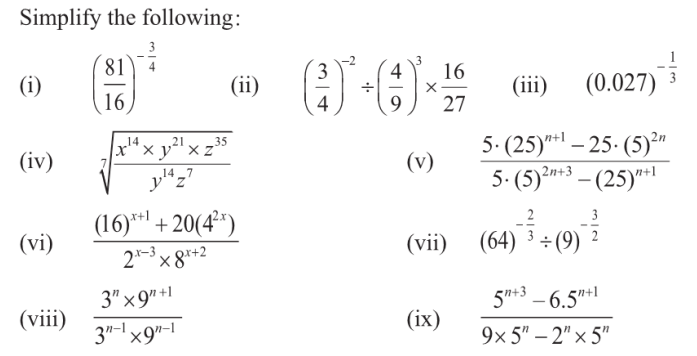
Question No.4:
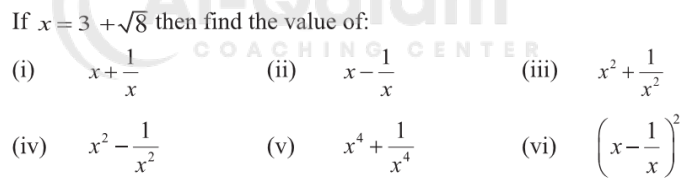
Question No.5:

Question No.6:
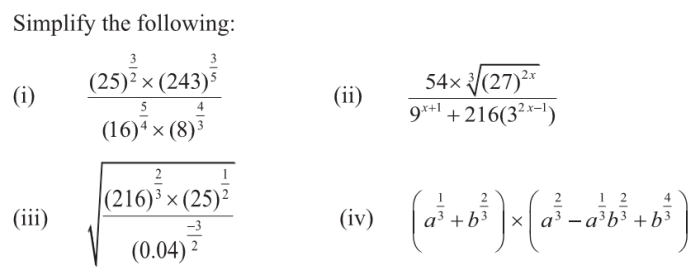
Important Review Exercise Questions
Students should pay special attention to:
- Classification of numbers
- Properties of equality
- Representation of irrational numbers on the number line
- Simplification of surds
- Rationalization of denominators
- Operations involving surds and conjugates
Most Important Exam Questions
If a student has limited time, these are the highest-priority questions:
- Prove that √2 is irrational.
- Represent √5 on the number line.
- Rationalize 1/(2 + √3).
- Simplify √75 + √27.
- Find two rational numbers between 3/5 and 4/5.
- Distinguish between rational and irrational numbers.
- State and apply the properties of equality.
- Simplify expressions involving surds and conjugates.
You May be Interested In:

================================================================
Leave a Reply